
Here's a pricing coincidence we didn't expect. Pixis Visibility's Premium plan costs $400 a month. RankControl costs $400 a month. For once, the sticker doesn't settle the comparison.
The differences sit underneath the price, in what each $400 buys and how it's metered. They also show up in which AI engines get checked and where your articles can go. Pixis is best known as an AI advertising company, and Pixis Visibility is its newer product for AI search and SEO. RankControl is a pipeline built for one job: getting your brand cited in AI answers and ranked on Google. The Pixis details below come from its site, FAQ and terms, checked on September 26, 2026.
RankControl vs Pixis: the short answer
Pixis Visibility is a broad, credit-based platform. It plans content around your goals, writes briefs and drafts, publishes to WordPress and Webflow, and tracks citations on four AI engines. It also runs technical SEO audits and authority campaigns for links and PR placements. Plans run from free to $400 a month on credits, plus a managed option where Pixis's team does the work.
RankControl is one plan with fixed allowances: 100 pages a month and 50 tracked queries checked weekly across six AI engines. It publishes natively to nine CMS destinations and drafts backlink outreach from your own mailbox.
For AI search visibility, we'd pick RankControl. It covers more of the engines buyers use, and it tells you exactly what each month includes.
Side by side
| Pixis Visibility | RankControl | |
|---|---|---|
| Company | AI ad-tech company, founded 2018; Visibility launched around May 2026 | Built for AI search visibility |
| Price | Free, $100, $400 or custom | $400/mo or $4,000/yr, one plan |
| How usage works | Monthly credits: 850 to start, 1,000, or 5,000 | Fixed: 100 pages/mo, 50 queries weekly |
| AI engines | ChatGPT, Gemini, Perplexity, Claude | ChatGPT, Perplexity, Claude, Gemini, Grok, Google AI Mode |
| Publishing | WordPress and Webflow | 9 destinations, native posts |
| Technical SEO audits | Yes, site-wide | Health checks on the articles it publishes, not a site-wide audit |
| Links | Authority campaigns with placements and PR | Outreach drafted from your own mailbox; Managed Backlinks add-on at $350/mo |
| Paid ads | Separate ad platform (Prism, Adroom) | Not offered |
| Trial | Free plan, no card | 7-day free trial, card up front, $0 today |
What Pixis Visibility is
Pixis raised around $209 million across four rounds between 2020 and 2023, with SoftBank Vision Fund 2 leading its Series C. It built its business on paid media: Prism is a conversational agent for ad operations, and Adroom generates ad creative. Pixis Visibility is newer and runs on its own site and login.
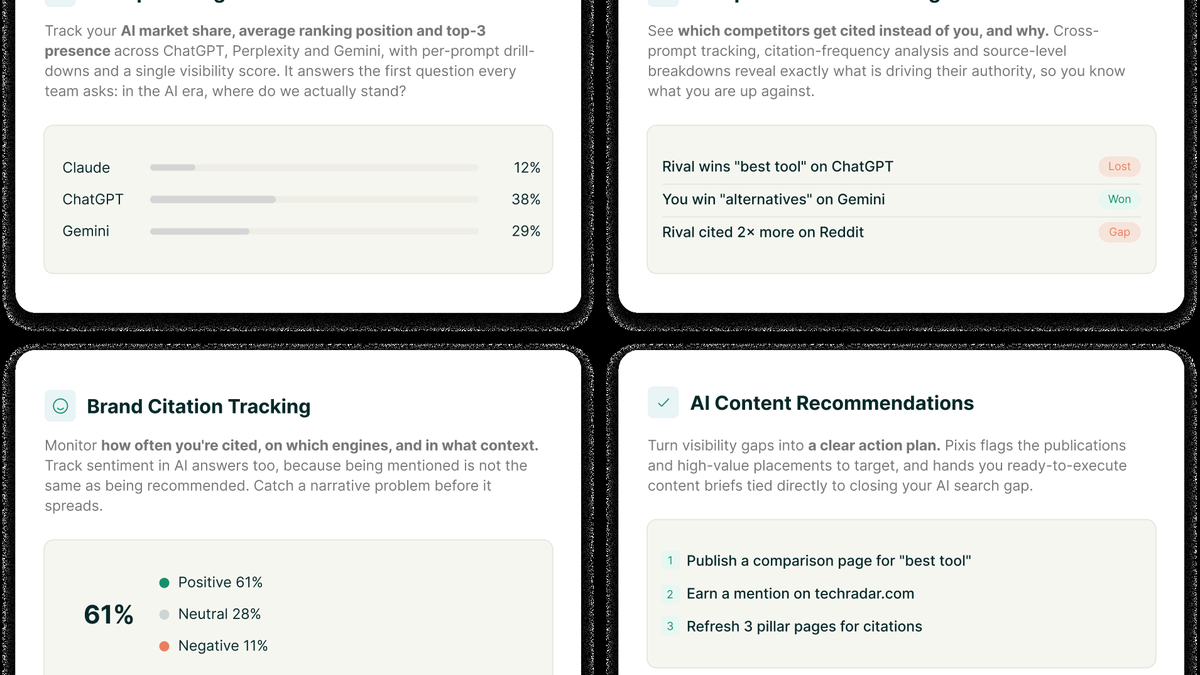
The product is built as a loop. A Strategy Brain takes your ideal customer, business model and brand voice, and a content calendar rebuilds around your goal. Citation tracking reads each engine by prompt, funnel stage and region, with sentiment. The SEO side covers keyword tracking, competitor benchmarks and a full technical audit, and an authority module runs link and PR campaigns.
Where Pixis goes further than RankControl is breadth on the SEO side. It audits your whole site, from Core Web Vitals to broken links and sitemaps, and it offers a free plan to start, while RankControl only works on the articles it writes.
See your first AI citation report in under 5 minutes.
No setup calls. No onboarding meetings. Connect your domain and see where AI mentions your brand right now.

Four engines or six
Pixis's FAQ is direct about coverage: "ChatGPT, Gemini, Perplexity, and Claude, read engine by engine, by prompt, funnel stage, and region." Google shows up on the SEO side, as keyword rank tracking.
That leaves two gaps. Grok isn't on the list, which matters if your buyers spend time on X, where Grok answers inside the app they already use. Neither is Google AI Mode, the conversational search that Google now offers alongside its regular results. RankControl's AI visibility tracking checks all six every week across 50 queries and keeps a citation history for each engine. The weekly rankings check also records Google and Bing positions, and whether an AI Overview showed for the keyword and cited your page.
Coverage matters most when your buyers spread across engines. If your category's shortlists get built in Google AI Mode, a tracker that doesn't read it can't tell you whether you made the list there.
What each one measures
Pixis scores your brand the way a rank tracker would: AI market share, average position in the answer and how often you land in the top three. It sorts mentions by tone into positive, neutral and negative, and flags inaccurate claims about you. Prompts come in two kinds: sets it discovers for you and custom ones you write by product, industry, region or language. The number of engines and prompts you can track scales with your plan.
RankControl's unit is the tracked query. Each of your 50 queries gets checked on all six engines every week, and the history builds up per engine, so you can see which one started citing you and when. It shows where competitors get cited and you don't, which sources the engines pulled from, and the tone of each mention.
It also measures what happens after the answer. RankControl's analytics record visits from AI crawlers and from people who clicked through from an AI answer, next to your Search Console data. So you can check whether a new citation in Perplexity sent anyone to the page it quoted.
Credits or fixed allowances
Pixis Visibility prices by credits. The $400 Premium plan buys 5,000 a month, which Pixis calls its lowest cost per credit. That works out to 8 cents a credit, against 10 cents on the $100 Growth plan.
What we couldn't find is a published cost per action. Pixis doesn't say how many credits an article, a brief, a prompt check or an audit uses, so there's no way to know from the pricing page how many articles 5,000 credits produce.
RankControl's $400 covers a fixed set of work: 100 pages a month across 26 content formats and 50 tracked queries checked weekly on six engines. It also includes five seats, publishing, and outreach drafts. You can plan a quarter of content without estimating credit burn, and the limits don't move with how you use the product.
Over a year, the gap widens a little. At monthly rates, 12 months of Pixis Premium comes to $4,800. RankControl's annual plan is $4,000, which works out to two months free.
| At $400 a month | Pixis Visibility Premium | RankControl |
|---|---|---|
| Content | Depends on credits used | 100 pages/mo |
| AI engines | 4 | 6 |
| Tracked queries | Depends on credits and plan | 50, weekly |
| Seats | Not stated on the pricing page | 5 |
| Publishing | WordPress, Webflow | 9 destinations |
| A year at this level | $4,800 at monthly rates | $4,000 on the annual plan |
Publishing and links
Both tools publish articles as native posts on your own site. Pixis connects to WordPress through a plugin that uses OAuth and the WordPress REST API, and it also lists Webflow. RankControl publishes to nine destinations, Shopify, Ghost and Notion among them.
The writing side is close in shape. Pixis builds a 30, 60 or 90-day calendar, you approve it, and then it drafts. Its terms make you responsible for reviewing every piece before it goes live. RankControl's content engine plans titles from the questions your buyers search and writes each article in your brand's voice against the pages already ranking. It scores each one for how easily AI engines can quote it, with a fix list, and auto-publish is off by default.
Links are where the approaches split. Pixis's authority module runs campaigns for editorial links, brand PR and community posts, and it tracks placements as orders. RankControl's Link Control finds prospects for each published article and drafts outreach that goes from your own mailbox. If you'd rather hand links off entirely, Managed Backlinks adds five a month from DR 25+ sites for $350.
Your competitors are building backlinks while you read this.
Organic outreach, social mentions, and citations from Editorial Circle member sites, with managed backlinks available as an add-on. Grow your domain authority without running the campaign yourself.

Setup and hands-on help
Both products start by reading your site. Pixis says connecting your domain produces a prioritized action plan in the first session. RankControl's setup reads your live site and drafts your brand profile, products, buyers and competitors, and you correct what it got wrong before anything gets written.
Support is tiered at Pixis: email on Growth, priority on Premium and a dedicated account manager on Enterprise. It also offers a managed mode, where its team runs research, content and reporting while you approve. RankControl includes priority email support on the one plan. If you want a person steering the work, the Dedicated Strategist add-on is $1,500 a month, billed separately and cancellable on its own.
Paid and organic in AI answers
Pixis comes from paid media, and AI answers now have a paid layer too. ChatGPT began testing ads for its Free and Go users on February 9, 2026. OpenAI says "ads do not influence the answers ChatGPT gives you," and self-serve ad buying opened on May 6.
That separation is the reason organic citations still matter. An ad buys a slot next to the answer, and a citation puts your page inside it.
The early numbers on the ads are modest. A B2B marketer on r/b2bmarketing shared four months of ChatGPT ads results this month, with click-through between 0.5% and 1% and leads costing $120 to $250 each. One reply made the organic case plainly: that commenter's team had seen better returns from getting clients named in the answers than from the ad unit.
What happened to all the buzz around ChatGPT ads?
"How do we join ChatGPT Ads?" "What does the targeting look like?" "Can we get going, the exec team wants in now." This was all I heard back in May and June as B2B brands wanted in on the platform I've been running ChatGPT Ads for B2B clien...
RankControl works only on the organic side. It doesn't run ads, and it measures the answers themselves.
What people say
Public discussion of Pixis Visibility is thin so far, which makes sense for a product that's about five months old. Most of what exists is Pixis's own material, like a case study on Confido Health reporting AI citations up from 2 in June to 15 in the first 18 days of August.
Independent reviews haven't caught up yet. The few Reddit threads that name Pixis at all are about its ad tools. Searching the name on X mostly turns up funding news and the June press release claiming $3 million in annual recurring revenue within 60 days.
We'd read both numbers as company-reported, a sign of demand for the category rather than proof of results. If you trial either one, write down where you stand on your top 10 queries first, so the first month has something to compare against.
Which wins AI search visibility?
For AI search visibility, the verdict is RankControl.
Pixis Visibility is a capable new product from a well-funded company, and it covers a lot of ground. But it reads four AI engines, meters its work in credits without saying what a credit buys, and publishes to two CMSs.
RankControl reads all six engines every week, including Grok and Google AI Mode. It spells out what $400 includes, and publishes to nine destinations. It plans from the questions your buyers search, writes and publishes the articles, and drafts the outreach. In the first month you get a calendar of titles, articles going live on your schedule and four weekly readings of where you stand.
You can run this by hand: write the pages, publish them, pitch the links and check six engines every week. Or RankControl's agents can do it every month while you focus on your product. Already on Pixis? Our guide to switching from Pixis covers what to copy out before you cancel.
Start with a free check of your brand in AI answers to see where you stand today.

You're getting AI traffic. But do you know where it comes from?
RankControl credits every visit to the assistant that sent it: ChatGPT, Perplexity, Claude, Gemini, Copilot, or Grok. Full source attribution, next to your Google traffic.