
A growth marketer posted in r/growthmarketing this fall after asking ChatGPT what their company does. The answer was a confident paragraph about a product they'd killed in 2022. Leadership saw the screenshot and wanted an AI visibility plan on the calendar that week.
chatgpts answer about our brand was from 2022 and leadership still wants an ai visibility plan this week
asked chatgpt what our brand does and got a confident paragraph about a product we killed in 2022. screenshotted it. leadership saw it and now wants an "ai visibility plan" on the calendar this week we already have ranking reports, social l...
Wrong facts are one problem. Tone is the quieter one, because AI engines also tell buyers whether you're worth the money, what people complain about and who you're for. So brand sentiment analysis now has to cover AI answers as well as social posts and reviews.
We wanted to know where that tone comes from. On October 19, 2026, we asked ChatGPT and Google 48 questions about 24 real brands and read every answer and source.
What we asked
We picked 24 brands in three groups of eight. The software group included ClickUp, Pipedrive, Gusto and Wave. The consumer group had brands like Allbirds, Ruggable, HelloFresh and Our Place, and the services group had Chime, Angi, Rover and TaskRabbit, among others.
For each brand, we asked two questions. One was "is [brand] worth it," and the other was "what are the biggest complaints about [brand]." We ran all 48 in ChatGPT with search turned on and in Google, where 46 of them showed an AI Overview. ChatGPT gave a median of seven sources per answer.
The verdict is almost always "yes, if"
Not one of ChatGPT's 24 "worth it" answers said no. Twelve opened with a flat yes, and the other twelve said the brand "can be worth it" or that it depends. Every answer then named a condition or a drawback.
Software got the friendliest verdicts. Seven of the eight software brands got a flat yes, against three of eight consumer brands and two of eight service platforms. Marketplaces like Angi, Thumbtack and Care.com were split by side, with one verdict for customers and another for the people who work through the platform.
The part that matters most is what we'd call the "if clause." Both engines wrote answers shaped as "worth it if you want X, not if you want Y." Google's overview called Our Place worth it for design and light weight, but not if you expect a long-lasting pan. HelloFresh was worth it for convenience, but not if you want to save money.
That clause is your positioning, written by someone else. It tells a buyer who you're for and names the flaw in one line, often before they ever reach your site.
Your site writes the praise, others write the complaints
The sources changed sharply between the two questions. When asked whether a brand was worth it, ChatGPT cited the brand's own site in 23 of 24 answers. When asked about complaints, it cited the brand's site in just 7.
| Who got cited | ChatGPT, "worth it" | ChatGPT, complaints | AI Overviews, "worth it" | AI Overviews, complaints |
|---|---|---|---|---|
| The brand's own site | 23 of 24 | 7 of 24 | 5 of 24 | 1 of 22 |
| Trustpilot | 2 of 24 | 18 of 24 | 5 of 24 | 15 of 22 |
| Better Business Bureau | 3 of 24 | 16 of 24 | 0 of 24 | 10 of 22 |
| 0 of 24 | 16 of 24 | 17 of 24 | 20 of 22 |
Review sites and forums made up 78% of the links ChatGPT cited for complaint questions. ChatGPT never cited Reddit for a "worth it" question, but it showed up in two-thirds of the complaint answers.
Google leaned on the crowd for both. Its AI Overviews cited YouTube in 21 of 24 "worth it" answers and Reddit in 17. The brand's own site was barely there, at 6 of 46 overviews in total.
Our guide to what AI search engines trust covers how each engine weighs these sources more broadly.
You're getting AI traffic. But do you know where it comes from?
RankControl credits every visit to the assistant that sent it: ChatGPT, Perplexity, Claude, Gemini, Copilot, or Grok. Full source attribution, next to your Google traffic.
Review scores get quoted, and so do their summaries
ChatGPT also pulled numbers from those sites. In 18 of the 48 answers, it quoted a review score or a complaint count right in the text. HelloFresh's answer listed its Trustpilot score of about 3.4 and 862 complaints filed with the Better Business Bureau over three years.
Ruggable's complaint answer said its Trustpilot listing showed "a 2.1 out of 5 score across 817 reviews," with quality, pricing, orders and customer service as recurring themes. We opened the listing the same day, and the numbers matched.
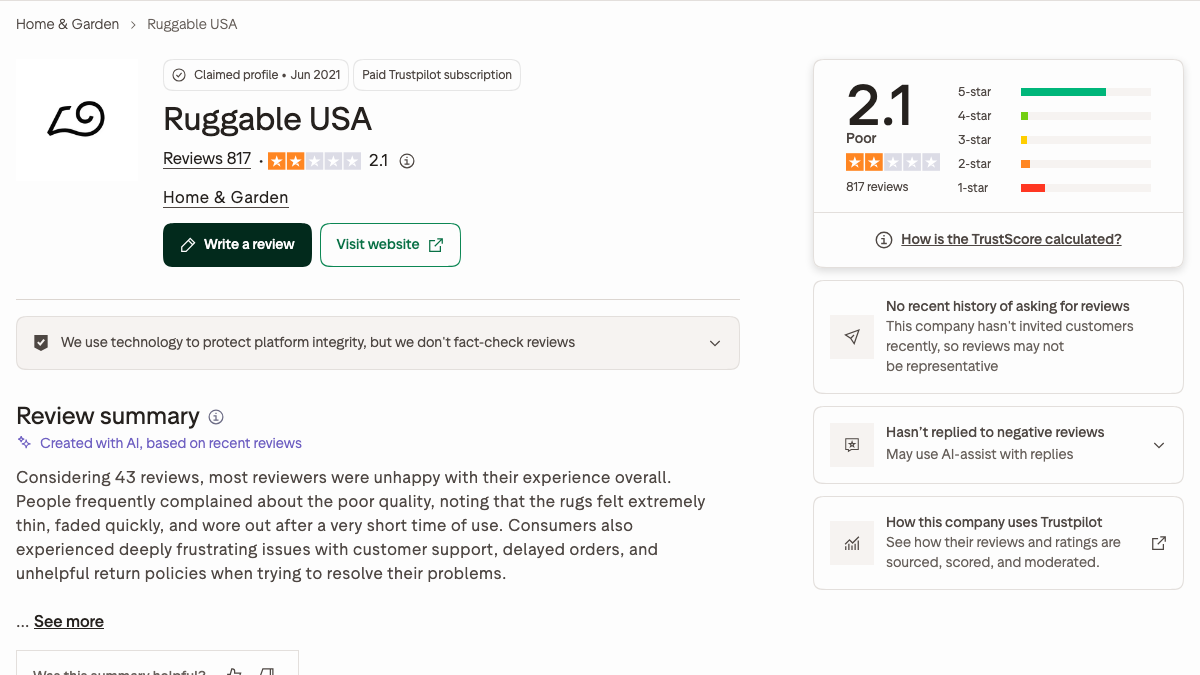
Those four themes came straight from Trustpilot's own review summary, which the site generates with AI from recent reviews. So one AI summarized the reviews, and another AI repeated that summary to a buyer.
The page also shows two things ChatGPT didn't pass on. Ruggable hasn't asked customers for reviews recently, so Trustpilot itself warns that the reviews "may not be representative." The company also hasn't replied to negative reviews.
Strong scores worked the other way. In 8 of the 24 complaint answers, ChatGPT used a high rating to say the complaints weren't the whole story. FreshBooks got that line from its 4.5 rating on Capterra, and Away got it from 4.7 on Trustpilot. We'd call this the counterweight score. Rover, TaskRabbit and Policygenius got the same treatment from their Trustpilot ratings.
Brands that ask for reviews score higher
We checked the Trustpilot pages of 17 of the 24 brands on the same day. The five that hadn't asked customers for reviews lately all scored 2.5 or lower.
| Trustpilot status | Brands | TrustScores | Median |
|---|---|---|---|
| Hasn't asked for reviews lately | Purple, Casper, Ruggable, Angi, Brooklinen | 1.3 to 2.5 | 2.1 |
| Asks customers to review | Away, Rover, Policygenius, Our Place, TaskRabbit, Lemonade and six others | 1.9 to 4.7 | 3.9 |
Asking doesn't guarantee a good score. Gusto invites reviews and still sits at 1.9, and Thumbtack sits at 2.1. Cause and effect could run both ways here too, since a brand with unhappy customers may simply stop asking.
Still, a profile filled only by people who went looking for a place to complain will read as negative, and the AI answers quote that number as fact.
Prices were right more often than we expected
We expected stale prices everywhere, since old facts were the main gripe in the Reddit threads we read. For Close, ClickUp and Wave, we compared ChatGPT's prices with each vendor's pricing page on the same day, and all three matched. A wider test in our AI hallucination rates roundup found the same for 8 SaaS headline prices.
Big brands with well-known pricing pages seem to be fine. The risk sits with smaller brands. A freelance marketer in r/freelance described a skincare client whose ChatGPT answer quoted a price that had been wrong for over a year, and listed a product she'd stopped selling.
A reply in that thread named the cause. The model repeats old pages, product feeds and marketplace listings that still carry the old number, and even after you fix them, it takes a few weeks of recrawling before the answer changes. Our post on how long AI search takes to learn a brand covers that lag.
We'll show you exactly where your brand stands in AI search.
No commitment. $0 due today, cancel anytime. See how ChatGPT, Perplexity, Claude, Gemini, Grok, and Google AI Mode talk about your brand today.

How to run a brand sentiment analysis for AI search
You can do a solid first pass in an afternoon. Here's the process we'd use, built on what showed up in the data.
- Write 15 to 20 questions in three shapes. Use "is [brand] worth it," "what are the complaints about [brand]," and "[brand] vs [main rival]," plus a few for your top products.
- Run each question in a fresh session on ChatGPT, Google, Perplexity and Gemini. A commenter in an r/SEO thread on this topic suggested memory off and the same prompt set every time, so you measure the brand rather than your chat history.
- Log the date, the engine, the full answer and every cited link.
- Code each answer. Note the verdict, the "if clause," every drawback and any score or count it quotes.
- Trace each negative claim to its source page. Is it a fair complaint, an old fact or a thin review profile?
- Repeat monthly, since answers change between runs.
Anyone else checking how ChatGPT describes their company?
I’m the head of marketing of a growing startup and recently started asking ChatGPT about our company and our competitors to see what comes up.It got me wondering how other companies are handling this. Do you actually monitor how ChatGPT, Cl...
The top reply in that r/SEO thread added a handy trick. Ask the engine where it got its information about your company, then fix or pitch those exact pages.
Here's a rough monthly time budget for doing it by hand.
| Task | Hours a month |
|---|---|
| Run 20 questions on four engines | 2 to 3 |
| Log and code the answers | 2 to 3 |
| Trace negative claims to sources | 1 to 2 |
| Fix pages, listings and review replies | 3 to 5 |
| Total | 8 to 13 |
What you can change and what you can't
You can't delete a fair complaint, and you shouldn't try. If many people say your rugs feel thin, the answer will keep saying so until the product changes.
What you can change is the evidence around it. Update or remove old pages, feeds and marketplace listings that carry wrong prices or retired products. Ask happy customers for reviews on the sites the answers quote, so the score reflects everyone. Reply to negative reviews in public, since the reply sits on the same page the engine reads.
Then give the engines better pages of your own to cite. A clear pricing page, a returns policy and honest comparison pages give "worth it" answers something current to quote. When an answer is plainly wrong, our response plan for wrong AI answers walks through the fix step by step. Our guide to content creation for brands shows which of these pages AI answers cited most.
Tracking how AI describes you every week
The real problem isn't checking once. It's knowing when the tone shifts, because a new wave of reviews or a viral Reddit thread can change the "if clause" within weeks.
You can run all of this by hand with a spreadsheet. Or RankControl can check 50 of your buyer questions every week on ChatGPT, Perplexity, Claude, Gemini, Grok and Google AI Mode, and its AI visibility tracking labels each answer that mentions you as positive, neutral or negative. Then you spend your hours on the fixes instead of the logging.
Know exactly what AI says about your competitors.
RankControl's Recon Agent monitors competitor citations across ChatGPT, Perplexity, Claude, Gemini, Grok, and Google AI Mode. See where they show up and you don't.