
In July, Lily Ray posted a parody of a genre every SEO has seen this year: the giant AI visibility study. Twenty million URLs, a proprietary embedding model, 47 regressions and more than 300 controlled variables, all to discover that the brands LLMs recommend "rank well in search engines, have a Wikipedia page, and get talked about on Reddit."
“We ingested 20M URLs, trained a proprietary embedding model, ran 47 regressions, controlled for 300+ variables, and applied a novel entropy-weighted citation index to determine what the top LLM-recommended brands have in common. The answer is… wait for it… They rank well in
 Lily Ray 😏@lilyraynycJul 29, 2026
The joke lands because it's mostly right. It's also a little out of date. ChatGPT largely stopped citing Reddit in August, and review sites matter in a way that barely shows up in citation counts. Each engine also leans on a different blend of sources. We call that blend the trust mix. This guide walks through what's in it for each engine and what you can do about each part. Sources were checked on September 26, 2026.
Most of what AI engines cite is someone else talking about you
The broadest data comes from a May 2026 analysis by a PR software company of more than 25 million links cited by ChatGPT, Claude and Gemini across 17 industries. Earned media, meaning coverage and mentions a brand didn't pay for or publish itself, made up 84% of the citations. Across three editions of the study, that share has stayed between 82% and 89%, while paid content took 0.3%.
Journalism alone was 27% of citations, and more than half of those articles had been published in the previous 12 months. The engines lean on recent reporting, so a glowing write-up from 2023 does less for you than a short mention last quarter.
The engines also disagreed about which earned sources to use. ChatGPT cited sources in 96% of its responses, about five per answer, and Wikipedia was its top domain. Gemini cited in 82% of responses with about eight sources each, leaning hardest on Reddit. Claude cited in only 55% of responses but used about 13 sources when it did, with PubMed Central at the top.
"What AI trusts" has a different answer on each engine, so the useful question is which sources each engine uses for the questions your buyers ask.
Reddit: trusted by most engines, dropped by ChatGPT
Reddit is the source people ask about most, and its standing changed most this year. In Ahrefs' September lists of the 50 most-cited websites, Reddit ranked first for ChatGPT at 16.8%, Gemini at 28.5%, Perplexity at 21.6% and Google AI Mode at 17.9%. It didn't make Copilot's top 50 at all, and an analysis of 379,321 Claude citations from June found no Reddit links.
ChatGPT is the complicated case. After GPT-5.6 became its default model in August, one tracker saw Reddit's share of all ChatGPT citations fall from 3.83% to 0.52% in four days. The two figures measure different things, since Ahrefs counts Reddit within the top 50 domains and the tracker counts it against every citation. Our per-engine citation data explains why trackers rarely agree.
Reddit still carries weight beyond citations, since it has licensed its data to both Google and OpenAI. For live answers, though, a Reddit plan built around ChatGPT citations is now aimed at a target that moved. Our piece on Reddit citations after GPT-5.6 covers where that effort should go instead.
AI search traffic grew 835% this year. Is your content ready?
RankControl generates 26 content formats optimized for ChatGPT, Claude, and Perplexity. Published on your domain, matched to your brand.

Review sites work more like a gate than a source
Review sites are where the numbers look contradictory at first. A June 2026 study of 233 AI software recommendations found no citations at all to G2 or Capterra. An AI visibility company's August study of 9,978 answers put G2, Capterra and TrustRadius together at about 5% of citations.
Presence tells a different story. Another 2026 study found that every software tool ChatGPT recommended had Capterra reviews, and 99% had a G2 profile. Our read is that reviews act as an eligibility gate: the engines check that a product has a real review footprint before they'll name it, even when the answer links somewhere else.
Google's AI features show the same pattern. One analysis of AI Overviews found review platforms made up only 8.5% of cited links but appeared somewhere in 34.5% of responses. Trustpilot also entered Ahrefs' top-50 list for Google AI Mode for the first time in September.
The hidden searches point the same way. A B2B SEO agency that extracted ChatGPT's background searches in July found it looked up Capterra about 50% more often than G2, which is worth knowing if you've only invested in one of them.
That changes how to measure review work. A reply in an r/SaaS thread about G2, Capterra and Trustpilot made the point from the sales side: treat review sites as a conversion layer before treating them as an acquisition channel, and measure how often prospects visit your profile during an active deal.
How do you actually use G2 / Capterra / Trustpilot for SaaS distribution?
I am building a SaaS AI marketing platform and trying to work out where review sites actually fit in our distribution, would love real numbers from people who've done it rather than theory. Few things i'm stuck on: Whats the best way to act...
For review content on your own site, our guide to review pages that get cited covers layout and schema.
Fake and incentivized reviews now carry real risk
The gate only works if the reviews are real, and the rules around that keep tightening. In the US, the FTC's rule on fake reviews has allowed civil penalties since October 2024. In July, Google added a line to its review snippet guidelines spelling out which reviews it won't accept.
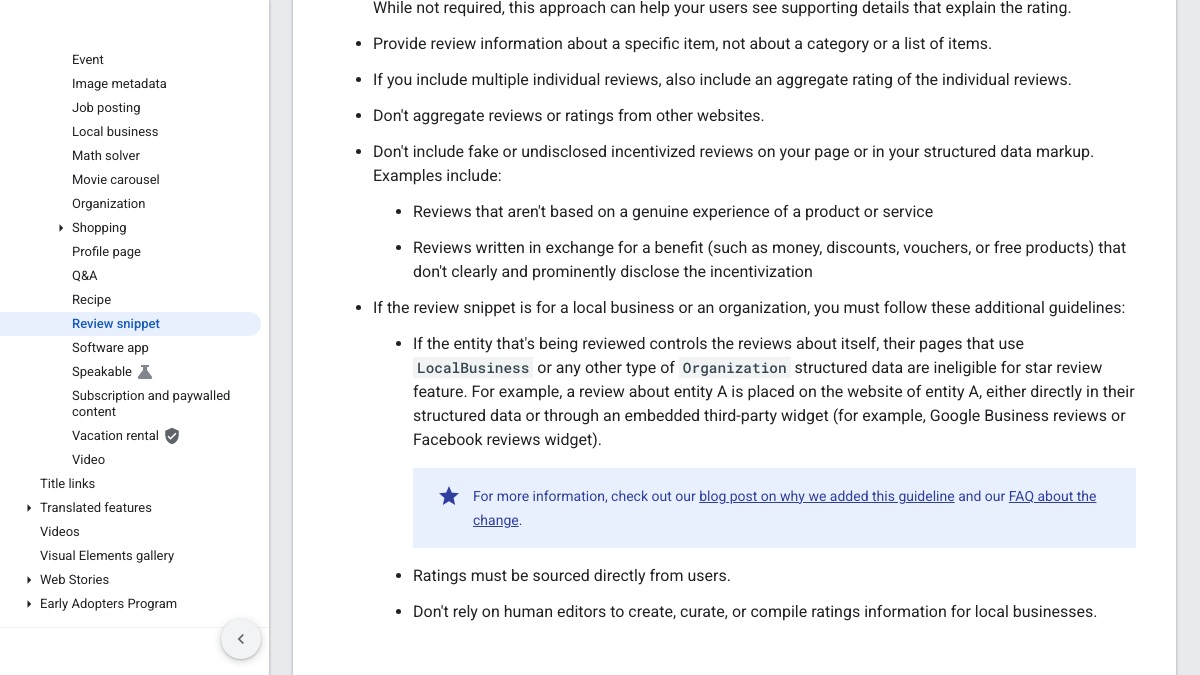
Incentives are allowed only when they're clearly and prominently disclosed. Lily Ray flagged the direction of travel in August, replying to a post about local SEOs calling reviews the most important factor in AI search.
Meanwhile Google is getting stricter and stricter with businesses who incentivize reviews (like offering discounts for leaving a review)
Lily Ray 😏@lilyraynycAug 17, 2026A sudden spike of five-star reviews is the pattern review platforms and skeptical buyers both watch for. A steady ask after a customer's first real result builds the footprint without that risk.
Press and expert mentions carry the most weight
Earned coverage is where the 84% comes from, and a handful of outlets take a large share of it. In the PR software company's data, Axios ranked among the three most-cited outlets on ChatGPT in 13 of the 17 industries. One business news site across that many categories shows how concentrated the pool is.
Publisher reviews and roundups count as earned media too. In the AI visibility company's August study, TechRadar was cited 1,114 times, more than Reddit's 807, which helps explain why "best tools" articles on big publisher sites turn up in so many software answers.
Mentions also track AI visibility more closely than links do. Ahrefs' study of 75,000 brands found branded web mentions correlated with AI visibility at 0.664, against 0.218 for backlinks. Our comparison of brand mentions and backlinks looks at where each signal works.
The catch for most marketing teams is ownership. An r/DoSEO poster put it plainly in July: earned mentions drive AI citations, but they don't sit under SEO. One reply, from an agency that works with attorneys, described getting clients onto podcasts and into local news as expert commentators.
"Earned" brand mentions are driving AI citations but don't fall under SEO. What are teams doing about this?
Read a study that showed by a large margin, earned citations and social & community citations outweighed all on-page content factors. This was tracking 6 major AI models across 31 industries. (Question 1) How are people getting these off-si...
Our digital PR playbook for AI citations covers the pitching side.
Wikipedia: trusted, and closed to self-promotion
Wikipedia is ChatGPT's most-cited domain in the PR study and second in Ahrefs' September list, at 7.0%. It's also the source a brand can least control. Wikipedia's conflict of interest guideline tells people not to edit in their own interests and requires paid editing to be disclosed.
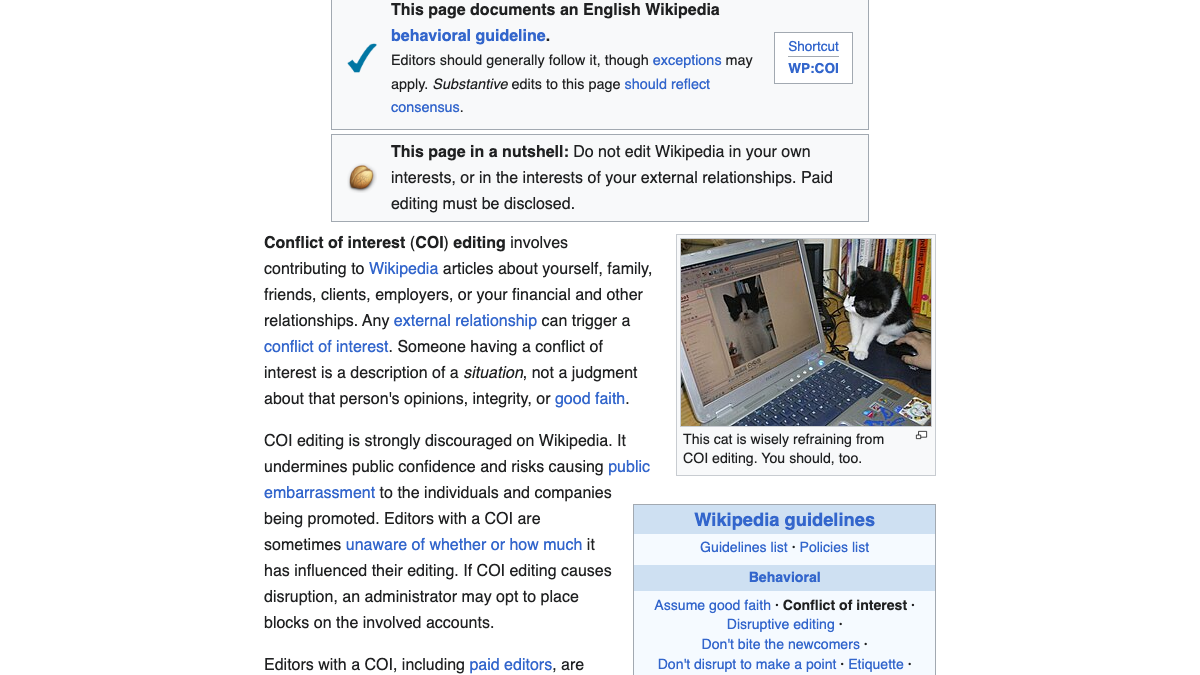
The route to a page runs through the press section above. Wikipedia's notability rules ask for significant coverage in reliable sources that are independent of the subject, so the same articles that feed AI answers directly are what make a page possible later. For most smaller B2B companies a page isn't realistic yet, and the independent coverage does useful work on its own.
Your own site counts for more than the studies suggest
The earned-media numbers make it sound as if your own site barely matters. Engine by engine, it matters a lot. The June Claude analysis found brand-owned domains took 64% of its citations, close to the reverse of Perplexity's Reddit-heavy mix.
ChatGPT moved toward official sources after GPT-5.6. One AI visibility tracker's data on the searches ChatGPT runs behind the scenes showed "official" up 165% and "pricing" up 185% as a share of search terms, while "vs" fell 82%. Searches restricted to a single site went from about 0.4% of the total to roughly a fifth, so the model increasingly picks where to look before it searches.
That shift fits the August study that found ChatGPT citing vendors' own websites 53% of the time, against 13% for Gemini. Gemini's number rises for local businesses, where one study of 14,472 Gemini citations found about 60% went to the businesses' own sites.
Your pricing page and docs are sources in their own right, and ChatGPT now looks for them by name. Keep the facts on them current and easy to quote.
The trust mix, engine by engine
Put together, the main engines lean on quite different sources:
| Engine | Leans on most | Reddit's place | Own-site share |
|---|---|---|---|
| ChatGPT | Wikipedia and press, plus official brand pages since August | First in Ahrefs' September list at 16.8%, after a sharp August drop in one tracker | 53% in one August study |
| Gemini | Reddit and YouTube for broad questions | 28.5%, the highest of any engine | 13% in the same study, about 60% for local services |
| Perplexity | Reddit and YouTube | 21.6% | No comparable figure |
| Claude | Brand-owned pages and research sources | None in 379,321 citations | 64% |
| Copilot | Retailers such as Amazon and Walmart | Outside the top 50 | No comparable figure |
The figures come from different studies and query sets, so compare shapes more than exact numbers. A brand can be well covered in one engine's trust mix and nearly invisible in another's. Our guide to how brands show up in ChatGPT, Gemini and Perplexity covers the model-memory side.

Built by the team that got cited in 48 hours.
Content generation, backlink building, AI visibility tracking, and Google rankings. One platform, zero guesswork.
What to do with this
Averages across millions of links won't tell you what an engine cites for your category, so start with your own questions. Then work the mix in this order:
- Ask your buyers' questions on each engine and log every cited source, grouped into community threads, review sites, press and your own pages.
- Build a real review footprint on the two or three sites your buyers check, with a steady ask after each customer's first result and no hidden rewards.
- Pitch the outlets and podcasts that already appear in your category's answers, with data or expert comment they can use.
- Make your pricing and docs pages the official answer, with current numbers and the same product description you use everywhere else.
Done by hand, checking 50 questions on six engines takes about five hours a week, and publishing eight solid articles a month takes 16 to 24 hours more. Those are rough estimates.
RankControl handles the repeated parts. AI visibility tracking runs your 50 questions every week on six engines, marks each one as mentioned, cited or both, and records which sources and competitors each engine used, so you can watch your trust mix change week to week. Brand Control keeps your products and positioning consistent in every article, and the content engine publishes on your own domain, the one part of the mix you fully control.
You can build the source log yourself with a spreadsheet and an hour a week. Or RankControl's agents can run it every week while your team works on the reviews and press mentions no tool can earn for you.
See your first AI citation report in under 5 minutes.
No setup calls. No onboarding meetings. Connect your domain and see where AI mentions your brand right now.