
You've probably heard that ChatGPT's search runs on Bing, and maybe also that it's Google now. An SEO who posted on r/SEO in June had heard a split version: some tiers searching Google, the paid and enterprise ones searching Bing. They asked the subreddit to settle it.
Is Chat GPT still using bing?
Hi everyone. A quick question. Is ChatGPT still grounding in Bing? I know that some ChatGPT tiers (maybe the free/lower ones) are using Google, but have heard that paid or enterprise tiers are grounding in Bing? Does anyone have a definitiv...
The best reply they got was from a moderator: more Google than Bing, ChatGPT definitely uses both, and it caches a lot. A second commenter asked what you may be asking too: how could anyone actually know?
In 2026 the safe answer is "sometimes." Bing is one ingredient, next to Google results that OpenAI buys from scraping services and an index of OpenAI's own making. Below you'll find OpenAI's statements and the outside research, then what both mean for your SEO and your reporting. Each source was checked on September 27, 2026.
What OpenAI says about ChatGPT search providers
Read OpenAI's help article about web search in ChatGPT and you won't find the word Bing anywhere. It describes your question being turned into queries that go out to partners:
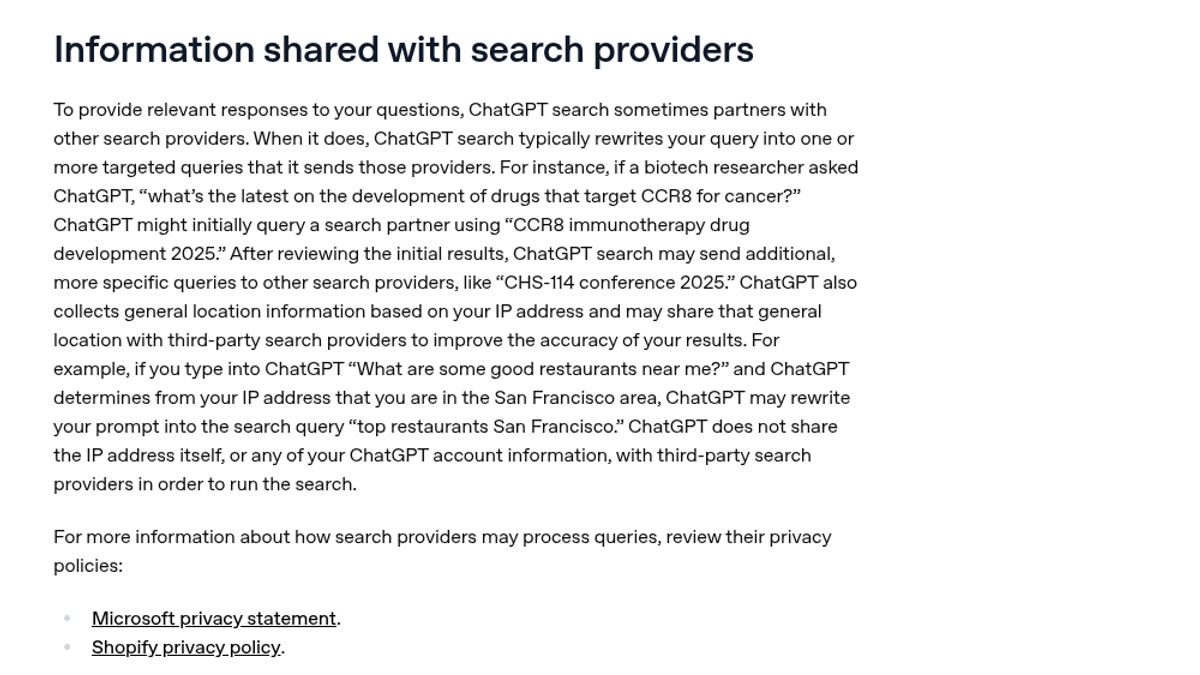
Then check the two privacy links at the bottom. One is Microsoft's, the company behind Bing, and the other is Shopify's, OpenAI's shopping partner, so the links tell you who the partners are. If your company has an Enterprise or Edu workspace, OpenAI's page for those plans spells it out: ChatGPT may share disassociated search queries with the Bing search engine to return web results.
So Bing is in. What OpenAI won't tell you is how much of a given answer Bing supplies, and the proportion doesn't hold still.
We use the term retrieval mix for this: whatever blend of sources feeds one ChatGPT answer, a blend that varies by mode and by week. With that term in hand, the r/SEO thread reads differently, since most of its posters were each reporting a different moment of the mix.
How the answer changed between 2024 and 2026
If you assumed Bing when ChatGPT search launched, you were in good company, and for sound reasons. Microsoft had invested in OpenAI and partnered with it for years, and Copilot already ran on Bing. A lot has changed since then:
| When | What happened |
|---|---|
| October 2024 | ChatGPT search launched, and most SEOs assumed Bing did the searching |
| 2025 | The Information reported that OpenAI used the scraping firm SerpApi to pull Google results, and SEOs showed ChatGPT citing pages that only Google had indexed |
| August 2025 | Microsoft retired its public Bing Search APIs |
| December 2025 | Google sued SerpApi, accusing it of scraping and reselling Google's results |
| May to July 2026 | ChatGPT's network traffic labeled where each search result came from, until OpenAI removed the label |
| August 2026 | An experiment testing OpenAI's own index against third-party results ran on about 8% of chats |
Remember the Google tests from 2025. A one-time Google engineer invented a term, wrote a page about it and kept the page out of every index but Google's. Asked about the term, ChatGPT cited that page, so the page could only have reached it through Google. When Backlinko repeated the test, Semrush reported, it worked on paid ChatGPT Plus but failed on the free tier.

Built by the team that got cited in 48 hours.
Content generation, backlink building, AI visibility tracking, and Google rankings. One platform, zero guesswork.
What researchers found inside ChatGPT's search
You can't see ChatGPT's sources today, but for roughly two months of 2026 you could. Each search result in ChatGPT's network traffic carried a label naming where it came from, readable by anyone who looked. Some labels led back to scraping services that supply Google results. Others said "bing" or "labrador," and Labrador proved to be OpenAI's own index.
Lily Ray connected the dots in July. As she saw it, ChatGPT had depended on Google's results to a large degree until a few months earlier. Then Google sued SerpApi and went after scrapers, and by late June the "bing" label was turning up:
It seems like ChatGPT was heavily reliant on Google's search results for web retrieval up until a few months ago, and now it looks like OpenAI is leaning on Bing results more heavily (again), while building its own cache/index. The timing makes sense: Google sued SerpApi in
 Lily Ray 😏@lilyraynycJul 15, 2026
For most sites, though, Labrador matters more than any of this. Inside it, researchers found separate indexes for news, shopping and other kinds of content, stocked by OAI-SearchBot, OpenAI's crawler. It barely resembles Bing, either. Put the same searches through Bing and only about 1.5% of what Labrador returned lands in Bing's top 20.
Your mode matters as well. In one SEO agency's study, OpenAI's index accounted for nearly every citation in the quick default mode free users see, and Google results came in mostly through the slower Thinking mode. Since late July, when OpenAI took the source label out of ChatGPT's traffic, you've had no direct view of the mix. Our numbers on how often ChatGPT searches the web show how far the two modes differ.
What we saw in our own check
Maybe you're wondering whether a good Google ranking gets you cited. We wanted to know the same thing, so we compared pages ChatGPT cites against what ranks.
| Step | What we did or found |
|---|---|
| September 26 | Collected answers from OpenAI's API with web search on, for 18 buying questions from help desk software to business insurance |
| Pages cited in those answers | 76 |
| September 27 | Checked Google's US top 20 for a short keyword version of each question |
| Cited pages ranking in that top 20 | 13 |
| Cited pages not in it at all | 63 |
So most of what ChatGPT cited never appeared in Google's top 20. That squares with Ahrefs' 2025 data, where only 8% of ChatGPT's citations lined up with Google's top ten for the same prompt. Bing is missing from the comparison because our automated checks couldn't pull clean Bing results that day.
Keep it in proportion, because it's one small snapshot. The API differs from the ChatGPT app you use, and our short keywords differ from the queries ChatGPT really sent. The pattern agrees with the research all the same: rank on any single engine and you've explained only a minority of ChatGPT's citations.
What it means for your SEO
Should you still care about Bing?
Yes, since this insurance is nearly free. Get your site verified in Bing Webmaster Tools with your sitemap submitted, and enable IndexNow if your CMS has it. You're covering one of ChatGPT's sources and the engine that runs Microsoft Copilot outright. Our Bing and Copilot optimization playbook has the setup.
Don't read your ChatGPT visibility off your Bing rankings, though. Our Bing rank tracking test found only about a quarter of ChatGPT's cited sites on Bing's first page. With about 1.5% overlap between OpenAI's index and Bing's top 20, you can look strong on one and weak on the other. Other assistants pull from other places again: Claude's web search runs through partners (Anthropic's Trust Center lists Brave Search, TurboPuffer and Parallel Web Systems and doesn't say which one serves a given query), which may partly explain why ChatGPT, Claude and Perplexity rank the same SaaS product differently.
Does ranking on Google help?
Some. It helps with certain answers, particularly in paid Thinking mode, and your Google rankings still bring in most of your organic traffic. With Ahrefs showing an 8% overlap, though, a top-10 Google spot still leaves you a long way short of a ChatGPT citation.
How do you get into OpenAI's own index?
Open your robots.txt first. OpenAI's crawler docs say a site blocking OAI-SearchBot is left out of ChatGPT search answers, and that edits take about 24 hours to register. Block all of OpenAI's bots to keep your content out of model training, as many sites do, and you may lock yourself out of citations too. GPTBot is the crawler that handles training, so you can block that one and still allow OAI-SearchBot. You'll find the exact user agents in our robots.txt checklist for AI crawlers.
Then view your pages with JavaScript switched off, because several tests this year caught OpenAI's crawlers reading raw HTML without executing scripts. Whatever question a page answers, the answer belongs near the top in plain text.
See your first AI citation report in under 5 minutes.
No setup calls. No onboarding meetings. Connect your domain and see where AI mentions your brand right now.

What it means for traffic tracking
Look for ChatGPT traffic in your usual reports and you'll mostly come up short, because of the retrieval mix. No one search engine's tools can show it to you, so you check a few places:
| Where to look | What it shows | What it misses |
|---|---|---|
| Google Analytics | Visits with chatgpt.com as the referrer or utm_source=chatgpt.com in the URL | Clicks that arrive with no referrer and land in direct traffic |
| Server logs | Visits from OAI-SearchBot and ChatGPT-User | Whether those visits led to a citation |
| Bing Webmaster Tools | Citations in Microsoft Copilot and Bing's AI answers | ChatGPT, which isn't included |
| Google Search Console | Some queries that look like ChatGPT's rewritten searches | Which clicks, if any, came from ChatGPT |
Search Console's spot on that list needs explaining. Lily Ray flagged a pattern in September: queries pairing site: with the word "official" that collect lots of impressions and no clicks. She's fairly sure they're ChatGPT's rewritten searches coming through Google, one more hint that Google hasn't left the mix.
Our GA4 guide to tracking AI referrals handles the analytics setup. Clicks won't tell you everything, though, since our comparison of ChatGPT citations and AI referral traffic found that most ChatGPT mentions never send a visit.
The practical takeaway
Which index answers a given question isn't your call, and the balance will keep tipping toward OpenAI's own index. Your part is narrower. Stay indexed in Google and Bing with OAI-SearchBot let in, then make sure the pages your buyers' questions land on state plainly what you do.
Doing it by hand, figure on about six hours a week to put 50 questions to seven engines. Eight solid articles a month will cost another 16 to 24 hours to publish, and both figures are rough estimates.
Every week, RankControl's AI visibility tracking puts your 50 questions to seven engines. Each question gets marked as mentioned, cited or both, with a record of the competitors and sources each engine used. Your Google and Bing rankings are tracked too, which shows you where the two part ways. The content engine writes each article against the pages already ranking for its keyword, then publishes it on your own domain.
A spreadsheet plus Bing Webmaster Tools will let you track the retrieval mix yourself. Or hand the weekly checks to RankControl's agents and keep your team on the pages buyers ask about.
Your competitors are building backlinks while you read this.
Organic outreach, social mentions, and citations from Editorial Circle member sites, with managed backlinks available as an add-on. Grow your domain authority without running the campaign yourself.