
At the end of October, Cyrus Shepard shared a small test that most site owners have been too nervous to run. He used Search Console's new control to take one site out of Google's AI Overviews and AI Mode, then compared its numbers from before, during and after.
The AI impressions went to zero, as you'd expect. They had been about 8% of the site's total impressions, and he estimated their click-through rate at about 0.9%. The surprise was that regular organic clicks dropped too while the site was out. He called it a "Search SERP Halo Effect," where showing up in more places on the page makes a click on any one of them more likely.
Amazing SEO Experiment: This site tested opting out of Google's AI features to measure the impact. It revealed that AI Overviews + AI Mode HAVE A 0.9% CTR!!!! So this was a great case study from @CyrusShepard and covered by @rustybrick on Search Engine Roundtable. He did https://t.co/cRfKzmPNVs
 Chris Long@chris_nectivOct 30, 2026

The AI impressions sent almost no clicks of their own, yet the site lost clicks further down the page once they were gone. I ran a smaller check of my own on November 4, on 20 Google results pages, and it's in step 3.
Why don't clicks show AI visibility?
Google's report for its AI features doesn't count clicks at all. It counts impressions, which Google defines as the number of times links to your site were shown to a user in an AI feature. At a 0.9% click-through rate, 1,000 of those impressions bring about nine clicks. Our post on whether an AI Overview citation brings more clicks or fewer collects the bigger studies.
On October 5, someone on r/SEO_for_AI asked whether anyone actually used the Search Console AI report now that it had reached every site. The top reply called it good for showing a boss that impressions are growing, with no practical use beyond that. Another person said the AI data showed where they were visible, but they still looked at clicks and conversions to see what worked.
Is anyone actually using the new AI performance reports in Search Console? Are they useful?
Now that they're rolled out globally, I'm curious whether the AI Overview / AI Mode data is changing how you report or prioritize work, or if it's just impressions with no real clicks behind them. What are you doing with it?
On October 1, a developer building an interview prep site posted their Search Console numbers on r/SEO. Over 28 days, impressions fell from about 36,000 to about 17,000. Clicks went from 98 to 93, and average position improved from about 19 to about 14. One reply said that pattern usually means a site stopped showing for searches that never sent it clicks anyway.
Step 1: What share of your Google impressions come from AI?
Google launched the generative AI performance report in Search Console on June 3, 2026, for a subset of sites, and rolled it out to every site on August 31. It shows impressions from AI Overviews and AI Mode, grouped by page, country, date or device.
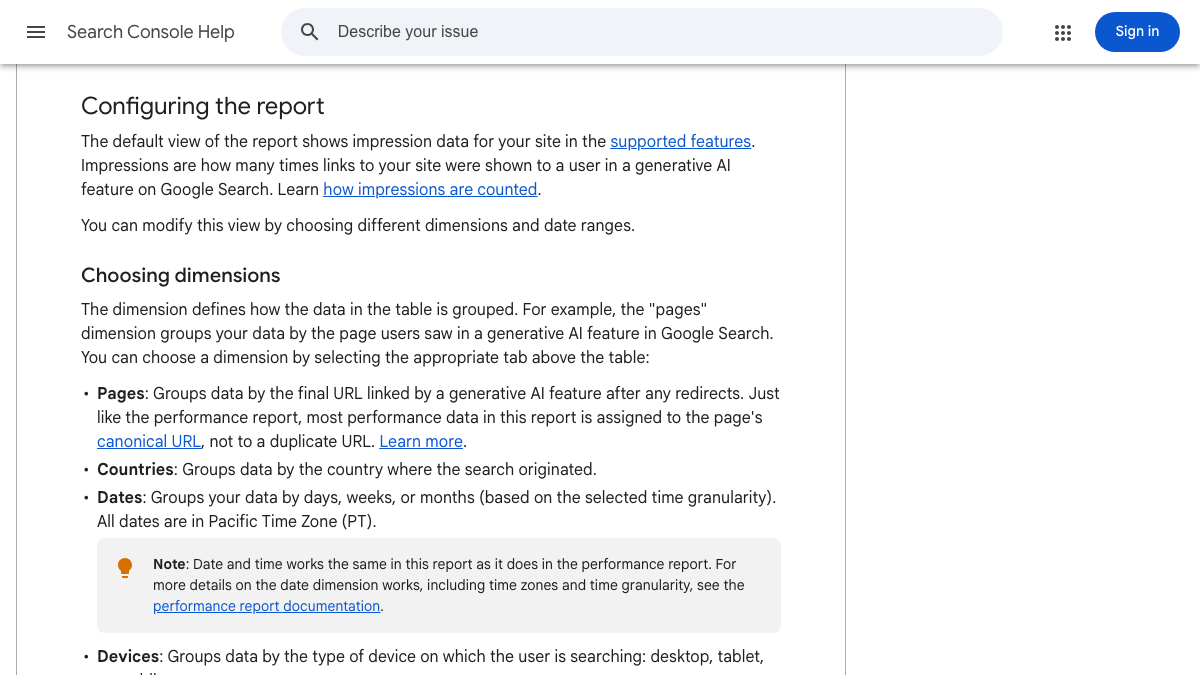
There's no query tab and no click column. Google says the same AI impressions are also counted in the regular performance report, so dividing one total by the other gives your AI share of impressions. On Shepard's site it was about 8%.
The page tab is the more useful one. Sorted by impressions, it shows which pages Google puts in AI answers, and which pages that rank well never appear there. Our guide to the Search Console AI performance report explains how Google counts an impression in each feature.
Step 2: How much of Copilot's citation space do you get?
Bing's AI Performance report went into public preview on February 10, 2026. It counts how often Copilot and Bing's AI answers show your site as a source, which of your pages they cite and a sample of the grounding queries the AI used to find them.
In June, Bing added two numbers that help when clicks are falling. Citation Share is the percentage of all citations for a grounding query that went to your site. Compare lays a past period over the current one, such as the last 30 days against the 30 before.
Bing calls Citation Share an observational metric, and says it doesn't show competitor domains or traffic share. A falling share on your main queries is still worth knowing about before clicks move. The same update added Intents and Topics, which group grounding queries by purpose and by theme.
15 hours a week manually. Or 15 minutes with RankControl.
Track citations, monitor competitors, and fix content gaps across every AI search engine. Automatically.

Step 3: Do you still have searches without an AI Overview?
On October 5, an SEO with mostly B2B clients asked r/SEO how to explain that AI Overviews had taken their traffic. One reply came from someone who'd been an expert witness in a lawsuit. A company had sued its web developer over a traffic drop after a redesign, but the site still ranked first and its rankings had gone up. The drop came from Google adding AI Overviews.
Another reply described a control group that had worked with clients. They split the informational queries into ones that show an AI Overview and ones that don't. If only the first group lost clicks, the client believed it. If both groups dropped, it was a ranking problem.
How do you explain to clients that traffic dropped because of AI Overviews? Do they actually get it? Have you lost a client over it?
Most of my clients are B2B and used to get a lot of their leads from informational articles and queries. Now I can see AI Overviews answering most of those queries directly, so people just don't click anymore. The problem is that clients do...
That only works if some of your searches still have no AI Overview. On November 4, I pulled Google's US desktop results for 20 email marketing searches. Half were how-to questions like "what is dmarc," and half were buying searches like "klaviyo pricing" and "mailchimp alternatives." All 20 showed an AI Overview. For "klaviyo pricing," it cited Klaviyo's own site and help center, along with Omnisend and Email Tool Tester. For "best cold email software," it cited only Instantly, Outboundly and YouTube.
| Searches | Showed an AI Overview | Overview cited Reddit | Overview cited YouTube |
|---|---|---|---|
| 10 how-to questions | 10 | 7 | 8 |
| 10 buying searches | 10 | 5 | 8 |
In a category like that, there's no control group left among the main searches. The fallback is to compare the same queries across two dates when your position held steady, so a fall in click-through rate can't be a ranking change. Our guide to measuring the click impact of AI Overviews walks through that math.
Should you switch AI features off to test them?
Shepard's site paid for its answer. While it was out, it lost the AI impressions and some regular clicks as well. On the URLs with the most AI visibility, he saw the average position drop, then rise again once AI was turned back on.
It's also one small site. Barry Schwartz, who covered the test on Search Engine Roundtable, noted that AI Overviews still showed on those results pages. The site just wasn't in them, so the test didn't compare pages with and without an Overview. In the comments, Greg Sterling said Near Media's research found AI Overviews create a brand lift that leads to later searches and clicks, though not every time.
If you want a number for your own site, test one section instead of the whole domain. Our post on whether to opt out of Google's AI search features explains how to exclude one folder with a URL-prefix property and compare it against a similar folder.
AI search traffic grew 835% this year. Is your content ready?
RankControl generates 26 content formats optimized for ChatGPT, Claude, and Perplexity. Published on your domain, matched to your brand.

How do you check the answers themselves?
Google and Bing only report on their own features. For ChatGPT, Perplexity, Claude, Gemini and Grok, someone has to ask the questions and record what comes back.
In October, a consultant who checks this for clients shared what they'd learned on r/GEO_optimization. Branded and unbranded prompts measure different things, they wrote. A prompt like "best family lawyer in Austin" shows whether the AI recommends you to a stranger, while "is [brand] any good?" shows how it describes you. Mixing the two inflates the score, because an AI almost always mentions a brand named in the question. They also track mentions and citations apart, since an AI can name you without linking to your site.
One reply added that logged-in accounts carry memory from past chats. It suggested temporary chats, or a clean account with memory off, plus three to five runs per prompt, which gives a mention rate instead of a yes or no. Our guide to tracking AI citations without depending on Reddit threads shows a sheet for logging each cited link.
What should go in the monthly report?
| Number | Where it comes from | What it tells you |
|---|---|---|
| AI share of Google impressions | Search Console's AI report divided by the performance report | How much of your Google visibility sits in AI features |
| Copilot citations and Citation Share | Bing Webmaster Tools, AI Performance | Which pages Copilot cites and your share of its sources |
| Clicks with and without an AI Overview | Search Console plus a check of the results pages | Whether AI or rankings cost the clicks |
| Mention and citation rate | The same unbranded questions each month, asked logged out | Whether ChatGPT, Perplexity and the rest name or cite you |
| AI referral visits | GA4 session source | The clicks that do arrive |
Clicks still belong in the report, just not as the only line. Shepard's site lost clicks when it lost its AI visibility, while the interview prep site on r/SEO kept its clicks as its impressions halved.
Doing it by hand or with help
My estimate for exporting the Google and Bing reports is about 20 minutes a month. Asking 20 unbranded questions across five AI engines, three times each, adds 300 answers a month to read and log.
You can do that by hand. Or RankControl's AI visibility tracking can check up to 50 of your buyer questions every week across seven AI engines. For each answer, our tracking records whether you were named or cited, plus the competitors and sources the answer used, and sends a notification when a new citation of yours appears. Our content engine writes the pages that give those engines something of yours to cite.

Built by the team that got cited in 48 hours.
Content generation, backlink building, AI visibility tracking, and Google rankings. One platform, zero guesswork.