
Someone posted in r/SEO in August that Google picked up their new site in the first week, but Bing showed a few impressions on random days and nothing else. The replies went both ways. One person got about 30 clicks a day from Bing and none from Google, and another said Bing was under 10% of traffic on every site they manage.
Decent traffic on Google vs no traffic on Bing
I started doing SEO for a website on both the platforms. While Google picked up in the first week itself, Bing has been weird with a few spikes with a couple of impressions on certain days and no traffic on most of the days. What can I do t...
That split is the reason to track Bing rankings on their own. Your Google positions tell you very little about Bing, and Bing now feeds Copilot's answers too. Here's how to set up Bing rank tracking next to Google and Copilot, plus what we saw when we compared the two engines on 38 keywords.
Why Bing rankings need their own tracking
On October 19, 2026, we searched 38 keywords on Google and Bing from the same browser, with both engines set to US English. They mixed software, shopping, how-to and brand searches. Then we compared the sites on each first page.
| What we compared | Result |
|---|---|
| Google's page-one sites also on Bing's page one | 31% |
| Same site in the top spot on both | 9 of 38 keywords |
| Google's top site anywhere on Bing's page one | 24 of 38 |
| Google's top three sites found on Bing's page one | 49 of 114 |
| Keywords with no shared site at all | 3 |
| Reddit on page one | Google 23, Bing 1 |
Bing and Google agree on far less than most people assume. For "payroll software for small business," Google's first page was software vendors like Gusto and ADP, while Bing's was review sites like Forbes and Fit Small Business. Not one site appeared on both.
Shopping searches overlapped the most, at about three shared sites per keyword, while software and how-to searches shared closer to two. Reddit was the biggest single difference. Google put a Reddit thread on page one for 23 keywords, and Bing did it for one.
The type of search mattered too, and brand searches were the one place the two engines often agreed at the top.
| Search type | Keywords | Shared sites on page one | Same top site |
|---|---|---|---|
| Shopping, like "robot vacuum" | 10 | about 3 | 1 |
| Brand, like "shopify fees" | 8 | about 2 | 4 |
| Software, like "help desk software" | 10 | about 2 | 2 |
| How-to, like "what is a 401k" | 10 | about 2 | 2 |
For brand searches, the brand's own site usually took first place on both engines, as HubSpot did for "hubspot pricing" and Canva for "canva pro price." Below that first result, the pages diverged again. So a tracker that only watches your branded terms will tell you the two engines look alike when, for the non-brand searches that bring new buyers, they mostly don't.
There's a second reason. Bing's June 2025 post on getting started with Bing Webmaster Tools says Bing powers Yahoo and DuckDuckGo, along with AI experiences, so a Bing position travels further than bing.com.
Step 1: Open Bing Webmaster Tools' Search Performance report
Bing's own report is the closest thing to Search Console for Bing, and it's free. Verify your site, or import it from Google Search Console, which saves redoing the verification. Then open Search Performance.
You get clicks, impressions, click-through rate and average position for your keywords and pages. Bing's March 2025 post says it extended the report from 6 to 16 months of data, so you can compare this quarter with the same one last year.
Average position is an average across every search where you showed up. A page at 3 for one search and 20 for another can read 11.5, which matches neither, so treat it as a trend line rather than a rank.

Built by the team that got cited in 48 hours.
Content generation, backlink building, AI visibility tracking, and Google rankings. One platform, zero guesswork.
Step 2: Put Google and Bing side by side
Export both reports for the same date range and match them by page. A simple sheet does the job, one row per page.
| Column | Where it comes from |
|---|---|
| Page URL | Both exports |
| Google clicks and average position | Search Console, Pages report |
| Bing clicks and average position | Bing Webmaster Tools, Search Performance |
| Position gap | Bing position minus Google position |
| Copilot citations | Bing's AI Performance report (step 3) |
Sort by the gap. The pages at the top are what we'd call one-engine pages, strong on one search engine and close to invisible on the other. In our test, Google's top site showed up nowhere on Bing's first page for 14 of the 38 keywords, so expect a long list.
A big gap usually points to one of three things. Bing hasn't indexed the page, Bing ranks a competitor's review page where Google ranks product pages, or the Google ranking leans on something Bing weighs less, like a Reddit mention. Our guide to submitting your sitemap to Google and Bing covers the indexing side.
Step 3: Add Copilot citations from AI Performance
Microsoft added an AI Performance report to Bing Webmaster Tools on February 10, 2026. It shows how often your pages are cited in Microsoft Copilot, Bing's AI summaries and some partner products.
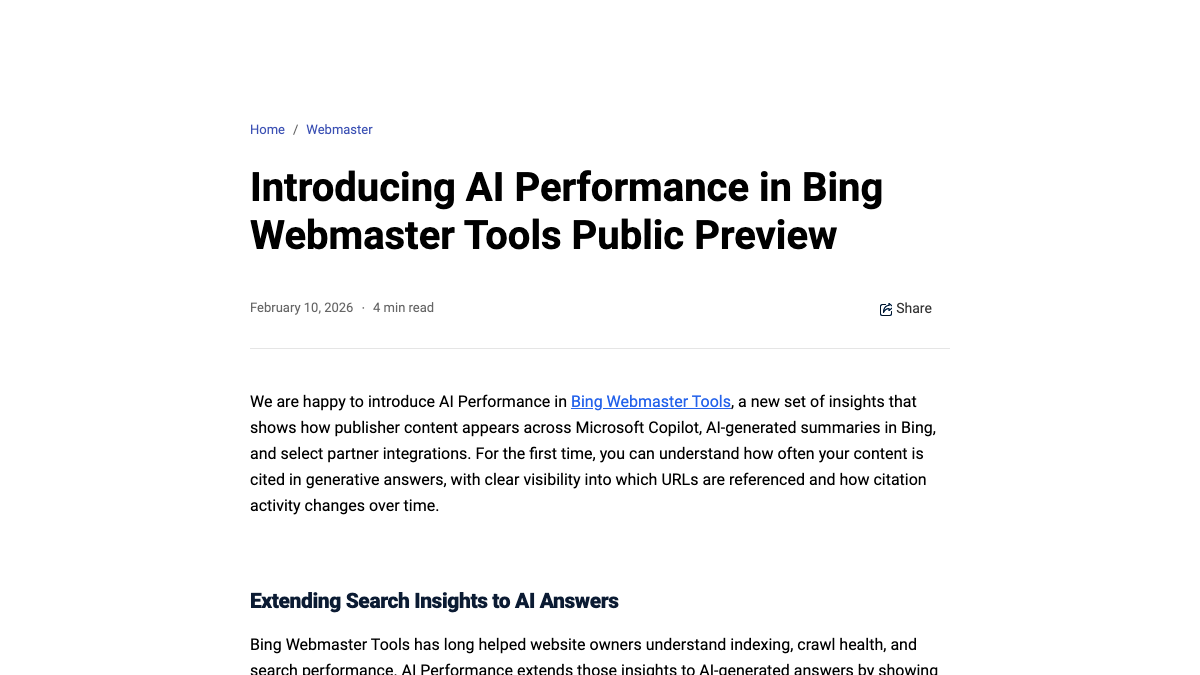
According to Bing's announcement, the report shows total citations, the average number of your pages cited per day, citations for each URL and a timeline. It also lists grounding queries, the phrases the AI used when it went looking for sources.
Grounding queries aren't what people typed. They're the search the AI ran after reading the question, and Bing notes the data is a sample. Put the page-level citation count in your sheet, not the queries.
On October 13, Bing added a beta tab called Topics Portfolio. It groups your grounding queries into themes and shows opportunity queries where other sites get cited and yours doesn't. Its Topics Portfolio post says smaller sites may not see the tab at all, and that the numbers are directional. Our Bing Copilot playbook covers what to do with the pages Copilot ignores.
Step 4: Add daily Bing positions if you need them
Bing Webmaster Tools gives you averages for searches you already show up in. If you want a daily position for a fixed keyword list, including ones you don't rank for yet, you need a rank tracker that lists Bing as an engine. Check the engine list before you buy, since not every tracker includes Bing.
Two that list Bing on their own pages, checked on October 19, 2026:
| Tracker | Engines listed | Starting price |
|---|---|---|
| SE Ranking | Google, Bing, Yahoo and YouTube, daily | Core at $129 a month |
| Nightwatch | Google, Bing, Yahoo, DuckDuckGo, YouTube and Maps | Starter at €79 a month, billed yearly |
Our roundup of rank tracking software compares more options, including which ones also track AI answers.
See your first AI citation report in under 5 minutes.
No setup calls. No onboarding meetings. Connect your domain and see where AI mentions your brand right now.
Step 5: Check the raw Bing results now and then
This step surprised us. Before the browser test, we pulled the same 38 Bing searches through one commercial SERP feed's live endpoint. For 17 of the 38 keywords, the feed's Bing page shared no sites at all with the Bing page we saw in the browser.
Some of the feed results were plain junk. For "best crm for small business," it returned a dictionary entry for the word "best." For "what is a 401k," it returned driving-directions sites. In the browser, the same searches showed CRM review pages and Investopedia. Google results from the same feed were at least on topic.
We don't know what caused it, and a tracker on a different feed may never see it. Trackers have bad weeks too. In September, users in r/DoSEO reported a popular rank tracker suddenly dropping most of their Google positions while Search Console showed nothing unusual.
SE Ranking Tracking Accuracy issues
Since about a week, SE Ranking does not report keywords position accurately.In all my client projects, 95% keyword positions have just disappeared while ranking on Google.I ask the support, which confess facing issues but does not offer a c...
So once a month, open five of your tracked keywords on bing.com in a private window and compare. If the sites on screen don't match what your tracker stores, trust Bing Webmaster Tools' averages until the tracker catches up.
Add the AI traffic to the same view
Positions and citations are only half the picture. The other half is visits, and Copilot sends its own traffic. In GA4, keep sessions from copilot.microsoft.com on a separate row from bing / organic, since one came from an AI answer and the other from a search result.
Our Copilot statistics roundup puts those visits next to other AI engines. Our explainer on whether ChatGPT search uses Bing covers the other path Bing rankings can take into AI answers, and our test of how much Bing positions feed ChatGPT measures it.
Limits of our test
We searched each keyword once, on one day. The browser sat outside the US, so even with both engines set to US English, local results leaned to that region, and we dropped the two local searches. We compared sites, not exact URLs, so two different pages from Forbes counted as a match.
What this takes by hand
Here's a rough monthly budget for tracking Bing next to Google and Copilot, by our estimate.
| Task | Hours a month |
|---|---|
| Exporting both search consoles and matching pages | 1 to 2 |
| Reviewing one-engine pages and their causes | 2 to 3 |
| Pulling Copilot citations from AI Performance | 1 |
| Spot-checking tracker results in a browser | 0.5 to 1 |
| Fixing indexing and content gaps on Bing | 3 to 5 |
| Total | 7.5 to 12 |
Doing it by hand or with help
You can run this routine yourself each month. Or RankControl can take on the content side while you keep an eye on the numbers. We write and publish articles for the questions your buyers ask, check 50 of those questions every week on ChatGPT, Perplexity, Claude, Gemini, Grok, Google AI Mode and Google AI Overviews, and our analytics count visits from Copilot alongside the other AI engines.
Your competitors are building backlinks while you read this.
Organic outreach, social mentions, and citations from Editorial Circle member sites, with managed backlinks available as an add-on. Grow your domain authority without running the campaign yourself.