An agency owner asked r/DigitalMarketing this month for reporting software with full white label dashboards. Looker Studio wasn't enough, they wrote, because they wanted their own branding on every screen clients see. The replies listed the usual tools and pointed out that most let you change the logo and colors but not much else.
marketing reporting software with white label dashboards needed
What’s the best option here? I know looker studio, but we can’t use that as we want a fully personalized UI with our own branding and the whole white label experience. What other options are worth looking into? This is primarily for branded...
The branding question is the easy one. The harder one is what goes inside the report, now that clients read their rankings and then ask why ChatGPT doesn't mention them. We checked how often a strong Google ranking carries over into AI answers, and the gap is big enough to change what an agency report should cover.
What white label rank tracking is
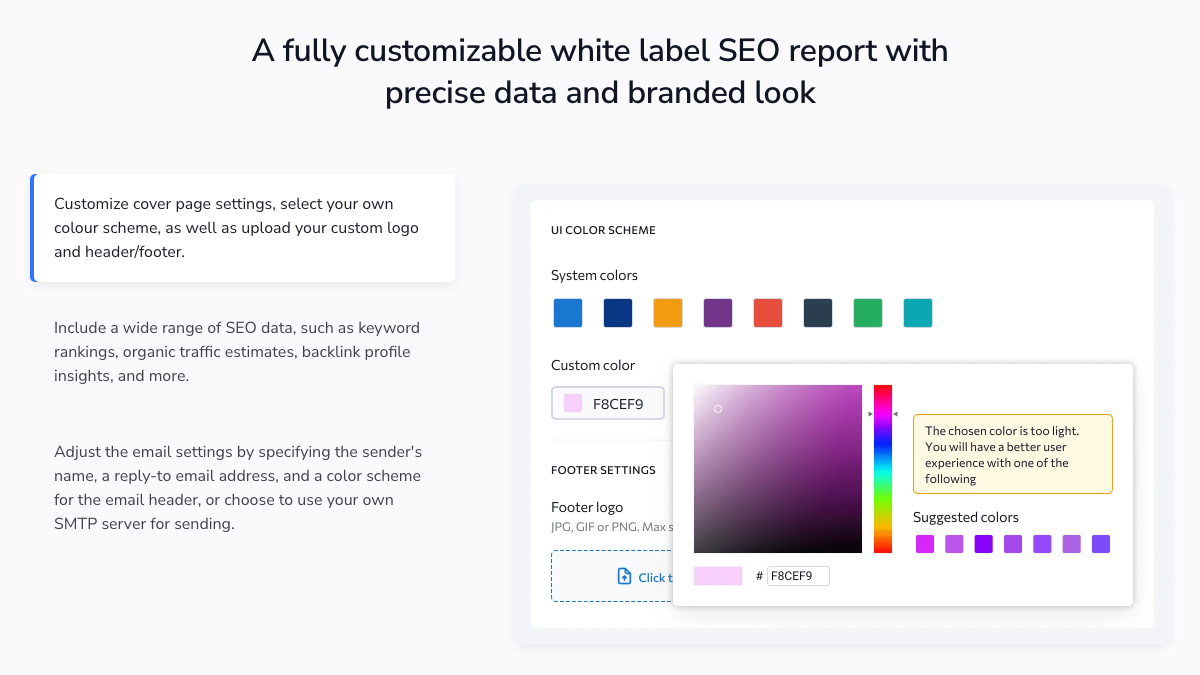
White label rank tracking is rank tracking software you can present as your own. Most agency trackers offer the same core set.
- Your logo, colors and report covers.
- Your own domain for the client login.
- Read-only client seats.
- Scheduled reports sent from your email address.
SE Ranking is a typical example. Its white label page lists custom colors, logos, your own domain and branded reports with keyword rankings, traffic estimates and backlink data. It's part of its Agency Success Kit, which it lists from $69 a month on an annual plan, checked on October 19, 2026.
Our list of the best rank tracking software compares ten trackers on price, update speed and AI tracking.
Does a top Google ranking carry into AI answers?
On October 19, 2026, we ran 12 local searches an agency client might care about, like "emergency plumber denver," "hvac repair phoenix" and "family law attorney san diego." For each, we recorded the three businesses in Google's map pack. Then we asked ChatGPT and Google AI Mode the same searches through a data provider's live US feed, and checked whether each business was named or linked.
| Result for the 36 map-pack businesses | Count |
|---|---|
| Named by ChatGPT | 8 (22%) |
| Named by Google AI Mode | 13 (36%) |
| Named by both | 3 (8%) |
| Named by neither | 18 (50%) |
| First in the map pack and named by ChatGPT | 2 of 12 |
| First in the map pack and named by AI Mode | 5 of 12 |
Half the businesses holding a map-pack spot didn't appear in either AI answer. The two engines also disagreed with each other. Only 3 of the 36 showed up in both.
Your competitors are building backlinks while you read this.
Organic outreach, social mentions, and citations from Editorial Circle member sites, with managed backlinks available as an add-on. Grow your domain authority without running the campaign yourself.

What that looks like for a single client
Take Goettl in Phoenix. It ranked first in Google's organic results for "hvac repair phoenix" and held a spot in the map pack. Neither ChatGPT nor AI Mode named it. ChatGPT's answer listed Benefit Air Conditioning, Mountainside Air Conditioning Repair and others instead.
In Houston, Zehl & Associates was first in the map pack for "personal injury lawyer houston." AI Mode named it. ChatGPT led with four other firms, starting with Simmons & Fletcher. ATX Family Dental in Austin was one of the few that both engines named.
If you report only rankings, Goettl's report looks great and ATX Family Dental's looks the same. The AI side tells a different story for each, and that's the part the client is now asking about. Our guide to the Google local pack covers the map side in more detail.
Why the AI answers differ from the map pack
The two engines get their lists from different places. AI Mode is Google's own product, built on its search index and business data, so it's no surprise it named more map-pack businesses than ChatGPT did.
ChatGPT runs its own web searches. Across the 12 answers it linked 232 pages, mostly businesses' own websites. About 15% went to directories and listings like Expertise.com, HomeAdvisor, Clutch, the BBB and the State Bar of California's lawyer search. So a client's website, reviews and listings shape ChatGPT's answer more than the map pack does.
That gives you something concrete to tell a client. A map-pack spot is mostly a Google asset. To show up in ChatGPT, they need pages that answer the question and a presence on the sites it reads. Our guide to setting up a Google Business Profile found the same split in ChatGPT's business cards, whose ratings rarely matched Google's.
What to add to a white label report
Keep the rankings, since they still drive Google traffic. Then add a section for AI answers. Here's what we'd include, based on our test and on what agencies in a September thread in r/MarketingandAI said clients actually read.
| Report section | What to show | Where it comes from |
|---|---|---|
| Rankings | Google positions, map pack spots, keywords with AI Overviews | Your rank tracker |
| AI answers | Named or cited, per question and per engine | A fixed set of buyer questions checked in each AI engine |
| Who got named instead | Competitors in each answer | The same AI checks |
| Sources | Sites the engines cited, like Yelp or review sites | The same AI checks |
| Visits | AI referral traffic and conversions | Google Analytics 4 or your analytics tool |
The best advice in that thread was to show the numerator and denominator. "Named in 6 of 20 answers" means more to a client than a visibility score of 30. Another reply said to split everything by engine, since ChatGPT and Google's AI behave like separate channels for the same brand, which matches what we saw.
What does your AI visibility report actually look like?
We’re currently tracking things like brand mentions across ChatGPT/Gemini/Perplexity, competitor visibility, recommendation share, citations and AI referral traffic where available. But reporting still feels much less standardised than SEO....
Choosing the questions
The AI section is only as good as the questions you check. Use a fixed core set, so month-to-month changes mean something, and add a few new ones each quarter. For a local client, that means the searches their customers type, with the city in them. For a B2B client, it means comparison and "best X for Y" questions.
Keep the set big enough to smooth out noise. AI answers change from one ask to the next, so one question checked once tells you little. Twenty to fifty questions checked weekly gives a trend you can defend in a client meeting.
How often to check
Rankings can stay on whatever schedule your tracker uses, usually daily. AI answers are better checked weekly across more questions than daily across a few. Report the AI section monthly, as a trend line and a short list of what changed, like a new competitor showing up or the client dropping out of an answer.
Checking your tracker's AI coverage
Many rank trackers have added AI tracking in 2026, but coverage differs a lot. Before you put a tool's AI numbers in front of clients, check three things.
- Which engines it covers on your plan. Some cover only Google's AI Overviews, others add ChatGPT, Perplexity, Gemini or Claude.
- How often it checks and how many questions it allows per client.
- Whether the AI data appears in the white label report itself, or only inside the tool.
Our guide to white label SEO for AI search covers reselling the work, including margins and what vendors will and won't promise.
You're getting AI traffic. But do you know where it comes from?
RankControl credits every visit to the assistant that sent it: ChatGPT, Perplexity, Claude, Gemini, Copilot, or Grok. Full source attribution, next to your Google traffic.
Limits of our check
We ran 12 local searches once each, on one day, from a US feed. We matched businesses by name and website, so a business mentioned under a different name may have been missed. Map-pack results also change by the searcher's location, which our feed fixed to one US setting per search.
What this takes by hand
Here's a rough monthly budget for adding AI answers to one client's report, by our estimate.
| Task | Hours a month |
|---|---|
| Keeping the question set current | 1 |
| Asking each AI engine the questions weekly and logging results | 4 to 8 |
| Recording competitors and cited sources | 1 to 2 |
| Pulling AI referral visits from analytics | 0.5 to 1 |
| Writing the AI section of the report | 1 to 2 |
| Total per client | 7.5 to 14 |
Doing it by hand or with help
You can run these checks by hand for each client. Or RankControl can do the checking every month while you focus on the client relationship. We aren't a white label tool, and our pricing is per brand at $400 a month. For each client brand, our AI visibility tracking checks 50 buyer questions every week on ChatGPT, Perplexity, Claude, Gemini, Grok, Google AI Mode and Google AI Overviews, shows which competitors and sources each engine named, and tracks Google rankings alongside. Our content engine then writes and publishes articles for the questions the client is missing from, after approval.
We'll show you exactly where your brand stands in AI search.
No commitment. $0 due today, cancel anytime. See how ChatGPT, Perplexity, Claude, Gemini, Grok, Google AI Mode, and Google AI Overviews talk about your brand today.