
Someone asked r/SEO in September whether ChatGPT uses Google's index or Bing's. The replies didn't agree. One person thought it always used Bing. Another said it's a mix now, with Bing as the main source for citations, Google results pulled in through a scraping service, and OpenAI's own index on top.
Does ChatGPT still use Google's index when doing web search or does it use Bing's index when recommending brands?
same as title
If the "it's Bing" answer were the whole truth, Bing rank tracking would double as ChatGPT tracking. Rank on Bing, get cited. So we tested how much Bing positions actually tell you about what ChatGPT cites, and what to track instead.
What we know about ChatGPT and Bing
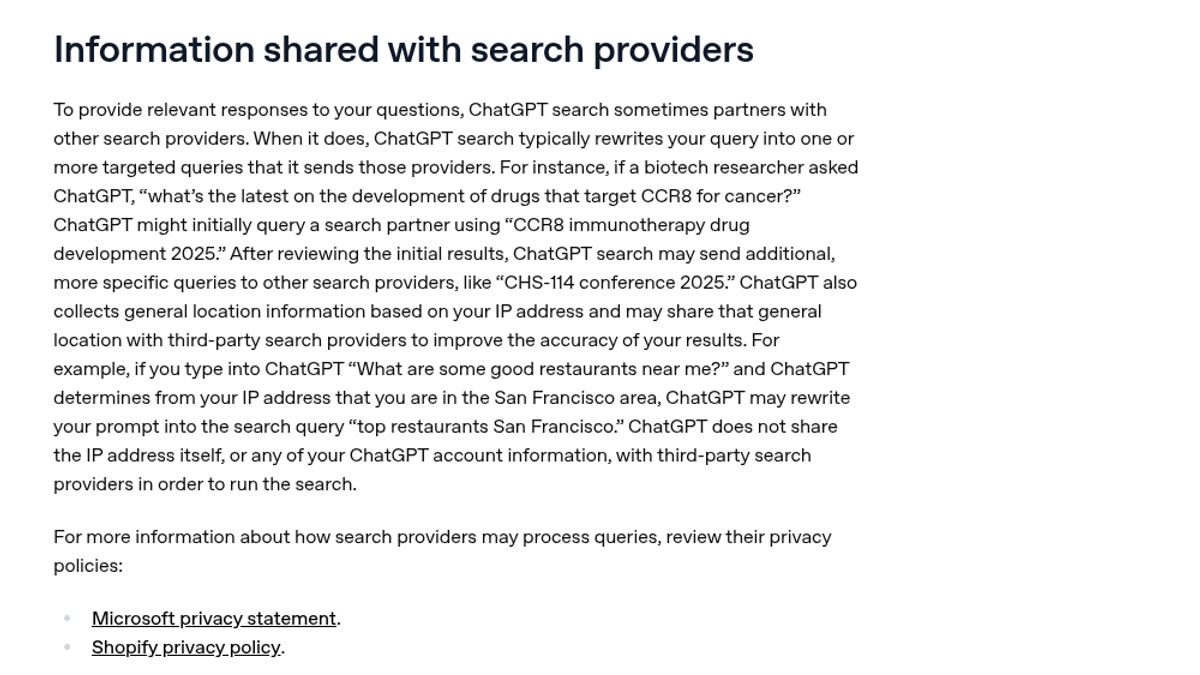
OpenAI's help page on searching the web says ChatGPT sometimes sends rewritten queries to search providers, and it links to Microsoft's privacy statement. That's the clearest public sign that Bing is one of them.
Bing isn't the only input. The 2026 research covered below found Google results and an index OpenAI built itself in the mix too. OpenAI keeps investing in its own crawling. On October 15, Cloudflare announced a pilot with OpenAI to help its crawler find useful pages and keep up with changes.
Our test: ChatGPT's sources vs Bing's page one
On October 19, 2026, we took 38 keywords and searched each on Bing and Google from the same browser, set to US English. We covered software, shopping, how-to and brand searches. Then we ran the same keywords through ChatGPT's web app via a data provider's live feed and recorded every site it cited.
ChatGPT searched the web for 26 of the 38. It answered the rest from memory, mostly how-to and "what is" questions, so no ranking mattered for those. That matches our study of how often ChatGPT searches the web, where lookups for products and prices nearly always triggered a search and stable how-to questions mostly didn't. For the 26 it searched, it cited 147 different sites.
| Where ChatGPT's cited sites ranked | Share of 147 sites |
|---|---|
| On Bing's first page for the keyword | 25% |
| On Google's first page for the keyword | 24.5% |
| On both first pages | 10% |
| On neither first page | 60.5% |
Bing and Google explained about the same share, and together they explained less than half. The top result told a similar story. ChatGPT cited the site in Bing's first spot for 7 of the 26 keywords, and the site in Google's first spot for 11.

Built by the team that got cited in 48 hours.
Content generation, backlink building, AI visibility tracking, and Google rankings. One platform, zero guesswork.
Where Bing mattered most
The overlap changed with the kind of search. Brand searches lined up best, since the brand's own site tends to rank on both engines and get cited. Software searches lined up worst.
| Search type | Keywords ChatGPT searched | Cited sites on Bing page one | Cited sites on Google page one |
|---|---|---|---|
| Brand, like "asana vs monday" | 8 | 37% | 33% |
| Shopping, like "best air fryer" | 8 | 28% | 24% |
| Software, like "help desk software" | 9 | 17% | 20% |
For "best crm for small business," ChatGPT cited nine sites, and just one of them was on Bing's first page. Among the three types, software was where rankings predicted ChatGPT's picks least.
The rewrite gap
The biggest reason the numbers are low is that ChatGPT doesn't search your keyword. It rewrites it first, and those rewrites are called fan-out queries.
For "best crm for small business," ChatGPT searched for "best CRM software for small businesses 2026 pricing features comparisons." For "running shoes for flat feet," it searched for stability shoes and named Brooks Adrenaline, ASICS Kayano, Hoka Arahi and New Balance 860 in the search itself. Our guide to how ChatGPT searches the web covers this rewriting step.
We'd call the difference the rewrite gap, the distance between the keyword you track and the search ChatGPT actually runs. To measure it, we ran ChatGPT's rewritten searches on Bing for 14 of the keywords.
| Comparison | Result |
|---|---|
| Sites shared by Bing's page one for the keyword and for the rewrite | 23% |
| ChatGPT's cited sites on Bing's page one for the rewrite | 19% |
| ChatGPT's cited sites on Bing's page one for the original keyword | 24% |
The rewrite changed Bing's results a lot, with fewer than a quarter of sites in common. But tracking the rewrite on Bing didn't explain ChatGPT's citations any better. Most of what ChatGPT cited wasn't on either Bing page.
When the rewrite names brands
One keyword broke the pattern in a useful way. For "payroll software for small business," ChatGPT's rewrite named Gusto, QuickBooks Payroll, OnPay and ADP and asked for official pricing. Five of the seven sites it cited were on Bing's first page for that rewrite, mostly the vendors' own sites.
None of those five ranked on Bing's first page for the plain keyword. The vendors got cited because ChatGPT already knew their names and put them into the search. One keyword is thin evidence, but it fits the rest of the test, where brand searches lined up best. Being a name ChatGPT reaches for seems to count for more than a single ranking.
What ChatGPT's search pulled in
The data also shows the pool of pages ChatGPT's search returned, before it chose which to cite. Across the 26 searched keywords, that pool held 220 sites.
Here Bing did pull ahead. 18.6% of the pool was on Bing's first page for the keyword, against 10% on Google's. So Bing rankings seem to matter more for getting into the candidate pool than Google rankings do, even if most of the pool, and most of what got cited, sits outside both first pages.
See your first AI citation report in under 5 minutes.
No setup calls. No onboarding meetings. Connect your domain and see where AI mentions your brand right now.

How this fits other research
Our numbers are higher than the best-known study, and the reason is method. Ahrefs found in 2025 that only 8% of ChatGPT's citations matched Google's top ten for the same prompt. That compared exact pages. We compared sites, so a Forbes article on page one counted as a match for a different Forbes article ChatGPT cited.
The 2026 research on ChatGPT's own index, which researchers found labeled "Labrador" in its network traffic, points the same way. When the same searches ran on Bing, only about 1.5% of what that index returned appeared in Bing's top 20. Our post on whether ChatGPT search uses Bing has the details.
Put together, Bing is one supplier among several. That makes Bing rankings a fair early signal and a poor substitute for checking ChatGPT itself.
How to use Bing rank tracking for ChatGPT
Bing positions are still worth tracking. They're one input into ChatGPT, and they feed Copilot directly. Just don't read them as a ChatGPT score. Here's a setup that fits what we found.
- Track Bing positions for your main keywords in Bing Webmaster Tools. Our guide to tracking Bing rankings next to Google and Copilot walks through the setup.
- Add rewritten versions of your best keywords, the way ChatGPT phrases them. Include the year, words like "pricing" and "compare," and the brands in your category.
- Ask ChatGPT the questions themselves each week and record which sites it cites. That's the only direct measure.
- Work on being named as well as ranked. Reviews, comparisons and mentions on sites ChatGPT trusts make it more likely your brand shows up inside its rewritten searches.
- Keep Bingbot and OpenAI's crawlers allowed in robots.txt, so both paths can reach your pages.
Bing's February 2026 announcement says its AI Performance report in Bing Webmaster Tools counts citations in Microsoft Copilot, Bing's AI summaries and some partner integrations. It doesn't name ChatGPT, so don't read it as a ChatGPT report. Bing's own Search Performance report, which Microsoft extended to 16 months of data, is still the best free source for your Bing positions.
Limits of our test
We checked each keyword once, on one day. Our browser sat outside the US, so even with both engines set to US English, page one may differ from what a US searcher sees, while ChatGPT's answers came from a US feed. We compared sites, not exact pages, so two different articles from one publisher counted as a match. The rewrite test covered 14 keywords.
What this takes by hand
Here's a rough monthly budget for tracking Bing with ChatGPT in mind, by our estimate.
| Task | Hours a month |
|---|---|
| Checking Bing positions in Bing Webmaster Tools | 1 to 2 |
| Writing and checking rewritten keyword versions | 2 to 3 |
| Asking ChatGPT your buyer questions and logging sources | 4 to 6 |
| Comparing cited sites with your rankings | 2 to 3 |
| Total | 9 to 14 |
Doing it by hand or with help
You can run this routine yourself. Or RankControl can take on the ChatGPT side. Its AI visibility tracking checks 50 of your buyer questions every week on ChatGPT, Perplexity, Claude, Gemini, Grok, Google AI Mode and Google AI Overviews, and shows which sources each engine cited, so you're measuring the answers directly instead of guessing from rankings.
Your competitors are building backlinks while you read this.
Organic outreach, social mentions, and citations from Editorial Circle member sites, with managed backlinks available as an add-on. Grow your domain authority without running the campaign yourself.