
A Shopify store owner posted in September about an order that didn't add up. The customer said they'd found the product through ChatGPT. Shopify's report said the order came from Direct traffic.
Customer said they found us through ChatGPT but Shopify shows direct traffic
Had an order recently where the customer mentioned they first came across the product through ChatGPT. Shopify had the order showing as direct traffic. I checked the conversion details because I thought I was missing something, but it looks...
The top reply said trying to make sense of attribution is a fool's errand, because people switch devices. Another said ChatGPT doesn't pass any tracking codes. That second claim is wrong, as you'll see below, but the confusion behind it is everywhere.
Search for how much AI traffic hides in Direct and one number keeps coming up, 70%. We traced where it comes from, read the two other studies people quote, and checked how six AI engines' links actually behave on October 19, 2026.
The short answer, and why it's shakier than it looks
Three vendor studies sit under almost every claim about AI traffic in GA4's Direct channel.
| Source | Headline number | What it actually measures | How they know |
|---|---|---|---|
| Loamly, an AI traffic analytics tool | 70.6% | Share of AI visits that arrived with no referrer, 14,413 of 20,428 | Its own detection model, across 446,405 visits in its database |
| Attrifast, an attribution tool | 34% median, range 21% to 47% | Share of GA4 Direct traffic that it judged to be AI | Behavioral fingerprinting on 200 Stripe-connected sites, about 80% precision |
| Clickport, an analytics tool | 35.7% | Share of recognized AI sessions with a ChatGPT tag but no referrer, 935 of 2,619 | Its own April 2026 snapshot |
All three sell the fix for the problem they measured. That doesn't make them wrong, but it's the first thing a careful reader should notice.
The second thing is that the two famous numbers answer different questions. Loamly's 70.6% is the share of AI visits that went dark. Attrifast's 34% is the share of your Direct bucket that might be AI. They're often quoted as if they were the same claim.
The third is scale. In Loamly's own table, visible AI visits were 1.3% of all traffic and the dark AI visits it detected were 3.2%. Even taken at face value, the hidden channel is a few percent of a site's visits.
How one 70.6% became three sources
We searched Google for the 70.6% figure on October 19 and followed it from page to page.
The number starts in a Loamly report on the state of AI traffic, first published in December 2025, in an update added in February 2026. A Loamly blog post from February 2, 2026 tells the backstory. The founder writes that the tool came out of a puzzle, Direct traffic up 126% in a year with no change in brand awareness.
From there the figure traveled. A marketing site in June 2026 credited it correctly to Loamly. A research page in July credited the same 70.6% to Clickport, a different company. A LinkedIn post credited it to Conductor, describing an analysis of billions of sessions.
So one vendor's estimate from its own customers now has three parents. We call this citation drift. Each copy adds authority the original never claimed.
The same research page also quoted a table of per-engine "pass-through rates" from Attrifast, with ChatGPT web at 28% and its iPhone app at 8%. On October 19 we couldn't find that table on the Attrifast page it linked to, which says it was last updated on August 22, 2026.
How big the Direct bucket is to begin with
The vendor numbers make more sense next to an ordinary benchmark. Ruler Analytics, an attribution company, published its own first-party data on Direct traffic by industry in August 2026.
| Industry | Direct share of all sessions |
|---|---|
| Health and social care | 18.1% |
| Education | 20.3% |
| Marketing and advertising | 25.0% |
| Software | 25.8% |
| Finance | 27.3% |
| Retail and ecommerce | 27.9% |
| Real estate | 28.6% |
So Direct is usually a fifth to a bit over a quarter of a site's sessions. Most of it is people who already know you, untagged email and app links, and visits analytics can't trace.
Now put Loamly's own figure inside that bucket. If dark AI visits are 3.2% of all traffic and Direct is about 25%, AI would be roughly an eighth of Direct. Attrifast's median says a third. The two vendors' numbers, read side by side, disagree by more than double before you even get to your own site.
15 hours a week manually. Or 15 minutes with RankControl.
Track citations, monitor competitors, and fix content gaps across every AI search engine. Automatically.

What the engines' links actually do
Every theory about dark AI traffic rests on one question. When someone clicks a link in an AI answer, what does your site receive? So we looked.
On October 19, 2026, we opened 30 public share pages from six AI engines in a desktop browser and read how each page handles outbound links. We checked the page's referrer policy, the link's rel attribute, and whether the link carried a source tag. We also counted tags across 217 links in ChatGPT answers collected that month through a data provider's ChatGPT feed.
| Engine | Referrer policy on the page | Link settings | Source tag on links | What your analytics should see from a desktop click |
|---|---|---|---|---|
| ChatGPT | strict-origin-when-cross-origin | noopener, no noreferrer on citations | utm_source=chatgpt.com on 155 of 217 links | chatgpt.com, plus the tag |
| Perplexity | strict-origin | nofollow noopener | None | perplexity.ai |
| Gemini | origin | No citation links on the shares we opened | Not checked | gemini.google.com |
| Copilot | origin-when-cross-origin | Links didn't load in our test | Not checked | copilot.microsoft.com |
| Claude | origin | Behind a Cloudflare check | Not checked | claude.ai |
| Grok | Behind a Cloudflare check | Not checked | Not checked | Unknown |
| Google AI Mode | Not checked | Not checked | None on 98 of 98 cited links | google.com, booked as Organic Search |
None of the five engines we could read strips the referrer on a desktop web click. Each one sends at least its own domain, which is what GA4 needs. ChatGPT goes further and tags most links, so even a visit that loses its referrer can keep its source.
We didn't bypass the Cloudflare checks on Grok and Claude, and share pages can differ from a live chat. Still, the desktop web isn't where AI traffic goes dark.
Where AI traffic does go dark
If desktop links pass a referrer, the hidden visits come from somewhere else. The evidence points to four places.
The first is mobile apps. Apps often open links in their own browser view, and those views don't always pass a referrer. A poster in r/Agentic_SEO reported on October 9, 2026 that ChatGPT links opened on iPhone had suddenly lost both the referrer and the tag. On the same day, Direct traffic from iPhones rose with the same pattern as their old ChatGPT visits.
Is ChatGPT traffic going “direct” on iOS?
Since yesterday, I’ve noticed a drop in traffic attributed to ChatGPT. After investigating, it looks like links opened on iPhone are missing both utm_source=chatgpt.com and the referrer. Android and desktop seem to work normally. At the exa...
That's one site's report, but it shows how fast this changes. An app update can move a slice of your AI traffic into Direct overnight, with no change in how often you're cited.
The second is the untagged link. About 3 in 10 links in the ChatGPT answers we collected had no tag. Many were a plain second link, along the lines of "see the official pricing page." If that click also loses its referrer in an app, nothing is left to name the source.
The third is copying. People copy a link from an answer into a message, a doc or another browser. That visit arrives with nothing attached, from any engine.
The fourth isn't a click at all. The Shopify customer may have read about the product in ChatGPT, then searched the brand on Google or typed the store's address days later. No analytics tool can link that visit to the answer, because there was no link to follow.
What GA4 does with each kind of visit
Google added an AI Assistant channel to GA4's default channel group in May 2026. A thread in r/GoogleAnalytics a month later said the rollout reached properties in batches, with some still waiting into June.
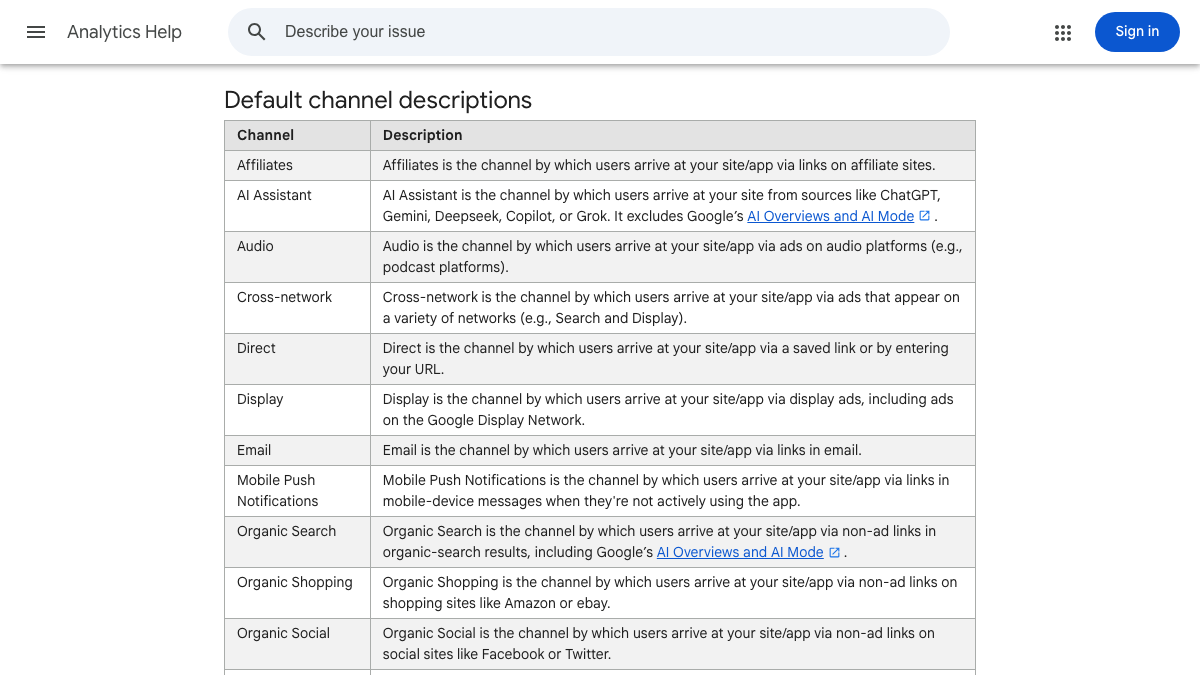
Google's channel definitions say the AI Assistant channel covers sources like ChatGPT, Gemini, Deepseek, Copilot and Grok. It excludes AI Overviews and AI Mode, which count as Organic Search. The rule sets the medium to "ai-assistant" when the referrer matches a list of AI assistants.
That detail matters for the tagged visits. A ChatGPT click that keeps its tag but loses its referrer has a source and no medium. In GA4 that kind of session usually shows as Unassigned, not Direct and not AI Assistant. Clickport's 35.7%, measured in its own tool, describes visits of exactly this kind.
| What arrives | Where GA4 usually puts it |
|---|---|
| AI referrer, with or without a tag | AI Assistant |
| Tag only, no referrer | Unassigned, with source chatgpt.com |
| Google AI Overview or AI Mode click | Organic Search |
| Nothing at all | Direct |
| A later visit after reading an answer | Wherever that later visit came from |
So the real question isn't only how much AI traffic is in Direct. Some of it is in Unassigned, some is in Organic Search, and some is credited to a Google search that happened days after the answer.
AI search traffic grew 835% this year. Is your content ready?
RankControl generates 26 content formats optimized for ChatGPT, Claude, and Perplexity. Published on your domain, matched to your brand.

The AI traffic that hides in Organic Search
Direct gets the attention, but Google's own AI answers hide somewhere else. Google's channel definitions put clicks from AI Overviews and AI Mode in Organic Search, mixed in with ordinary blue-link clicks.
Nothing in the click separates them. The 98 links Google AI Mode cited in our October tests were plain page addresses, with no tag and no marker, and the referrer is google.com either way. A visit from an AI Overview looks exactly like a visit from the result below it.
For many sites this is the bigger blind spot. Google still sends far more visits than all the chatbots combined, and a growing share of searches now show an AI answer first. If your organic clicks fall while your rankings hold, AI answers on those searches are a likely reason, and no channel report will name them.
Our guide to AI referral traffic by engine puts the chatbot share in context against Google.
How to estimate your own number
Borrowing someone else's percentage gives you a number you can't defend. Here's what the two big studies would say for the same site, which shows why.
Say your GA4 shows 400 AI Assistant sessions and 10,000 Direct sessions in a month. Loamly's ratio, 2.4 dark visits for every visible one, would add about 960 hidden AI visits. Attrifast's median, 34% of Direct, would add about 3,400. The two estimates differ by more than three times.
A better route builds up from your own data.
- Take the floor you can see. That's the AI Assistant channel plus any session with source chatgpt.com and no medium, which usually sits in Unassigned.
- Split it by device. If AI Assistant traffic on iPhone is far below its share on desktop, the gap is your strongest clue that app visits are going dark.
- Look for Direct visits from new users landing on deep pages, the guides and comparisons nobody types by hand. If those pages are the ones AI answers cite, that's a likely AI share.
- Ask buyers. A "how did you hear about us" field catches the visits no tag ever will, including the Shopify-style ones that come back through Google.
Our guide to AI referral tracking in GA4 covers the channel and regex setup step by step. For a fuller method with server logs and fingerprints, see how to track AI search traffic when referrers are missing.
The conversion claims ride on the same models
The hidden-traffic numbers usually arrive with a second claim, that the hidden visits convert far better than everything else. Loamly reports that its dark AI visitors converted at 10.21%, against 2.46% for non-AI traffic. That rate comes from 1,195 unique visitors, a small slice of its 446,405 visits.
Clickport found that 20.7% of AI Search sessions completed a goal, against 11.1% of Direct sessions. It describes the sites behind that number as a small, self-selected subset.
There's a catch in how hidden visits get found. A tool that flags no-referrer visits as AI when they're new visitors landing on deep pages is picking the visitors most likely to be buyers. Those visits would convert well whatever sent them, so part of the high rate comes from how they were chosen.
Labeled AI visits are the safer place to measure conversion. Our roundup of AI referral conversion statistics compares the studies that used them.
What the evidence can't tell you
Every number in this post comes with a limit.
The vendor studies rely on each company's own detection model, and their customers aren't a random sample of the web. Attrifast says its fingerprinting is about 80% precise, which it calls good enough for cohort numbers but not for any single site. Loamly's report doesn't explain how its detection decides that a visit with no referrer came from AI.
Our own link check was a desktop browser on public share pages, on one day. We didn't test the iPhone or Android apps, desktop apps, or a live GA4 property, and engines change their link handling without notice.
What holds up is the shape of the problem. Desktop web clicks from the engines we checked arrive labeled. Most of the dark share comes from apps, copied links and visits that happen after the answer. How big that share is on your site depends on how mobile your buyers are and which engines they use.
ChatGPT's own share has moved around this year too, as our look at ChatGPT's falling referral share shows, so recheck your split every few months.
Checking it by hand
Here's a rough monthly budget for keeping an honest estimate of your AI traffic, by our estimate.
| Task | Hours a month |
|---|---|
| Reviewing AI Assistant, Unassigned and Direct reports | 1 to 2 |
| Splitting AI traffic by device and engine | 1 to 2 |
| Matching Direct landing pages to pages AI answers cite | 2 to 4 |
| Reading "how did you hear about us" answers | 1 to 2 |
| Checking which pages each engine cites | 3 to 5 |
| Total | 8 to 15 |
Doing it by hand or with help
You can run these checks yourself each month. Or RankControl can take the steady part of it. Its analytics labels visits by the AI engine that sent them and records AI crawler visits as they happen, and it checks 50 of your buyer questions every week on ChatGPT, Perplexity, Claude, Gemini, Grok and Google AI Mode, so you can see which pages are being cited before you go looking for the visits.

Built by the team that got cited in 48 hours.
Content generation, backlink building, AI visibility tracking, and Google rankings. One platform, zero guesswork.