This week we read through half a dozen of the busiest GEO vs SEO threads on Reddit, from r/SEO to r/seogrowth, and checked each piece of advice that kept coming up against the studies we track. The result is less dramatic than either side of the argument would like. Most of what Reddit says about GEO vs SEO is right, a few favorite tips went out of date this year, some only hold on one engine, and some of the loudest advice was wrong from the start.
Here's the sorted version, with the evidence for each call and a simple test for judging the next tip you read.
The two camps, and why both are half right
Every GEO thread splits the same way. One camp says GEO is SEO with a new label and a higher invoice. The other says AI search is a different game, and what ranks on Google won't get you cited by ChatGPT.
A thread in r/GenerativeSEOstrategy asking whether anyone is "actually doing GEO right" drew 152 comments, and the most upvoted reply summed up the middle ground better than most blog posts: GEO is still built on SEO, and the difference is how it's measured and how different sources are weighted.
Is anyone actually doing GEO right, or is it just SEO with a new name?
I've been seeing more people talk about Generative Engine Optimization (GEO), but a lot of the advice feels like recycled SEO tips. If the goal is to become the source AI tools like ChatGPT, Gemini, Claude, and Perplexity actually reference...
We think that reply is correct, and the rest of this piece is really an expansion of it. The on-page fundamentals barely change. What changes is which engines you measure and which outside sources carry weight.
The advice that holds up
Five tips come up in almost every thread, and the evidence backs all of them.
The first is that good SEO is the foundation. Google says so directly: its guide to generative AI search has a box asking "What about AEO and GEO?" and answers that optimizing for AI search is still SEO.
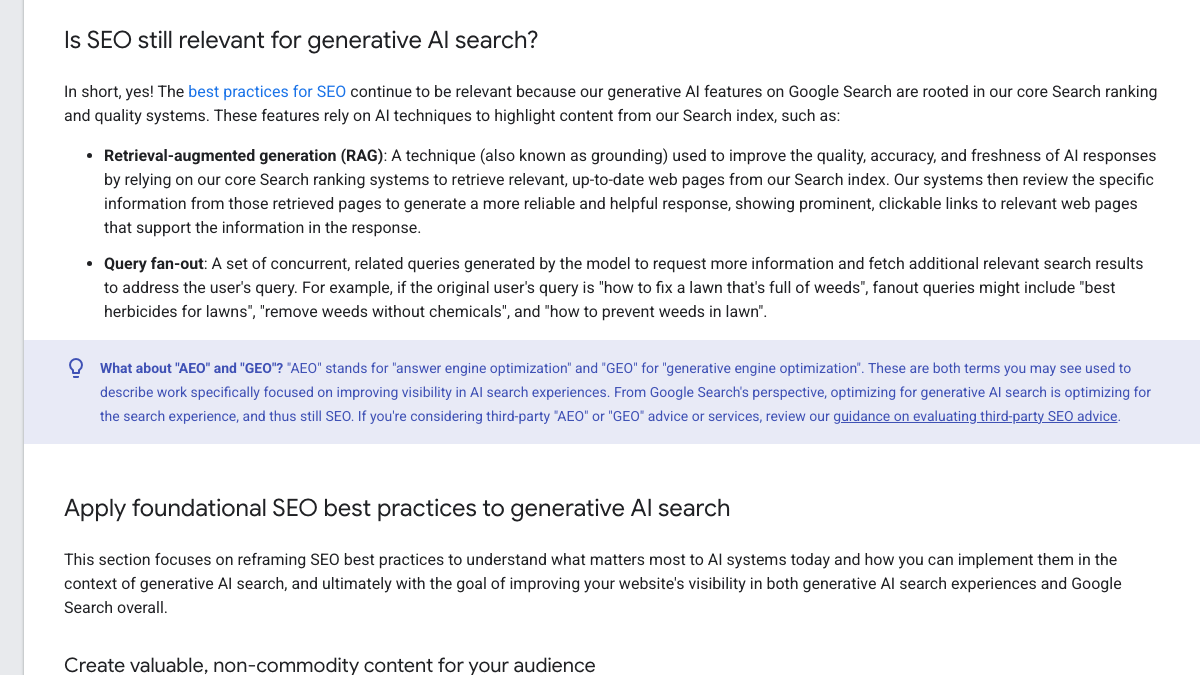
Google's own people keep repeating it. Brendon Kraham, a Google VP, titled a June piece "Good SEO is good GEO," and John Mueller told site owners in January that "what you call it doesn't matter." For Google's AI Overviews and AI Mode, which run on the same ranking systems as regular search, that's close to the whole story.
A version of this tip is circulating with numbers attached. An r/DoSEO post shared a slide attributed to Mueller at a Search Central Live event, saying about 80% of what wins in AI search is core SEO and 20% is off-site brand presence. We couldn't find a primary source for that split, so treat the numbers as someone's summary. The reply we'd keep from that thread noted that Google's 80% is about Google's index, and ChatGPT doesn't retrieve from it.
The second is to answer the question at the top of the page. A July 2026 study of 1,249 ChatGPT answers found the free tier often works from a snippet of about 200 characters cut from the top of a page, without opening the rest. A page that buries its answer under an introduction gives the engine nothing to use.
The third is that mentions on trusted outside sites matter a lot. Across 75,000 brands, Ahrefs found unlinked brand mentions correlated with AI visibility at 0.664, against 0.218 for backlinks. Reviews and community threads that name you are how an engine decides who belongs on a shortlist.
The fourth is to let the AI search crawlers in, which several threads mention in passing under "technical SEO." It deserves more weight than that. Since July 2025, Cloudflare has blocked AI crawlers by default for new sites unless the owner allows them, and the most popular AI crawler block list on GitHub disallows OAI-SearchBot, PerplexityBot and Claude-SearchBot along with the training bots. A site that blocks the search crawlers can't be cited by those engines, however good its content is.
The fifth is the one we'd put first if we were ranking them: test the real questions yourself. One reply in that r/GenerativeSEOstrategy thread said things clicked when the poster stopped reading GEO advice and asked the engines their customers' actual questions. That habit protects you from most of the bad advice below.
Your competitors are building backlinks while you read this.
Organic outreach, social mentions, and citations from Editorial Circle member sites, with managed backlinks available as an add-on. Grow your domain authority without running the campaign yourself.

The advice that went out of date this year
Two tips were reasonable in 2025 and stopped being reliable in 2026, which is why you still see them repeated with confidence.
"Post on Reddit to get into ChatGPT" is the biggest one. After GPT-5.6 became ChatGPT's default in August, one tracker saw Reddit's share of ChatGPT's citations fall from 3.83% to 0.52% in four days. Reddit still matters elsewhere, since it tops Ahrefs' September lists of the sites Perplexity, Gemini and Google AI Mode cite most. Claude is the opposite case: one study of 379,321 Claude citations found none from Reddit. Our write-up of what happened to Reddit citations after GPT-5.6 covers what to do instead.
The other is "AI only cites the top three to five Google results." One r/seogrowth commenter was still waiting for someone to show an AI answer sourced from anywhere else. Ahrefs has shown it: in an 863,000-keyword study published in March, only 38% of AI Overview citations came from pages in Google's top 10, down from 76% the previous summer. About 31% came from pages outside the top 100.
Ranking still helps, and it's still the most reliable way into Google's candidate pool. It just isn't the whole selection anymore.
The advice that depends on the engine
A third group of tips is true on some engines and useless on others, which is why threads argue about them endlessly. Both sides are usually reporting what they saw. Our look at Perplexity SEO advice from Reddit tests several of these tips against a single engine.
"Get on YouTube" is the clearest example. In Ahrefs' September lists of the sites each assistant cites most, YouTube was the top source for Google AI Overviews at 22.9% and a close second for Perplexity at 20.8%. For ChatGPT, it was eighth at 2.5%. A B2B team that mostly worries about ChatGPT would get far less from a video program than one chasing Google's AI features.
"Update your pages often" splits the same way. An analysis of 3.5 million citation events found ChatGPT cycles through its sources fastest, with half of a week's citations gone in about 3.4 weeks, while Perplexity citations lasted about 5.8 weeks. Perplexity is also the engine most often described as favoring fresh pages. Freshness matters everywhere, but the payoff and the timing differ by engine.
The advice to ignore
Some tips were never well supported, and 2026 data has made that clearer. Here are the ones we'd drop, with the evidence against each:
| Advice | What the evidence says |
|---|---|
| Add an llms.txt file to get cited | Google's guide says it won't harm or help, because Google Search ignores it; no major engine has said it uses the file for citations |
| Add schema to get cited | Ahrefs tracked 1,885 pages that added JSON-LD against 4,000 controls: no meaningful gain in ChatGPT or AI Mode, and a small drop in AI Overviews |
| Chop content into small chunks for LLMs | Google's guide says there's no need to break content into tiny pieces for its AI features |
| Track your "position" in ChatGPT | SparkToro found the same prompt returned the same list of brands less than once in 100 runs |
| Publish "best X" lists that rank yourself first | Lily Ray found Google cited those pages but skipped the brand behind them in 224 of 323 cases |
The schema result surprises people, because cited pages really are about three times more likely to carry JSON-LD. Ahrefs reads that as a sign of well-run sites, not a cause, and the before-and-after test supports that reading. Schema is still worth having for rich results; it just isn't a citation lever.
The llms.txt debate has a similar shape. One r/digital_marketing poster added the file to two sites in June, then saw barely any bot fetches and no change in citations. Our breakdown of whether you need llms.txt goes through the rest of the evidence.
You're getting AI traffic. But do you know where it comes from?
RankControl credits every visit to the assistant that sent it: ChatGPT, Perplexity, Claude, Gemini, Copilot, or Grok. Full source attribution, next to your Google traffic.
The which-engine test
Most bad GEO advice starts as a real observation from one engine at one moment, then gets repeated as a general rule. We call the fix the which-engine test, and it's four questions to ask before acting on any tip.
- Which engine was this tested on? ChatGPT, Perplexity, Claude and Google's AI features draw on different indexes and cite different sites.
- When was it tested? A tip from before August 2026 may describe a ChatGPT that no longer exists.
- How many runs was it based on? One screenshot of an AI answer proves almost nothing, since answers change between runs.
- Is the person posting selling something? A lot of GEO content on Reddit comes from agencies and tool makers.
That last question matters more than it sounds. In May, a post in r/SEO celebrated Reddit shutting down GEO subreddits that had filled up with agency spam and bot replies, and it collected 114 upvotes. The top comment made the obvious point: it's strange how much AI engines lean on Reddit when regular users know how much of it is noise.
Phenomenal - Reddit is starting to shut down the Spam filled 'GEO' Subs
Just saw this on Reddit - these subs had 0 moderation against bot comments, GEO spam from GEO agencies....... More of this needs to happen! There are great SEO's sharing valuable insights and ideas on Reddit - as this gets shut down, more a...
The research is worth applying the same test to. A NeurIPS 2025 benchmark called C-SEO Bench found that most published "conversational SEO" methods were largely ineffective and often hurt rankings, while traditional SEO strategies worked better. Our review of GEO research on GitHub covers that benchmark and the code behind it.
Where the "GEO is different" camp has a point
The SEO-is-enough camp is right about the page and wrong about the rest. Google's advice covers Google's engines, and the other engines don't share its index. Anthropic's Trust Center lists Brave Search, TurboPuffer and Parallel Web Systems as web search providers for Claude, and doesn't say which one serves a given query. A June 2026 analysis found close to 80% of the URLs Claude cites also ranked in Brave's top 10, measured before Anthropic listed Parallel Web Systems. ChatGPT draws on its own index plus Bing. A site with excellent Google fundamentals can still be missing from both.
Cyrus Shepard made the same point when Google published its "good SEO is good GEO" line. He agreed with it, then listed work that AI-savvy SEOs do now that they'd never have done before, from AI visibility tracking to auditing AI crawler access.
Rant: Google says, "good SEO is good GEO" I don't disagree. But the same advice doesn't always work in reverse. There are a whole lot of things AI-savvy SEOs do right now that they likely would never do if AI had never existed. A short list: 1. AI visibility tracking 2. https://t.co/L1Ubh7K7Ub
 Cyrus SEO@CyrusShepardJun 23, 2026

The measurement gap is the part that matters most for a B2B team. Only about 11% of the domains ChatGPT and Perplexity cite overlap, according to one 2026 study of 100,000 prompts, so "are we visible in AI search?" has a different answer on each engine. Our per-engine citation data shows how far apart they are.
So our position is simple. Do SEO properly, because it's the foundation for every engine. Then measure each engine separately and work on the outside sources that engines trust, since that's the part a Google-only SEO program leaves out. Our longer take on whether GEO is SEO with extra steps makes the same argument from the SEO side.
Doing both without doubling the work
The overlap is good news for effort, because most GEO work is SEO work you should already be doing. The extra piece is measurement across engines, and that's where the hours go. Checking 50 questions on seven engines takes about six hours a week, and publishing eight solid articles a month takes 16 to 24 hours more. Those are rough estimates.
RankControl's AI visibility tracking runs your 50 questions every week on seven engines, from ChatGPT to Google AI Mode, alongside your Google and Bing rankings, and notifies you when a new citation lands. The content engine writes each article against the pages already ranking for its keyword and publishes it on your own domain. For a quick first read, the free AI visibility checker shows who ChatGPT cites for three questions from your market.
You can run the which-engine test on every tip yourself and keep a weekly spreadsheet of answers. Or RankControl's agents can run the checks and the publishing every week while you decide which Reddit advice is worth trying next.
We'll show you exactly where your brand stands in AI search.
No commitment. $0 due today, cancel anytime. See how ChatGPT, Perplexity, Claude, Gemini, Grok, Google AI Mode, and Google AI Overviews talk about your brand today.