
Search GitHub for "generative engine optimization" and the most-starred result is a Claude Code skill with about 1,300 stars. The repository that actually tested whether conversational SEO tricks work has 20. That gap sums up the state of generative engine optimization on GitHub: plenty of tooling, very little of it checked against what AI engines do.
We went through the repos that come up for GEO, AEO and AI search in September 2026 and sorted the ones worth your time from the ones to handle with care. Each entry below was checked on its GitHub page on September 26, 2026, with star counts and last updates as of that day. One is ours, and we say so where it appears.
The research repos worth reading first
Start with the research, because most commercial GEO advice traces back to these papers, often loosely. Reading the code and the benchmark design tells you what was measured, on which engine and how big the effects were.
1. GEO-optim/GEO
This is the code and dataset behind the 2023 paper that named the field, "GEO: Generative Engine Optimization," later published at KDD 2024. The repo lets you rerun the paper's experiments and define your own optimization methods, and it points to GEO-bench, the query dataset the authors released on Hugging Face.
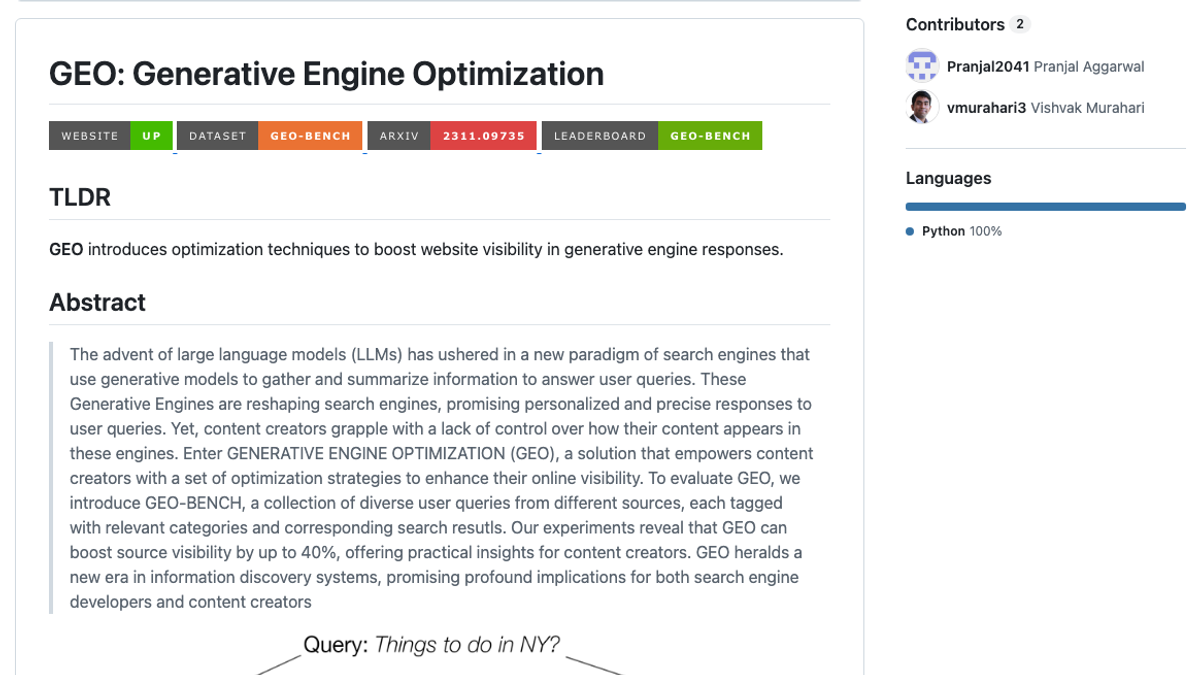
The headline finding is the one vendors quote: in the original paper, adding statistics or quotations raised a source's visibility by up to about 40% in the authors' tests. Reading the code shows how that was measured, mostly on a simulated engine built on an older OpenAI model, so treat the exact numbers as directional. The repo has 337 stars, an Apache 2.0 license and no code changes since October 2025.
2. parameterlab/c-seo-bench
This is the repo we'd most want every GEO buyer to read, and it has 20 stars. C-SEO Bench, from Parameter Lab with NAVER AI Lab and university partners, was published at NeurIPS 2025 and tests conversational SEO methods across web questions and product recommendations.
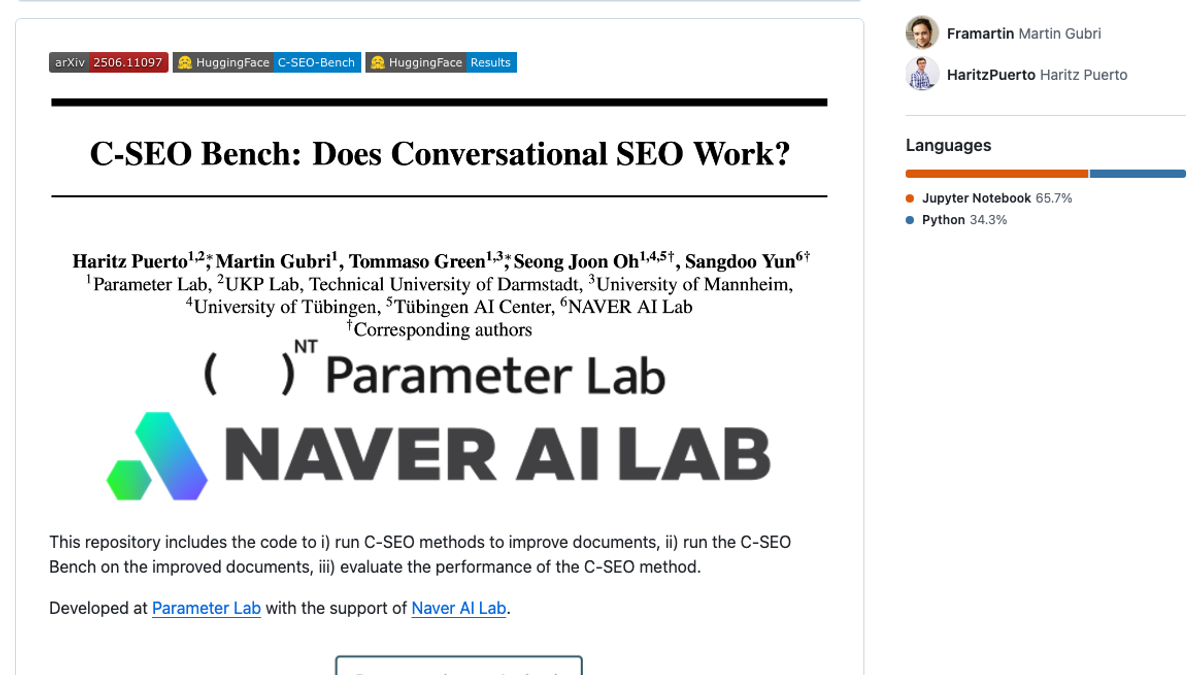
The paper's conclusion is blunt. Most current C-SEO methods are "largely ineffective" and "frequently have a negative impact on document ranking," while traditional SEO strategies "are significantly more effective." The authors also found that gains shrink as more sites adopt the same methods, which they describe as a congested, zero-sum problem.
3. cxcscmu/AutoGEO
AutoGEO, from Chenyan Xiong's group at Carnegie Mellon, was accepted at ICLR 2026. It mines the content preferences of a generative engine as a set of rules, then rewrites documents to match them, with a small reinforcement-trained model for cheaper rewriting.
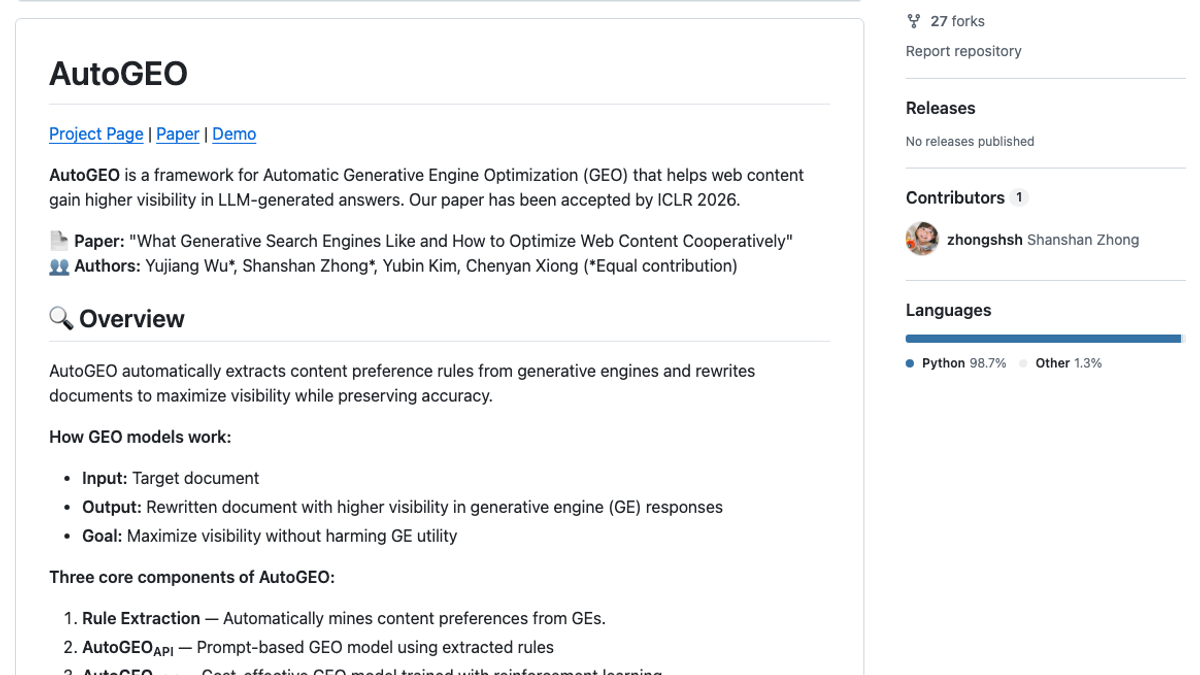
It's the most sophisticated open code in the space, with 221 stars and an MIT license. The README's own warning is the important part: the rules are tailored to a specific engine and domain, and you need to rerun extraction when either changes. Engines change often. ChatGPT's 5.6 update in August reshuffled its preferred sources in a matter of days, so rules extracted in spring would already be stale.
4. DavidHuji/Awesome-GEO
A plain reading list of GEO research, grouped by year and updated on September 24. Its value is the company it keeps: next to optimization papers, it lists work on ranking manipulation, poisoning and stealthy prompt attacks against AI search.
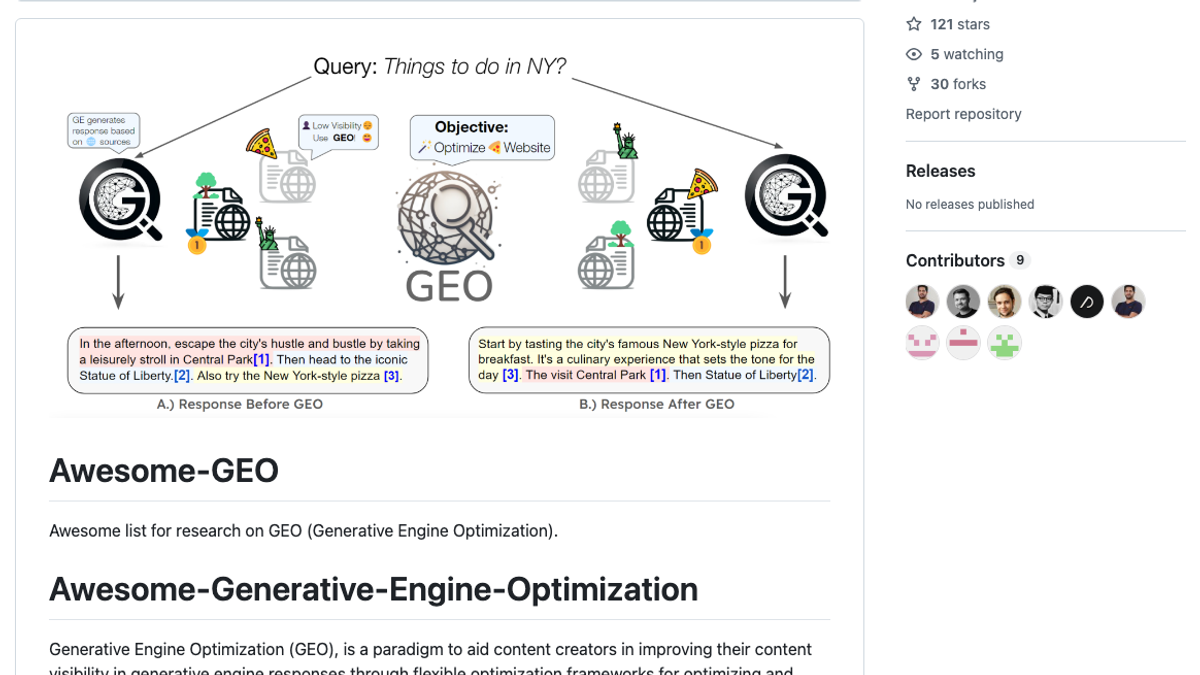
That makes it the fastest way to see where optimization ends and manipulation starts, which matters when a vendor's tactic sounds a lot like one of the attack papers. The list has no annotations, and a few 2026 entries are studies from GEO vendors, so check who wrote a paper before you cite it.

Built by the team that got cited in 48 hours.
Content generation, backlink building, AI visibility tracking, and Google rankings. One platform, zero guesswork.
The practical repos
These three are tools you can use this week. Each needs care in a different way.
5. ai-robots-txt/ai.robots.txt
With 4,138 stars and daily updates, this is the most-used AI crawler list on GitHub. It names AI-related user agents of every kind and ships ready-made blocking rules for robots.txt and several web servers, from Apache to Caddy.
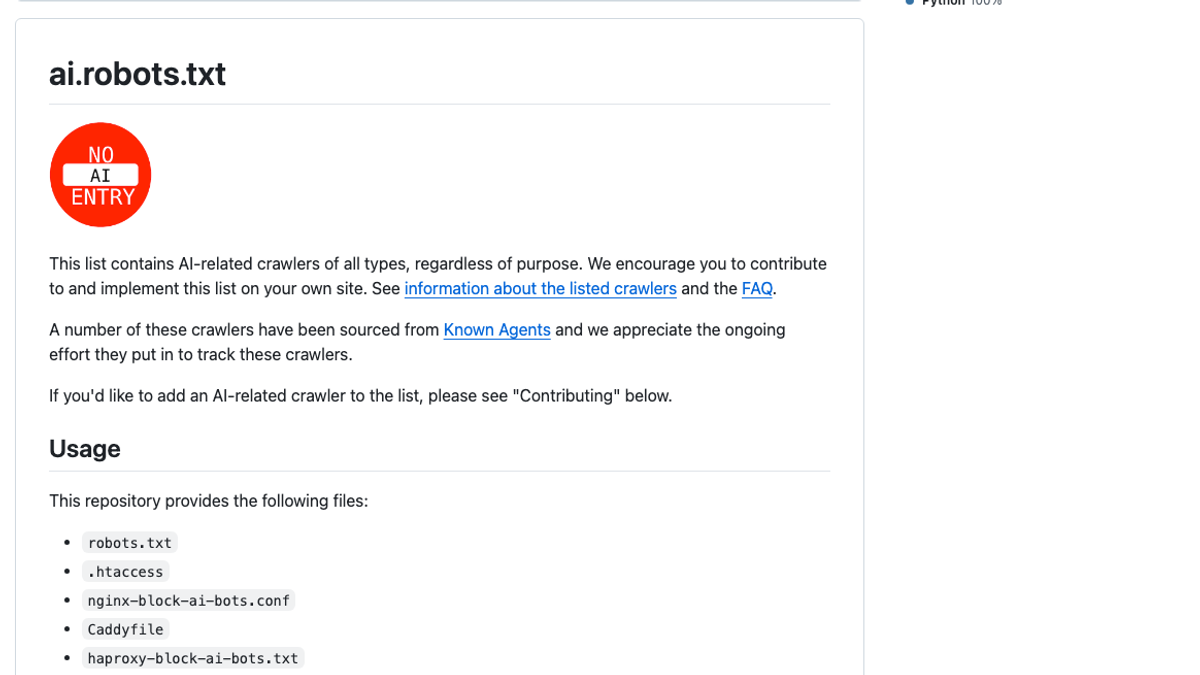
The robots.txt file lists 180 user agents and disallows all of them, including OAI-SearchBot, PerplexityBot and Claude-SearchBot. Those are the crawlers that fetch pages for ChatGPT search, Perplexity and Claude's answers, so copying the file as-is takes you out of all three. Use it as the reference list of names, then decide bot by bot, as our robots.txt directive reference for AI explains.
6. rankcontrol/rankcontrol
This one is ours. The repo is RankControl's Claude Code plugin and agent skill, MIT-licensed, and the plugin lets Claude Code, Cursor, Codex and other skills-compatible agents drive your workspace from the command line.
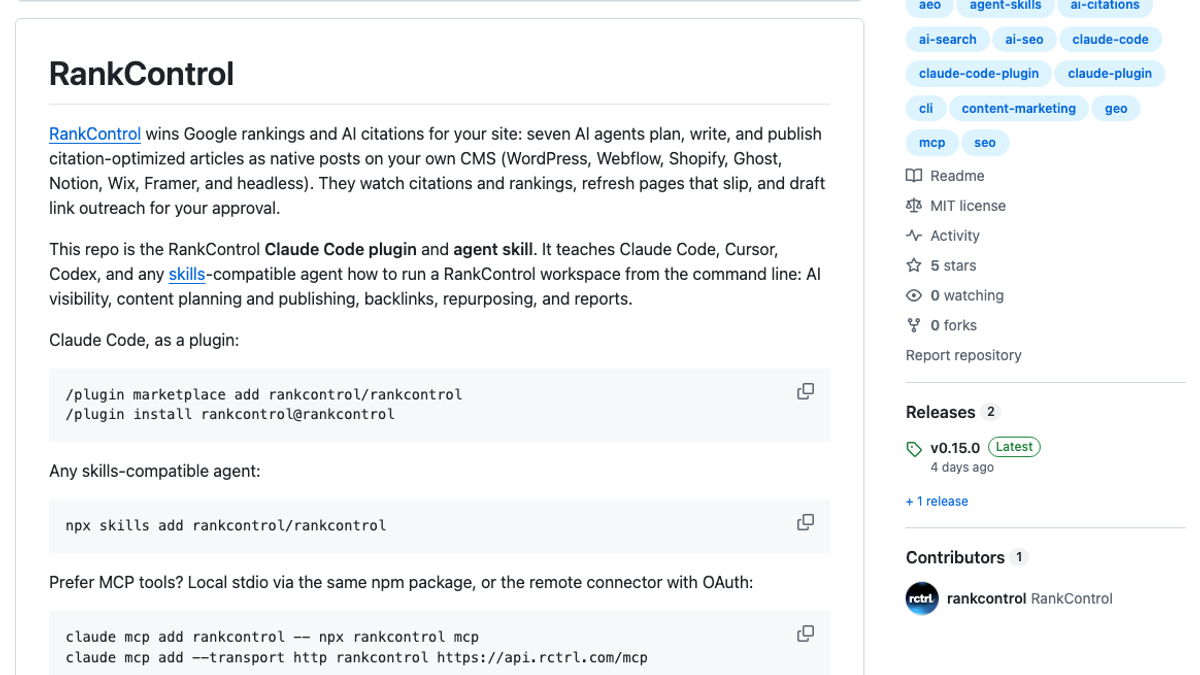
From your AI tool you can check citations on seven engines or plan and publish articles, all over the RankControl MCP server. The skill is free, but every action needs a RankControl account. We offer one plan at $400 a month with a 7-day free trial. The repo has 5 stars, having gone public only in August. Our guide to doing SEO in Claude over MCP shows the workflow end to end.
7. AgriciDaniel/claude-seo
With 17,710 stars, this is one of the most-starred SEO repos for Claude Code, and it's MIT-licensed. It runs 26 sub-skills and 19 specialist agents covering technical SEO, content quality, schema and GEO, and it produces a prioritized action plan from a site audit.
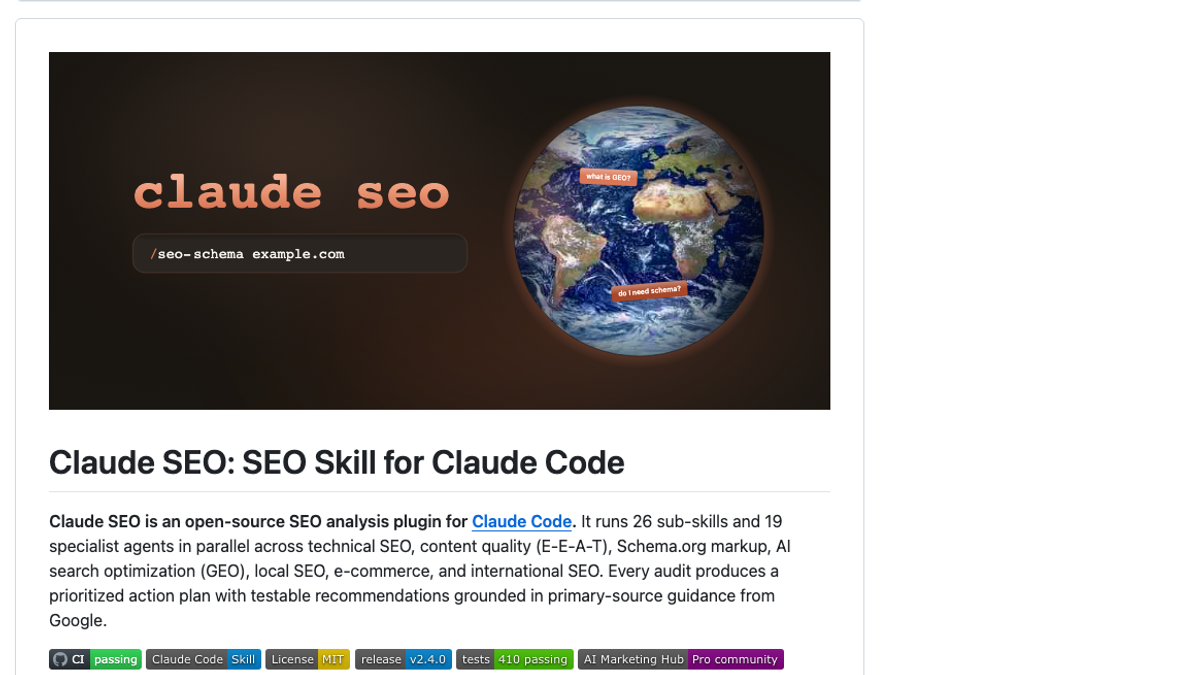
It's a good way to get a thorough technical audit in minutes. Two cautions apply. The recommendations are written by the model reading your site, so check each one before acting on it. And an audit is a snapshot: it tells you what your pages look like today, not whether ChatGPT or Perplexity will cite them next week. Also open the main skill file before running it for clients. When we checked, it told the agent to end the output of 17 commands, the GEO report among them, with a footer promoting the maintainer's free and Pro communities.
Useful, with a warning label
The last three show up in almost every GEO thread. Each has a legitimate use that's narrower than the hype around it.
8. AnswerDotAI/llms-txt
The llms.txt proposal from Jeremy Howard of Answer.AI has 2,633 stars and a version 2 dated August 10, 2026. It proposes a markdown file at your site root that guides AI agents to clean versions of your key pages.
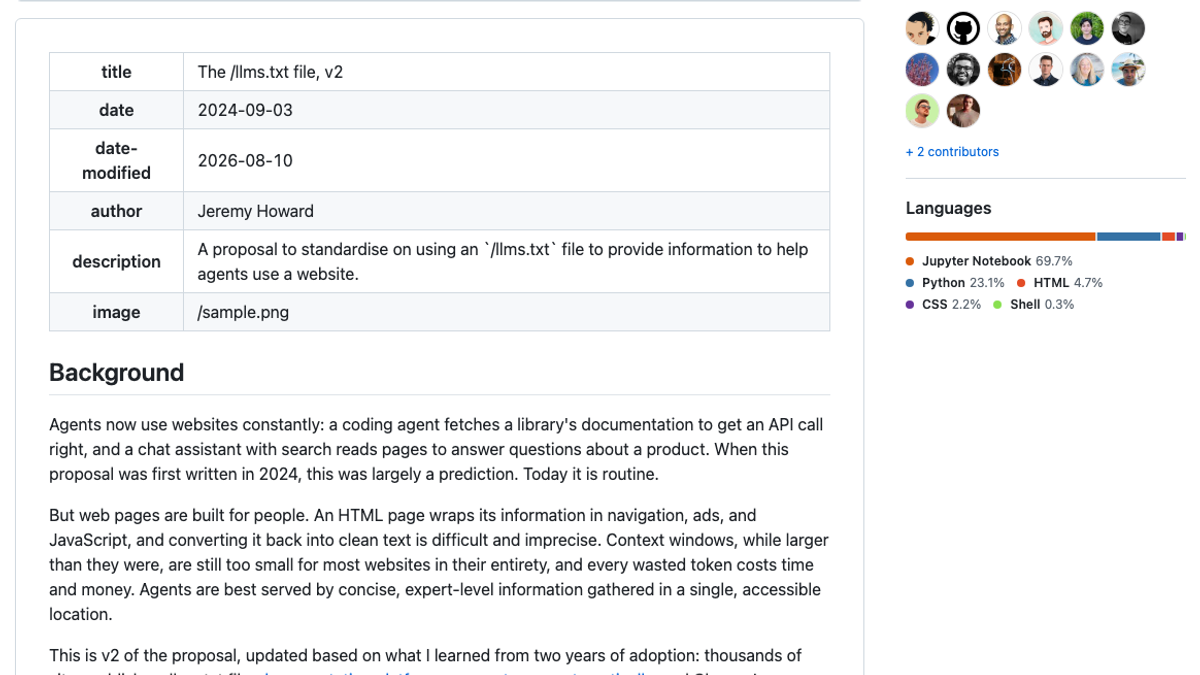
The spec itself now says llms.txt files are used most heavily for software documentation, where coding agents follow them to API references. For AI search, Google's guide says they won't harm or help, because Google Search ignores them.
Google updates help doc to say LLMS.txt won't help or hurt you in Google Search and Google Search does not use them or markdown files https://t.co/e5fsojWrN0 https://t.co/EStiJTT22o
 Barry Schwartz@rustybrickJun 16, 2026
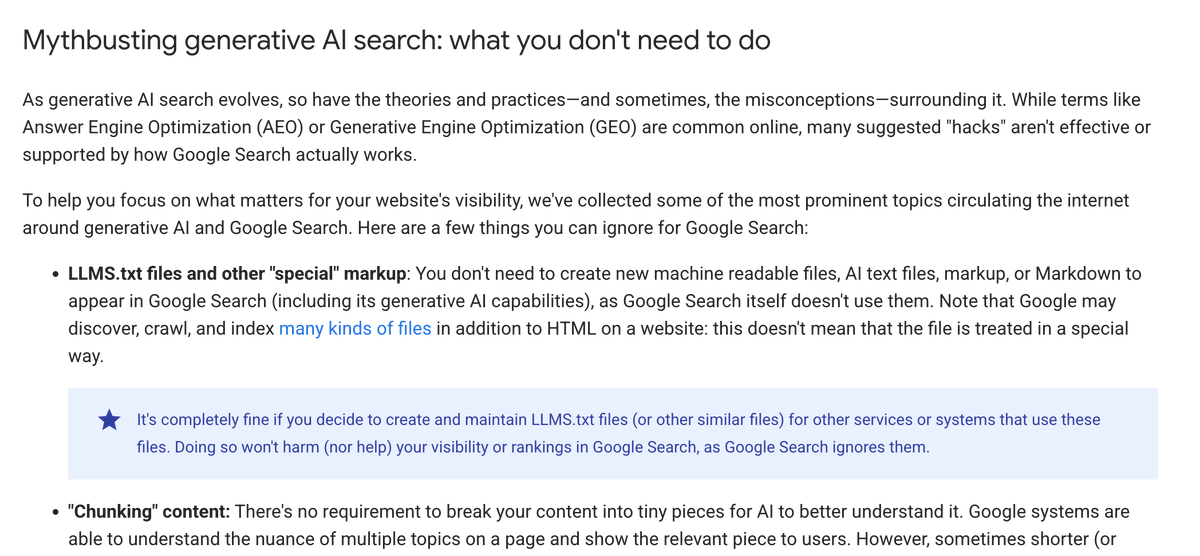
Site owners report the same thing. One r/digital_marketing poster added llms.txt to two sites in June and found barely any bot fetches in the logs and no change in citations. If you run developer docs, publish one. If you're hoping for AI citations, our breakdown of whether you need llms.txt covers the evidence.
Did llms.txt actually change anything on your site, or is it a 20 minute feel-good task?
Added it to two sites in June. Server logs show barely any bot pulls and citation tracking moved zero. I keep it because it costs nothing, but the loud advice around it feels way ahead of the evidence. Someone tell me I'm wrong with numbers...
9. amplifying-ai/awesome-generative-engine-optimization
A broad "awesome" list with 514 stars and 182 forks, covering guides, tools, research, newsletters and events. It's a decent map of who's writing about GEO.
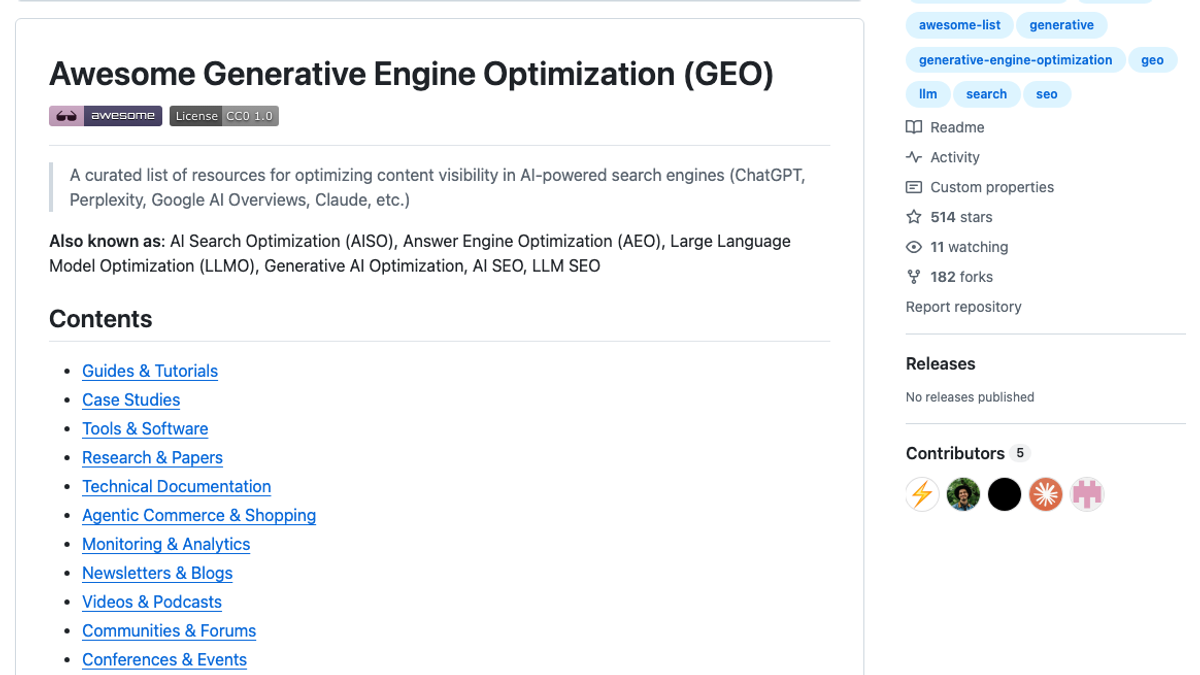
It hasn't been updated since April 14, and it mixes Google's own documentation with vendor blog posts on equal footing. One linked piece describes a "3-layer reranking system" at Perplexity, a claim we couldn't trace to any primary source from Perplexity. Use it to find reading, then check anything it links before you repeat it.
10. Open-source AI readiness audits and trackers
The biggest category on GitHub, and the one to approach most carefully. Dozens of repos either score your site from 0 to 100 on AI readiness or run prompts through ChatGPT and log whether your brand appears. The most-starred have a few hundred to about 900 stars, and several are the free edition of a paid product.
The audits are useful for catching real technical problems, such as a blocked crawler or content that only renders in JavaScript. The scores are the weak part. A readiness score measures a checklist, and C-SEO Bench is the reminder that on-page tricks rarely move citations. The self-hosted trackers work, but you'll be managing API keys and repeated runs yourself, since a single run of a prompt says little.
What to skip
Two kinds of repos are worth avoiding, however many stars they collect. The first is anything that shows AI crawlers something people don't see, from hidden AI-only versions of your pages to text that smuggles instructions to language models. Google's guide says you don't need machine-readable copies to appear in its AI features. In August, Perplexity also blocked Time's sponsored copy placed in markdown versions of its pages and warned publishers about a hit to their trust score. The attack papers on the Awesome-GEO list show why engines are building defenses against hidden instructions.
The second is bulk rewriting scripts that push every page toward one engine's current preferences. Those preferences change with each model update, and C-SEO Bench found that rewriting methods rarely paid off even before they changed.
See your first AI citation report in under 5 minutes.
No setup calls. No onboarding meetings. Connect your domain and see where AI mentions your brand right now.

What the star counts tell you
Stars measure attention, and GEO attention runs toward tools that promise a score. The C-SEO Bench repo, the only one on this list built to test whether conversational SEO works, has 20 stars, while the most-starred GEO skill on GitHub has about 1,300.
Forks can mislead too. An llms.txt directory we looked at has 752 forks against 906 stars, most likely because sites fork it to submit their own listing, which says nothing about whether llms.txt works.
For judging a repo, the last commit and the open issues say more. A research repo that hasn't changed since 2025 is fine, because a paper doesn't need updates. A crawler list or an audit tool that stopped changing in the spring is another matter, since AI crawlers and engines have changed several times since then.
How to use GitHub for GEO without losing a week
Here's the order we'd use it in:
- Read the GEO paper and C-SEO Bench before any tool, so you know which effects have been measured and which have been refuted.
- Check each tool's license and last commit, and whether it's the free edition of a paid product.
- Treat any score a tool produces as a hypothesis, and check it against real answers on each engine.
- Test crawler rules and page rewrites on a handful of pages before rolling them out sitewide.
The research repos take an afternoon to read. The tools take longer, mostly because checking their output against real AI answers is the slow part: running 50 questions on seven engines by hand takes about six hours a week, and publishing eight solid articles a month takes 16 to 24 hours more. Those are rough estimates.
RankControl's AI visibility tracking runs those 50 questions every week on seven engines, with a citation history for each question and a notification when a new citation lands. The content engine writes and publishes articles on your own domain for the questions where you're missing, and our list of the best generative engine optimization tools for B2B SaaS teams compares the commercial options.
You can assemble a GEO stack from GitHub repos and run it yourself. Or RankControl's agents can run the tracking and publishing every week while you read the next paper.
Your competitors are building backlinks while you read this.
Organic outreach, social mentions, and citations from Editorial Circle member sites, with managed backlinks available as an add-on. Grow your domain authority without running the campaign yourself.