
Search Google for "what is GEO in digital marketing" and most of the top results describe generative engine optimization. The third result, though, sells geolocation services that tailor websites and ads to where people are. Both answers are correct, depending on when you learned marketing.
This guide covers both meanings, then focuses on the one most people mean in 2026: what generative engine optimization is, where the term came from, how it fits the rest of a digital marketing plan, and how to measure it. Sources were checked on September 26, 2026.
GEO has two meanings in marketing
For most of the last decade, "geo" in digital marketing meant location. Geo-targeting shows ads to people in a chosen area, geofencing triggers an ad or offer when someone enters a defined boundary, and geomarketing uses location data to plan campaigns. Plenty of ad platforms and agencies still use the word that way.
Since 2024, GEO has increasingly meant generative engine optimization: getting your brand cited and recommended in AI-generated answers. Search data shows the shift. In the US, searches for "what is generative engine optimization" rose from about 880 a month in September 2025 to 2,900 in August 2026, while "geotargeting" fell from 2,400 to 1,300 over the same year.
Even the AI engines get confused. SEO consultant Lily Ray noticed in February that ChatGPT still didn't fully understand what GEO meant in this context, even with web search turned on.
lol, chatGPT still doesn’t fully get what “GEO” means in this context, even with web search enabled. Almost like it’s a dumb name for this 🤭 https://t.co/8j6cjDLAvL
 Lily Ray 😏@lilyraynycFeb 18, 2026

The two meanings collide most often in local marketing. An agency owner in r/digital_marketing asked earlier this year how to do "local GEO" for clients, meaning how to get a dentist named when someone asks ChatGPT for the best dentists in Austin. That's generative engine optimization applied to a location-based search, and the question drew replies about both kinds of work.
GEO for local business? Is it possible? Are there any strategies I need to research?
I run an agency for local businesses and we're getting more questions from our clients about showing up in Al-generated answers for location specific questions. Like when someone asks Chatgpt "best dentists in Austin", can we influence our...
If a proposal or job ad says GEO, check which one it means before anything else.
Generative engine optimization, defined
Generative engine optimization is the work of making your content a source that AI engines use in their answers, and your brand a name those answers recommend. The engines include ChatGPT, Perplexity, Claude, Gemini and the AI features in Google Search.
The term comes from a paper titled "GEO: Generative Engine Optimization," first posted on November 16, 2023. Its six authors included researchers from Princeton, and it was accepted to KDD 2024, a major data-mining conference. The paper built a benchmark called GEO-bench and tested ways content creators could improve their visibility in AI answers, reporting gains of up to 40%.
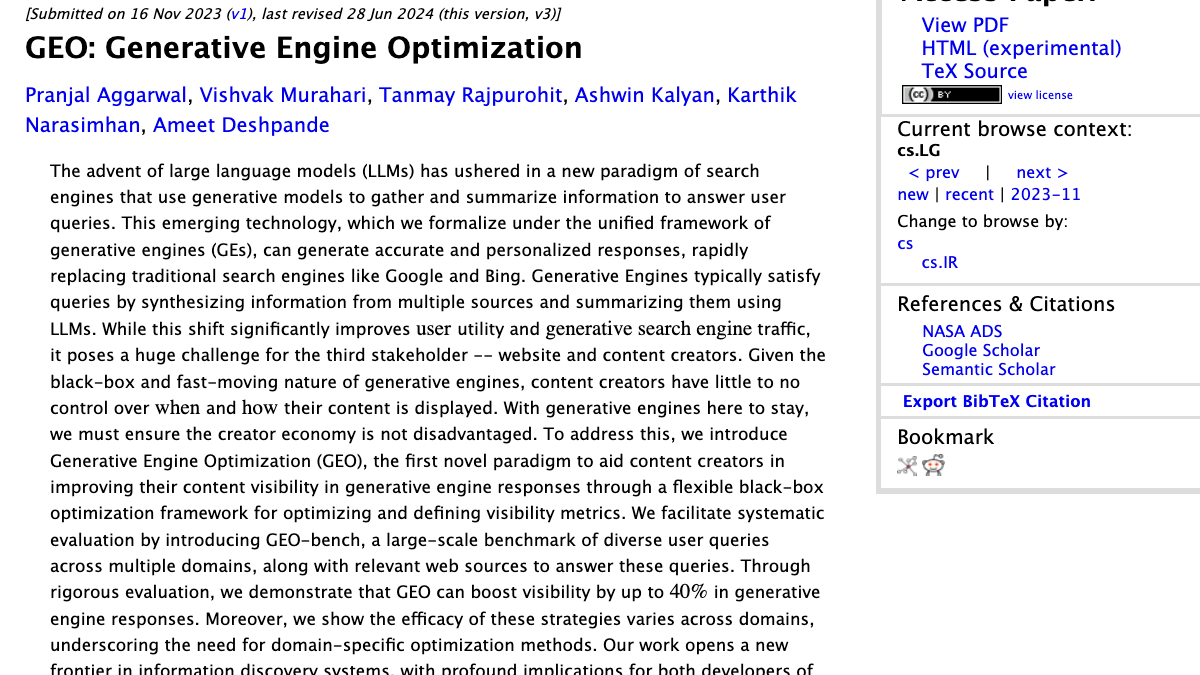
The abstract also predicted that generative engines were "rapidly replacing traditional search engines like Google and Bing." That part hasn't happened yet. In June 2026, Google's Brendon Kraham wrote that the company had seen "an all-time high in Search queries" the previous quarter. People now use AI answers alongside search, which is why GEO sits next to SEO in most plans rather than replacing it.
15 hours a week manually. Or 15 minutes with RankControl.
Track citations, monitor competitors, and fix content gaps across every AI search engine. Automatically.

How GEO fits a digital marketing plan
GEO doesn't need its own department. It changes what several existing channels are for.
| Channel | Its usual job | What it does for GEO |
|---|---|---|
| SEO and content | Rank pages and bring in clicks | Supplies the passages AI engines quote |
| PR | Win coverage and backlinks | Creates the third-party mentions engines trust |
| Reviews | Build ratings for buyers | Gives engines review profiles to cite for "best" questions |
| Community and social | Drive engagement | Shapes what engines read about your brand |
The PR row matters more than most teams expect. Ahrefs studied 75,000 brands and found that branded web mentions correlated with visibility in Google's AI Overviews at 0.664, far above the 0.218 it measured for the number of backlinks.
Google's own framing puts GEO close to SEO. Kraham's piece, titled "Good SEO is good GEO," says Google's AI features use the same core ranking and quality systems as regular search. The other engines don't use Google's index, though, which is where GEO adds work of its own. Our explainer on what SEO for ChatGPT is called compares GEO with the other names for the same job. Our AEO vs GEO explainer compares how ChatGPT, AI Mode and Google's own guide define the two.
GEO for local businesses
Local searches are where GEO and old-school local SEO meet. When someone asks an AI engine for the best dentist in a city, the engine runs that search and several narrower ones, then builds its answer from what comes back. An August 2026 study of 14,472 Gemini citations for local searches found that about 60% pointed to the businesses' own websites, ahead of directories and review platforms.
That makes the basics count again: a page for each service and location, accurate hours and prices, consistent details on Google Business Profile and directories, and a steady flow of recent reviews. The top reply in the r/digital_marketing thread gave the agency the same advice from a different angle, telling it to rank for the narrower questions an engine searches behind the scenes.
What GEO work involves
Most of the work falls into four areas, and none of them are tricks:
- Make sure AI crawlers can read your pages, which means checking robots.txt and your CDN settings and serving content that doesn't depend on JavaScript.
- Put the answer first. Engines lift short passages, so each page should answer its question in the opening lines, with numbers and names in the same sentence.
- Cover the questions around your main topic, including pricing, comparisons and setup, since engines split one question into several searches.
- Earn mentions on review sites, publications and communities your buyers read.
The Princeton paper found that adding quotations and statistics from credible sources raised visibility, while keyword stuffing lowered it. A 2025 follow-up called C-SEO Bench found most of those content edits did little in realistic conditions, where how well a page ranks mattered most. Read together, they suggest GEO formatting helps pages that already get found, and it's no substitute for being found. Our complete guide to answer engine optimization goes through each area engine by engine.
RankControl's content engine handles the on-site part: it plans articles from your buyers' questions, writes each one against the pages already ranking and scores it for how easily AI engines can quote it.
How GEO is measured
This is where GEO feels least like SEO. A post in r/WebsiteSEO summed up the frustration in one line: rankings you can track, but AI mentions and citations feel random.
GEO is confusing. What are you actually doing to get mentioned in AI answers?
I keep seeing people say “optimize for GEO” (Generative Engine Optimization) like it’s a checklist, but nobody clearly explains what they’re doing in a way that’s measurable. Rankings I can track. AI mentions/citations feel random. If you’r...
They feel random because AI answers vary from one run to the next. The fix is a fixed sample. Pick 30 to 50 questions your buyers ask, run them on each engine on the same day every week, and log whether you were cited, whether your brand was named and which competitors appeared instead. The trend over several weeks is the number to report.
For Google specifically, Search Console added generative AI performance reports in June 2026 and made them available to every site by August 31. They show how often your pages appeared in AI Overviews and AI Mode. The reports count impressions only, so they won't tell you whether your brand was named.
RankControl's AI visibility tracking runs the weekly check for you on six engines, with a citation history for each and a notification when a new citation lands.
AI search traffic grew 835% this year. Is your content ready?
RankControl generates 26 content formats optimized for ChatGPT, Claude, and Perplexity. Published on your domain, matched to your brand.

What GEO isn't
GEO isn't a volume game. In r/smallbusiness this September, a marketer described watching an agency sell a client 60 "AI-optimized" listicles. Three months later the client had zero citations in ChatGPT or Perplexity, while its plain comparison page with real pricing and test data kept getting quoted.
Special files won't do it either. Google's guide to its AI features says it ignores llms.txt files and other AI-specific markup, and that you don't need to chunk pages into small pieces or rewrite them for AI.
No agency controls what an AI engine says, and answers change between checks, so treat a guarantee as a warning sign. A useful GEO proposal names the engines it will track, the questions it will measure, how often it checks and the work it will do on and off your site.
How to start with GEO
Start by looking. Our free AI visibility checker asks ChatGPT three real buyer questions from your market and shows who it cites. Then run 15 to 20 of your own buyer questions across ChatGPT, Perplexity and Gemini, note who gets named and which pages get cited, and fix anything the engines get wrong about you before chasing new citations.
From there, the work is steady rather than clever. Publish pages that answer the questions where you're missing, keep them current, earn mentions where your buyers read and check the same questions every week. Done by hand, publishing eight solid articles a month takes 16 to 24 hours, and checking 50 questions on six engines takes about five hours a week. Those are rough estimates.
You can run GEO yourself with a spreadsheet and a few hours every Monday. Or RankControl's agents can run it every month while you focus on the rest of your marketing plan.

Built by the team that got cited in 48 hours.
Content generation, backlink building, AI visibility tracking, and Google rankings. One platform, zero guesswork.