
Back in July, someone on r/DigitalMarketing posted that nearly everyone talks about AEO and GEO, but hardly anyone can say how they differ. Their own short take was tidy. AEO helps your content become the answer, they said, and GEO helps your brand show up in the answer. A reply was blunter. "They're the same thing. Same with SEO."
AEO and GEO: what's the difference?
Almost everyone speaks about AEO and GEO But a small percentage of them know the difference AEO - Answer Engine Optimisation It’s about creating content that clearly answers the questions people are asking Sources can be: BooksDocumentaries...
I'd say both of them are right, and that's why people keep asking. Below is the plain difference. Then comes what ChatGPT and Google AI Mode told us when we asked, what Google itself says, and which of the two terms your buyers search for.
AEO vs GEO in one line each
AEO stands for answer engine optimization. You want your content to be the direct answer to a question, the way a featured snippet or a voice assistant reply is, or the short answer at the top of a result.
GEO, or generative engine optimization, is about being cited inside an answer that an AI writes. Picture ChatGPT naming three tools it would pick, or the list of sources Perplexity shows under its summary.
| AEO | GEO | |
|---|---|---|
| Stands for | Answer engine optimization | Generative engine optimization |
| Goal | Be the answer | Be cited or recommended in the answer |
| Typical surfaces | Featured snippets, voice assistants | ChatGPT, Perplexity, Gemini, Claude |
| Content style | Short, direct answers, FAQs, structured data | Original facts, expert detail, evidence |
| How you measure it | Answer placements | Citations and brand mentions in AI answers |
| Origin | Grew out of featured snippets and voice search | Named in a November 2023 research paper |
Of the two, only GEO has a birth date. It was named in "GEO: Generative Engine Optimization", a paper by Pranjal Aggarwal and co-authors that was posted to arXiv on November 16, 2023. AEO is older and looser. People used it for years before AI chat took off.
What the original GEO paper found
A lot of the GEO advice you read goes back to this paper, so it helps to know what it said. The authors built a benchmark of queries on many subjects. Then they rewrote web pages in different ways and measured how often a generative engine used each page in its answer.
The best methods, they reported, raised a page's visibility by up to 40%. KDD 2024, a major data science conference, accepted the paper.
People quote the second finding much less. What worked changed from one subject to the next, so the study found no single GEO recipe. Keep that in mind the next time a vendor tries to sell you one.
The same buyer, one AEO question and one GEO question
It's easier to see with a real case. Say you sell CRM software to small businesses.
Someone asks, "How much does a CRM cost for a small business?" That's an AEO question. The win is your page's opening paragraph, with real price ranges in it, being lifted out as the answer.
Now they ask, "What's the best CRM for a small business?" That one is GEO. There's no single answer to pull out. The win is ChatGPT or Perplexity naming your product among its picks, which often comes down to review sites and comparison articles that mention you.
15 hours a week manually. Or 15 minutes with RankControl.
Track citations, monitor competitors, and fix content gaps across every AI search engine. Automatically.

What ChatGPT and AI Mode say
On October 19, 2026, we put three questions to ChatGPT and Google AI Mode through a data provider's live US feed. We asked "what is the difference between AEO and GEO," "AEO vs GEO" and "is GEO the same as SEO."
The two engines drew the line in the same place. ChatGPT said AEO is about getting your content picked as a direct answer, and GEO about getting your brand or content referenced in AI-generated responses. AI Mode said it comes down to being the exact answer versus being cited in the synthesis. It cited two r/DigitalMarketing threads for that short version.
Where they split was a detail that matters. ChatGPT put Google AI Overviews under GEO. AI Mode is Google's own product, and it put AI Overviews under AEO, next to featured snippets and voice assistants. So the engines can't even agree on which bucket Google's AI answers go in.
They did agree that GEO and SEO aren't the same thing. ChatGPT's answer began with "No," and AI Mode said SEO is about ranking pages while GEO is about being cited in AI answers. In our post on whether SEO is dead, both engines were just as sure that SEO isn't going away.
What Google says
Google's own docs don't side with its AI Mode. Its guide to AI features in Search takes on the two terms by name.
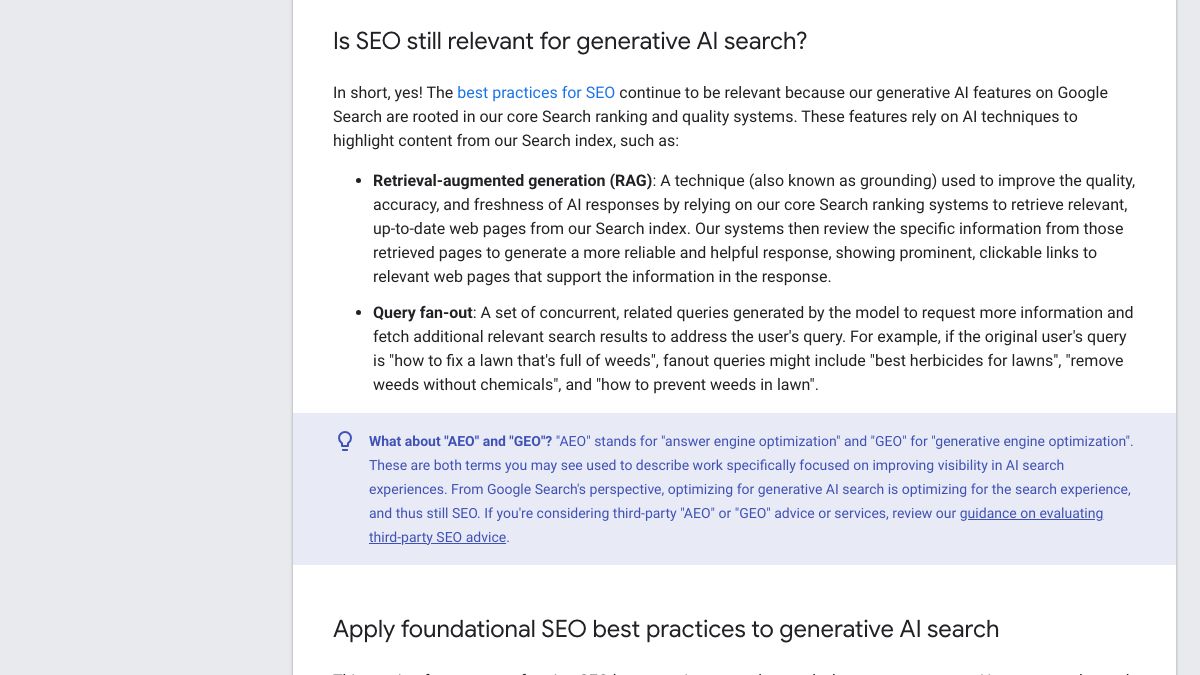
As far as Google Search is concerned, optimizing for generative AI search is optimizing for the search experience, so it's still SEO. The same guide says Google ignores llms.txt files. It also says you don't need to cut your pages into chunks or rewrite them just for AI.
For Google that's fair, since its AI answers come out of its own index and ranking systems. It tells you less about ChatGPT, Perplexity and Claude, which run their own searches and lean on other sources. When we tested what ChatGPT cites against Bing and Google rankings, most of the sites it cited weren't on the first page of either one.
Which term people search for
The table shows how US monthly searches moved from October 2025 to September 2026, going by a data provider's estimates.
| Search | October 2025 | September 2026 |
|---|---|---|
| what is aeo | 3,600 | 8,100 |
| what is geo | 5,400 | 6,600 |
| answer engine optimization | 2,400 | 4,400 |
| generative engine optimization | 5,400 | 4,400 |
| aeo vs geo | 880 | 2,400 |
| llm seo | 1,300 | 590 |
AEO is the one gaining. "What is aeo" more than doubled over the year, and "answer engine optimization" nearly did the same, while "generative engine optimization" moved within a range. "LLM SEO" is fading.
The comparison itself is a fast-growing search. Searches for "aeo vs geo" close to tripled, so plenty of people are as lost as that Reddit poster.
Take "what is geo" with care, since GEO also means geography and geolocation. "AEO" by itself has the same problem, which is why we kept it out of the table.
AI search traffic grew 835% this year. Is your content ready?
RankControl generates 26 content formats optimized for ChatGPT, Claude, and Perplexity. Published on your domain, matched to your brand.

Does the label change the work?
Not much. Line up the AEO advice next to the GEO advice and you get mostly the same list.
| Tactic | Helps AEO | Helps GEO |
|---|---|---|
| A clear, direct answer near the top of the page | Yes | Yes |
| Original facts and data that others can cite | Somewhat | Yes |
| Mentions and reviews on other trusted sites | Somewhat | Yes |
| Structured data, like FAQ and Article schema | Yes | Somewhat |
| Crawlable pages that AI crawlers can reach | Yes | Yes |
| Checking what AI engines actually say | Yes | Yes |
What differs is the weight you give each part. AEO leans on short answers with a clean structure. GEO leans on authority, and most of that comes from other sites that mention you.
The most useful point came from a Reddit reply in the same thread. It said to track a brand being mentioned apart from a page being cited, because the two are different signals.
Which term should you use?
Use whichever word your audience uses. With clients or buyers in the US, AEO is the faster-growing search. With people who've read the research, GEO is the sharper word for being cited in answers an AI writes. Inside your own team, the label matters less than which questions you track and which pages you write for them.
For the rest of the alphabet, see our explainer on SEO, GEO, AEO and the other acronyms. Our AEO vs GEO vs SEO guide goes further into the tactics for each.
Limits of our check
We asked each engine the three questions once, on a single day, from a US feed. The search volumes are a data provider's estimates of US Google searches. Words like "geo" carry other meanings too, and that pushes their counts up.
What this takes by hand
For one site, here's our rough estimate of the monthly hours that AEO and GEO work takes.
| Task | Hours a month |
|---|---|
| Writing or updating answer-first articles | 12 to 20 |
| Adding structured data and checking crawl access | 1 to 2 |
| Earning mentions on other sites | 4 to 8 |
| Asking AI engines your buyer questions and logging answers | 4 to 6 |
| Total | 21 to 36 |
Doing it by hand or with help
Whatever you call it, you can do all of this yourself. Or RankControl can handle the steady part each month while you work on your product. Our AI visibility tracking runs 50 of your buyer questions every week on seven engines. Those are ChatGPT, Perplexity and Claude, then Gemini and Grok, and Google's own AI Mode and AI Overviews.
We log when your brand gets mentioned and when your pages get cited. Our content engine writes the answer-first articles those questions need.

Built by the team that got cited in 48 hours.
Content generation, backlink building, AI visibility tracking, and Google rankings. One platform, zero guesswork.