
A year ago you'd have struggled to find a course on AI search. Now Google returns pages of them: free academy videos, university extension classes, day-long workshops and certificates that promise to make you the answer in ChatGPT.
We wanted to know what they teach. On September 27, we searched Google for "AI search optimization course," "generative engine optimization course" and "AEO course," then read the syllabus pages of the courses that ranked. Eight had syllabi we could read in full. Here's what they cover, what most of them skip, and a checklist for judging any program before you spend a team's time on it.
The eight courses we read
| Course | Provider | Format and length | Price |
|---|---|---|---|
| AI Visibility Essentials | Semrush Academy | Self-paced videos | Free |
| Answer Engine Optimization Course | Ahrefs Academy | 12 video lessons, about 1.5 hours | Free |
| AEO from Webflow | Webflow University | Self-paced | Free |
| Fundamentals of Generative Engine Optimization | Muck Rack Academy | Self-paced, about 1.5 hours, certificate | Not listed |
| AI SEO: Mastering Generative Engine Optimization | Coursera | 2 modules, about 4 hours | Coursera pricing |
| Generative AI for SEO: Be the #1 Answer in AI Search | Coursera | 8 modules, about 8 hours | Coursera pricing |
| From SEO to AEO: Optimising for AI-led Search | Jellyfish | One-day live online class | $549 per person |
| Search and AI Engine Optimization | UC Santa Cruz Extension | Classroom and Zoom, 2 quarter units | $650 |
Four of the eight come from companies that sell software. That isn't a problem in itself, since vendors often know the subject well, but their courses double as tours of their own tools. Semrush's, for example, includes walkthroughs of its AI visibility toolkit.
What most courses cover well
Three topics showed up almost everywhere.
Measurement was the most consistent. Semrush's course is built around tracking prompts instead of keywords and share of voice instead of rankings. Ahrefs ends with tracking AI traffic in GA4, and Muck Rack, Jellyfish, Webflow and one of the Coursera courses all include measuring AI visibility in some form.
Content structure came next. Most courses teach formats that AI answers can lift cleanly, such as tables, Q&As, step-by-step guides and clear headings, and several mention schema markup.
Third-party mentions got real attention too. Semrush has a lesson on finding citation sources beyond your own site, Ahrefs covers earning brand mentions across the web, and Muck Rack's whole course leans on earned media, which makes sense for a PR software company.
See your first AI citation report in under 5 minutes.
No setup calls. No onboarding meetings. Connect your domain and see where AI mentions your brand right now.

The missing module
What stood out was what the syllabi left out. We call it the missing module: learning to test AI answers the way they behave in practice.
None of the eight course pages mentions that AI answers change from one run to the next. That's not a detail. When we asked OpenAI's model the same question about webinar software five times, it picked one tool in two runs and a different one in three. A team that checks each question once would have seen either answer, depending on which run it happened to catch.
Technical access was thin as well. Only two courses, Semrush's and Ahrefs', clearly cover robots.txt and AI crawlers, and one more lists technical steps in general terms. That's the one hard requirement for ChatGPT's search, which can't show sites that block its crawler.
And few courses separate questions AI engines search for from questions they answer from memory. In our checks, ChatGPT answered most definition questions without any web search, which means no new page can be cited for them in the short term. A course that doesn't teach the difference will send people after questions they can't win.
A 30-minute exercise every course should include
If a course skips the missing module, you can add it yourself. Pick five questions a buyer in your market would ask an AI assistant. Run each one five times in ChatGPT with search on and five times in Perplexity, in a logged-out window. For every run, write down whether your brand was named, whether your site was cited, and which pages were cited instead.
Two things usually jump out. The answers move more than you'd expect, and the same handful of outside pages keep showing up as sources. The first tells you how many runs a trustworthy check needs. The second tells you where to spend your effort, which no slide deck can tell you about your own market.
Red flags in an AI search course
A few patterns should make you look closer before enrolling.
The course is mostly about using AI tools. One of the Coursera courses is titled "Be the #1 Answer in AI Search," but much of its syllabus covers producing content with ChatGPT, a video generator and an image generator, plus AI-assisted keyword research. That's a legitimate subject. It isn't the same as getting your brand cited in AI answers.
llms.txt gets top billing. Two of the eight courses list llms.txt among their technical steps. Google's guidance says there are "no additional requirements to appear in AI Overviews or AI Mode, nor other special optimizations necessary," and our own look at llms.txt adoption vs crawler behavior found little sign the file changes what engines do. It's fine as a footnote, but it shouldn't be a headline lesson.
The promise is a guarantee. No one can guarantee citations. Engines change their sources between runs and between model updates, so any course promising a fixed result is selling certainty that doesn't exist.
There's no date anywhere. This field changed noticeably in 2026 alone. A course that doesn't say when it was last updated may be teaching last year's engine behavior.
The checklist: what a good course should teach
Use this to judge any course, free or paid.
- How AI answers are built: when engines search, how they rewrite a question into several searches, and how citations get attached. Our explainer on how generative engine optimization works walks through one question end to end.
- How the engines differ, since ChatGPT, Perplexity and Google's AI features often cite different pages for the same question.
- Technical access, including robots.txt rules for AI crawlers, CDN bot settings and content that loads without JavaScript.
- The pages that get cited, such as pricing pages, help articles and integration pages, and how to plan them.
- Earning third-party mentions from publications, review sites and communities.
- Measuring mentions and citations separately, over repeated runs, and tracking AI-referred visits in analytics.
- What not to do, using Google's spam policies on scaled content and link schemes.
- Hands-on practice with real questions from your own market, beyond the instructor's examples.
Items 2, 6 and 8 are where the courses we read were thinnest, so they're the questions worth asking a provider before you pay.
Your competitors are building backlinks while you read this.
Organic outreach, social mentions, and citations from Editorial Circle member sites, with managed backlinks available as an add-on. Grow your domain authority without running the campaign yourself.

Free or paid?
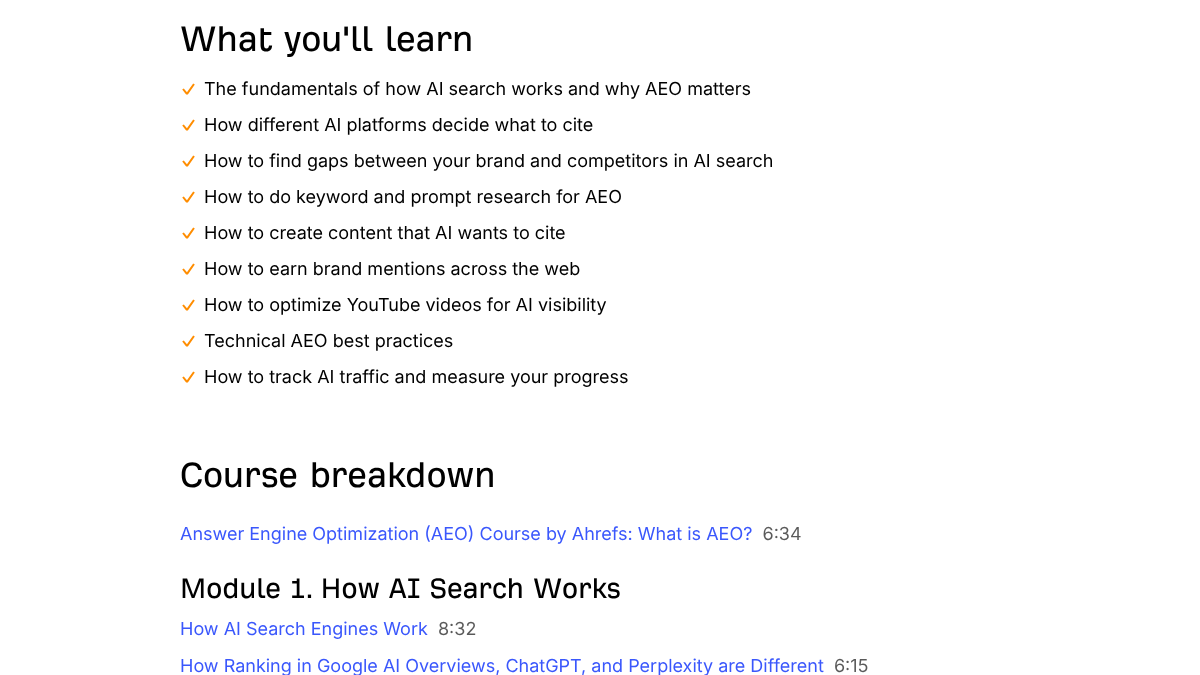
For most teams, start free. The Semrush and Ahrefs courses are short, current and cover the fundamentals well, as long as you remember they're also showing you their products. HubSpot Academy offers an AEO Fundamentals course with a certification too. Our free generative engine optimization course adds up the free lessons and turns them into a four-week plan.
Paid courses earn their price when they add live practice. A one-day workshop at $549 is worth it if the team leaves with a tested workflow and a list of questions to track, and not worth it if it repeats what the free videos cover. Ask for the agenda and check it against the checklist above. Whatever you choose, plan a refresher every six months, because the engines change faster than most course material does.
The other option is to learn by doing. Pick 20 buyer questions, run them on ChatGPT, Perplexity and Google a few times each, and study the pages that get cited. Our guide to checking ChatGPT citations is a good place to start, and our guide to using AI search queries to plan content shows how to turn what you find into content.
Learning it yourself or handing it off
A course gives your team the vocabulary. The work after it is steady: tracking questions, publishing the pages they point to and checking the results every week.
You can run that routine yourself. Or RankControl can run most of it. Our AI visibility tracking checks up to 50 buyer questions every week across seven AI engines and records every source each answer cited. Our content engine writes each article against the pages already ranking for its keyword, scores it for how easily AI engines can quote it, and publishes it on your own site. For a quick first look, run the free AI visibility check.

You're getting AI traffic. But do you know where it comes from?
RankControl credits every visit to the assistant that sent it: ChatGPT, Perplexity, Claude, Gemini, Copilot, or Grok. Full source attribution, next to your Google traffic.