Every GEO guide has a list of tactics. Most of those lists look alike, and very few say how anyone knows the tactics work.
So we lined up three kinds of evidence. One is what search professionals said worked for them, from the largest recent practitioner survey on the topic. One is what controlled studies measured. The third is what Google itself says about its AI features. Then we checked what the guides ranking for "GEO tactics" actually tell people to do.
The short version: the tactics marketers credit most are mostly old SEO fundamentals, and the research backs them. The two tactics that look most underused, original research and earned mentions, are the ones the studies keep pointing to.
The ranking at a glance
| Rank | Tactic | What marketers said | What the evidence says |
|---|---|---|---|
| 1 | Cover more of the questions buyers ask | Most-named win | Supported |
| 2 | Make pages crawlable and indexable | Second most-named | Required by Google |
| 3 | Make answers easy to find on the page | Third most-named | Partly supported |
| 4 | Earn third-party mentions (digital PR) | Few do it, most who do say it works | Strongly supported |
| 5 | Publish original data and expert input | Few do it, half say it works | Strongly supported |
| 6 | Strengthen brand and entity signals | Widely done, middling payoff | Mixed |
| 7 | Add more structured data | Widely done, weakest payoff of the big five | Not needed for AI, per Google |
The order puts the most-named fundamentals first, then moves the underused tactics up where the controlled evidence is strongest.
Where the data comes from
| Source | What it is | Sample | Date |
|---|---|---|---|
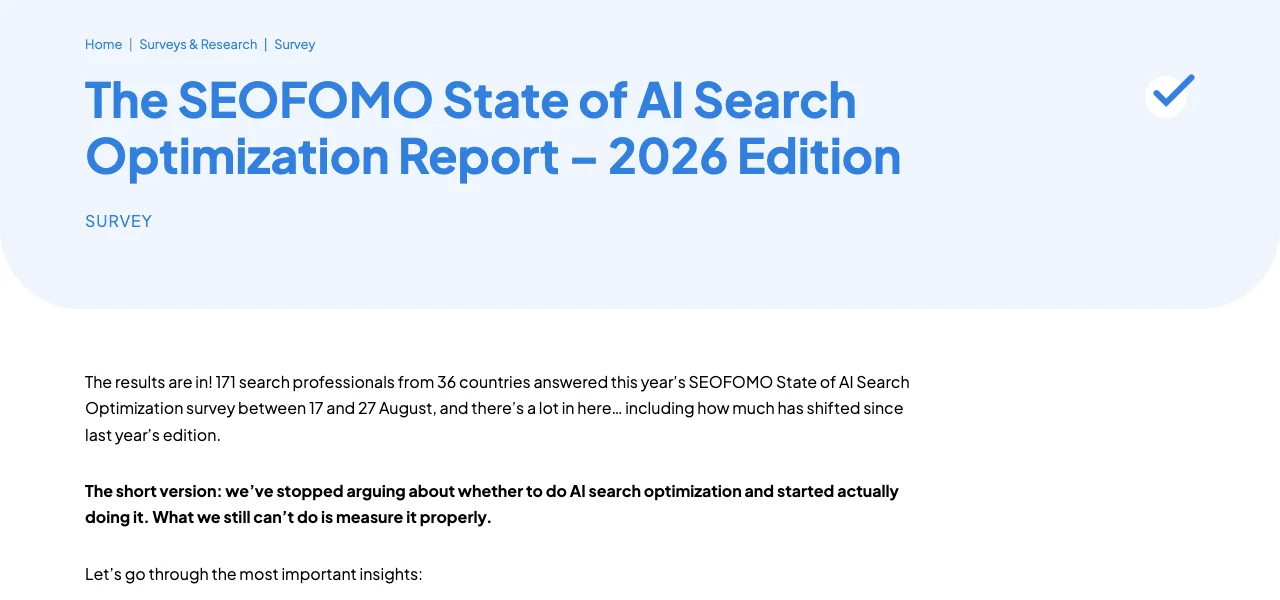
| SEOFOMO State of AI Search Optimization | Practitioner survey | 171 search professionals, 36 countries | Fielded Aug 17 to 27, 2026 |
| GEO: Generative Engine Optimization | Controlled study, KDD 2024 | 10,000-query benchmark | Nov 2023, revised June 2024 |
| Generative Engine Optimization: How to Dominate AI Search | Controlled study | Several verticals and languages | Sept 2025 |
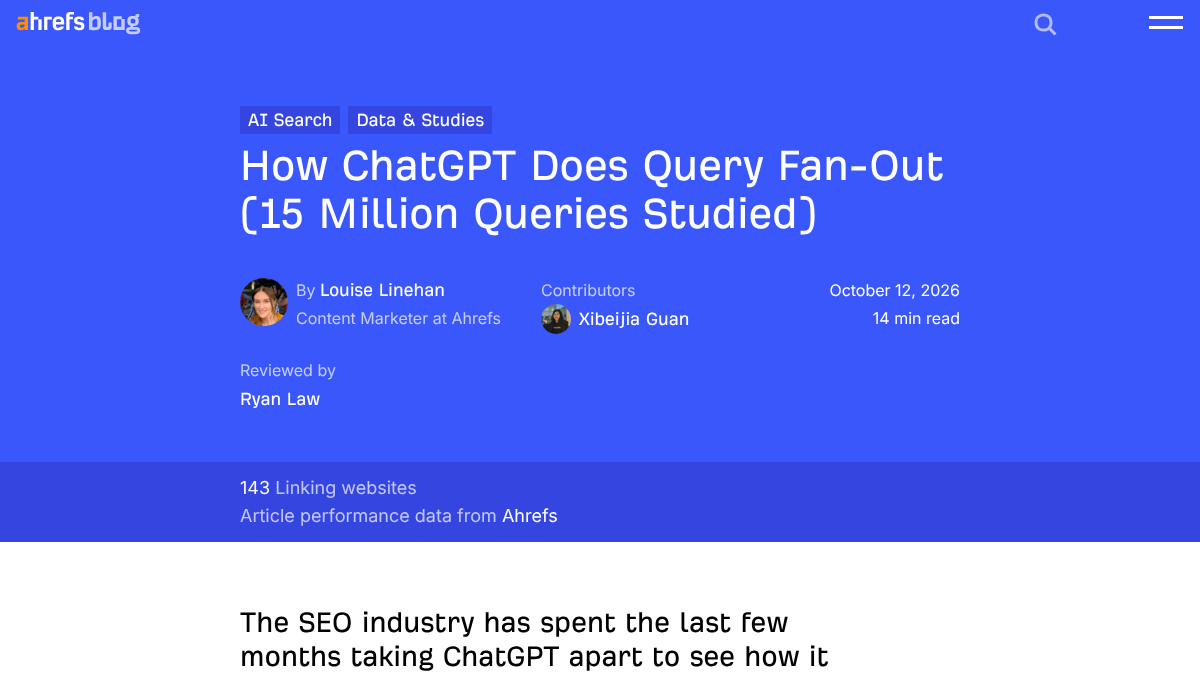
| Ahrefs query fan-out study | Log analysis | 66.6 million ChatGPT responses | Oct 12, 2026 |
| Google's guide to generative AI features | Official guidance | Not a study | May 15, 2026 |
| Our check of ranking guides | First-hand review | Top results for "geo tactics" | Oct 19, 2026 |
SEOFOMO is the newsletter run by SEO consultant Aleyda Solis. Its survey ran with support from several SEO and AI-visibility tool makers, which is worth keeping in mind, though the questions themselves are neutral.
What 171 search pros said worked
The survey asked two questions that matter here. First, which AI search activities respondents are doing. Second, which three of those have delivered the most meaningful positive impact so far.
Putting the two answers side by side tells you more than either one alone. A tactic that everyone does will collect impact votes simply because it's common. The more useful number is how many of the people doing a tactic picked it as a top-three win.
We call this the payoff ratio. It's the share of teams using a tactic who said it was one of their three biggest wins.
| Activity | Doing it (votes) | Named a top-3 win (votes) | Payoff ratio |
|---|---|---|---|
| Expanding content to cover more questions, topics and intents | 105 | 80 | 76% |
| Improving crawlability and access for AI platforms | 106 | 75 | 71% |
| Restructuring content so answers are easier to retrieve | 97 | 69 | 71% |
| Strengthening brand and entity signals | 96 | 45 | 47% |
| Implementing or expanding structured data | 90 | 38 | 42% |
| Earning third-party mentions through digital PR | 51 | 38 | 75% |
| Creating original research, data or expert content | 52 | 26 | 50% |
| Improving reviews and reputation on other sites | 27 | 15 | 56% |
| Increasing visibility on Reddit and forums | 19 | 7 | 37% |
| Increasing visibility through YouTube and video | 21 | 6 | 29% |
| Researching relevant prompts | 28 | 4 | 14% |
Source: SEOFOMO State of AI Search Optimization Report, 2026 edition. Payoff ratio is our calculation from the published vote counts.
Three things stand out.
The fundamentals win on both counts. Content coverage, crawlability and page structure are the three most common activities and the three most-named wins. Around seven in ten teams doing each said it paid off.
Digital PR has a payoff ratio as high as the top three, with half the uptake. Only 51 respondents were earning third-party mentions, but 38 of them named it a top-three win. That's the biggest gap between how few people do something and how well it works for them.
Structured data is common but pays off least among the big five. Ninety respondents were adding it, and 38 credited it. That fits what Google says, which we cover below.
In comments published with the results, SEO consultant Gianluca Fiorelli said the low uptake of third-party and community work was "quite surprising," given how much the industry talks about it. Fiorelli's point was that owning a topic on your own site is needed but not enough, because AI engines look to other sites to confirm it.
Fourteen respondents said none of their activities had delivered meaningful impact yet. That's a reminder that this is early work for many teams.
How often does ChatGPT mention your brand?
Most founders have no idea. The answer might surprise you.

What the controlled studies measured
Surveys tell you what people believe worked. Controlled studies change one thing and measure the result.
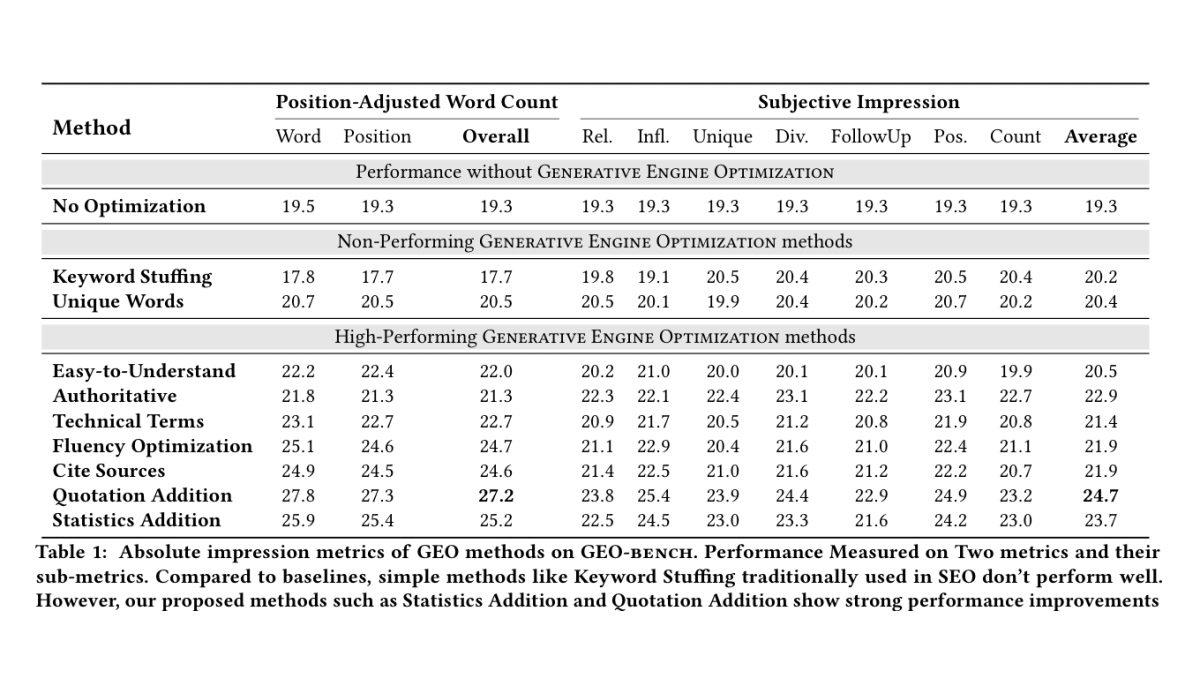
The best-known one is "GEO: Generative Engine Optimization," a paper by researchers from Princeton and other institutions, presented at the KDD 2024 conference. The team built a benchmark of 10,000 queries, rewrote source pages using different tactics, and measured how much of each page showed up in AI-generated answers.
| Tactic tested | Score | Change vs. no changes |
|---|---|---|
| Adding quotations | 27.2 | +41% |
| Adding statistics | 25.2 | +31% |
| Improving fluency | 24.7 | +28% |
| Citing sources | 24.6 | +27% |
| Adding technical terms | 22.7 | +18% |
| Making it easier to understand | 22.0 | +14% |
| Using an authoritative tone | 21.3 | +10% |
| Adding unique words | 20.5 | +6% |
| Keyword stuffing | 17.7 | −8% |
| No changes (baseline) | 19.3 | 0% |
Scores are the paper's position-adjusted word count, overall. Changes are our calculation against the 19.3 baseline.
The authors reported that GEO "can boost visibility by up to 40% in generative engine responses." Adding quotations, statistics and citations did the most. Keyword stuffing, the old SEO trick, made pages less visible.
There are limits. The tests ran on a research benchmark with an older model, then checked on Perplexity. Real engines in 2026 search differently. Treat the numbers as direction, not a promise.
A second study, by Chen, Wang, Chen and Koudas in September 2025, looked at where AI engines get their sources. It found "a systematic and overwhelming bias towards Earned media (third-party, authoritative sources) over Brand-owned and Social content," compared with Google's more balanced mix.
Log data points the same way. Ahrefs studied 66.6 million ChatGPT responses from August and September 2026 and reported that only 14.4% of them triggered a web search at all. When they did, 84.4% of factual questions about pricing, product features or company details cited at least one official source. Ahrefs found that sites summarizing other people's reporting were losing citations to "original research, hands-on testing, and your own product facts."
What Google says you can skip
Google published its own guide, "Optimizing your website for generative AI features on Google Search," on May 15, 2026. It's the closest thing to an official answer for Google's AI Overviews and AI Mode.
The baseline is ordinary SEO. "To be eligible to be shown in generative AI features on Google Search, a page must be indexed and eligible to be shown in Google Search with a snippet," the guide said.
It then lists a set of popular tactics you can ignore for Google Search.
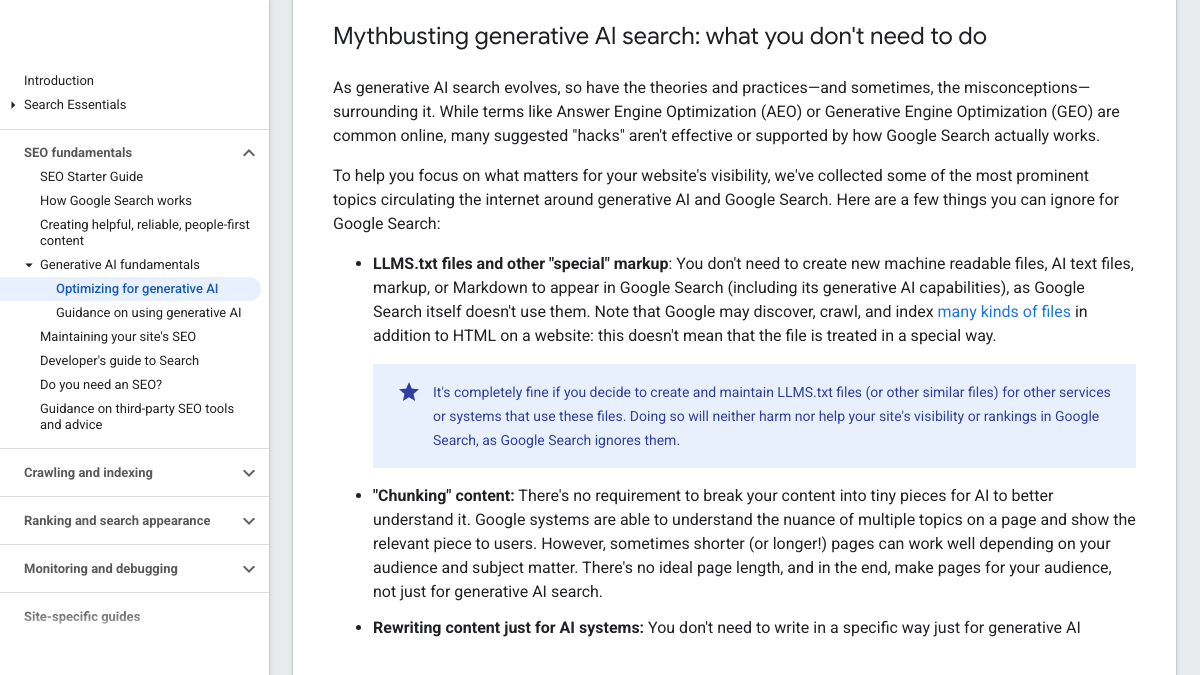
- llms.txt and special markup. Google said it doesn't use them, and that creating them "will neither harm nor help your site's visibility or rankings in Google Search."
- Chunking content. "There's no requirement to break your content into tiny pieces for AI to better understand it."
- Rewriting just for AI. "You don't need to write in a specific way just for generative AI search."
- Inauthentic mentions. Seeking them "isn't as helpful as it might seem."
- Overfocusing on structured data. "Structured data isn't required for generative AI search, and there's no special schema.org markup you need to add." Google still recommends it for rich results.
And what Google says matters most: "Creating content that people find unique, compelling, and useful will likely influence your website's presence in generative AI search in the long run more than any of the other suggestions in this guide." It gives first-hand reviews as an example of a unique view, against summaries that restate what's already out there.
This guide covers Google only. ChatGPT, Perplexity and Claude make their own choices. Our post on why Google says llms.txt won't help covers the other engines' side of that debate.
Where marketers and the evidence agree
Put the three sources together and most of the survey's top answers hold up.
Covering more questions. This was the most-named win, and it lines up with how AI answers find pages. They run searches and pull from what ranks. More pages answering more specific questions means more chances to be found. Google's guide says its AI features are "rooted in our core Search ranking and quality systems," so the same pages that rank are the ones in the pool.
Crawlability. Google requires it outright. A page that isn't indexed can't appear in AI Overviews. It's less a tactic than an entry ticket.
Clear, fluent writing. The Princeton paper found fluency and readability edits helped, by 28% and 14%. That supports the survey's third-place answer, restructuring content so answers are easy to find.
Avoiding keyword stuffing. The one tactic that measurably hurt in the Princeton study is also the one every guide warns against.
15 hours a week manually. Or 15 minutes with RankControl.
Track citations, monitor competitors, and fix content gaps across every AI search engine. Automatically.

Where they split
The bigger story is in the gaps.
Structured data gets more credit than the evidence gives it
It's the fifth most common activity, and its payoff ratio is the lowest of the top five. Google says there's no special markup for AI search. The Princeton study didn't test schema at all. Structured data still helps with rich results in classic search, so it's not wasted. But it isn't the AI lever many guides present it as. Our analysis of schema and AI citations goes deeper on what it does and doesn't do.
Restructuring helps, but chunking doesn't
The survey lumps "restructuring content" into one answer. The evidence splits it in two. Clear headings, a direct answer near the top and plain language all fit both the Princeton results and Google's advice. Breaking pages into tiny fragments for machines does not, according to Google.
Original research and quotes are underused
Adding statistics and quotations were the two strongest tactics in the Princeton study. Ahrefs' 2026 log data found original research winning citations away from summary pages. Google's guide asks for unique, first-hand content.
Yet only 52 of the survey's respondents were creating original research, data or expert content. That's fewer than a third. Our guide to statistics and data roundup posts covers how to build these pages.
Earned mentions are the clearest underused tactic
The Chen and Koudas study found AI engines lean hard toward third-party sources. Ahrefs' October 2026 study of branded searches tracked 100 large brands. Of the AI Overviews that cited an outside site, 71.9% cited Wikipedia, 38.6% YouTube and 22.8% LinkedIn. None of those are pages a brand writes itself.
The survey's digital PR numbers match. It's one of the least common activities, with one of the highest payoff ratios. Our post on off-page SEO in 2026 covers earning those mentions.
One caution. Google's guide warns that seeking inauthentic mentions isn't as helpful as it seems. The mentions that count are real coverage, reviews and recommendations, not paid placements.
What the ranking guides recommend
On October 19, 2026, we pulled the top Google results for "geo tactics" in the US and read each guide's list of tactics. Four of the top eight were full guides we could read. The others were a LinkedIn post, a Reddit thread and two pages that blocked our request.
| Tactic | Guides recommending it (of 4) |
|---|---|
| FAQ sections and schema markup | 4 |
| Author credentials, dates and other trust signals | 3 |
| Original data or proprietary insights | 2 |
| Adding expert quotations | 0 |
| llms.txt files | 0 |
The guides lean heavily on schema and FAQ markup, which Google says isn't needed for AI search. Only two of the four asked for original data. None of them suggested adding quotations, the single strongest tactic in the Princeton study.
We call the gap between what's recommended and what's been measured the advice lag. Guides repeat what was easy to explain in 2024, while the measured winners take more work to produce.
To be fair to the guides, none recommended llms.txt either, which suggests Google's May guidance landed.
What practitioners are saying
The same split shows up in practitioner threads. In r/aeo, a junior marketer who already had schema, FAQs and an llms.txt file in place asked what to do next.
Quick wins in AEO?
I am a junior digital marketer working for a company that has very little knowledge on AEO, I have been tasked by the boss to firstly Fix our SEO, this is not new to me so the SEO is no problem but I honestly dont have that much knowledge o...
One reply said those basics are table stakes. They help AI read a site, the commenter wrote, but they don't make AI recommend it. The bigger lever was independent mentions on other sites.
In another r/aeo thread asking whether AEO now matters more than traditional SEO, several commenters reached the same view. AEO sits on top of SEO, not in place of it, and crawlability and indexing still decide whether a page is seen at all.
Is AEO becoming more important than traditional SEO in 2026, and what strategies are actually working for better visibility in AI search results?
Why buyers make this worth doing
The tactics matter because buyers have moved. In Wynter's January 2026 survey of 101 B2B SaaS CMOs at companies with $50 million or more in revenue, 84% said they now use AI tools like ChatGPT, Claude and Perplexity for vendor discovery. That was up from 24% the year before. Wynter also found that 68% start their searches with AI tools before traditional search engines.
Marketers have noticed. In a Botify survey of 300 marketing leaders, run with research firm Centiment in December 2024, 52% said they'd moved from tracking rankings alone to measuring their presence in featured snippets, AI Overviews and AI answers. Botify sells technical SEO software, and that survey is nearly two years old, so read it as an early signal.
Our guide to AI visibility optimization covers tracking where you stand before you change anything.
The measurement problem
None of this is easy to prove yet, and the survey says so plainly.
| Finding | Share of respondents |
|---|---|
| Tracking AI visibility and citations | 92% |
| Some positive business impact | 51% |
| Significant positive impact | 5% |
| No measurable impact yet | 28% |
| Negative impact | 5% |
| Can't tell what AI search adds to revenue | 35% |
Reliably measuring AI visibility was the most-named challenge. Understanding what actually influences it tied for second.
That matters for reading the tactic ranking. People credit what they can see. Content changes show up in tracking tools within weeks. Earned mentions build slowly and are harder to tie to a single result. If anything, that would push the survey to undercount PR and research, which makes their high payoff ratios more striking.
A plan based on the evidence
If you're choosing where to spend your next few months, here's the order the evidence supports.
- Fix crawling and indexing first. It's a requirement, not an option. Check that key pages are indexed and can show a snippet.
- Publish pages for the specific questions buyers ask. One clear answer per page, near the top, in plain language.
- Put real numbers and named sources in every page. Your own data, customer results, expert quotes and citations to primary sources.
- Do one piece of original research a quarter. A survey, a dataset or a test that others will want to cite.
- Earn mentions on other sites. Reviews, roundups, podcasts, journalist requests and community answers that actually help.
- Keep structured data as SEO hygiene. Use it for rich results, not as your AI plan.
- Skip llms.txt, chunking and AI-only rewrites for Google. Google says they don't help there.
Our AEO best practices post covers the on-page side of this list in more detail.
What the data doesn't answer
A few gaps worth knowing before you act on any of this.
- The survey measures belief, not cause. Respondents named what they think worked. Nobody ran a control group.
- Vote counts aren't respondents. We don't know how many of the 171 answered each question, so the payoff ratio uses votes only.
- The Princeton benchmark is from 2023. Engines now search, rank and quote differently, and newer models may respond to different signals.
- Engines differ. Google's guide covers Google. ChatGPT, Perplexity and Claude each pick sources their own way.
- Correlation studies aren't experiments. The Ahrefs findings show patterns in what gets cited, not why.
Doing it yourself or handing it off
The evidence points to steady work: pages that answer real questions, carry real numbers, and get mentioned by other sites. None of it is quick, and the publishing side takes the most hours.
RankControl handles that part. We find the questions your buyers search, write each article against the pages already ranking for it, with its sources cited, and publish it to your site. Our outreach finds link prospects for each published article and drafts the emails from your own mailbox, and nothing goes out without your approval. Our AI visibility tracking checks up to 50 buyer questions every week across seven AI engines. Expect traffic from Google first, with AI citations following more slowly as links and mentions build up.
AI search traffic grew 835% this year. Is your content ready?
RankControl generates 26 content formats optimized for ChatGPT, Claude, and Perplexity. Published on your domain, matched to your brand.