
Most AI visibility tools answer one question. Does ChatGPT mention you? That's worth knowing. But it's the start of the work, not the end. When the answer is no, someone still has to figure out why and do something about it.
AI visibility optimization is that second part. This guide covers the kinds of gap you'll find, then sorts ten tools by what they do once a gap shows up. Prices come from each vendor's own page, checked on October 19, 2026. We haven't run every tool ourselves, so the facts come from vendor pages and docs.
The five kinds of gap
| Gap | What it looks like | What fixes it |
|---|---|---|
| Not mentioned | AI answers for your category don't name you | Mentions on third-party pages, plus content of your own |
| Mentioned, not cited | You're named, but your site isn't a source | A clear page that answers the question directly |
| Cited, wrong page | The answer cites an old or off-topic page of yours | Update or consolidate the right page |
| Outdated facts | The answer repeats old prices or features | Fix the facts on your site and listings |
| Competitor favored | Your page is cited, but a rival is recommended | Earn mentions and reviews where buyers look |
The second gap is common. Search Engine Land shared new UK and US data on X in October 2026. On average, fewer than half of the top 100 brands that ChatGPT, Gemini, AI Mode and AI Overviews mention also appear among their top 100 cited sources.
Being mentioned in AI answers isn't the same as being cited. On average, under half of the top 100 brands ChatGPT, Gemini, AI Mode and AI Overviews mention also make their top 100 sources. New UK + US data: https://t.co/mDgFHWHxok https://t.co/bKzhQ4igFL
 Search Engine Land@senginelandOct 15, 2026

Our guide to mention tracking vs citation tracking covers why you need to watch both.
15 hours a week manually. Or 15 minutes with RankControl.
Track citations, monitor competitors, and fix content gaps across every AI search engine. Automatically.

What we checked: the five-leg test
We call our yardstick the five-leg test. For each gap, a tool can do up to five things. It can track it, recommend a fix, write the content, publish it and reach out to other sites for mentions and links. We checked each vendor's pricing and product pages on October 19, 2026.
| Tool | Tracks | Recommends | Writes | Publishes | Outreach |
|---|---|---|---|---|---|
| Semrush AI Visibility Toolkit | Yes | Crawler audits | No | No | No |
| RankControl | Yes | Yes | Yes | Yes, native | Yes |
| Ahrefs Brand Radar | Yes | Not stated | No | No | No |
| Frase | Yes | Yes | Yes | Yes | No |
| Surfer | Yes | Yes | Yes | Through integrations | No |
| Profound | Yes | Yes | Drafting agents | Not shown | No |
| Peec AI | Yes | Yes | No | No | No |
| AthenaHQ | Yes | Yes | No | No | Link analysis only |
| Otterly.AI | Yes | Yes | No | No | No |
| Rankscale | Yes | Yes | No | No | No |
Tracking and tips are now the norm. Writing is rarer, publishing rarer still, and outreach was missing from every tool but one. That matches what we found earlier this month on branded and unbranded prompts: most of the gap sits on other sites, as in the Foundation Marketing and AirOps data, so a tool that stops at a report leaves the hardest part to you.
1. Semrush AI Visibility Toolkit
Semrush's toolkit benchmarks your brand's visibility and mentions in AI answers against competitors, discovers the prompts and topics in your space and tracks them daily. It also runs technical audits that flag when AI crawlers are blocked.
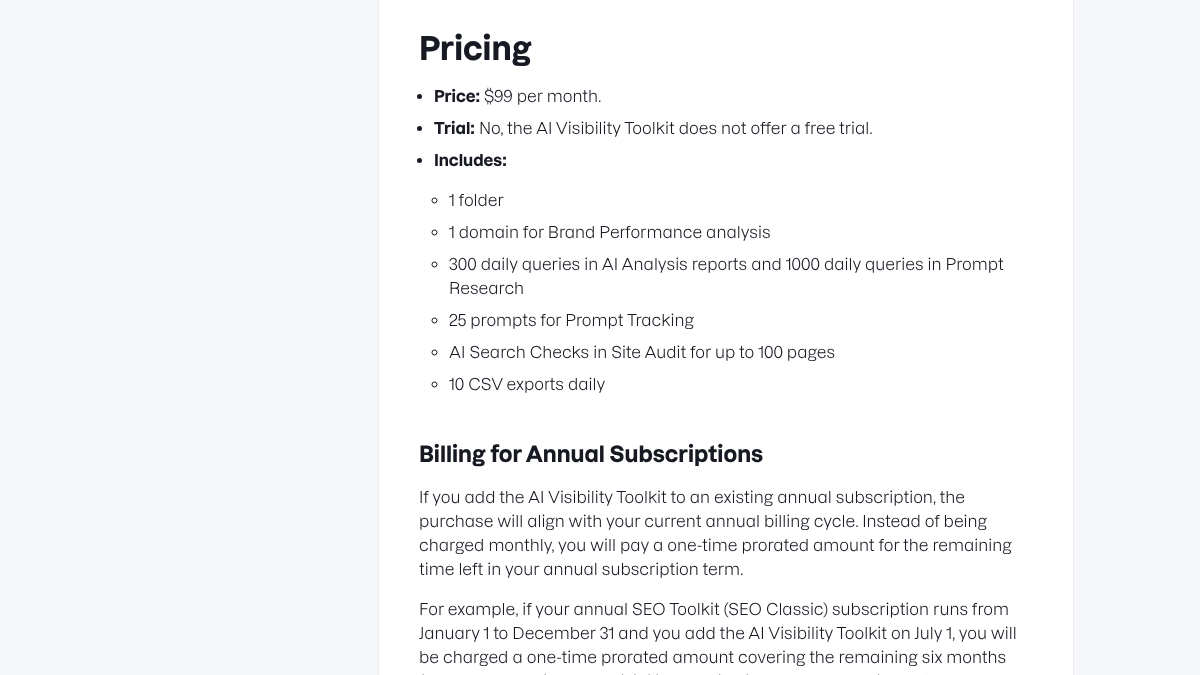
It costs $99/mo, alone or inside Semrush One, and Semrush says "the AI Visibility Toolkit does not currently offer a free trial."
It covers tracking for every gap type, and the technical side of "not cited" when crawlers are blocked.
You still handle the content, publishing and outreach.
2. RankControl
RankControl is built around the other four legs. We check up to 50 buyer questions every week across ChatGPT, Perplexity, Claude, Gemini, Grok, Google AI Mode and Google AI Overviews, and record which answers mention you, cite you and name competitors instead.
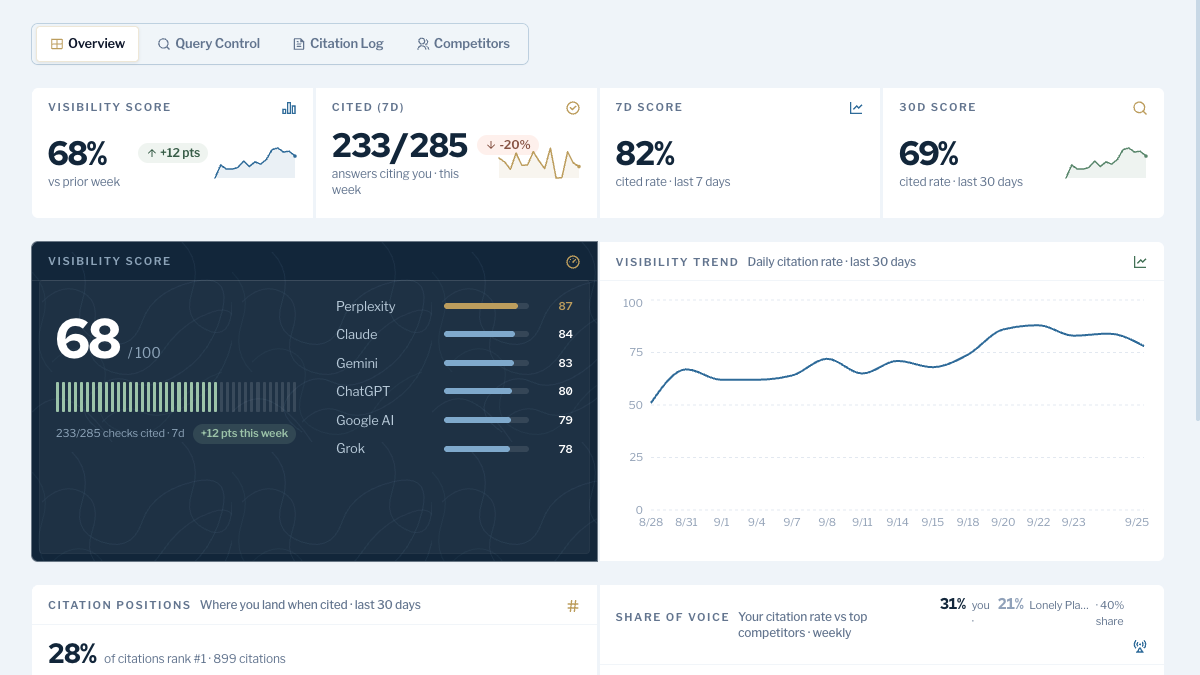
Then RankControl does the work. We find the questions your buyers search, write each article against the pages already ranking for it, scored for how easily AI engines can quote it, and publish it as a native post on your CMS, after your approval. Link Control finds link prospects for each published article and drafts outreach from your own mailbox, with nothing sent until you approve it.
RankControl costs $400/mo or $4,000/yr, with a 7-day trial, and covers up to 100 pages a month.
We work on "not mentioned" and "mentioned, not cited" through content and outreach, and on "competitor favored" through mentions built over time.
RankControl can't promise citations, though. Expect traffic from Google first, with AI citations following more slowly as links and mentions build up.
3. Ahrefs Brand Radar
Brand Radar tracks your brand's visibility across AI answers, YouTube and Reddit. Its AI index covers AI Overviews, AI Mode, Perplexity, Gemini, Copilot and ChatGPT, with Claude on the higher tier.
Custom prompt tracking comes free with paid Ahrefs plans, which include a few tracked prompts from Lite at $129/mo. The AI Visibility Index starts at $199/mo.
It covers tracking, with a lot of data to compare against.
You still handle recommendations, content and outreach. Ahrefs' link data does help with the outreach side if you do it yourself.
AI search traffic grew 835% this year. Is your content ready?
RankControl generates 26 content formats optimized for ChatGPT, Claude, and Perplexity. Published on your domain, matched to your brand.

4. Frase
Frase calls itself "the content operating system for AI search." It covers the most legs of any tool here after RankControl. It tracks where AI cites you, scores drafts for AI search, drafts with an agent and can publish. In its own words, the agent "publishes on its own when you let it" to WordPress, Webflow, Sanity or Wix, or to its own hosted FraseCMS.
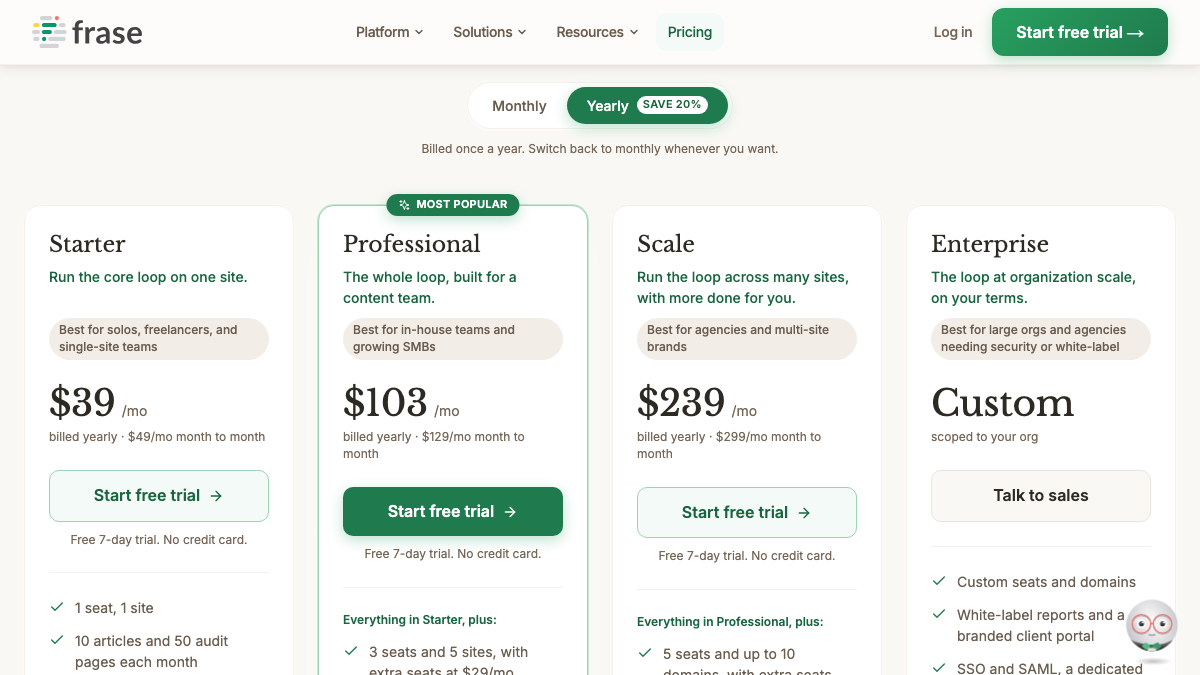
Plans cost $39, $103 or $239/mo billed yearly, with a 7-day free trial and no card.
You still handle outreach. Our comparison of Surfer, Frase and RankControl goes deeper.
5. Surfer
Surfer is a content editor first. It tracks how your brand appears in AI tools on its higher plans, gives AI SEO optimization guidelines and helps write and optimize drafts. Publishing works through integrations like WordPress, Google Docs and Contentful.
Plans start at $49/mo billed yearly, with a separate AI Search Analytics plan at $82/mo.
You still handle the writing itself, with help, plus publishing and outreach.
6. Profound
Profound is aimed at large brands. Its pricing page describes "a superintelligent teammate who knows your brand," with suggestions that "proactively" identify opportunities and agents for recurring marketing work.
There's a free 7-day trial covering ChatGPT, Gemini and Google AI Overviews, then custom enterprise pricing.
You still handle publishing and outreach, as far as its pages show. Our list of Profound alternatives covers other options.
7. Peec AI
Peec AI tracks your visibility and adds "recommended actions: ranked opportunities to improve AI visibility, grouped by earned and owned."
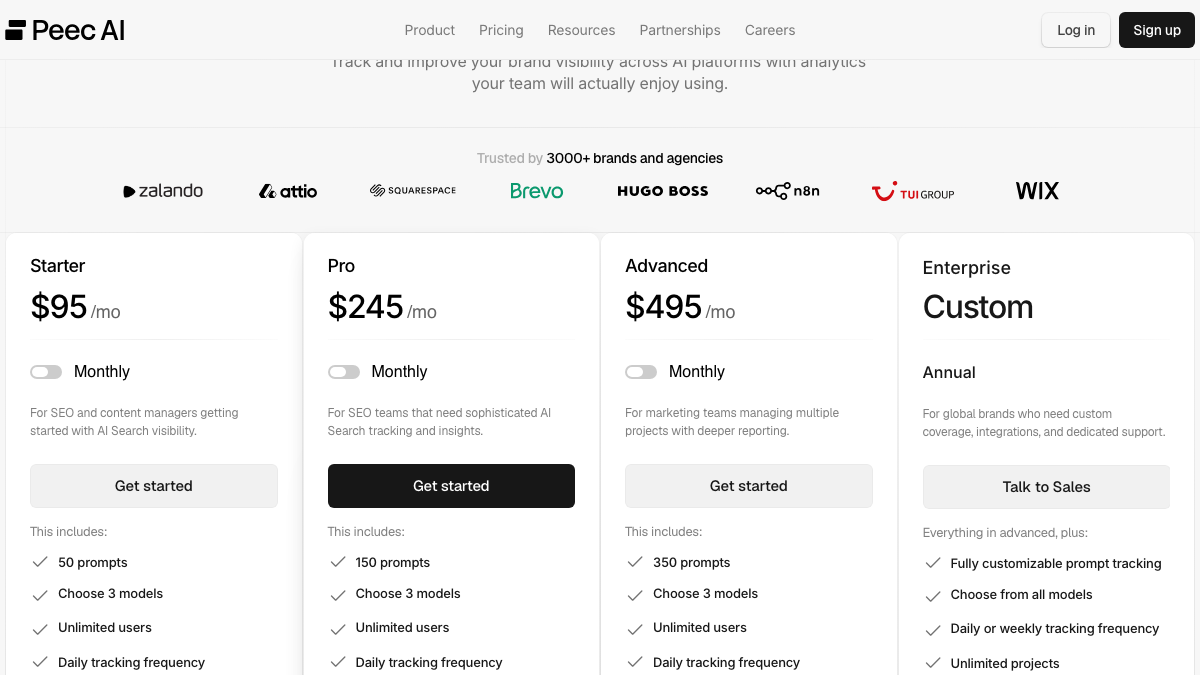
Plans cost $95, $245 or $495/mo, with enterprise pricing on request.
You still handle acting on the list.
8. AthenaHQ
AthenaHQ tracks a long list of engines, including ChatGPT, Perplexity, Google AI Overviews and AI Mode, Gemini, Claude, Copilot and Grok. It offers "automated content optimization recommendations" and citation source analysis.
There's a free tier with starter credits, then $295/mo for Starter.
You still handle writing, publishing and the outreach itself.
9. Otterly.AI
Otterly.AI is the cheapest way in. It tracks ChatGPT, Google AI Overviews, Perplexity and Copilot on every paid plan, with other engines as add-ons, and includes recommendations on all paid tiers.
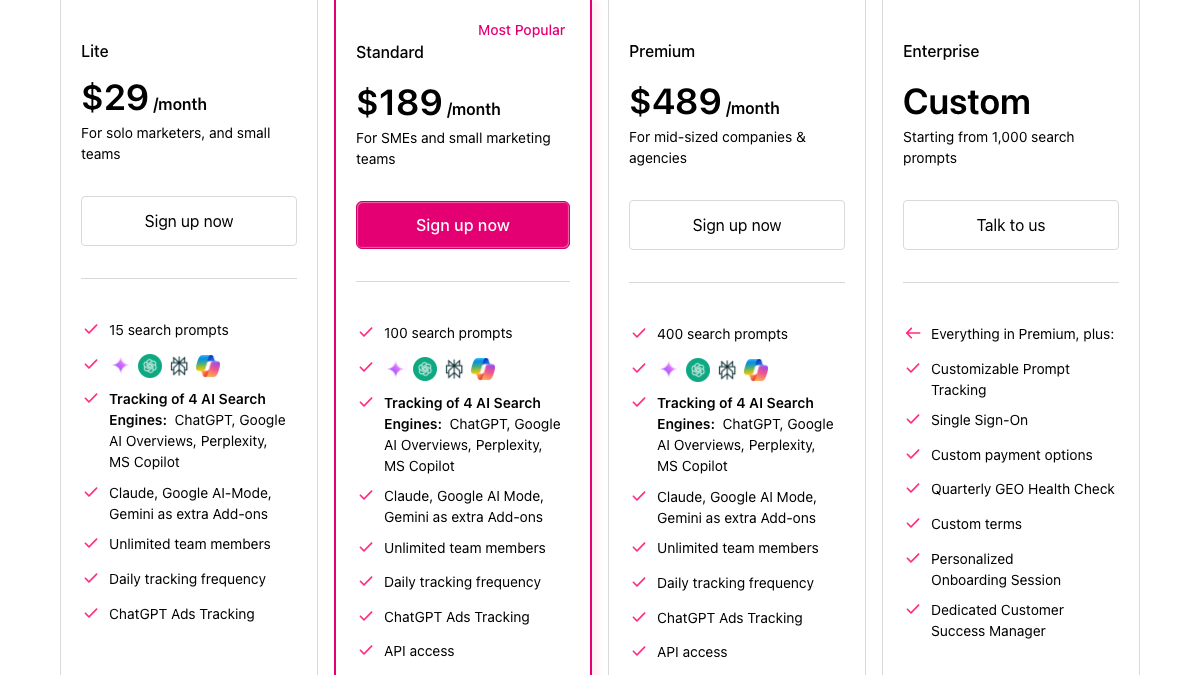
Plans cost $29, $189 or $489/mo. Our list of Otterly.AI alternatives compares it with others.
10. Rankscale
Rankscale runs on credits and tracks a wide range of engines, with "Rankscale Scout" suggestions to improve visibility.
Essentials costs $17/mo billed yearly, and Pro $99/mo with a 7-day trial. The top plan is $780/mo.
You still handle everything after the recommendation.
What the evidence says closes each gap
Tools aside, the research on what moves AI answers points mostly in one direction, toward other people's pages.
Not mentioned. Ahrefs studied 75,000 brands and found branded web mentions correlated with visibility in Google's AI Overviews at 0.664, about three times the 0.218 for backlinks. A Foundation Marketing and AirOps study of 57.2 million citations found about 90% came from third-party sources rather than brands' own sites. So being talked about elsewhere is the main lever.
Mentioned, not cited. Semrush's study with Kevin Indig found that in 61.7% of appearances, a domain was cited without being named in the answer, and the reverse gap is common too. A page that answers the exact question clearly near the top gives an engine something to cite.
Competitor favored. Lily Ray's 2026 study of 100 "best" queries found brands whose own lists were cited were left out of the recommendation 69% of the time. Recommendations follow reviews, comparisons and community talk more than a brand's own claims. Our analysis of self-promotional listicles and AI citations covers that data.
Outdated facts. Fix the source first. Update your pricing and product pages, then your listings and profiles, since AI answers often repeat whatever those pages say.
Cited, wrong page. Consolidate or update. If an old page keeps getting cited, redirect it to the current one or bring it up to date.
Only one of these five gets fixed by a dashboard. The rest need content, corrections or outreach, which is why the five-leg test matters more than how many engines a tool tracks.
Questions to ask any vendor
Before you buy, put these to the sales page or the demo.
- Which engines, on which plan? Several tools only cover a few engines on their cheaper tiers.
- How often are prompts checked? Daily, weekly, or on demand, and does the count include each engine separately?
- Do you show mentions and citations separately? They're different gaps with different fixes.
- What happens after the report? A list of suggestions, a draft, a published page or an outreach email.
- Who does the work? If the answer is your team, budget the hours as well as the subscription.
The fifth question is the one that decides the real cost. A cheap tracker plus ten hours a week of writing and outreach can cost more than a tool that does both.
How to choose
- To measure first, use Semrush's toolkit, or Ahrefs Brand Radar if you already use Ahrefs.
- For a to-do list, look at Peec AI, Otterly.AI or AthenaHQ.
- If you write in-house and want help, try Frase or Surfer.
- For a large brand with a team, Profound fits.
- To have the gaps fixed for you, pick RankControl. RankControl is the one tool here that also writes, publishes and drafts outreach for each gap found.
Whichever you pick, track more than one engine. Engines cite very different sources, so a single-engine check can hide a gap. Our list of AI visibility tools by engine coverage shows which tool tracks which engines.
Doing it yourself or handing it off
A tracker tells you where the gaps are. Closing them takes content, corrections, mentions and links, week after week.
For teams that want that work done as well as measured, RankControl tracks seven AI engines every week, writes and publishes the articles, and drafts the outreach, all on one plan. Expect traffic from Google first, with AI citations following more slowly as links and mentions build up.

Built by the team that got cited in 48 hours.
Content generation, backlink building, AI visibility tracking, and Google rankings. One platform, zero guesswork.