
Writesonic started as an AI writer and has spent 2026 turning into an AI visibility platform. Its pricing page now leads with tracking your brand across AI answers. The most interesting part of that pitch is a feature called the Action Center, which finds what's hurting your visibility and works on the fixes.
That puts Writesonic and RankControl after the same goal. Both track how AI engines answer questions about your category, and both write content to change those answers. The differences are in which engines you get on each plan, and how much of the fixing comes with the price you'd actually pay.
Everything about Writesonic below comes from its own pricing page, product pages and terms, which we checked on October 19, 2026. If you've already decided to move, our guide to switching from Writesonic covers exports and cancelling. If you're still shopping, our list of Writesonic alternatives covers seven options.
RankControl vs Writesonic at a glance
| Writesonic | RankControl | |
|---|---|---|
| Price | $79, $199 or $399/mo billed yearly; Enterprise on request | $400/mo, or $4,000/yr |
| AI engines | ChatGPT, Gemini and Google AI Overviews below Enterprise | ChatGPT, Perplexity, Claude, Gemini, Grok, Google AI Mode, Google AI Overviews on the one plan |
| Tracking | 50, 100 or 200 prompts, checked daily | Up to 50 questions, checked weekly |
| Articles | 15, 25 or 50 a month | Up to 100 pages a month |
| Fixing gaps | Action Center trial on Growth; full version on Enterprise | Writes and publishes articles aimed at the gaps, plus drafted outreach |
| Publishing | WordPress, Sanity, Contentful, Notion and more | Native posts on 9 destinations, including Shopify and Webflow |
| Trial | 7 days, no card | 7 days, card up front |
What Writesonic is in 2026
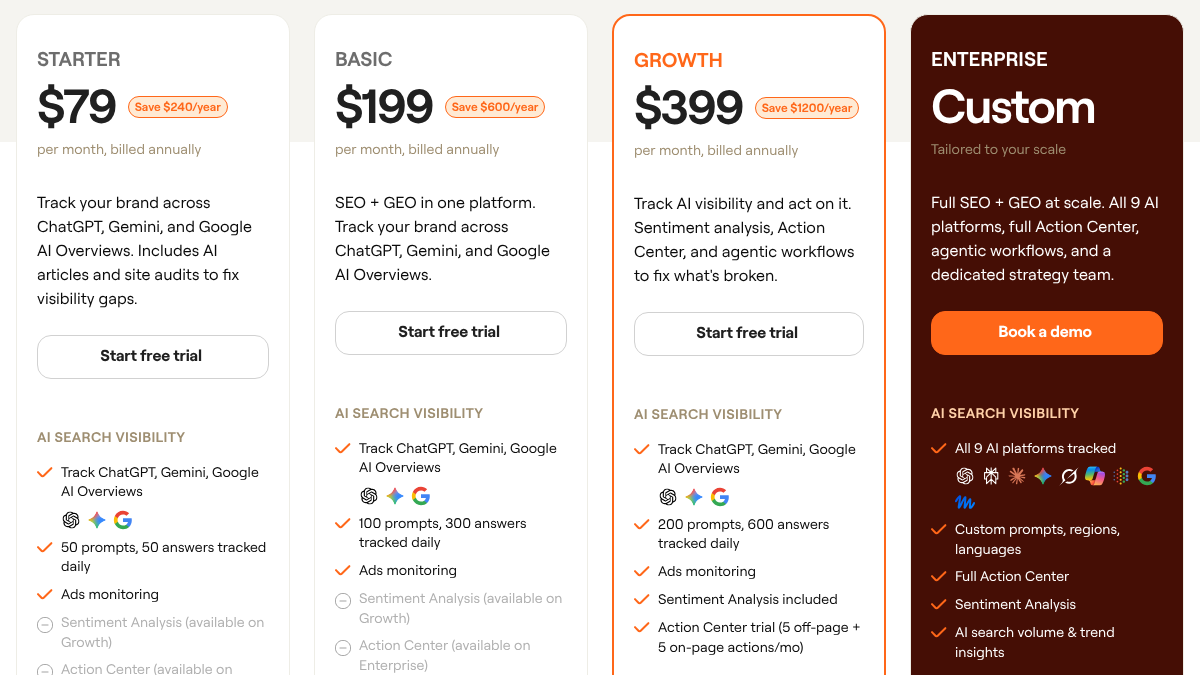
Writesonic sells three self-serve plans and an Enterprise tier. The pricing page defaults to yearly billing and shows each plan's yearly saving.
| Plan | Price, billed yearly | Prompts | Articles | Users |
|---|---|---|---|---|
| Starter | $79/mo | 50 | 15/mo | 1 |
| Basic | $199/mo | 100 | 25/mo | 2 |
| Growth | $399/mo | 200 | 50/mo | 3 |
| Enterprise | Custom | Custom | Custom | Custom |
Every plan includes site audits and AI articles. Starter covers 10 audits of up to 100 pages each, Basic 20 audits of up to 1,200 pages, and Growth 50 audits of up to 2,500 pages. Growth adds sentiment analysis and lets you buy 20 more articles for $100 a month. Extra users cost $50 a month each on Basic and Growth.
The engines you actually get
This is the biggest difference between the two, and it's easy to miss on Writesonic's pricing page.
Starter's card says it tracks "ChatGPT, Gemini, and Google AI Overviews." Basic and Growth list the same three. Only the Enterprise card says "All 9 AI platforms tracked," and its icons add Perplexity, Claude, Grok, Microsoft Copilot, Google AI Mode and a ninth platform called Muse Spark.
So on any plan you can buy without a sales call, Writesonic doesn't track Perplexity, Claude, Grok or Google AI Mode. If your buyers use those engines, a self-serve Writesonic plan won't show you what they see.
RankControl has one plan, and it tracks all seven engines it supports from the first week. Its AI visibility tracking checks up to 50 buyer questions every week. Each check records whether the answer mentioned you, cited you or both, and every source the answer used.
We call this the engine gap. It's the distance between the engines a tool can track and the engines your plan actually includes.
How often does ChatGPT mention your brand?
Most founders have no idea. The answer might surprise you.

Week one on each tool
Writesonic's first week starts with its trial, which needs no card. According to its pricing page FAQ, you get full access during those seven days. You add your brand and competitors, choose prompts to track, and the daily checks begin on ChatGPT, Gemini and AI Overviews. Site audits and AI article drafts are there from the start. Publishing to WordPress needs a connection, which every plan includes.
RankControl's first week follows a similar path, with more of the setup done for you. Brand Control reads your site and drafts your voice, products, buyers and competitors, and you correct whatever it got wrong. Then the planner turns your tracked questions into article titles on a calendar.
The first citation check runs across all seven engines while you're still setting up. So you get a baseline before the first article is written, and every later check shows whether the new pages are changing anything.
The Action Center, and who gets it
The Action Center is the newest part of Writesonic's pitch. Its product page headline is "Every AI visibility gap. Found and fixed." The page says its AI agents "find what's hurting your visibility, prioritize fixes by impact, run the work, and prove the lift."
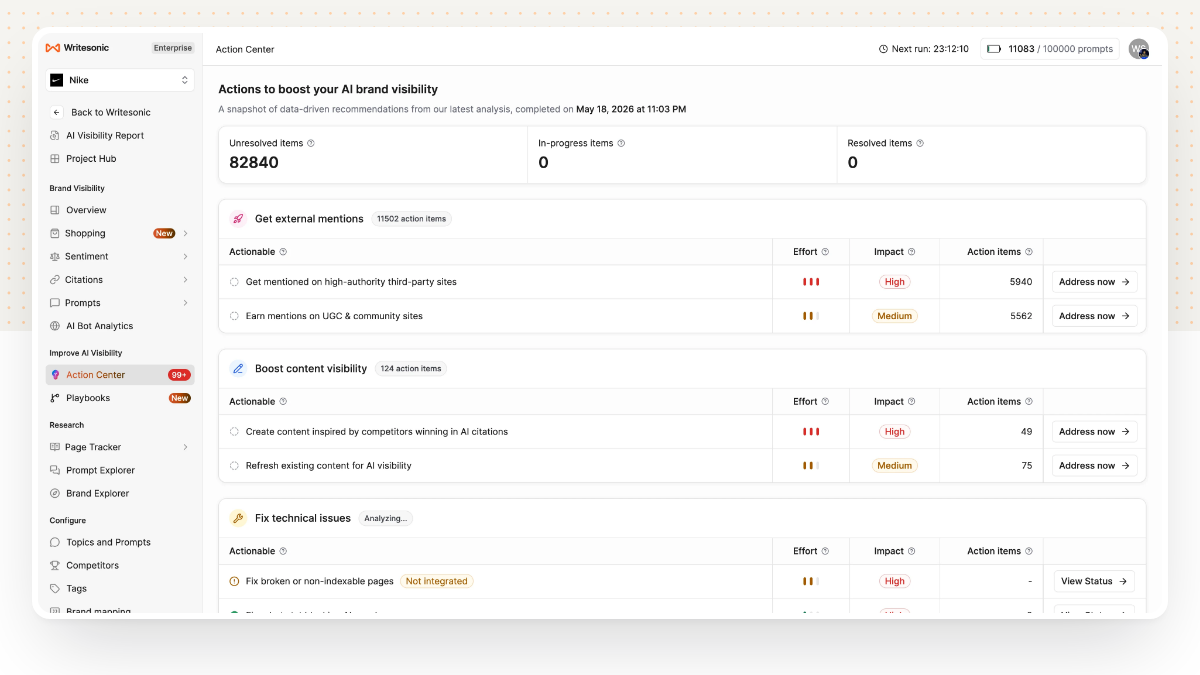
The dashboard on that page shows ranked actions, like getting mentioned on high-authority third-party sites and creating content inspired by competitors winning AI citations. That's the part of AI visibility work most teams struggle with.
The catch is who gets it. According to Writesonic's pricing page, the Action Center is "available on Enterprise" for Starter and Basic. Growth, at $399 a month, gets an "Action Center trial (5 off-page + 5 on-page actions/mo)." The full Action Center is Enterprise-only.
So at almost the same price, the two tools give you different things. Writesonic Growth gives you daily tracking of ChatGPT, Gemini and AI Overviews, plus ten actions a month. RankControl gives you weekly tracking on seven engines and up to 100 pages a month written against the gaps it finds.
Writing and publishing
Both tools write articles. Writesonic's plans include 15, 25 or 50 a month, and its pricing page says you can "push finished articles straight to your CMS." It lists WordPress, Sanity, Contentful, Notion and Google Docs, plus an open API and MCP. WordPress publishing is available on every plan, including Starter.
RankControl writes each article against the pages already ranking for its keyword, matched to your brand voice. It scores the draft for how easily AI engines can quote it, with a list of fixes. Then it publishes natively to WordPress, Webflow, Shopify, Ghost, Notion, Wix, Framer, webhooks and headless sites. Auto-publish is off by default, so you approve each article until you're ready to let it run.
Both also work with AI assistants. Writesonic lists an open API and MCP on its pricing page. RankControl includes an MCP server too, so you can plan, check and publish from Claude or ChatGPT if you'd rather work there.
The volume difference matters if content is your main lever. Writesonic Growth's 50 articles a month is half of RankControl's 100 pages, at about the same price.
Daily or weekly checks
Here's where Writesonic is genuinely stronger. Its plans check prompts daily, and Growth tracks up to 600 answers a day across 200 prompts. RankControl checks weekly. If you want to see day-to-day swings in a few engines, Writesonic shows more of them.
Whether you need daily data is a fair question, though. AI answers change from run to run, so a single day's result says little on its own. A thread on r/b2bmarketing asked whether AI visibility is useful or just a vanity metric. The replies leaned the same way. Raw mention counts felt like vanity, they said, while a fixed set of buyer questions tracked as a trend over weeks, with the cited sources behind each answer, showed whether a gap was about content or positioning.
Is AI visibility useful, or is it just another vanity metric?
I’m trying to understand how marketing and business leaders know whether their company appears in answers from ChatGPT, Gemini, or Perplexity. Right now, the process seems to involve trying dozens of prompts, copying results into a spreadsh...
History and reporting
Both tools keep a record of what AI engines said over time, which is what makes tracking useful.
Writesonic's daily checks build a dense history for the engines it tracks on your plan. According to its pricing grid, the GA4 and Looker Studio integrations are Enterprise-only, so connecting AI visibility to your own analytics needs that tier.
RankControl keeps every weekly check, with the sources each answer used. A new citation sends you a notification, and a lost one shows in the dashboard. Each Monday, an email brief lists new citations, ranking moves and visits from AI answers.
Links and outreach
Writesonic's Action Center includes outreach to sites that cite competitors, but that sits in the Enterprise version and the limited Growth trial.
RankControl's outreach finds prospects for each article it publishes, finds the right contact and drafts a personalized email from your own mailbox. If you'd rather not run outreach at all, the Managed Backlinks add-on places five links a month from DR 25+ sites for $350 a month.
15 hours a week manually. Or 15 minutes with RankControl.
Track citations, monitor competitors, and fix content gaps across every AI search engine. Automatically.

Pricing and what the difference buys
At the top of Writesonic's self-serve range, Growth costs $399 a month billed yearly. RankControl costs $400 a month, or $4,000 a year. So the real comparison is Growth against RankControl.
| Writesonic Growth | RankControl | |
|---|---|---|
| Price | $399/mo billed yearly | $400/mo, or $4,000/yr |
| Engines tracked | 3 | 7 |
| Checks | Daily, 200 prompts | Weekly, up to 50 questions |
| Articles | 50/mo | Up to 100 pages/mo |
| Fixing gaps | 10 Action Center actions/mo | Articles aimed at gaps, plus drafted outreach |
Below Growth, Writesonic's plans cost less but track the same ChatGPT, Gemini and AI Overviews set, with no Action Center at all. Once you want Perplexity, Claude, Grok or AI Mode tracked, Writesonic's answer is an Enterprise quote.
Trials, cancelling and refunds
| Writesonic | RankControl | |
|---|---|---|
| Trial | 7 days, no card | 7 days, card up front, $0 charged during the week |
| Changing plans | Upgrades right away; downgrades and cancellations at the next billing cycle | One plan |
| Refunds | Full refund within 7 days of first purchase, per its terms; Enterprise and agency plans not refundable | None for unused time |
| Data after leaving | Deleted 30 days after termination, per its terms | Your articles stay on your site |
Writesonic's trial is easier to start, since it doesn't ask for a card. The refund wording is worth reading twice. Its pricing page FAQ promises a "7-day, no-questions-asked refund," while its terms limit that to the first purchase and exclude Enterprise and agency plans. If you're about to pay, go by the terms.
RankControl doesn't refund unused time. Cancelling takes effect at the end of the paid period, and the articles it published stay on your site as ordinary posts.
RankControl vs Writesonic: which wins AI search visibility?
Writesonic is built around daily tracking of ChatGPT, Gemini and AI Overviews, with most of the fixing held back for Enterprise. RankControl is built around doing the work. It tracks all seven major engines on one plan, then writes and publishes up to 100 pages a month aimed at the gaps it finds.
At $400 a month, RankControl costs about the same as Writesonic Growth. Growth leaves out Perplexity, Claude, Grok and AI Mode, and limits the Action Center to ten actions a month. For a team that wants its AI search visibility to improve, and to see it measured along the way, RankControl is the better fit.
You can run AI visibility work yourself with any tracker and a writer. Or RankControl can track the questions, write and publish up to 100 pages a month aimed at the gaps, and draft the outreach, while you approve what goes live. Expect traffic from Google and AI search first, with citations following more slowly as other sites link to and mention you.
AI search traffic grew 835% this year. Is your content ready?
RankControl generates 26 content formats optimized for ChatGPT, Claude, and Perplexity. Published on your domain, matched to your brand.