Ask ChatGPT about your company by name, and there's a good chance it cites your website. Ask it for the best tools in your category, and there's a good chance it doesn't cite you at all, even if you're a strong option.
That gap is one of the most useful things to understand about AI search, because the two kinds of prompt do different jobs. Branded prompts come from people who already know you. Unbranded prompts are where new buyers find their options.
This post compares five dated studies on how often AI cites a brand's own site, split by branded and unbranded prompts where the data allows. It covers where the studies agree, where they disagree and why, how engines differ and what it means for your content.
The short answer, by source
| Source | Date | Sample | Finding |
|---|---|---|---|
| Foundation Marketing and AirOps | Updated July 30, 2026 | 50 brands, 57.2 million citations | Own site: 30.7% of citations on branded prompts, 2.24% on unbranded |
| LEOPRD | September 28, 2026 | 31,200 responses, 27 brands | On unbranded prompts, first choice 29% of the time; 86% of citations from outside own properties |
| Maverick Indonesia, via PRovoke Media | September 22, 2026 | 63,286 citations, beauty, Indonesian | 11.6% of citations from brand-owned channels |
| Yext | October 9, 2025 | 6.8 million citations | 86% from sources brands "can directly influence or manage," including listings |
| Semrush with Kevin Indig | June 9, 2026 | 3,981 domain appearances | 61.7% cited without being named in the answer |
Four of the five point the same way. The odd one out uses a much broader definition of "brand-controlled," which the section on disagreements explains.
Branded prompts: the home field
The clearest branded-versus-unbranded comparison comes from Foundation Marketing and AirOps. Over a 60-day period, they "evaluated 50 brands across seven verticals, covering 5.1 million responses and 57.2 million individual citations across five major AI platforms."
On branded prompts, brands did well on their own turf.
| Branded prompts | Result |
|---|---|
| Share of citations pointing to the brand's own site | 30.7% |
| Share of responses citing the brand's own site at least once | 77.6% |
So when someone asks about you by name, your site shows up as a source in roughly three answers out of four. That's the home field. Pricing pages, product pages and about pages do real work here.
Our post on whether ChatGPT answers from memory or live search covers why branded questions are more likely to trigger a search in the first place.
How often does ChatGPT mention your brand?
Most founders have no idea. The answer might surprise you.
Unbranded prompts: the away game
On category prompts, the picture flips.
| Unbranded prompts | Result |
|---|---|
| Share of citations pointing to the brand's own site | 2.24% |
| Share of responses citing the brand's own site at least once | 15.3% |
In the study's words: "In 85% of those responses, no brand-owned source was cited at all."
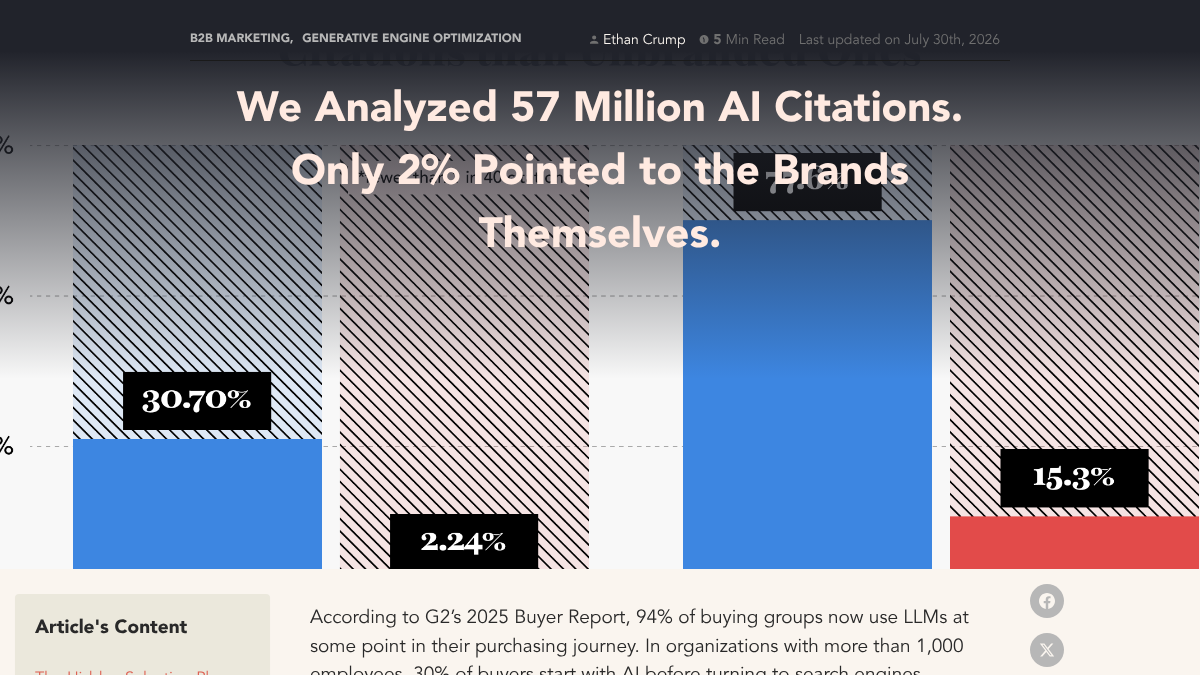
That's about a 14-to-1 gap, 30.7% against 2.24%, between how often your own site is cited when people name you and when they don't. Across all prompts together, only 10.15% of citations pointed to brand-owned domains. "The remaining 90% came from third-party sources, including review sites, Reddit threads, LinkedIn posts, YouTube videos, and competitor pages."
We call this the home-field gap. Brands win the questions about themselves and lose the questions about their category, which are the ones new buyers ask.
One caveat on the source. Foundation Marketing is an agency that sells content and earned-media work, and AirOps sells an AI content platform. A finding that owned sites barely register supports what both sell. But the sample is large, and the other studies point the same way.
Other studies, same direction
LEOPRD. This reputation agency's "Reputation to Revenue 2026" report analyzed 31,200 AI responses for 27 brands across seven categories. It found that "86% of citations came from outside brands' own properties, including editorial coverage, reviews, communities, comparison content, research and institutional sources."
On unbranded recommendation prompts specifically, the brands it tracked did poorly.
| On unbranded recommendation prompts | Share of answers |
|---|---|
| The brand was AI's first choice | 29% |
| Mentioned but passed over | 35% |
| Missing entirely | 36% |
So even being mentioned isn't winning. In more than a third of answers where a brand appeared, AI recommended someone else first.
The gap between showing up and being picked first varied a lot by industry.
| Category | Present in relevant answers | Picked first when present |
|---|---|---|
| Travel and transport | 90% | 28.1% |
| Fintech | 92.3% | 32.1% |
| B2B software | Not given | 67.8% |
| Energy and utilities | Not given | 92.9% |
Travel and fintech brands were almost always in the answer and usually not the answer. That's the unbranded problem in one row: being known is the floor, not the win.
In one case study, LEOPRD reported that 55% of citations about the workplace safety platform SafetyCulture came from commercial content, like comparison pages and competitor sites, against 10% from its own domains.
Maverick Indonesia. A study of beauty and personal care questions in Indonesian, reported by PRovoke Media on September 22, 2026, analyzed 8,000 answers and 63,286 citations. It found "just 11.6% of citations used by AI platforms to answer general beauty and personal care questions came from brand-owned channels," against 46.6% from news media and health sources combined. It's one industry and one language, so treat it as narrower evidence.
The study did include a branded slice. Of its 100 prompts, 20 named brands and 80 were general questions. It doesn't report citation rates for that split, but its breakdown by question type tells a similar story. On questions about whether a product works or suits someone, brand websites supplied 10.5% of citations against 45.5% from health and medical sources. On reputation and review questions, the brand-owned share fell to 7.6%. Brands did best on questions about beliefs and cultural fit, like halal status, and even there they reached only 21.3%.
15 hours a week manually. Or 15 minutes with RankControl.
Track citations, monitor competitors, and fix content gaps across every AI search engine. Automatically.

Where the studies disagree, and why
Yext's research seems to say the opposite. Its October 2025 study of 6.8 million citations found brands "can directly influence or manage the sources that account for approximately 86% of all consumer-facing citations."
The difference is the definition.
| Study | What counts as "brand" |
|---|---|
| Foundation Marketing and AirOps | The brand's own domain only |
| LEOPRD | The brand's own properties |
| Maverick Indonesia | Brand-owned channels |
| Yext | Brand websites plus listings, reviews and social it can manage |
Yext's 86% breaks down into first-party websites at 44%, listings at 42%, reviews and social at 8% and forums at 2%. Listings, like business directory profiles, are a big share of that. They're also what Yext sells, so the definition suits its product. Take the listings out, and Yext's own-site share, 44%, sits closer to the other studies, though still higher. Yext's sample is also more local and consumer-focused, covering retail, financial services, healthcare and food service.
Yext's press release also claimed that on unbranded objective queries, "first-party websites and local pages made up nearly 60% of citations," while branded queries leaned on listings and reviews. That's the reverse of the other studies. But Yext's full report says citations across query types were "mostly evenly distributed," and leaves the detailed breakdown for later reports. So that claim isn't backed by numbers we could check.
Engines treat sources differently
The engine matters too. LEOPRD found "ChatGPT was the most editorially oriented of the six platforms for which citation data was available, with editorial sources accounting for 25.3% of citations." Microsoft Copilot had the highest share of commercial sources at 35.8%, and "Gemini had the highest share of owned sources at 19.1%."
Maverick Indonesia saw similar spread. News media made up 53.1% of Copilot's citations and 37.3% of Perplexity's, against 9.5% for Google AI Overviews. ChatGPT drew 19.5% of its citations from brand-owned channels.
Yext found Gemini drew 52.15% of its citations from brand websites, while OpenAI's models drew 48.73% from listings.
Semrush's data, covered in more detail below, split the engines another way. ChatGPT cited a domain in 87% of appearances but named the brand in only 20.7%. Gemini cited in 21.4% and named the brand in 83.7%. So ChatGPT tends to use your page without saying your name, and Gemini tends to say your name without linking your page.
The numbers vary widely by study and sample. The consistent point is that no two engines weigh owned and third-party sources the same way. Our breakdown of citation data by engine goes deeper.
Cited isn't the same as named
There's a second gap inside the citations themselves. Semrush's "Ghost Citations" study with Kevin Indig, published June 9, 2026, looked at 3,981 domain appearances across 115 prompts. In 61.7% of cases, a domain was cited as a source without the brand being named in the answer.
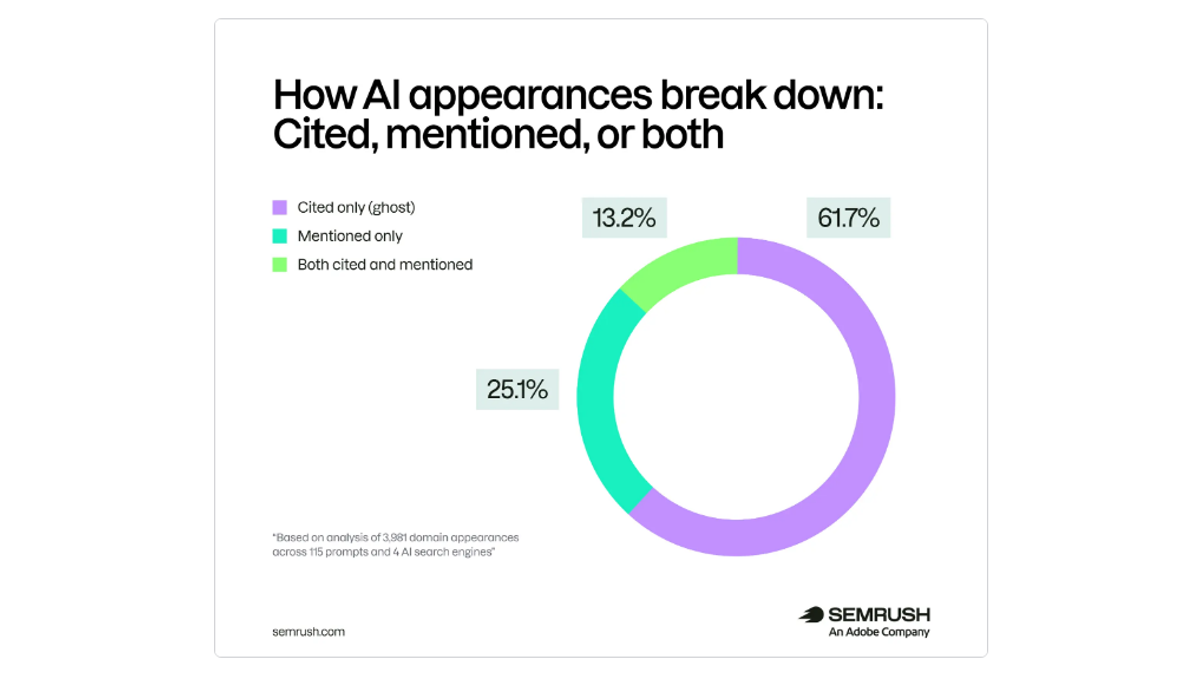
Kevin Indig put it this way: "The AI knows the information about the brand came from somewhere, but doesn't feel the need to explicitly say so to users."
Query type mattered here too. On informational queries, which skew unbranded, brands were mentioned 18% of the time. On commercial queries, 35.6%. On comparisons, 43.3%.
A comment on r/SaaS showed the worst version of this. In a thread about getting cited by ChatGPT, one commenter said ChatGPT had cited their article to recommend a competitor.
How to get cited by ChatGPT (official study by Ahrefs)
Only one important thing from this article: "Ultimately, the pages that get cited are the ones whose titles and content match the questions ChatGPT is asking behind the scenes, and that surface through the right retrieval channel" Here's ho...
Our guide to mention tracking vs citation tracking covers why you need to watch both.
Intent shifts the sources
Even within unbranded prompts, the kind of question changes who gets cited. Maverick Indonesia found reviews made up 11% of citations on shopping prompts, but 33% when people asked "red flag" questions about potential problems. Brand-owned sources rose from 2% to 9% on those questions too.
Freshness showed up as well. Of the citations with a publication date, 61.3% came from content published within the previous year.
The gray zone between branded and unbranded
Not every prompt sorts neatly. Here's how common prompt types usually fall, from your side.
| Prompt | Type, for you | Why |
|---|---|---|
| "What does [you] cost?" | Branded | Names you, asks a fact your site holds |
| "[You] vs [competitor]" | Branded, shared | Names you, but the answer leans on comparison pages |
| "Alternatives to [competitor]" | Unbranded | Names a rival, not you |
| "Best [category] for [audience]" | Unbranded | Names nobody |
| "Is [you] legit?" | Branded, reputation | Names you, but reviews tend to supply the answer |
The last row matters. A prompt can name you and still be answered mostly from other people's pages. Maverick's reputation questions fit this pattern, with brand-owned sources at 7.6%. So branded doesn't always mean home field. Facts about you, like price and features, come from your site. Opinions about you come from everyone else.
"Alternatives to [competitor]" prompts deserve their own list when you track. They're unbranded for you, they come from buyers who are already shopping, and they're exactly where a comparison page or a review mention can get you into the answer.
Our check: can AI even reach the pricing page?
If branded prompts are where your own site wins, the pages that answer them need to be reachable. On October 19, 2026, we checked the robots.txt files of 13 domains, mostly AI visibility vendors and the research sources above.
Ten had no rules naming AI crawlers, which usually means they're allowed. Two explicitly allowed them. One, yext.com, blocked GPTBot, ClaudeBot, PerplexityBot and CCBot on its plans pages. So a branded question about Yext's pricing can't be answered from Yext's own plans page, by Yext's own robots.txt.
That's one site in a small sample, not a trend. But it's worth checking your own. Your pricing page is exactly the page a branded prompt needs.
What it means for your content
Put together, the studies point to a split strategy.
- Own the branded questions. Make sure your pricing, product, about and comparison pages answer the questions people ask about you by name, clearly and near the top. Check that AI crawlers can reach them.
- Earn the unbranded ones. Category answers lean on third parties: reviews, comparisons, community threads and editorial coverage. Get mentioned there, accurately.
- Publish category content anyway. Your own articles on category questions still help you rank, and pages that rank are more likely to be retrieved. They just aren't enough on their own.
- Track both kinds of prompt. A dashboard full of branded prompts will look great and tell you little about growth.
Our post on brand mentions vs backlinks covers the earned side, and our analysis of how many sites never get cited covers why many sites never make it into the answer at all.
How to measure your own split
- Write ten branded prompts, like "what does [you] cost?" and "[you] vs [competitor]."
- Write ten unbranded prompts, like "best [category] for [audience]."
- Run each in ChatGPT, Perplexity, Gemini and Google's AI Mode.
- For each answer, note whether you're named, whether your site is cited and who's recommended first.
- Repeat weekly. LEOPRD found only 40% of repeated test groups gave the same recommendation every time, so one run isn't enough.
Expect a big gap between the two lists. That gap is your home-field gap, and closing it is the real work.
Mistakes that skew the numbers
- Tracking mostly branded prompts. It's tempting, because the results look good. But a list that's 80% branded will report a strong share while new buyers never hear your name.
- Counting mentions as wins. LEOPRD's data shows brands mentioned but passed over in 35% of unbranded answers. Note who gets recommended first, as well as whether you appear.
- Counting citations as mentions. Semrush found most cited domains weren't named in the answer. A citation to your page that recommends a competitor isn't a win either.
- Running each prompt once. Google AI Mode's recommendations changed in 28% of LEOPRD's observations even when the sources stayed the same. Look at the trend over weeks.
- Mixing engines into one number. The engines weigh owned and third-party sources differently, so a blended score can hide a strong engine and a weak one.
Doing it yourself or handing it off
Tracking twenty prompts across four engines every week is a couple of hours. Closing the gap takes longer.
RankControl does both. Our AI visibility tracking checks up to 50 buyer questions every week across seven AI engines and records whether each answer mentions you, cites your site and which competitors it names instead. We write and publish articles that answer the category questions, and draft outreach for links and mentions from your own mailbox. Expect traffic from Google first, with AI citations following more slowly as links and mentions build up.
AI search traffic grew 835% this year. Is your content ready?
RankControl generates 26 content formats optimized for ChatGPT, Claude, and Perplexity. Published on your domain, matched to your brand.