A content marketer posted in r/seogaps in September that listicles are the sneakiest way to grow AI visibility. They're cheap to make and engines cite them, but you have to include your competitors for the list to be credible. One reply noted that the AI then takes your list and recommends your competitors anyway.
Listicles are the most sneaky and controversial method to grow AI visibility
From one side, it's cheap in execution, because you don't need a lot of unique data to make it good enough for indexing and citation. From other side, you have to add your competitors to make the listicle complete, and this decrease the val...
Listicles get most of the attention in this debate, and the big studies do put them on top. But depending on which study you read, they're either a fifth of AI citations or two thirds. Here's what the large studies found, what our own October sample showed, and why the question someone asks matters more than the format you pick.
AI citations by page type, at a glance
| Source | Sample | Listicles | Other leading types |
|---|---|---|---|
| Wix Studio AI Search Lab, March 2026 | 1,056,727 citations, ChatGPT, AI Mode, Perplexity | 21.9% | Articles 16.7%, product pages 13.7% |
| Otterly, October 2026 | 617,985 citations, 7 engines, September data | 66.6% | Comparisons 7.9% |
| Orbit Media, August 2026 | 13,184 citations, 4 engines | Not split by format | ChatGPT leaned on docs and pricing pages |
| Our pooled sample, October 2026 | 744 citations, ChatGPT and AI Mode | 19.9% | Product and category pages 18.7%, homepages 14.2% |
Every study agrees listicles are the single biggest type. They disagree, by a factor of three, on how big. That gap is the most useful thing here, because it tells you what really drives citations.
Why the studies disagree
The prompts decide the answer. Otterly says so plainly in its own report. Of the 400 prompts behind four of its five industry reports, 295 used words like "best," "top" or "cheapest." When the question asked for a ranking, 73.2% of cited pages were listicles.
When Otterly's question compared two things head to head, comparison pages took 62.3% instead. For open questions like "where can I learn to code for free," listicles fell to 55.2% and how-to guides rose from 3.6% to 11%.
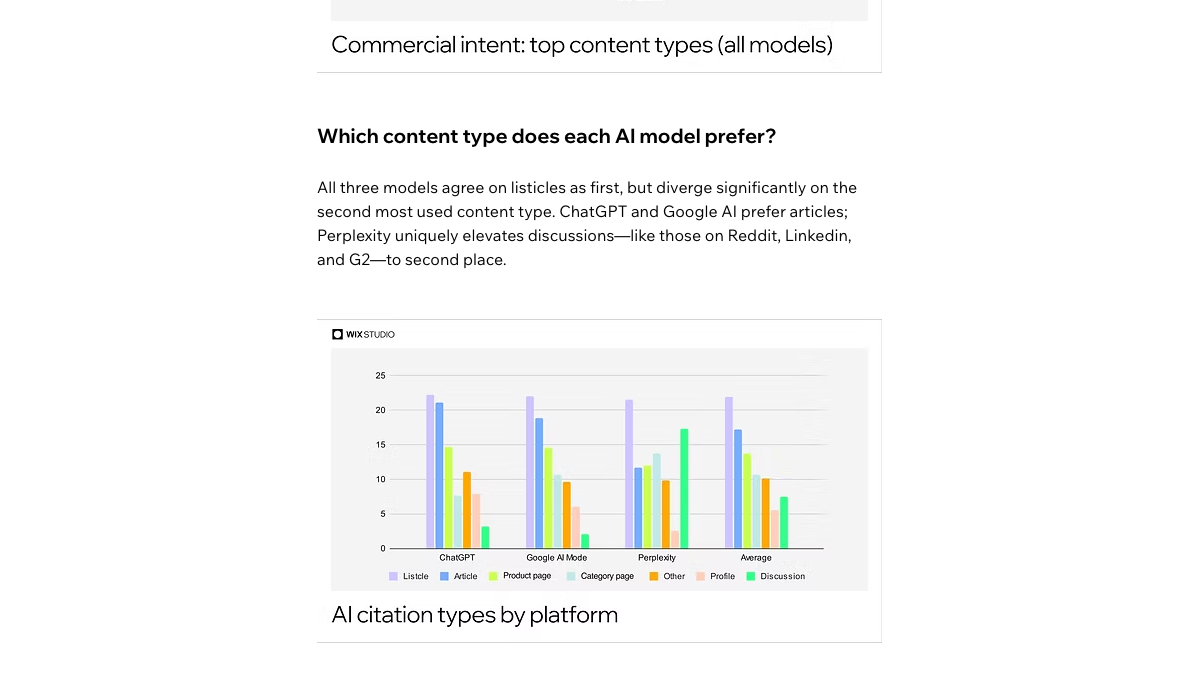
Wix Studio's study split by intent from the start. Listicles took 40.9% of citations for commercial questions, like "best smartphones under $500," but articles took 45.5% of informational ones. For local and transactional questions, product and category pages took the most.
We'd call this the prompt-mix effect. A study's headline number mostly reflects which questions it chose. Ask buying questions and you get a listicle-heavy result. Ask how-to and local questions and listicles shrink.
One thing to know about both studies is that the authors sell AI visibility tools. The Wix study's author works at Peec AI, where the data came from, and Otterly runs its own tracking product. That doesn't make the numbers wrong, but their prompts look like the ones their customers track, which skew toward buying questions.
Your competitors are getting cited by AI. You're not.
Every day without citation tracking is a day your competitors pull ahead in ChatGPT, Perplexity, and Claude.
Our October sample
Through October 2026 we ran six sets of questions through ChatGPT's web app and Google AI Mode for studies on this blog, via a data provider's live feed. They covered software buying, shopping, local services, statistics, small-business how-tos and a mixed set of everyday keywords. That's 135 questions and 744 cited pages.
We sorted every cited page by type, using its address and title. A spot check of 40 random pages found about 9 in 10 labeled the way a person would label them.
| Page type | Citations | Share |
|---|---|---|
| Listicle or best-of page | 148 | 19.9% |
| Product or category page | 139 | 18.7% |
| Homepage | 106 | 14.2% |
| Government or official page | 66 | 8.9% |
| Statistics or research page | 64 | 8.6% |
| Pricing page | 44 | 5.9% |
| Review site or directory listing | 37 | 5.0% |
| Docs or help page | 32 | 4.3% |
| Head-to-head comparison | 23 | 3.1% |
| Blog article or news story | 35 | 4.7% |
| Reddit, YouTube or other forum | 17 | 2.3% |
| How-to guide | 14 | 1.9% |
| Other | 19 | 2.6% |
Listicles still came first, at about the Wix level. But over 40% of all citations went to pages a business owns about itself, its homepage, product pages, pricing and docs. That fits what we found when we tested which pages AI cites for B2B SaaS buyers, where three in four citations sat on software companies' own sites.
The question decides the winner
Split by the kind of question, the winner changed every time. Many how-to questions never triggered a search, so the table counts every question asked, including the ones that produced no citations.
| Question type | Questions | Top page type | Its share |
|---|---|---|---|
| Shopping, like "best air fryer" | 26 | Listicle | 40% |
| Software buying, like "is Vanta worth it" | 24 | Pricing page | 18% |
| Software best-of keywords, like "help desk software" | 10 | Homepage | 39% |
| Brand questions, like "hubspot pricing" | 8 | Homepage | 25% |
| Local services, like "plumber in Austin" | 12 | Review site or directory | 28% |
| Statistics, like "average email open rate" | 20 | Statistics or research page | 52% |
| Small-business how-to, like "what is form I-9" | 35 | Government page | 78% |
Shopping questions looked most like the big studies, with listicles at 40% and product pages close behind at 38%. Software buying questions spread their citations widely, across pricing pages, listicles, homepages and docs. Statistics questions went to the page that published the number, and local questions went to Yelp-style directories and lists of local businesses.
That's why one format answer doesn't work. A software company that only writes listicles misses the pricing, docs and homepage citations that made up nearly half of all citations for software buying questions. Our AEO content playbook maps each question type to the page to publish.
Did ChatGPT really move away from listicles?
Earlier this year, a lot of people noticed ChatGPT citing fewer best-of lists after its GPT-5.6 update. Our posts on why AI search cites fewer listicles and on formats cited after ChatGPT 5.6 tracked that shift on B2B buying questions, where pricing pages, product pages and docs took over.
Our October sample shows the shift depends on the question. For software buying questions, listicles were 18% of ChatGPT's citations, behind homepages and pricing pages. For shopping questions, listicles were 37% of ChatGPT's citations, second only to product pages. For local questions, they were 33%, its top type.
So ChatGPT still uses listicles, mostly where the buyer is choosing between physical products or local businesses. For software, it now goes to the vendors' own pages more often than to the lists about them.
Industry matters less than the question
Wix Studio also split its data across five industries, and its author's verdict was that the type of question predicted the cited format better than the industry or the AI engine did. Within that, software showed the strongest lean toward listicles, health and wellness flipped toward articles, and home repair spread its citations most evenly across page types.
That matches the pattern in our sample. A health question that asks "what is" gets an article or a government page. A health product question that asks "best" gets a list. Plan by question first, and use your industry to break ties.
ChatGPT and AI Mode cite different kinds of pages
The two engines in our sample had different habits, and they line up with what other studies found.
| Page type | ChatGPT, 606 citations | Google AI Mode, 138 citations |
|---|---|---|
| Listicle | 20.6% | 16.7% |
| Product or category page | 20.3% | 11.6% |
| Homepage | 17.5% | 0% |
| Government or official page | 10.9% | 0% |
| Pricing page | 6.4% | 3.6% |
| Statistics or research page | 5.0% | 24.6% |
| Reddit, YouTube or forum | 0.5% | 10.1% |
| How-to guide or article | 2.5% | 13.0% |
ChatGPT went to the source. Homepages, product pages, pricing pages and government pages made up more than half its citations. Orbit Media's study found the same habit, with ChatGPT leaning on primary sources like vendors' pricing and help pages.
AI Mode reached for content pages, statistics roundups, articles and forum threads. Otterly found that forums and video made up about a quarter of citations in Google's AI Overviews and AI Mode, and under 3% everywhere else. Our sample was smaller and heavy on statistics questions for AI Mode, so treat its column as a direction, not a precise share.
200+ SaaS teams already track their AI citations.
They know exactly when ChatGPT mentions their brand, and when it stops. Do you?
What the other engines prefer
Our sample only covered ChatGPT and AI Mode, so for the rest we lean on Orbit Media's study. Bill Widmer tracked 72 prompts weekly across ChatGPT, Claude, Gemini and Perplexity through August 2026 and logged 13,184 citations.
Each engine had its own habits. Perplexity cited the most, about 19 sources per answer, and its favorite sites were LinkedIn, YouTube and Reddit. Gemini averaged about 8 and leaned on Reddit and roundups. Claude averaged under 4 and liked review sites and curated listicles, with Clutch as its most-cited third-party site. ChatGPT averaged 4.5 and went to primary sources.
The engines also rarely agreed. Across 1,792 pairs of question and site, all four cited the same site for the same question just 30 times, under 2%. A page type that wins on one engine can be invisible on the next, which is why it's worth checking each engine your buyers use.
Who writes the listicles that get cited
Listicles lead, but whose? Wix Studio checked the 1,000 most-cited professional services pages and found 80.9% of listicle citations went to third-party lists, against 19.1% to self-promotional ones. Otterly found brands published 35.6% of the listicles in its study.
Our own software test found rivals' lists everywhere. When we asked ChatGPT for Gong alternatives, it cited alternatives articles written by three companies that sell against Gong, and one of them made the shortlist. Our post on self-promotional listicles covers where that line sits.
The practical point is that you can't control most of the lists that cite your category. You can write one honest list on your own site and work to get onto the lists others publish.
Why how-to guides barely show up
How-to guides were under 2% of our citations, which surprises people who write a lot of them. The reason is that ChatGPT often doesn't search for how-to questions at all.
Our study of how often ChatGPT searches the web found it searched for only 21% of everyday how-to questions. It answers "how long to boil an egg" from what it already knows, so no page gets cited. When a how-to question does trigger a search, it's usually because the answer depends on rules or current facts.
Our small-business questions show what happens then. For questions like "how to classify employees vs contractors" or "what labor law posters do I need," 78% of ChatGPT's citations went to government pages, including the IRS, the Department of Labor and state labor sites. A business blog was rarely in the running.
So how-to content still matters, but for Google traffic and for training data more than for citations. Write it for readers and rankings, and don't measure it by citations.
Why product pages and homepages win more than you'd think
Product and category pages, homepages and pricing pages together made up 39% of our sample. That's the part of AI citation that a business controls completely.
A store owner in r/aeo made a sharp point about this. In their experience, product pages rarely get cited for their marketing copy. What gets pulled in is the spec table, the comparison table or a straight answer to a specific question.
What's actually getting your product pages cited by AI search?
I've been tracking how AI tools cite ecommerce sites for a couple years now, and one thing keeps standing out. Product pages almost never get cited for their marketing copy. When a page does get pulled into an answer, it's usually the specs...
That matched our shopping test, where 23 of ChatGPT's 27 product cards showed a price. Our explainer on agentic commerce covers how shopping answers pick those pages.
What to publish, by question type
Here's how we'd translate all of this into a content plan.
| If your buyers ask | Make sure you have |
|---|---|
| "Best X for Y" | A place on third-party lists, plus one honest list of your own |
| "X vs Y" | A fair comparison page on your site |
| "How much does X cost" | A pricing page with prices in plain text |
| "Does X do Y" or "how do I set up X" | Docs and help pages that answer it directly |
| "What percentage of" or "average X" | Original data with the number in the first lines |
| "X near me" or "X in [city]" | A complete Google profile and matching directory listings |
| "How do I do X" | A clear guide for Google, without expecting AI citations |
Our test of curated vs original content found ChatGPT favored the original source for statistics questions and AI Mode favored roundups, so a stats page may need both.
Limits of these numbers
Our sample is small next to the big studies and comes from questions we wrote for other studies, so the mix of question types isn't random. We labeled pages by their address and title, which works for most pages and misses some. Google AI Mode's column rests on 138 citations, and 56 of them came from statistics questions.
The two large studies sell tracking tools and built prompt sets like their customers', which leaned toward buying questions. All the numbers here describe citations, not clicks or sales, and an engine can change its habits with a model update.
What tracking this takes by hand
Here's a rough monthly budget for checking which page types win your buyers' questions, by our estimate.
| Task | Hours a month |
|---|---|
| Running buyer questions in ChatGPT and AI Mode | 3 to 5 |
| Sorting cited pages by type | 2 to 4 |
| Matching page types to your own pages | 1 to 2 |
| Writing or fixing one page per question type | 6 to 10 |
| Total | 12 to 21 |
Doing it by hand or with help
You can run these checks yourself. Or RankControl can take on the steady part. Its AI visibility tracking checks 50 of your buyer questions every week on ChatGPT, Perplexity, Claude, Gemini, Grok, Google AI Mode and Google AI Overviews and shows which sources each answer cited, and its content engine writes the comparison pages, guides and listicles your plan calls for and publishes them once you approve.
How often does ChatGPT mention your brand?
Most founders have no idea. The answer might surprise you.