
A broker with twelve years in business posted a close call in r/InsuranceAgent in March. A client of almost six years had asked ChatGPT for insurance recommendations for her new business, and the answer named a competitor. It didn't mention her broker at all, and she nearly switched.
A client of mine almost went with a competitor because ChatGPT recommended them to her and we've been her broker for almost six years, is this a new thing now?
We've been in this business for twelve years now, we have a good retention, a strong referral network, and a solid Google presence, so I have never been worried too much about digital discoverability because most business came through our r...
The relationship is what kept her, and a new prospect won't have one yet. So on September 26 we put six insurance questions to OpenAI's API, Perplexity's API and Google's AI Overviews, then asked Google's AI Mode to recommend an independent agency in one city. What came back shows where agencies, brokers and carriers can win AI answers in 2026, and where, for now, they can't. All sources were checked on September 26, 2026.
What buyers ask AI about insurance
If you sell insurance, the questions people bring to AI engines come in two kinds, and each rewards a different page. Buying questions ask which policy to get and what it will cost, like general liability for a consulting business or life insurance for a 40-year-old. Explainer questions ask how insurance works, like whether you should use an independent agent or buy straight from an insurer.
You can watch both kinds change who gets the call in agents' own threads. In June, a Florida agent described a homeowner who used ChatGPT to judge a quote. In August, another said leads were arriving with AI-generated lists of coverage requirements, and many of those items were uninsurable for a small business.
Leads showing up with AI prepared requirements
Hi fellow brokers / agents. Recently clients and leads started coming in with a ready-made list of requirements for the insurance they want. This would be fine, and even useful, except they’re using LLMs to generate huge lists of risks that...
We see an opening for you in that second thread. Buyers do their homework with AI before they talk to anyone, so the pages the engines cite end up setting what those buyers expect.
What the engines cited in our test
Four of our six questions were buying questions and two were explainers. We sorted every website the engines cited by type:
| Question type | Cited websites | Agency and broker websites | Official sources |
|---|---|---|---|
| Buying: which policy, what it costs (4 questions) | 49 | 5 | 1 |
| Explainer: how agents and brokers work (2 questions) | 45 | 18 | 5 |
Those two rows hardly look like the same industry. The buying answers leaned on digital brokers and comparison publishers, and on the carriers themselves. Insureon, a digital insurance agency, was cited in five answers across the six questions, and the comparison site MoneyGeek matched it, with NerdWallet in four. Carrier pages from Hiscox, NEXT, Travelers and Chubb turned up as well, and insurtech brokers showed up for the cyber insurance question.
The explainer answers split sharply by engine:
| Engine | What it cited for the two explainer questions |
|---|---|
| Google's AI Overviews | 12 independent agency websites, mostly small local agencies with a blog post on exactly that topic |
| Perplexity's API | Six independent agency websites |
| OpenAI's API | Only official sources: the NAIC, the Insurance Information Institute and the California Department of Insurance |
Google also skipped the AI Overview entirely for two of the four buying questions, the ones on life insurance and cyber insurance.
How often does ChatGPT mention your brand?
Most founders have no idea. The answer might surprise you.

The explainer layer is where agencies win
We call the how-it-works questions the explainer layer, and for an independent agency it's the most open part of AI search right now. The pages winning it are plain. Think of a local agency's post comparing captive agents with independent brokers, or one explaining when buying direct makes sense.
New pages get picked up quickly, too. A small agency published an article on September 20 about what professional liability insurance costs for a small IT consulting business. Six days later, OpenAI's API and Google's AI Overview were both citing it for our cost question.
So which explainers should you write? Start with the things clients ask you every week: what a policy excludes, when coverage kicks in, how deductibles work for a claim like theirs, and what changes once a business hires its first employee. Give each question one clear page, written by someone who actually handles those claims, and the engines get something better to cite than a generic definition.
ChatGPT won't make this easy for you. It went straight to the regulators for both explainer questions, so the realistic goal there is getting named in the recommendations that follow. That depends more on reviews and mentions on other sites than on anything you post on your own blog.
Build pages for the exact buyer
Buying questions reward pages written for the exact person asking. When we asked about life insurance for a 40-year-old non-smoker, both API engines cited MoneyGeek's page on the best life insurance for 40-year-olds. Perplexity added NerdWallet's page on life insurance in your 40s and 50s.
Carriers get treated the same way. For general liability for a consulting business, Perplexity cited Hiscox and NEXT pages about insurance for business consultants, a Travelers page for management consulting firms and a Chubb page for professional services firms. The cyber question went to pages written specifically for SaaS companies, from several insurtech brokers along with MoneyGeek and Insureon.
If you're a carrier or an insurtech, the takeaway is one page per industry and life stage you actually underwrite, each explaining the coverage in that buyer's own terms. A general product page is up against every other general product page, while a page for 40-year-old non-smokers or for SaaS companies has far fewer rivals.
Publish the numbers buyers ask for
Our cost question leaned heavily on pages that print specific price figures. Insureon's pages, cited in five answers overall, also say where their figures come from:
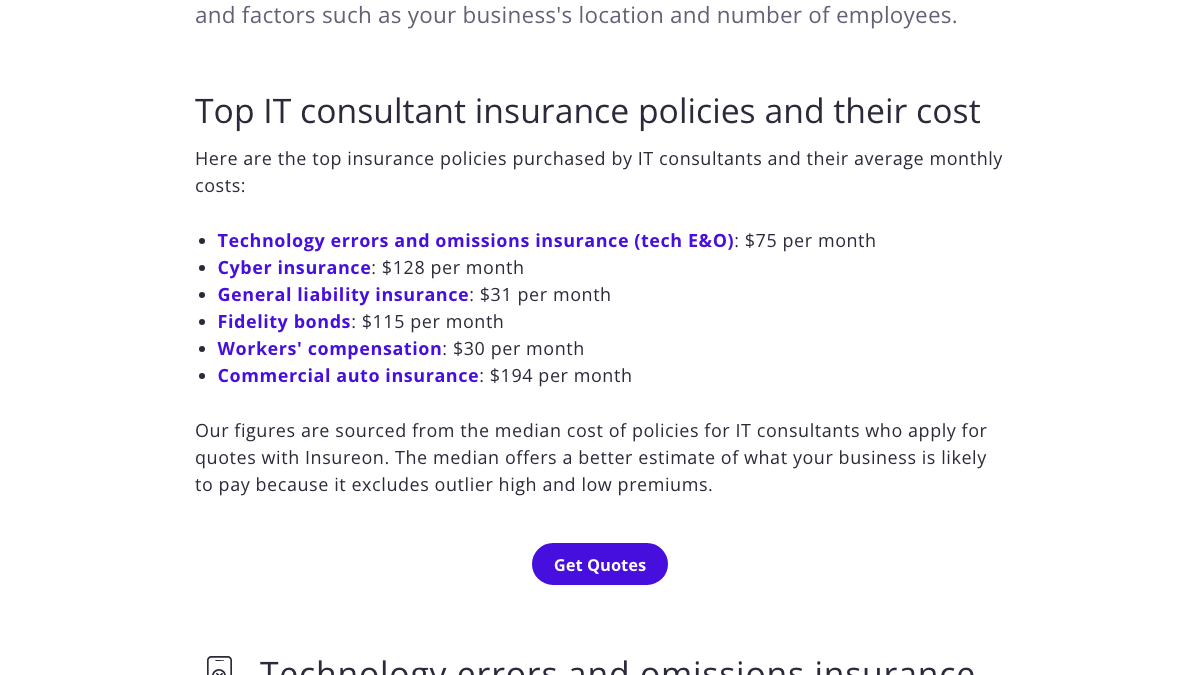
Those numbers are the median cost of policies for IT consultants who apply for quotes with Insureon. Most agencies are sitting on the same kind of data in their own book, meaning typical premium ranges for the industries they write and the factors that move them.
A cost page like that gives the engines numbers no generic site can match, but publishing yours takes care. Show the ranges as examples from real policies, labeled with the date and the business type. Say plainly that they aren't quotes, and have a licensed colleague review the page before it goes up.
Win the local answer
Local searches follow different rules. We asked Google's AI Mode for the best independent insurance agency in Tulsa for small business insurance, and it named four agencies. Three of them appeared as Google Business Profile cards with star ratings between 4.9 and 5.0. Their review counts ran from 34 to 318.
Behind the answer sat the agencies' own service pages and a Yelp list of top agents. One of the four agencies is based in Prosper, Texas, and it got into the Tulsa answer through its own page about small business insurance in Tulsa.
Even the short profile AI Mode wrote for each agency came from the agencies' own pages, so if your site doesn't state the basic facts plainly, the answer has less to say about you. One entry opened with the year the agency was founded, then listed the industries it specializes in, from construction to transportation.
That's why the local basics still carry the most weight. You want a complete Business Profile with a steady flow of genuine reviews, plus a page for each city and industry you really serve. Describe your agency the same way everywhere it appears, from your own site to every directory listing, because answers get assembled from all of them.
15 hours a week manually. Or 15 minutes with RankControl.
Track citations, monitor competitors, and fix content gaps across every AI search engine. Automatically.

Keep every page inside the advertising rules
Insurance marketing carries rules most industries never deal with. State unfair trade practices laws, most of them based on an NAIC model act, prohibit misrepresenting a policy's terms or benefits in advertising. Many states also follow NAIC model rules for life insurance advertising, which cover how policies are described and how testimonials are used.
Disclosure rules change from state to state. California, for example, requires licensees to print their license number on business cards, written price quotations and print advertisements, and to include it in emails about licensed activity. Many agencies show their license number on their website as well, which costs nothing and answers the question in any state.
Anything AI writes for you needs the same review as the rest of your marketing. A generated sentence claiming a policy "covers" something it doesn't is still a misrepresentation, and an engine that cites your page may repeat it to buyers. Our guide to trust signals for fintech in AI answers deals with the same problem in another regulated field.
Track the questions your clients ask
What should you actually measure? Pick 20 to 50 questions across both layers, the local ones included, and run them on each engine every week. Record whether your agency is named or cited, and which competitors appear in your place. Our guide on how to check your AI visibility walks through a first baseline, and the accounting firm playbook shows the same approach for another local profession.
Doing it by hand adds up. Publishing eight solid articles a month takes 16 to 24 hours. Checking 50 questions on seven engines takes about six hours a week on top of that, and both of those are rough estimates.
RankControl handles the repeatable parts. The Radar agent finds the questions your buyers actually search, checks them against real search data and plans titles onto your content calendar. The content engine writes each article against the pages already ranking for its keyword and publishes it on your own domain, with auto-publish off by default so a licensed reviewer can check each page. AI visibility tracking then runs your 50 questions every week on seven engines and marks each one as mentioned, cited or both.
You can run this playbook yourself with a spreadsheet and a few hours a week. Or RankControl's agents can keep the explainers coming and the tracking running while your team looks after clients.
AI search traffic grew 835% this year. Is your content ready?
RankControl generates 26 content formats optimized for ChatGPT, Claude, and Perplexity. Published on your domain, matched to your brand.