Ask Google for the best romantic restaurant in New Orleans and the AI Overview names a handful of places, each with a short reason. Look at the sources behind that answer and you'll find 32 references. Thirty of them are Google's own place cards from Maps. The other two are Resy pages. None is a restaurant's website.
That was one of 12 hospitality searches we ran on September 27, 2026, split across hotels, restaurants and trip planning. Across the eight AI Overviews that appeared, 4 of 120 cited sources were a hotel or restaurant's own site. Perplexity, asked four of the same questions, cited 40 sources and none of them belonged to a property. This playbook is about what hotel and restaurant operators can do when the answer about them is mostly built from other people's pages.
If you run a tour operator, destination marketing or travel publishing business, our AI search playbook for travel brands covers your side. This one is for the people who run the rooms and the dining rooms.
What guests ask AI before they book
AI is a real part of how people choose where to eat and stay, but it's still second to Google. A survey Nielsen ran for Reputation in August 2025 found 20% of US consumers use AI tools like ChatGPT to research restaurants and bars, close to TikTok and Instagram at 26%. Google Search was still first at 56%.
The travel numbers look similar. Expedia Group and YouGov surveyed more than 5,700 adults in the US, UK and India in March 2026 and found 40% use AI to help build itineraries. Only 8% of US and UK travelers said they rely on AI chatbots and agents for planning, against 59% for search engines.
What's different is the shape of the questions. OpenTable's 2026 diner trends report says 44% of Americans plan to use AI more to discover restaurants and book reservations this year, and it lists the questions diners most often ask its own AI concierge: whether a restaurant is kid-friendly, what the best dish is, and whether dogs are allowed. Nobody types "restaurant New Orleans" into ChatGPT. They ask for a quiet place for a business dinner with a private room.
What the engines cited in our test
We picked four hotel searches, four restaurant searches and four planning searches, then pulled Google's results with AI Overviews and asked Perplexity four of them.
| Search type | AI Overview shown | What showed up instead |
|---|---|---|
| Hotels, like "hotels near Fenway Park with parking" | 2 of 4 | A hotels pack with prices and a map |
| Restaurants, like "private dining room Chicago" | 2 of 4 | A local pack of restaurants |
| Planning, like "where to stay in Lisbon for first time" | 4 of 4 | Not applicable |
Commercial searches often skipped the AI Overview entirely and showed Google's own hotels or local pack, which run on Business Profile data. When an overview did appear, Google's own place cards made up 71 of its 120 sources, mostly in three overviews that listed 20 to 30 properties each. Independent travel and food blogs came next with 14, then social posts with 12. Online travel agencies and reservation platforms had three sources each.
Perplexity leaned harder on third parties. Across 40 sources for four questions, publishers like The Infatuation and independent blogs each supplied 12, and Tripadvisor, OpenTable, Expedia-type sites and tourism boards made up most of the rest.
One blog stood out. A Tokyo family-travel site, The Tokyo Chapter, was cited by both Google and Perplexity for the same question about where families should stay. A single well-made guide won the question on two engines.
The before-the-booking page
The four own-site citations are the most useful part of the data, because they show what an operator can publish and get cited for.
The clearest one was Belle Air Mansion, a Nashville bed and breakfast. It was cited in Google's AI Overview for "best time to visit Nashville for food," through a guide on its own site titled "Best Time to Visit Nashville." The question wasn't about lodging at all. The B&B got into the answer by writing the page a guest reads before deciding where to stay.
We call that a before-the-booking page: a guide that answers the planning question a guest has before they choose a place. Planning searches produced an AI Overview every time in our check, and apart from Google's place cards, their sources were mostly independent blogs and social posts. That's a field an operator can compete in, because a local hotel or restaurant knows the area better than most travel bloggers do.
Good candidates come straight from what your front desk or host stand hears every week:
- The best time to visit your city or neighborhood, by season or event
- Which area to stay in for families, business trips or a first visit
- How to spend two or three days nearby, with realistic travel times
- Where to eat before a show, near the stadium or late at night
Write them as a local would, with specific names, times and prices, and keep them current. A guide that still lists a restaurant that closed last year hurts you with guests and with the engines. In an r/TravelProperly thread about using ChatGPT to pick restaurants, one traveler said it had recommended places that closed years ago or never existed.
Your competitors are getting cited by AI. You're not.
Every day without citation tracking is a day your competitors pull ahead in ChatGPT, Perplexity, and Claude.
Your Business Profile is the page AI reads most
Since 71 of 120 overview sources were Google's own place cards, the most-read page about your property in Google's AI answers probably isn't on your website. It's your Business Profile.
Google has been building travel planning on that data. Its November 2025 post on trip planning in AI Mode's Canvas said the feature combines real-time flight and hotel data, "details from Google Maps like photos and reviews and relevant information from sites across the web." In August 2026 Google added hotel booking inside AI Mode.
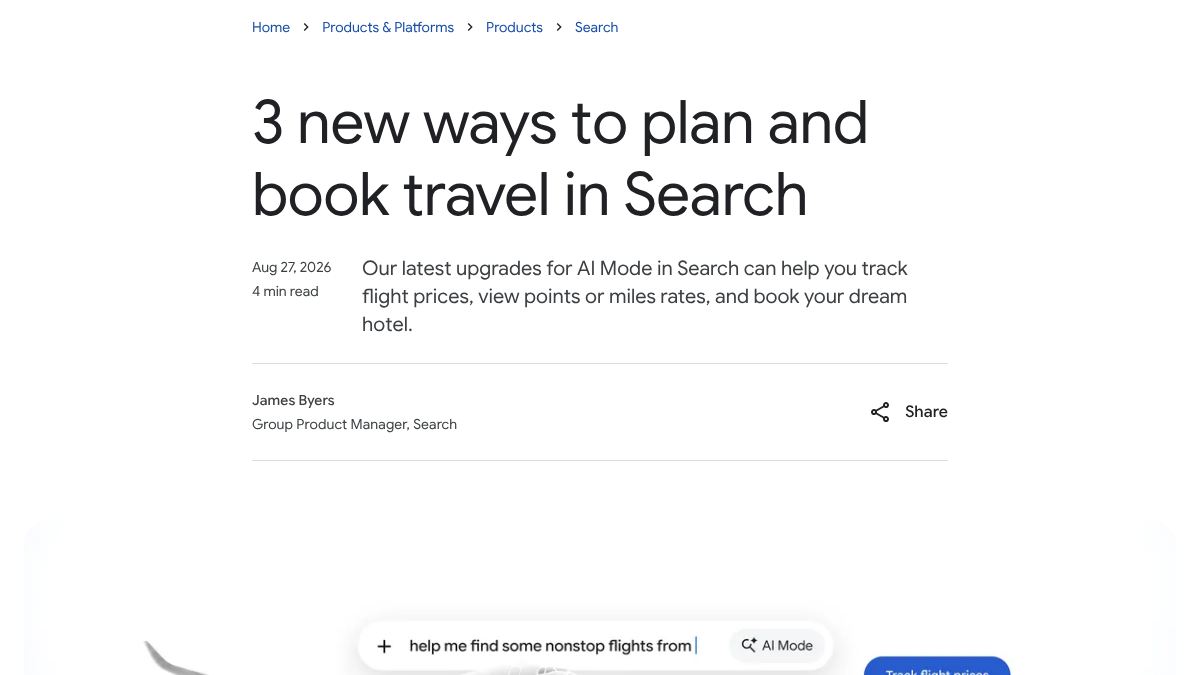
Google's own announcement described it this way:
And finally, we’re introducing hotel booking through AI Mode in Search, so you can discover and book your next hotel in one conversation. Simply tell AI Mode about your upcoming trip and your hotel preferences to get a visual list of options, complete with guest reviews and key https://t.co/vxW1j0BI8z
 Google@GoogleAug 27, 2026

The practical list is short. Fill in every attribute a guest might filter on, like parking, pet policy, private dining, accessibility and kids' menus. Keep hours, holiday closures and the booking link current. Add recent photos of rooms, tables and the view.
Reviews: the part you can't write yourself
Reviews feed these answers directly. Google's AI Mode hotel booking shows a list of options "complete with guest reviews," and the Reputation survey found 55% of consumers trust AI-generated review summaries.
So ask every guest for a review, including the ones who looked unhappy at checkout. It's also what the rules require. Google Maps' review policy bans businesses from offering incentives like discounts or free goods in exchange for a review, and from selectively asking only satisfied customers. The FTC's 2024 rule on fake reviews separately bans incentives conditioned on a positive or negative review. A "10% off your next stay for a five-star review" card breaks both.
Reply to reviews with specifics, too. A reply that says the rooftop reopens in April or that the kitchen now does a gluten-free tasting menu adds a current fact to a page the engines read.
OTAs, booking apps and where independents fit
AI booking is arriving, and the first partners are big. Google's August 2026 launch partners for AI Mode hotel booking included Booking.com, Expedia, Hilton, Marriott, IHG and five others. The hotel or booking platform acts as the merchant of record. OpenAI's apps in ChatGPT launched in October 2025 with Booking.com and Expedia among the pilot partners. Perplexity added hotel booking in March 2025, which Skift reported as a first among rivals like ChatGPT and Gemini.
For an independent hotel, that means your OTA listings are part of your AI footprint. When a guest books through one of these flows, the photos, room descriptions and policies they see often come from your Booking.com or Expedia profile. Keep those consistent with your own site and your Business Profile, down to the check-in time and the pet fee.
For restaurants, the equivalent is your reservation platform. OpenTable and Resy pages turned up in both Google's and Perplexity's answers in our check, so treat them as pages you maintain, with current menus, photos and the private dining details people search for.
What your own site still needs
Your site is less cited than you'd like, but it's still the source of truth everyone else copies. Google's guidance on AI search says structured data "isn't required for generative AI search," so no special markup is needed. If you already use schema, Google's local business documentation recommends the most specific type available, such as Restaurant.
What matters more is that the facts are there in plain text: rates or price ranges, room types, menus with prices, parking, pet rules and how to book a private room. Our guide to AI search for local businesses covers the rest of the local basics.
200+ SaaS teams already track their AI citations.
They know exactly when ChatGPT mentions their brand, and when it stops. Do you?
Track the questions your guests ask
Build a list of about 20 questions: eight planning questions for your area, six specific-need questions like "dog-friendly hotel near downtown with parking," and six about your property by name. Run them monthly in Google, ChatGPT and Perplexity, and note which properties get named and which pages get cited. Our guide to LLM visibility monitoring shows how to keep that consistent from month to month.
Two things are worth watching most closely. First, whether your before-the-booking pages start appearing for planning questions. Second, whether the details the answers give about you, like hours, prices and policies, are current. A wrong fact in an AI answer usually traces back to one stale page, and our guide to correcting false information in AI Overviews walks through fixing it.
Doing it yourself or handing it off
By hand, this is a Business Profile cleanup of a few hours, a review routine at checkout, one or two destination guides a month and a monthly check of 20 questions. Plan on several hours a month after the first push.
Or RankControl can run the content and the checking. Our content engine writes guides like these against the pages already ranking for each question and publishes them on your own site through the CMS you already use. Our AI visibility tracking checks up to 50 guest questions every week across seven AI engines and records which sources each answer cited, so you can see when your guide starts showing up.
How often does ChatGPT mention your brand?
Most founders have no idea. The answer might surprise you.