
A marketer asked r/DoSEO in September whether sites are publishing too much content. The sharpest reply said you should only publish if you add something net new to the index, because saying what's been said 100 times before, slightly differently, isn't a long-term plan.
Are we publishing too much content for SEO?
I’ve noticed something interesting. Some sites publishing only a few genuinely useful pages seem to be making more progress than sites constantly pushing out new articles. It made me question the whole “publish consistently” approach. Maybe...
That's the usual case against content curation. But curation is everywhere in AI answers. Statistics roundups, "best tools" lists and resource pages are all curated, and AI engines cite them constantly. So which wins in AI search, the page that made the data or the page that collected it? We tested it.
Content curation vs original content, defined
Original content is information you made. That covers a survey you ran, data from your own product, a test you did, or a first-hand account. The company that runs the study is the original source.
Content curation gathers information other people made and puts it in one place. A page titled "50 email marketing statistics" is curated. So is a list of tools or a page of links on a topic. Curation can be lazy copying or careful work, depending on what the curator adds.
There's a middle type too, which we'll call news coverage. A trade publication writing up someone else's study is reporting on an original, close to the source but not the source.
We checked who AI cites for 20 statistics questions
On October 19, 2026, we asked ChatGPT and Google AI Mode 20 questions that each have a well-known original source. They included "what percentage of Google searches end without a click," "what is the average email open rate" and "what is the average monthly churn rate for SaaS."
Then we sorted all 123 cited pages into three groups. Original meant the publisher collected the data, like SparkToro's click study or ChartMogul's churn benchmarks. News meant a publication reporting a study, and roundup meant a page compiling numbers from elsewhere.
| ChatGPT | Google AI Mode | |
|---|---|---|
| Pages cited | 67 | 56 |
| Original sources | 43 (64%) | 11 (20%) |
| Roundups | 16 (24%) | 41 (73%) |
| News coverage | 8 (12%) | 4 (7%) |
| First source listed was an original | 16 of 20 | 5 of 20 |
The two engines behaved like opposites. ChatGPT went to the source most of the time and usually listed it first. AI Mode reached for roundups, and its first listed source was a roundup for 12 of the 20 questions.
15 hours a week manually. Or 15 minutes with RankControl.
Track citations, monitor competitors, and fix content gaps across every AI search engine. Automatically.

Same question, different sources
Three questions show the split most clearly. ChatGPT cited only original sources for them, and AI Mode cited only roundups.
| Question | ChatGPT cited | AI Mode cited |
|---|---|---|
| How many people use LinkedIn? | LinkedIn's own about page and workforce reports | Three LinkedIn statistics roundups |
| What is the average monthly churn rate for SaaS? | ChartMogul's benchmarks and help docs | Three churn benchmark roundups |
| What percentage of small businesses have a website? | An NFIB survey and a Clutch report | Two "small business website statistics" pages and a Forbes Advisor roundup |
If you run the original study, you're well placed for ChatGPT. If you want to show up in AI Mode for the same question, you may need a curated page as well, or a place on someone else's.
One roundup site showed up in AI Mode for three different questions, covering email open rates, Google Ads benchmarks and ad blocking. Curation at scale clearly earns AI Mode citations, whatever you think of it.
How one statistic travels
The zero-click question shows how a number moves from source to roundup. SparkToro published the original in 2026, using clickstream data, and found about 68% of US Google searches ended without a click. Search Engine Land wrote it up as news. Then the roundups picked it up.
Both engines gave the right answer, 68%, and both cited SparkToro. But AI Mode's sources also included a March 2026 contributor post on Forbes headlined "60% of searches now end without a click," an older figure from before SparkToro's 2026 study. Another cited roundup had updated its headline to 68% while its web address still said 60.
We'd call that the copy chain. Every hop from the original adds a chance for an old number to survive, and a curated page is only as good as the date on its newest link. That's the best argument for curation done well, since a careful roundup updates the chain instead of adding a stale link to it.
When curation wins everywhere
For two of the 20 questions, both engines cited only roundups. They were "how many websites are there in the world?" and "how many blog posts are published every day?"
Neither has a clean original source. Nobody publishes a direct daily count of blog posts, so every answer is an estimate pieced together from other numbers, and the curated pages that do the piecing get the citations. Our own blogging statistics roundup exists for the same reason.
That's the gap curation fills best. When the facts are scattered or nobody owns the number, a careful roundup is the most useful page on the web, and AI engines treat it that way.
What Google says about curated content
Google doesn't ban curation. Its guidance on helpful content asks a pair of questions that set the bar.
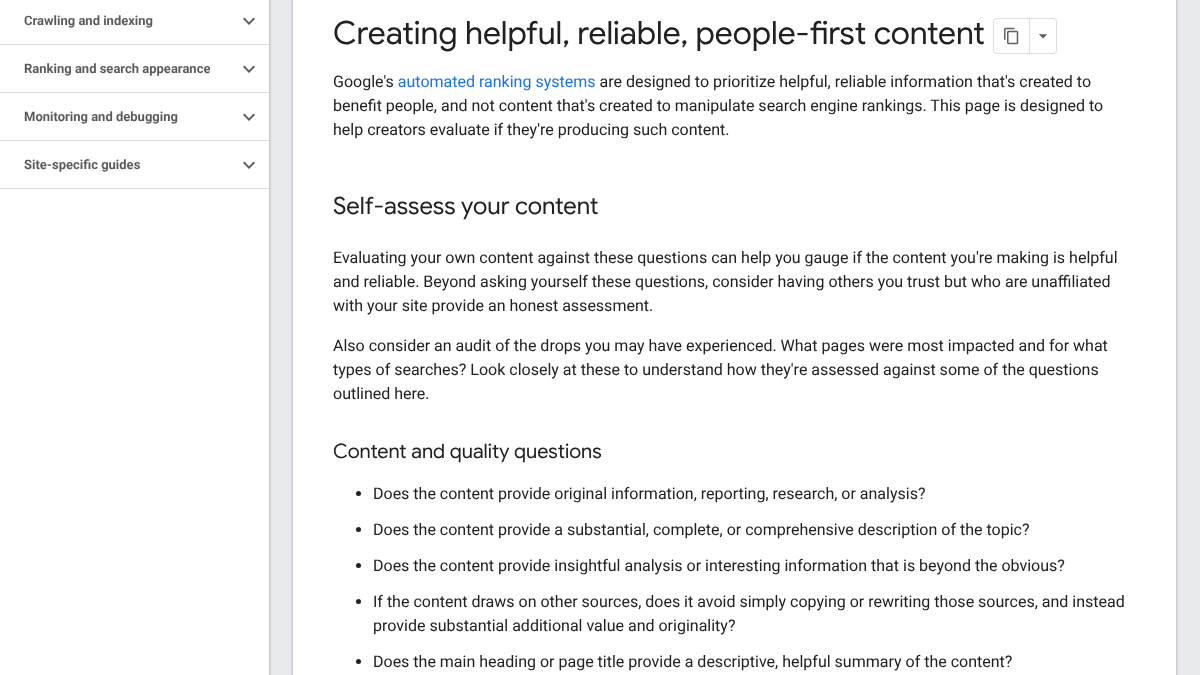
The first asks whether the content provides original information, reporting, research or analysis. The second asks whether content drawing on other sources avoids simply copying or rewriting them, and adds substantial value and originality instead. A roundup can pass the second test if it compares, checks and explains, and fail it if it only pastes numbers.
How to curate content that AI engines cite
Google's second question is the brief for good curation. A roundup earns its place when it does work the original sources didn't, and these five habits are where that work shows.
- Link every number to its original source, so readers and engines can follow it.
- Date every statistic and replace old ones when new data lands.
- Show the number in plain text near the top, since a figure that lives only inside a chart is easy to miss.
- Point out when sources disagree, and say which you trust and why.
- Add one thing the sources don't have, like a calculation, a comparison or a note on what the number means for a reader.
Our guide to statistics roundup posts covers the format in more detail, including how often to refresh one.
AI search traffic grew 835% this year. Is your content ready?
RankControl generates 26 content formats optimized for ChatGPT, Claude, and Perplexity. Published on your domain, matched to your brand.

How to make original content that gets cited
Original content doesn't have to mean a huge survey. Many of the originals ChatGPT cited in our test came from a company's own product data, like an email platform's open rates or a billing tool's churn numbers. Others came from a survey the company ran itself.
- Look for data you already have, such as anonymized usage numbers, support tickets or sales calls.
- Run small tests and publish the method, so others can trust and cite the result.
- Put the main finding in one plain sentence near the top.
- Give the study its own page with a clear title, not a buried paragraph in a longer post.
- Update it every year, since the original source for a stat that changes needs to stay current.
Our study of how often ChatGPT searches the web found that questions about facts and numbers almost always trigger a search, so a well-titled original page has a real chance at those answers.
The mix that works
You don't have to choose one. The test points to a simple split for each topic you cover.
Make one original asset per topic where you can, so ChatGPT has a primary source to cite. Then build curated pages around it that collect the wider numbers, link to the originals, including yours, and stay current. That gives AI Mode the roundup it tends to prefer, with your study inside it. Our guide to choosing content pillars can help you decide which topics deserve the original work.
Limits of our test
We used 20 statistics questions and checked each once, from the US, on one day. Statistics questions favor original sources more than how-to questions would. We labeled each page by hand, and a few could fit two groups, like vendor blogs that publish their own benchmark data alongside other companies' numbers.
What this takes by hand
Here's a rough monthly budget for running both kinds of content, by our estimate.
| Task | Hours a month |
|---|---|
| Pulling and checking one small original data set | 6 to 10 |
| Writing up the original study | 3 to 5 |
| Updating two curated roundups | 3 to 4 |
| Checking which pages AI engines cite | 2 to 3 |
| Total | 14 to 22 |
Doing it by hand or with help
You can run this mix yourself. Or RankControl can handle the steady part. Its content engine writes and publishes articles for the questions your buyers ask, and its AI visibility tracking checks 50 of those questions every week on ChatGPT, Perplexity, Claude, Gemini, Grok, Google AI Mode and Google AI Overviews, showing which sources each engine cites.

Built by the team that got cited in 48 hours.
Content generation, backlink building, AI visibility tracking, and Google rankings. One platform, zero guesswork.