
A store owner asked r/SEO in August whether to build content pillars around car culture, racing and car history. The store sold one product, license plate mounts, and they worried there wasn't much to write about. The most useful reply said no. Stay one step from the purchase, it said, and write about plate laws by state, front-plate rules and sensors the mount might block.
Ecom content pillar advice
I’m helping a friend with an Ecom store and he sells specialized license plate mounts for all car makers. The issue here is that it’s a website with one product and there’s not much content you can make about the product. We’re assessing if...
That reply is a good definition of content pillars. They're the three to five themes you publish about again and again, and each one has to lead back to what you sell. In 2026 there's a second test, because a pillar also has to work in AI answers, and AI engines treat some themes very differently from Google.
What content pillars are, and what they aren't
A content pillar is a theme, like "payroll" or "hiring" for a payroll software company. It isn't a single page. The page you might build at the center of a theme is a pillar page, and our guide to pillar pages for AI search covers how to build one.
Under each pillar sits a set of articles that answer narrower questions. Our explainer on topic clusters and content hubs covers how those pages link together. This guide is about the step before both, which is choosing the themes.
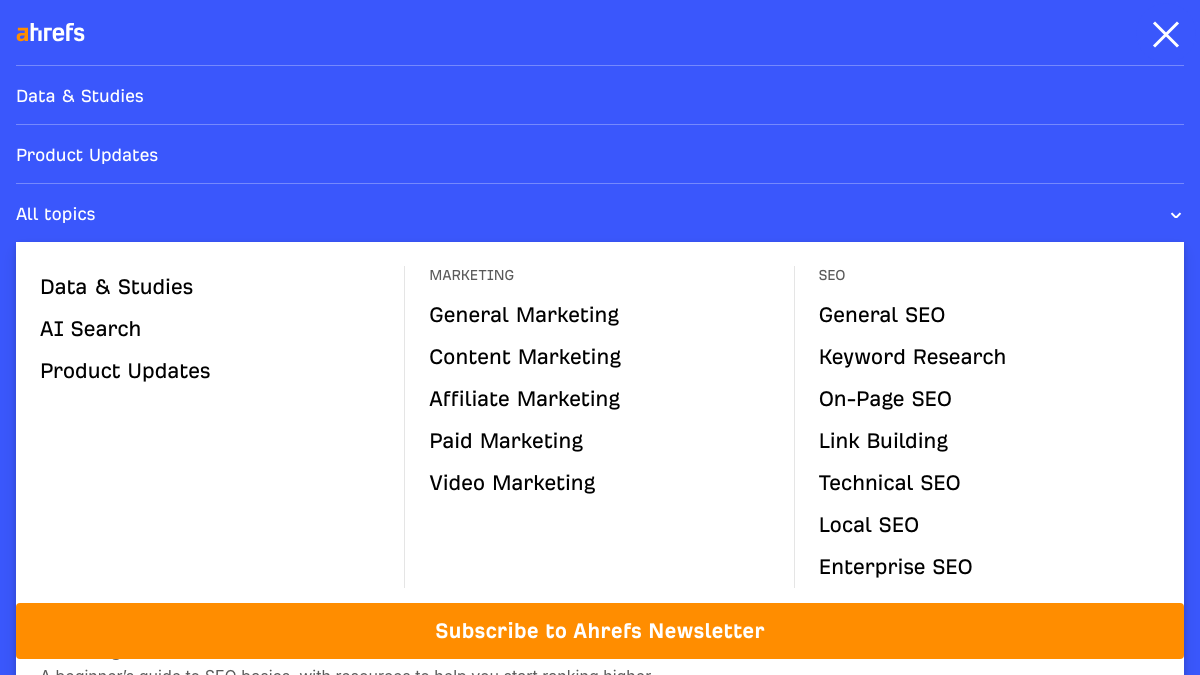
Big software blogs make the pattern easy to see. Ahrefs groups its blog under two parent themes, marketing and SEO, with topics like keyword research, link building and local SEO underneath, plus data studies and AI search. Each topic maps to a job someone would use Ahrefs for.
How many content pillars you need
Three to five is the usual answer, and it holds up. When a newsletter writer asked r/content_marketing how to pick pillars this month, the top reply said to niche down and keep it to three or four.
If I'm writing about content strategy for newsletter, what should be my content pillars?
I'm starting a new newsletter on Substack where I want to discuss newsletter content strategy or strategy-related stuff. How should I decide my content pillars for it?
Another reply in that thread offered a smart shortcut. Write eight to ten pieces first, then look at what they cluster into. Whatever you kept coming back to is a pillar, and you've already shown you can keep writing about it.
Fewer is better for small teams. Each pillar needs enough articles to look like real coverage, and a team publishing four posts a month can cover three pillars in a year far better than seven.
26 content formats. Published on your domain. Matched to your brand.
Guides, comparisons, listicles, case studies, and more. RankControl generates content that gets cited by ChatGPT, Perplexity, Claude, Gemini, Grok, Google AI Mode, and Google AI Overviews.

The two-scoreboard test
Choosing pillars used to mean checking search demand and stopping there. Now there are two scoreboards, Google and AI answers, and a theme can win one while losing the other.
We'd call this the two-scoreboard test. To see how it plays out, we picked a real-world case. Imagine you run a payroll software company like Gusto, and you're choosing from five candidate pillars. On October 19, 2026, we took five common questions for each pillar and checked three things.
- Google demand, as monthly US searches from a data provider.
- Whether ChatGPT searched the web before answering, which is the only way a site gets cited.
- Whether Gusto already showed up, in Google's top 10 or in ChatGPT's sources.
| Candidate pillar | Monthly searches (5 questions) | ChatGPT searched | Gusto in Google top 10 | Gusto cited by ChatGPT |
|---|---|---|---|---|
| Payroll | 17,700 | 4 of 5 | 1 | 2 |
| HR compliance | 18,430 | 5 of 5 | 1 | 0 |
| Hiring | 1,290 | 2 of 5 | 1 | 0 |
| Benefits | 34,490 | 2 of 5 | 2 | 0 |
| Small business finance | 10,630 | 3 of 5 | 0 | 0 |
Some questions had no volume in the data, so treat the search totals as a floor.
What the scores say
Benefits had the most Google demand by far, almost all of it from one question, "what is an HSA," at about 33,100 searches a month. ChatGPT answered that question without searching. It did the same for "what is a 401k match." On the AI scoreboard, benefits barely scores.
HR compliance was the opposite. ChatGPT searched the web for all five questions, from "what is form I-9" to "do I need workers comp insurance." Rules change and vary by state, so the model looks them up. That makes compliance a strong AI pillar, even though Gusto wasn't cited for any of them yet.
Definitions were the clearest pattern. Of the five "what is" questions in the test, ChatGPT searched for one. Those five questions also had some of the biggest Google volume. We found the same split in our study of how often ChatGPT searches the web, where lookups triggered a search and stable explanations mostly didn't.
Hiring is the odd one. Its five questions added up to only about 1,290 searches a month, the smallest pillar in the test by a wide margin, and ChatGPT searched for two of them. On both scoreboards it looks weak.
But look at the questions. "How to hire your first employee" is the moment a business needs payroll for the first time, and Gusto already ranked in Google's top 10 for it. A small pillar that sits right before the purchase can be worth more than a big one that sits far from it. So add a fourth, softer check to the scores, which is how close each pillar's questions sit to the moment someone buys.
For this company, hiring could stay as a smaller pillar with fewer articles, aimed at first-time employers. It doesn't need the same volume of posts as payroll to earn its place.
Check whether you can win the pillar
Demand and AI behavior aren't enough. The third check is who already owns the results, because some pillars belong to someone else.
Small business finance looked fine on demand, with about 10,600 searches across its five questions. But Google's results were full of QuickBooks, Bank of America, Chase, Wells Fargo and NerdWallet, and Gusto showed up for none of the five. A payroll company would spend a year fighting banks for loan and budgeting searches.
Payroll was the only pillar where Gusto was already cited by ChatGPT, for "how to run payroll for a small business" and "best payroll software for small business." That's the core of the business, and it's where the existing authority sits.
So for this company, the scores point to three pillars. Payroll is the home ground. HR compliance is the AI opportunity. Benefits carries the Google demand and stays as long as the articles go past definitions into setup questions like "how to offer health insurance to employees," which ChatGPT did search for.
How to choose your own content pillars
Here's the process we used, in order.
- List what your product helps people do. Each job is a candidate pillar.
- Add the problems buyers hit just before and after buying, the "one step from the purchase" rule from the r/SEO thread.
- Write five real questions for each candidate, in the words buyers use.
- Check monthly searches for each question in any keyword tool.
- Ask each question in ChatGPT and note whether the answer shows sources.
- Search each question on Google and note who holds the top results.
- Keep the three to five pillars that pass at least two checks, and drop the ones another type of company clearly owns.
Then name your pillars the way Ahrefs names its topics, after jobs people recognize, and file every new article under one of them. Our guide to building a content calendar shows how to spread pillars across the months.

Your competitors are getting cited by AI. You're not.
Every day without citation tracking is a day your competitors pull ahead in ChatGPT, Perplexity, and Claude.
Common mistakes with content pillars
The most common one is the store owner's first instinct, picking themes the audience likes but the product can't serve. Two replies in that r/SEO thread pointed to HubSpot as a warning, describing a blog that wrote far outside what its buyers needed.
Another is choosing pillars by Google volume alone. Definitions bring big numbers, and in our test they were the questions ChatGPT was least likely to look up. If AI answers matter to you, weight the pillars where the engine searches.
The last is letting pillars go stale. A theme like HR compliance only works if the pages stay current, since that's why ChatGPT looks it up in the first place. Our guide to evergreen content covers which pages age well and which need updates.
Limits of our test
We used five questions per pillar and checked each once, from the US, on one day. ChatGPT's choice to search can change between runs. The Gusto example is our own illustration, not Gusto's actual content plan, and the search volumes come from one data provider's estimates.
What choosing pillars takes by hand
Here's a rough budget for a first round of pillar research, by our estimate.
| Task | Hours |
|---|---|
| Listing jobs and buyer problems | 1 to 2 |
| Writing five questions per candidate | 1 to 2 |
| Checking search demand | 1 |
| Running the questions in ChatGPT and Google | 2 to 3 |
| Scoring and choosing pillars | 1 to 2 |
| Total for one round | 6 to 10 |
Doing it by hand or with help
You can run this test yourself once a quarter. Or RankControl can do the steady part. Its content engine plans articles inside the topics you set, writes them and publishes them once you approve. Its AI visibility tracking checks 50 of your buyer questions every week on ChatGPT, Perplexity, Claude, Gemini, Grok, Google AI Mode and Google AI Overviews, so you can see which pillars are earning citations.
200+ SaaS teams already track their AI citations.
They know exactly when ChatGPT mentions their brand, and when it stops. Do you?