
A question in r/SEO in September asked whether "humanized AI-generated content" could rank first on Google for a brand-new blog. One of the top replies wasn't about rankings at all. It asked what humanized content even meant, and whether anyone was keeping humans in vats to type for the AI.
The joke points at a real problem. "Humanizer" tools promise text that reads as human, but SEO doesn't run on how human a page sounds. So we tested one to see what it actually does to the things that do matter for search, like facts, keywords and length.
What humanizers are built for
Search data says most people use humanizers for school. US searches for "ai humanizer" hit about 1,000,000 a month in October 2025 and again in April 2026, then fell to about 246,000 in July, according to Google Ads data. That's the school calendar, with peaks around essays and exams. Demand follows the detectors, too. "AI detector" drew about 5 million US searches a month over the past year, roughly six times the volume for "ai humanizer." People mostly buy humanizers because someone else is running a detector on their work.
Google's results say the same thing. On October 19, 2026, the top results for "ai humanizer" included a YouTube video on beating Turnitin and several tools pitched at essays. These tools are tuned to pass academic detectors, and Google isn't one of those.
That matters because the goal changes the method. A tool trying to fool a detector swaps in unusual words and changes sentence shapes. Neither of those makes a page more useful to someone searching.
Our test: one pricing paragraph, one humanizer
We wrote a 118-word paragraph in typical AI style about Close CRM pricing, using prices we'd checked on Close's pricing page that day. Then we ran it once through a popular paid humanizer on its strongest "More Human" setting and compared the two versions line by line.
| Measure | Before | After |
|---|---|---|
| Words | 118 | 164 (+39%) |
| Average sentence | 17 words | 23 words |
| Average word length | 5.0 letters | 4.6 letters |
| Prices kept | 7 of 7 | 7 of 7 |
| Exact keyword "Close CRM pricing" | 2 | 1 |
| Claims not in the source | 0 | 2 |
The good news is that every price survived. The humanizer didn't change a number, and it used shorter, plainer words.
The bad news came in the details. It said the Scale plan is "geared towards large sales teams," which the source never said. It added that calling and SMS "usage is tracked," another new claim. It also wrote "the workflow automation and powerful power dialer features," which no editor would let through. And it kept the stiff transition word our AI draft used to open the sentence about calling fees, one of the best-known tells of AI writing.
It also slipped in "We believe" before the closing verdict, turning a summary into a first-person opinion the writer never gave. We'd call these drift claims, meaning small new facts a rewriting tool adds on its own. On a pricing page, a drift claim is how a page ends up saying something false about a product.

Built by the team that got cited in 48 hours.
Content generation, backlink building, AI visibility tracking, and Google rankings. One platform, zero guesswork.
What Google says about humanized content
Google has been clear for years that it judges the page, not the tool. Its guidance on AI-generated content, posted on February 8, 2023, says "appropriate use of AI or automation is not against our guidelines."
The catch is in its spam policies, last updated on August 28, 2026. Under scaled content abuse, Google lists making many pages "through automated transformations like synonymizing, translating, or other obfuscation techniques."
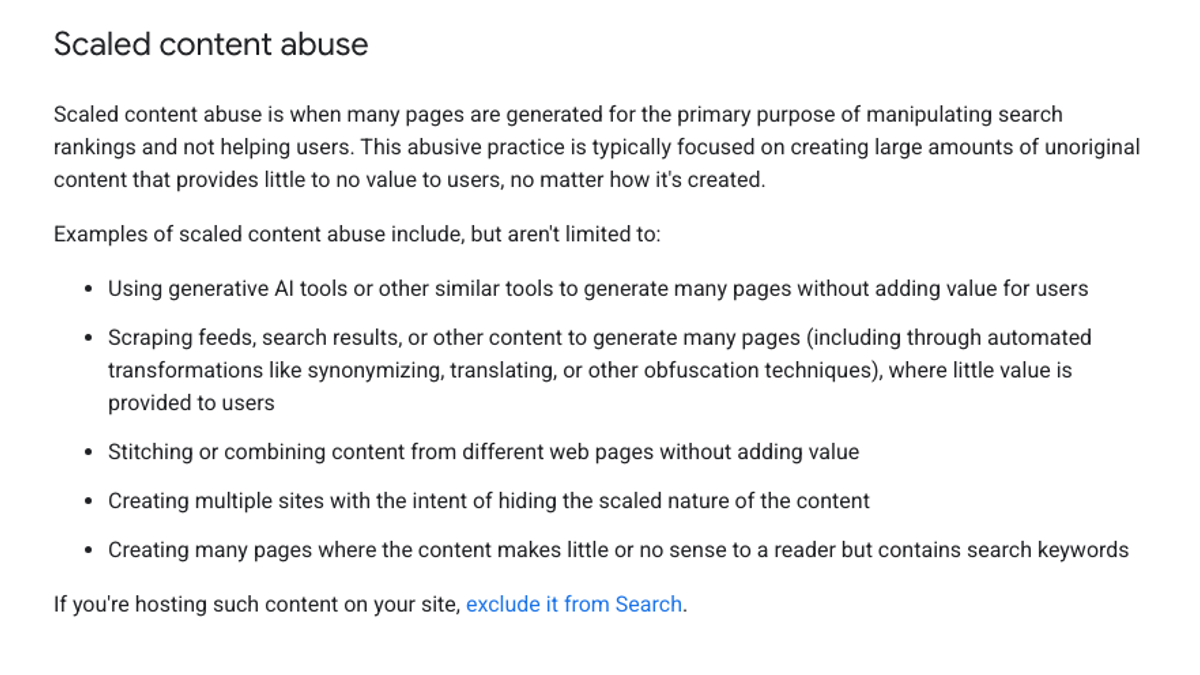
A humanizer is an automated rewording tool. Running one page through it is not a violation. Running hundreds of thin pages through it to hide where they came from is close to the exact example Google gives.
Our look at whether Google can detect AI content covers why Google doesn't need a detector to act on this.
Does humanized content rank better?
There's no good evidence that it does. The large studies on AI content and rankings point in different directions, and none of them tested humanizers.
Ahrefs found in July 2025 that the correlation between AI content and ranking position across about 600,000 pages was 0.011, which it called "effectively zero." A Semrush study from April 2026 found position 1 results were more often human-written, using GPTZero to classify them.
Both studies leaned on a detector to label pages, which is the same kind of tool humanizers are built to fool. So if humanized text simply scores as human, these studies can't tell it apart at all. Our breakdown of AI content and Google penalties puts the studies side by side.
One person in an r/AISEOTricks thread on AI rankings said they'd run AI-only content on several sites in Denmark with fine rankings. One of about eight sites lost a lot of rankings and recovered after a clean-up. Their read was that Google cares whether a page answers the question, not how it was written.
Why drift claims matter more in AI search
A wrong line on your page used to cost you one confused reader. Now it can end up inside an AI answer. When we checked how ChatGPT describes 24 brands for our brand sentiment study, it quoted prices, review scores and complaint counts straight from the pages it read. For Close, ClickUp and Wave, the prices it quoted matched each vendor's pricing page exactly.
That cuts both ways. A clean, current page gets quoted accurately. A page where a humanizer added "geared towards large sales teams" can get quoted too, and then the made-up claim reaches buyers who never see your site. The fix is the same as for any page, which is to check every fact before it goes live.
Where humanizers can hurt SEO
The risks are small on one page and real at scale. These are the ones our test and Google's policy point to.
- Facts change. Drift claims add things the source never said, and a reader or an AI answer may repeat them.
- Keywords thin out. Our test dropped one exact use of the phrase the paragraph was written for.
- Pages get longer without getting better. A 39% longer paragraph with no new information is padding.
- Mistakes slip in. "Powerful power dialer" is a small error, but readers notice them.
- It invites scale. A tool that makes rewording cheap makes it tempting to publish hundreds of thin pages.
A humanizer also does nothing about the reasons AI pages often fail. It can't add a real price check, a product detail you know from using it or a view on which option fits whom.
See your first AI citation report in under 5 minutes.
No setup calls. No onboarding meetings. Connect your domain and see where AI mentions your brand right now.

What a human edit adds instead
The editing that helps SEO is about substance, not tone. A poster in r/SEO put it well in a thread on what "human-reviewed" really means for AI content.
What does “human-reviewed” actually mean in an AI-assisted SEO workflow?
Question for people who manage content after it publishes: when a team says “human-reviewed,” what did the reviewer actually do? I see that phrase used for everything from a proofread to a genuinely accountable editorial process. Those are...
Their checklist asked whether factual claims were checked against sources, what the page adds that other results don't, which parts depend on real expertise, and who updates the page when facts change. None of those questions can be answered by a humanizer.
Here's the edit we'd run on any AI draft before it goes live.
- Check every number, price and claim against its source.
- Add one or two details only you know, like a real customer question or a limit you've hit.
- Cut filler sentences and stock openers like "Overall" and "In short."
- Keep the exact words your buyers search for, in the title, the first paragraph and a heading or two.
- Read it aloud and fix anything you wouldn't say.
Our post on why "make it sound more human" is a bad AI prompt shows the same problem at the prompt stage, where asking for "human" added comfort sentences instead of facts.
The time this takes
Editing for substance is slower than clicking a humanize button. Here's a rough budget per article, by our estimate.
| Task | Minutes per article |
|---|---|
| Fact and price checks | 15 to 30 |
| Adding first-hand details | 10 to 20 |
| Cutting filler and tightening | 10 to 15 |
| Keyword and heading check | 5 to 10 |
| Total | 40 to 75 |
At ten articles a month, that's roughly 7 to 12 hours of editing.
Doing it by hand or with help
You can do all of this by hand for every draft. Or RankControl can write your articles from your brand profile and the pages already ranking for each topic, and score each one for how easily AI engines can quote it, with a fix list. Nothing publishes until you approve it, so the fact check stays with someone who knows the product.
Your competitors are building backlinks while you read this.
Organic outreach, social mentions, and citations from Editorial Circle member sites, with managed backlinks available as an add-on. Grow your domain authority without running the campaign yourself.