
A post in r/ChatGPT from July has one line of body text: "Make it professional, but human. Not too formal. Don't sound AI generated. And please don't use" and then it stops, right where the forbidden punctuation mark would go. The title asks why making ChatGPT sound human takes so much effort.
Why does making ChatGPT sound human take so much effort?
“Make it professional, but human. Not too formal. Don't sound AI generated. And please don't use —”
It takes effort because "sound more human" is a request for a feeling, and a feeling isn't something a model can build from nothing. We think it's one of the worst prompts in content marketing, and on September 26 we ran a small test to see whether that opinion holds up. It mostly did, though not in the way we expected.
The test: one paragraph, four prompts
We asked GPT-5.5, through OpenAI's API, for the same 200-word paragraph four ways. The topic was deliberately boring: how a small business should choose payroll software. Each call was fresh, with no system prompt and default settings.
| Version | What we asked for |
|---|---|
| A | The plain request: a 200-word paragraph on choosing payroll software |
| B | The plain request plus "Make it sound more human." |
| B' | Version A pasted into a new chat with "Make this sound more human:" |
| C | The plain request plus a brief: one named reader, one real number, one worked example, and a list of banned phrases |
B' is there because it's how most teams use the prompt. Someone drafts with AI, the draft reads flat, and somebody pastes it back in and asks for it to sound more human.
What "sound more human" actually added
We expected the usual complaints. A marketer in r/DigitalMarketing described the prompt's output in September as less formal writing, more contractions, one awkward joke and fake enthusiasm. Version B had none of that. It had zero contractions, zero jokes, no exclamation marks and no stock phrases.
What it had instead were what we've started calling comfort sentences. These are lines that sound warm and carry no information. Here are the ones B added to the same facts A already covered:
- "payroll is stressful enough without confusing menus or hidden steps"
- "being honest about what you actually need, not what looks impressive in a demo"
- "the one that makes payroll feel less like a chore and gives you confidence"
Compare B to A and the substance is identical. Both run exactly 201 words across nine sentences. They list the same checklist in roughly the same order, from compliance and pricing through integrations and security. B just has a sympathetic narrator reading over the top.
That's the real problem with the prompt. The model can't find anything more specific to say, because you didn't give it anything more specific, so it adds tone. Tone without detail is the thing readers notice when they say something "sounds like AI," even when the grammar is fine and none of the famous tells show up.
The second pass is worse
Version B' is where things went sideways. We took A's finished paragraph, opened a fresh call, and asked only for it to sound more human. The rewrite came back at 260 words, 29% over the 200 we'd asked for, because the length limit lived in the first prompt and the second prompt never saw it.
It also split one paragraph into six short ones and added three contractions, which is fine. Then it added two em dashes, which are on every list of AI tells there is. A "humanizing" pass introduced one of the most recognizable machine habits into text that didn't have it.
The content didn't change. The same checklist came back in the same order, just broken into smaller pieces with "Be sure to" and "Support is important too" as connective tissue.
Here's the whole test side by side:
| A: plain | B: plus "sound human" | B': humanize pass | C: specific brief | |
|---|---|---|---|---|
| Words | 201 | 201 | 260 | 200 |
| Sentences | 9 | 9 | 14 | 11 |
| Contractions | 0 | 0 | 3 | 0 |
| Em dashes | 0 | 0 | 2 | 0 |
| Real, checkable specifics | None | None | None | One sourced number, one priced example |
| Written for a specific reader | No | No | No | Yes |
One small test on one topic proves very little on its own. We're sharing it because it's easy to reproduce: run one of your own drafts through a humanize pass and compare the word count and the facts before and after.
We ran that comparison on a dedicated humanizer tool too, and our post on whether AI humanizers help SEO found it added two claims the source never made.
Know exactly what AI says about your competitors.
RankControl's Recon Agent monitors competitor citations across ChatGPT, Perplexity, Claude, Gemini, Grok, Google AI Mode, and Google AI Overviews. See where they show up and you don't.

What worked: a brief with real inputs
Version C didn't mention sounding human at all. It named the reader, the owner-operator of a 12-person landscaping company moving off a spreadsheet and a part-time bookkeeper. It asked for one example, two vendor quotes at $40 a month plus $6 per employee versus $75 a month flat, worked out for a 12-person crew. We also supplied one number with its source and banned ten phrases, including "game-changer" and "unlock."
The output was the only one of the four that sounded like someone who knew the reader. It talked about "hours from crew leads, overtime, seasonal hires." It suggested a trial payroll using last period's spreadsheet, and it did the math correctly: $40 plus $6 times 12 is $112 a month, so the flat plan saves $37 at the current size.
It also had one bad sentence, and it's instructive. The model had to fit in the statistic we gave it, the SBA's figure that small businesses employ 46.4% of U.S. private-sector workers. It bolted on "so many vendors build plans for firms like yours," which doesn't follow from the number at all. Forcing a fact in isn't the same as giving the model a fact it can use. The quote comparison worked because it answered a question the reader had.
None of the four versions invented a personal story, for what it's worth. The informational topic didn't invite one. Ask a model for "a personal example" in a humanizing prompt, though, and it will write one whether or not it happened. Google's quality guidance puts experience first in E-E-A-T, and an invented anecdote fakes exactly that.
Why "human" is the wrong target anyway
Most people who ask for human-sounding copy are really worried about two things: Google and AI detectors. Neither is a good reason to write this prompt.
Google settled its position in February 2023. Its guidance on AI-generated content, posted by Danny Sullivan and Chris Nelson, says its systems aim at "rewarding high-quality content, however it is produced." The spam line is using AI "with the primary purpose of manipulating ranking," not using AI. A page that sounds human and says nothing specific still fails the quality bar Google describes, and we've written about what Google targets in more detail.
Detectors are a shakier target still. OpenAI launched its own AI text classifier in January 2023, and by its own numbers it caught just over a quarter of AI-written text while flagging human writing as AI 9% of the time. OpenAI withdrew it in July 2023 "due to its low rate of accuracy."
The false positives aren't random, either. A Stanford team published a study in Patterns that same July showing that seven detectors labeled more than half of essays by non-native English writers as AI-generated, with an average false-positive rate of 61.3%. The sample was small, 91 TOEFL essays from a Chinese forum, but the direction is hard to ignore: plain, careful writing from someone working in a second language looks "machine-like" to these tools.
Writers are living with this now. A fantasy author in r/royalroad ran their own chapters through Grammarly's AI checker in September, and some came back flagged at 25% and 30%. The checker's reasons included imagery that's common in the genre. The author wrote that several writers at a workshop that weekend had seen the same thing, and the post drew 75 comments.
False positives for AI
This post is not a debate about writers using AI. I went to a writer's workshop this past weekend and of course AI came up. More than one writer shared about AI detectors giving false positives of their work. I use grammarly to help check f...
The paranoia runs both ways. In May, a writer on X described a lecturer who accused a student of using AI, and when people pointed out the email's clumsy wording, the reply was that students ask AI to write like that so it won't sound like AI. The post drew more than 3,000 likes.
I saw a lecturer share an email a student sent, claiming it was AI. When people commented saying it didn't look like ai, pointing out the imperfect sentence structure and wording, OP said, "they ask ai to write it like that so it doesn't sound like ai." And I just sat there
 Imogen Lee 🦆@ImogenLeewriterMay 29, 2026
OpenAI kept its own detector online for less than six months.
The tells are symptoms
We'd still avoid the tells. Volunteers at WikiProject AI Cleanup keep a field guide called Signs of AI writing, and it reads like a style guide in reverse. It flags inflated claims about significance and a handful of overused words, and em dashes and rule-of-three lists are on it too. It even has a section on indicators that don't work.
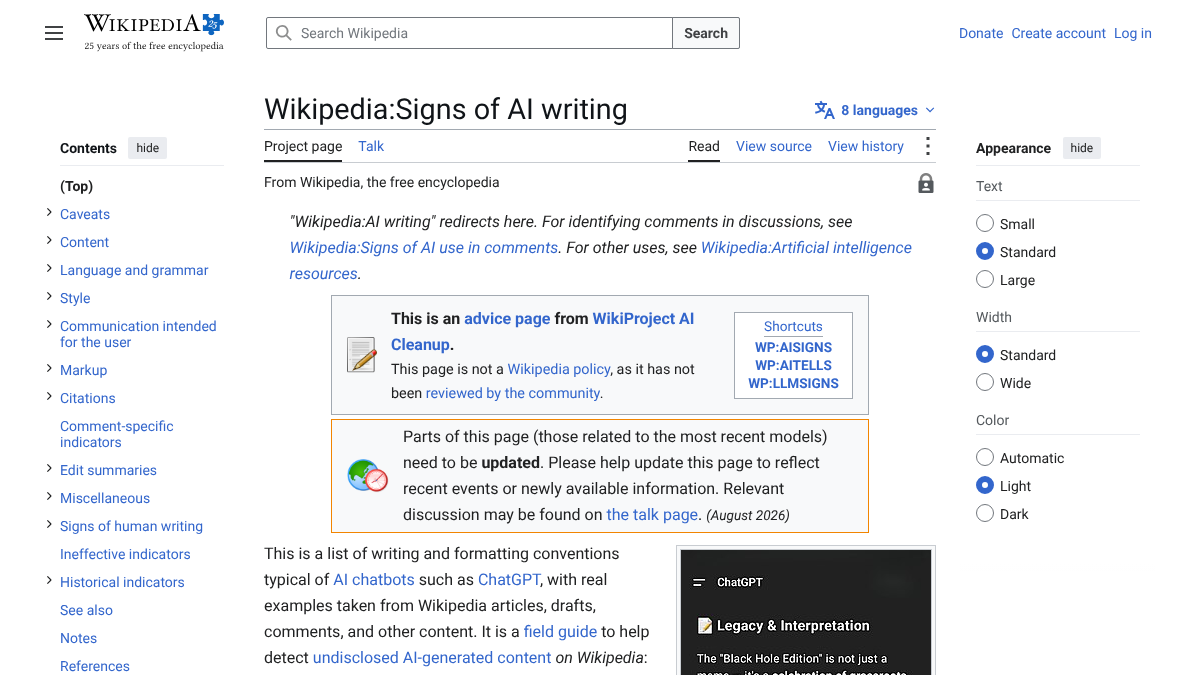
The page carries a banner from August 2026 saying the sections on the newest models need updating, so even the volunteers tracking these tells can't keep the list current.
Joseph Allen, a Harvard professor, put the deeper problem well in September. The real tell, he wrote, isn't em dashes or stock sentence shapes, since models are already improving on those. It's that AI writing is nearly impossible to edit, because there's no intent underneath it to work with. When you edit a person, their mistakes show you what they were going for.
The "tell" that something is written by AI isn't things like em-dashes or 'not just x, it's y' structures (AI is already improving on these), it's this: --> AI writing is impossible to edit. That’s the tell. I read this somewhere a few months ago and it's the truest and most
 Joseph Allen@j_g_allenSep 20, 2026
That matches our test almost exactly. Versions A, B and B' had nothing to edit toward. Version C had a reader and a decision, so even its weak sentence was easy to spot and fix.
What to write instead
Replace the adjective with inputs. Here's a brief template we'd hand to any model, built from what worked in version C:
Write [length] on [topic].

Reader: [one specific person, their situation, what they're deciding]
What they already know: [so the model skips the basics]
Facts to use: [numbers with sources, product details, prices]
One worked example: [a real scenario with real figures]
Our view: [what we recommend and why]
Avoid: [phrases your team is tired of, plus anything off-brand]
Format: [paragraphs, a table, steps] and [hard length limit]
A few notes on using it. Give facts the model needs to make the argument, not facts it has to squeeze in, or you get the SBA sentence again. Put the length limit in every prompt, including any editing pass. And the "Our view" line matters more than it looks, because a model with no opinion to defend fills the space with balance and reassurance.
Then do the part only a person can do. Add the thing you know that the model doesn't: the customer who churned over exactly this, the price that changed last month, the mistake your team made on the first rollout. That's the detail readers remember, and no prompt can invent it honestly. Our post on better context over better prompts goes deeper on keeping those facts on hand, and we ran a similar test on ChatGPT prompts for keyword research.
Budget about 20 minutes to write the first brief for a new content type, then five minutes per article to fill it in. It's slower than typing "make it sound more human," and it's the only version in our test that produced something worth publishing.
26 content formats. Published on your domain. Matched to your brand.
Guides, comparisons, listicles, case studies, and more. RankControl generates content that gets cited by ChatGPT, Perplexity, Claude, Gemini, Grok, Google AI Mode, and Google AI Overviews.

Where this leaves AI-written content
Most content teams use AI somewhere in their writing now, so the argument here is about inputs. A model given a reader, real numbers and an opinion writes something close to what a knowledgeable person would write. A model given "sound more human" writes the same generic draft in a friendlier voice.
If your AI drafts read flat, look at what went into them before you reach for a humanizing prompt or a tool that promises to fool a detector. The fix sits upstream, in the brief. For the planning side of this, our guide to using AI for SEO without publishing content nobody reads covers which jobs AI handles well, and our five-step process for using AI in content marketing without sounding generic runs from the brief through the edit.
You can build and maintain these briefs yourself. Keep a facts file per product, update the prices when they change, and fill in a brief for every article.
Or RankControl can do the heavy part. Brand Control keeps your products, voice and competitors on file, read from your own site, so every draft starts from your real details, and the content engine writes each article against the pages already ranking for its keyword, then scores it for how easily AI engines can quote it, with a fix list. You add the story only you know.

Your competitors are getting cited by AI. You're not.
Every day without citation tracking is a day your competitors pull ahead in ChatGPT, Perplexity, and Claude.