
Getting cited by AI search without SEO spam comes down to two things. You need plain, accurate pages on your own site that answer buying questions, and you need genuine mentions on the pages AI engines already trust. Most of the rest is either unnecessary or risky.
To see what ChatGPT cites when buyers ask for recommendations, I ran a small test. This guide covers what it found, which pages to build, and where Google draws the spam line.
What ChatGPT cited in 24 buying answers
On September 27, 2026, I sent 12 buying questions to ChatGPT through OpenAI's API with web search on, twice each. They ranged from "best CRM for a 10-person B2B sales team" to "best payroll service for a small business." The 24 answers carried 100 citations between them.
| Page type | Citations |
|---|---|
| Vendor pricing pages | 53 |
| Vendor product or solution pages | 27 |
| Vendor comparison or best-of pages | 8 |
| Vendor help and docs | 7 |
| Other vendor files | 2 |
| Third-party reviews and research | 3 |
Ninety-seven of the 100 citations pointed to a vendor's own site. Only three answers cited an independent review page at all: two software guides from TechnologyAdvice and one agency's research page comparing GEO tools. None cited Reddit, YouTube, Wikipedia, G2 or Capterra.
The two runs of each question agreed on the broad picture but not the details. The CRM question cited the same five pricing pages both times. The project management question cited four pages on the first run and two on the second, and the contractor invoicing answer changed its top pick between runs.
Treat this as one sample, not a law. The API's web search is close to the ChatGPT app but not identical, and the app often shows more third-party sources. Still, the pattern is hard to miss: for buying questions, ChatGPT went straight to the pages where vendors state their prices and plans. We found the same pattern for HR software, alongside a very different mix in Google's AI Overviews, in our HR tech playbook.

Your competitors are getting cited by AI. You're not.
Every day without citation tracking is a day your competitors pull ahead in ChatGPT, Perplexity, and Claude.
The plain page
I call it the plain page: the unglamorous page that states a fact a buyer needs, such as a price, a plan limit, a feature or a setup step. Pricing pages alone drew more than half the citations in the test. Answers quoted per-seat prices, plan names and entry costs straight from them.
That makes the plain page the first and least spammy place to work. Five things help:
- Put real prices on the page. An answer can't quote a price that sits behind a demo form.
- Name who each plan is for. Answers often sorted picks by situation, such as solo contractors or product-led SaaS.
- Keep plan limits and features in text. A number inside an image or a toggle is harder to quote than a line of text.
- Write help docs for setup questions. Seven citations came from help centers and docs.
- Date your prices. Plans change, and an answer that quotes last year's price sends a buyer into a surprise at checkout.
Balanced comparison pages on your own site count too. Jobber's page comparing itself with Housecall Pro was cited, and the answer picked Jobber for most contractors. A comparison earns that when it states the rival's strengths as plainly as your own.
The same logic applies to articles. A post that answers one buying question with specifics gets quoted, and a vague one doesn't. RankControl's content engine writes articles from the questions you're losing. It scores each one it writes for how easily AI engines can quote it, with a fix list. It doesn't edit your pricing or product pages, so those stay your job.
Where Google draws the spam line
Google's guide to its generative AI search, last updated in July, is blunt about the shortcuts. Creating separate content for every variation of how people might search, mainly to manipulate rankings or AI answers, "violates Google's scaled content abuse spam policy." The guide adds that a high number of pages doesn't make a site higher quality.
It's equally direct about mentions. "Seeking inauthentic 'mentions' across the web isn't as helpful as it might seem," the guide says, because Google's AI features depend on both its ranking systems and the systems that block spam. It also lists things you can ignore for Google: llms.txt files, chunking content into small pieces, rewriting pages only for AI, and special AI schema.
In r/GEO_optimization this September, a post walking through that list drew more than 50 upvotes. The author called it "basically a free procurement tool" for anyone being quoted for GEO work.
Google published a "what you don't need to do" list for AI optimisation and it kills off half the GEO packages being sold
Why gamed citations don't last
Citations you get by gaming what a search engine retrieves today, such as a burst of self-serving list posts, can look like progress on a dashboard. Then they vanish when retrieval changes.
Harpreet Chatha, an SEO consultant, showed how this works in January. Ask ChatGPT for the best accounts payable software with web search on, and a young vendor appears, because it features in listicles that rank. Turn live retrieval off and it disappears, since the model's own knowledge favors older, established brands.
AI prompt tracking can fool you into thinking you’re doing great at AEO or GEO, when really you've just temporarily hijacked a search result. Here’s an example. Ask ChatGPT for the best AP software with web search enabled, and SuitiAP shows up. Why? Because it appears in https://t.co/bmTnPDtX2u
 Harpreet@harpreetchatha_Jan 9, 2026
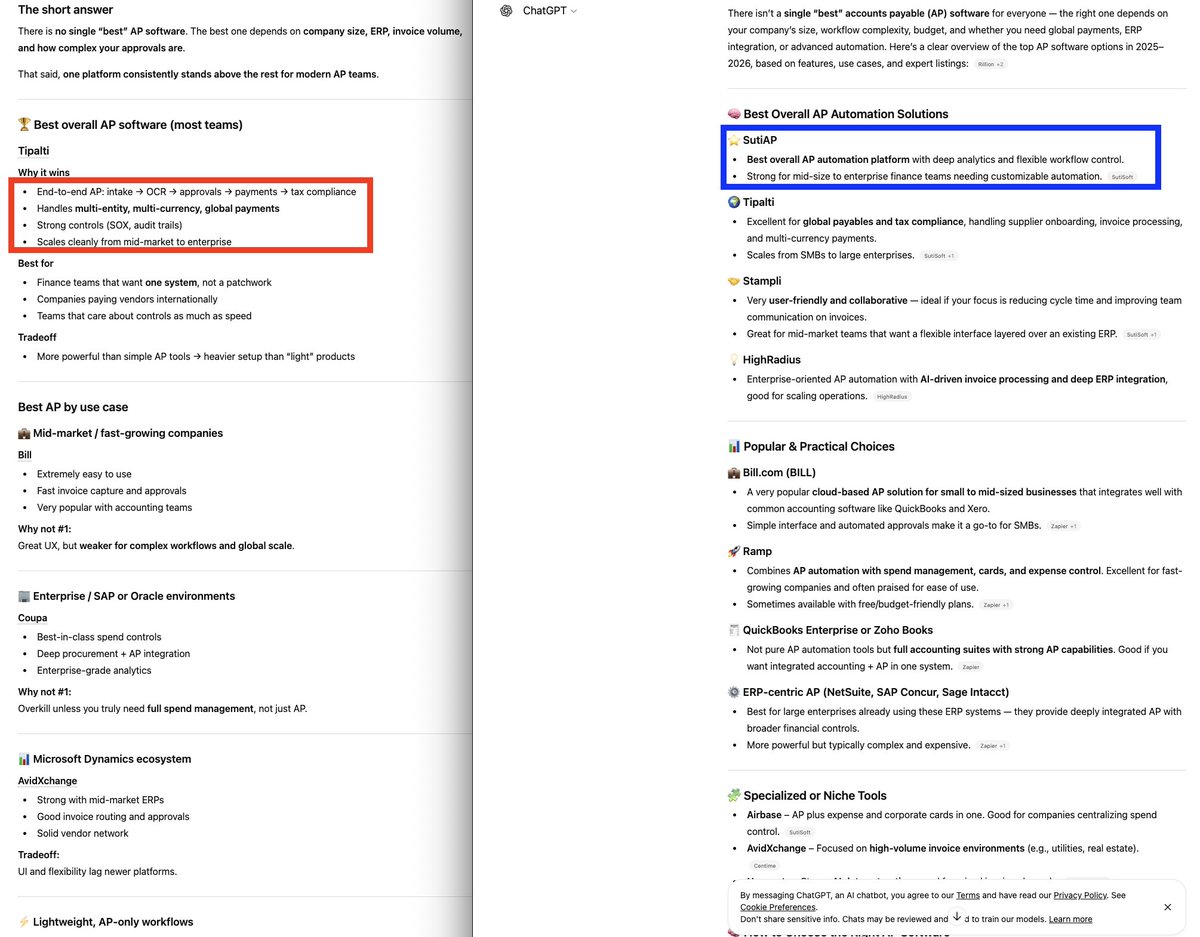
Our test showed the other risk. Six vendors had their own comparison or best-of page cited. Four were the answer's top pick. For the other two, a payroll company and a help desk company, ChatGPT used their list and recommended a rival. Writing yourself into first place doesn't guarantee the answer follows. We looked at this in why listicle SEO is losing power.
Earn mentions the normal way
Your own pages carry buying questions, but third-party pages still shape which brands an answer trusts. The clean way to appear there is the old way: give editors and writers a reason to include you.
- Find the pages AI already cites for your questions. In our test these were independent review sites; in your market they might be trade blogs, podcasts or analyst pages.
- Pitch with something useful. Offer accurate pricing, a free trial, a customer they can speak to, or data they don't have.
- Get real reviews. Ask customers to review you on the sites your buyers read, and never pay for fake ones.
- Disclose any paid placement. A sponsored mention is fine when it's labeled.
Link Control in RankControl finds prospects and contacts for each article it publishes and sends the pitch from your own mailbox after you approve it. Follow-ups stop when someone replies. You can do the same by hand with a spreadsheet and a lot of patience.
200+ SaaS teams already track their AI citations.
They know exactly when ChatGPT mentions their brand, and when it stops. Do you?

How long it takes
Pages that engines find through live search can start earning citations within weeks, once they're crawled and indexed. That's why pricing and product pages show up so fast: they already exist and get crawled often. What a model says from its own training data moves much more slowly, over model updates, and depends on years of what the web has said about you. Plan for both: fix the plain pages now, and build real mentions for the long run.
Make sure AI crawlers can read your pages
None of this matters if the engines can't fetch the page. Check that your robots.txt doesn't block the AI crawlers you want, such as OAI-SearchBot, ChatGPT-User, PerplexityBot and Claude's crawlers. Check your firewall too: bot protection can return a 403 to AI crawlers while your site looks fine in a browser. Our guide to Cloudflare Bot Fight Mode and SEO covers that case. RankControl checks every day whether AI crawlers can reach your site.
Check that it's working
The real problem isn't doing this once. It's knowing when it stops working. Prices change, plans get renamed, and a competitor publishes a better page. Answers also move from run to run, so one check tells you little.
Pick 20 to 50 buying questions and check them on a fixed day each week, across the engines your buyers use. Note which of your pages get cited and which competitors appear. AI visibility tracking in RankControl does this weekly across six engines and notifies you when a new citation appears. A lost citation shows up in the dashboard, not as an alert.
A spam-free citation plan, step by step
- List the 20 to 50 questions your buyers ask AI before they buy.
- Update your pricing, product and help pages so each fact is current and in plain text.
- Write one clear article for each buying question you don't yet answer.
- Unblock AI crawlers in robots.txt and your firewall.
- Pitch the third-party pages already cited for your questions, and collect real reviews.
- Check your questions weekly and fix what slips.
You can run that loop by hand, or RankControl's agents can run it every month for $400, with a 7-day free trial. Before you start, the free AI visibility check shows who ChatGPT cites for three questions from your market today.
How often does ChatGPT mention your brand?
Most founders have no idea. The answer might surprise you.