Our help desk questions turned up a customer support software startup whose lists were cited seven times, and the startup wasn't named in any of the answers that cited them. The engines took its research and handed the recommendation to its competitors.
It wasn't the only vendor this happened to. On September 26 we reread the AI answers our recent tests had produced and flagged each time a software vendor's self-written "best X" list was cited. That gave us 44 cases, and in 27 of them the list's author got no mention at all.
Listicles still get cited heavily. The part that's fading is the reward for ranking yourself first in a "best of" list you wrote, and that's why listicle SEO is losing power in AI citations. The rest of this guide goes through the data, the reasons behind it and what you should publish instead. We checked every source on September 27, 2026.
Listicles still get cited
Lists haven't lost their place as sources. When Ahrefs studied ChatGPT's responses to 750 top-of-funnel queries, in research published in December 2025, the page type cited most often was the "best X" blog list.
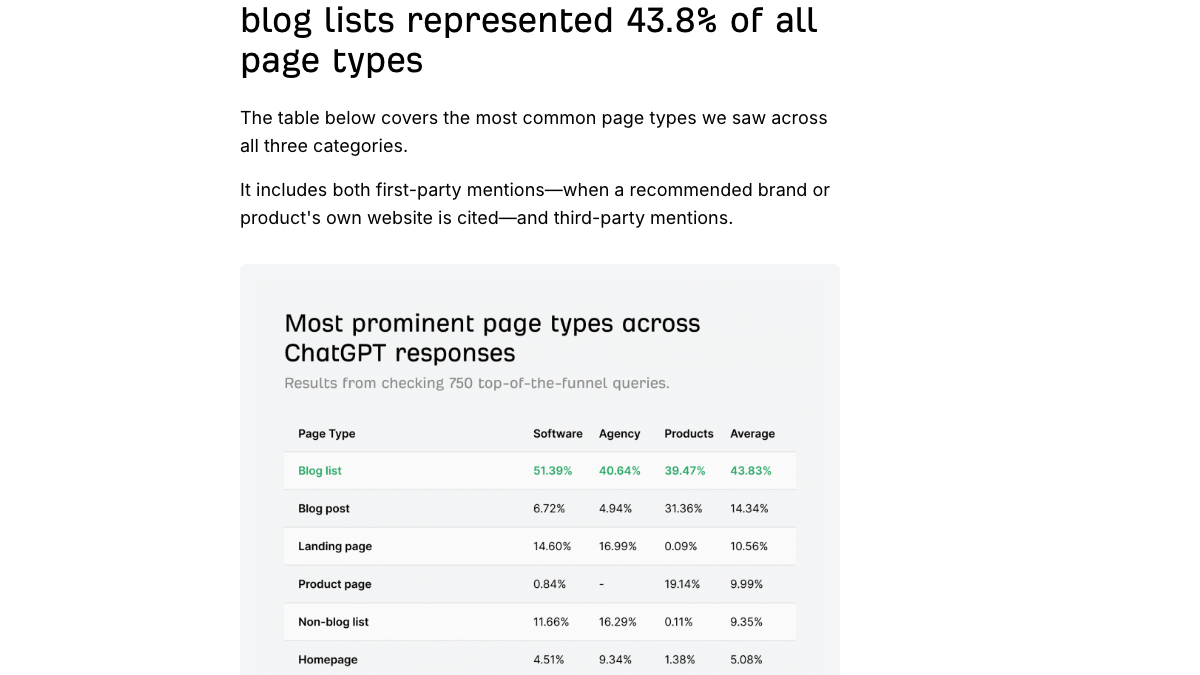
We saw much the same on buying questions in September. When we asked which CRM, help desk or similar tool is best, lists and comparison pages accounted for 58% of the pages cited through Perplexity's API. Through OpenAI's API, they accounted for 71%.
It's easy to see why. If a person wants help choosing one product, a page that lines up ten of them side by side saves an engine more work than anything else it could fetch, so lists stay the main research source for these questions.
Cited, then passed over
The shift is in what an engine does once it has cited the list. Lily Ray's June study took 100 Google searches of the form "best [category] software," and an AI Overview appeared on 80 of them. Those overviews used self-promotional lists as sources 323 times. On 224 occasions, an overview relied on a brand's own list and still left that brand out of its picks.
It’s still funny to me that Google will cite self-promoting listicles to back up various parts of the AI Overview / AI Mode answer… but it (often) ignores the part about the person recommending themselves https://t.co/DmU3HXBbg5
 Lily Ray 😏@lilyraynycJul 28, 2026
Ahrefs got a similar result from an experiment on its own site. It promoted its conference on its own pages, and 43% of the answers citing those pages didn't mention the conference. Lined up with the other two checks, the numbers look like this:
| Check | What was measured | Cited without recommending the publisher |
|---|---|---|
| Lily Ray, Google AI Overviews (June 2026) | 323 self-promotional list citations | 69% |
| Ahrefs self-promotion experiment (2026) | Answers citing its own promotional pages | 43% |
| Our check, OpenAI's and Perplexity's APIs (September 2026) | 44 citations of vendors' own best-of lists | 61% |
We think of this as the corroboration test. An engine treats your list about yourself as a single opinion, and before it recommends you, it wants sources outside your control to say the same. With that backing, your list helps you. Without it, you've written research that somebody else's recommendation gets built on.

Built by the team that got cited in 48 hours.
Content generation, backlink building, AI visibility tracking, and Google rankings. One platform, zero guesswork.
When a self-promotional list does work
Vendors do get something out of these lists, and it's worth being precise about what. Working from Ahrefs' December data, Glen Allsopp looked at software-category ChatGPT responses that recommended a list's publisher. In more than a third of them, that publisher's self-promotional blog list was among the sources too.
In April, someone on r/seogrowth took that finding as a reason for brands to publish a list for each use case they cover. Commenters weren't having it. They pointed out that Google had already started acting on the tactic, and that nobody can cleanly tell how much the list helped versus how much the brand's existing authority did.
brands writing themselves into self promotional "best X" lists for geo - ahrefs research
so ahrefs had this recent study about whether self promotional best lists work for chatgpt or not. the data set was good - 26k+ so worth noting the result was: self promotional blog lists showed up in more than a third of chatgpt responses...
So where does the line fall? Splitting our 44 vendor-list citations by question set gives a clue:
| Questions | Citations of a vendor's own list | Vendor named | Vendor not named |
|---|---|---|---|
| 5 help desk questions | 23 | 8 | 15 |
| 6 B2B software questions, from CRM to billing | 21 | 9 | 12 |
Named vendors were mostly the ones that genuinely fit the question. We asked which shared inbox is best for email support, and the engines cited lists from two shared inbox specialists and named them both. They also cited a broader help desk vendor's list twice for that question, without naming that vendor once. The vendors that got skipped had mostly written lists for broad categories, where outside sources didn't rate them a top pick.
Google is pushing back too
Put the Google signals next to the ChatGPT ones and a list built to crown its publisher looks worse on both fronts than it did a year ago. It carries more search risk, and it earns less in AI answers.
Starting in mid-to-late January 2026, Lily Ray watched visibility fall sharply on the blogs of several well-known software companies. Each had published a lot of "best" lists ranking itself, and one blog had 191 of them. Ray attributed the drops to refinements in Google's reviews system. According to Search Engine Land, the sites affected lost 30% to 50% of their visibility.
No listicle policy has come from Google. What does exist is its guidance on writing high-quality reviews, which asks anyone calling a product the best overall, or best for some purpose, to explain the call and support it with first-hand evidence. If you rank yourself first without doing that work, your list misses the bar Google sets out.
On ChatGPT the trend runs the same way. One agency analyzed 2 million ChatGPT citations and watched listicle citations drop by 30%. That happened between December 2025 and January 2026. Then in September, Lily Ray shared data in which ChatGPT cited more commercial pages and documentation, and fewer listicles and social posts.
Why the recommendation goes elsewhere
Think about how an engine assembles a buying answer. It collects sources, looks for the products that most of those sources agree on, and writes up the reasons. Your self-promotional list gives it categories, features and prices to work with, which is useful, so it gets cited. The ranking at the top of your list is different. That's the one piece the engine can compare against everyone else, and a single vote cast for yourself almost never holds up.
The places engines look are shrinking, too. In July, Lily Ray noted that newer ChatGPT models search more times per answer, and some of those searches only cover a handful of trusted sites. A vendor's own page gets less say in the verdict as a result.
That fits what we found. A product that G2, independent review sites and other vendors' lists all bring up for a use case gets named. When a product's own list is the only one bringing it up, the engine cites that list as research and gives the recommendation to a different product.
See your first AI citation report in under 5 minutes.
No setup calls. No onboarding meetings. Connect your domain and see where AI mentions your brand right now.
What to publish instead
Your existing lists can probably stay up. They need a new purpose, though, and they shouldn't be where your effort goes first.
Your first priority is the independent lists. G2 was home to more of the cited best-of lists in our check than any other site, with ten across the answers, and review sites and publishers came after it. Keeping complete, current profiles on those sites, and landing on respected third-party roundups, gives you the outside agreement your own page can't supply.
Second, write pages for the narrow use cases your product really wins. A claim like "Best help desk for a two-person support team" is one you can back with details, which is rarely true of "best help desk software." For list structures that keep you honest, see our earlier guide to the listicle strategy.
Any best-of list you keep on your own site should earn its place. Show the criteria, rank yourself where you actually belong, and update it regularly. Of the lists ChatGPT cited, Ahrefs found 79.1% had been updated in 2025, so old ones fall away quickly. Mentions on sites the engines already trust matter as well, and our comparison of brand mentions and backlinks goes into how to earn them.
Then measure whether you're recommended, as well as whether you're cited. Most tracking will score a cited list as a win even when your name never appears in the answer. Our guide to an AI visibility dashboard keeps mention rate and citation rate apart, so you can see that gap.
Auditing your lists works the way our check did. Take the buying questions each list targets and put them to two or three engines. For each answer citing one of your list pages, write down whether your product gets named. If it's named in under half of them, most of that list's work is going to your competitors.
The hours add up if you do it all manually. We'd estimate, roughly, six hours a week to check 50 questions across seven engines. Eight solid articles a month would take another 16 to 24 hours on top.
RankControl's AI visibility tracking puts your 50 questions to seven engines every week. Each question is marked mentioned, cited or both, and the competitors and sources each engine drew on are recorded. Articles come from the content engine, which writes each one against the pages that already rank for its keyword and publishes it on your own domain.
A spreadsheet and one afternoon will get your own audit done. Or RankControl's agents can keep weekly track of mentions and citations, and your team can put its time into earning independent coverage.
Your competitors are building backlinks while you read this.
Organic outreach, social mentions, and citations from Editorial Circle member sites, with managed backlinks available as an add-on. Grow your domain authority without running the campaign yourself.