Most blog posts never earn a single link. Backlinko's study of 912 million posts, run together with BuzzSumo, found that "94% of all blog posts have zero external links."
The posts that do earn links tend to share a handful of traits: useful to reference, hard to copy, easy to cite. Those are the exact same traits that make a page show up in AI answers. This guide covers the types of linkable assets that actually work, the link counts behind some well-known examples, and why those same pages keep getting quoted by AI.
What a linkable asset is
Ahrefs, which wrote the standard guide on this, describes a linkable asset as "a piece of content purposely crafted with the intention of attracting links," usually from other sites in your niche.
The same guide makes a blunter point too: "people rarely link to commercial content." Product pages, pricing pages and sales pages almost never earn links on their own merit, no matter how good they are. Linkable assets do that earning instead, and the authority they build spreads to the rest of a site through internal links.
I think of this as the reference test. Before building anything, ask whether another writer would ever need to point at your page to make their own point. If the honest answer is no, what you've got is a blog post, not an asset.
The main types
| Type | Example | Why people link |
|---|---|---|
| Free tool or calculator | Color palette generator, headline analyzer | Readers can use it directly |
| Original study or data | Industry survey, analysis of your own data | Writers need a source for a number |
| Visual explainer | Infographic, diagram, map | Easier to show than explain |
| Template or checklist | Spreadsheet, swipe file | Saves readers time |
| Definition or coined term | A clear name for something new | Writers cite where a term came from |
| Definitive guide | The most complete answer on a topic | A single place to send readers |
What we found on well-known assets
On October 19, 2026, we pulled referring-domain counts from one backlink index for five well-known linkable assets, plus two pricing pages thrown in for comparison.
| Page | Type | Referring domains |
|---|---|---|
| Coolors color palette generator | Free tool | 14,658 |
| CoSchedule Headline Analyzer | Free tool | 4,149 |
| Ahrefs study, "How long does it take to rank in Google?" | Original study | 1,525 |
| Backlinko and BuzzSumo content study (912M posts) | Original study | 1,455 |
| NeoMam "13 reasons your brain craves infographics" | Visual explainer | 367 |
| CoSchedule pricing page | Commercial page | 216 |
| Ahrefs pricing page | Commercial page | 1,960 |
Three things jump out of that table. Free tools earned the most, with both clearing 4,000 referring domains, probably because people link to a tool they'll keep returning to rather than one they used once. On the same site, the asset also beat the pricing page by a wide margin: CoSchedule's headline analyzer pulled in roughly 19 times as many referring domains as its own pricing page.
Famous brands break that pattern. Ahrefs' pricing page actually had more referring domains than the Ahrefs study next to it in the table, because a well-known product earns links from reviews and comparisons almost by default. A smaller brand doesn't get that for free, so the asset has to do far more work.
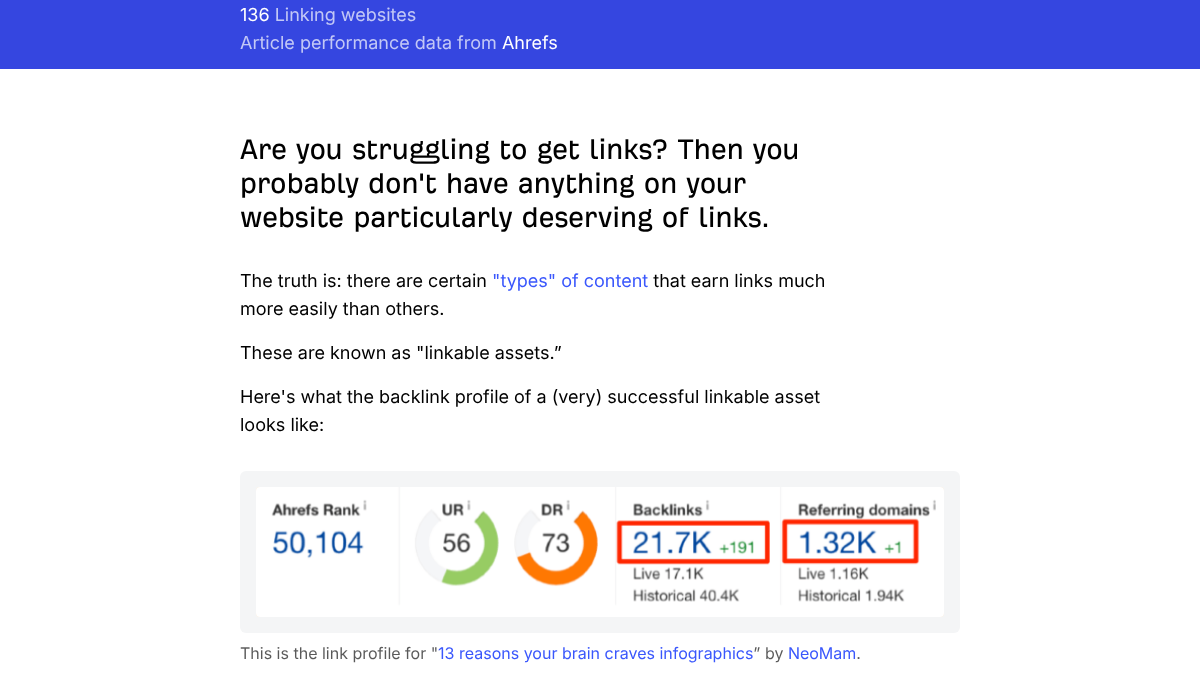
Link counts also shift depending on which index pulled them. Ahrefs' own guide showed 1.32K referring domains for that same NeoMam page, while the index we used found only 367. Different crawlers cover different slices of the web, so compare pages within one tool rather than across tools.

Your competitors are getting cited by AI. You're not.
Every day without citation tracking is a day your competitors pull ahead in ChatGPT, Perplexity, and Claude.
Which formats earn links, according to the studies
The Backlinko and BuzzSumo study, from 2019, compared formats against each other directly. It found that "'Why Posts', 'What Posts' and infographics received 25.8% more links compared to videos and 'How-to' posts." Long-form content, anything over 3,000 words, earned "an average of 77.2% more links" than articles under 1,000 words.
The same study also shows just how rare links really are. Only 2.2% of content earned links from multiple websites, and most content earned none at all, which is exactly why picking the format matters before you start writing a word of it.
Ahrefs' guide makes a similar point about studies specifically. "Four of the five most linked-to pages on our blog are studies," it said. Shares and links don't move together either. The same Backlinko study found "virtually no correlation between backlinks and social shares," meaning a post can go viral on social and earn nothing, or earn hundreds of links while barely getting shared at all.
Why the same pages get cited by AI
The traits that earn links turn out to overlap heavily with what makes AI engines quote a page in the first place.
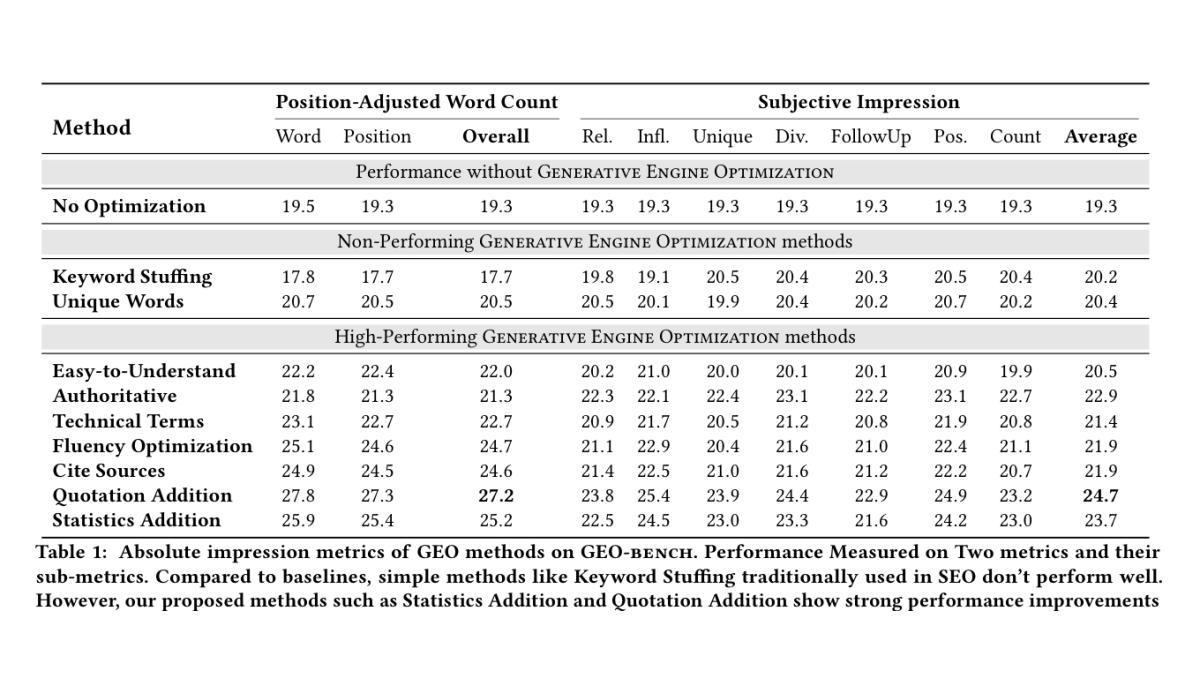
A Princeton-led study called "GEO: Generative Engine Optimization," presented at KDD 2024, tested which changes to a page raised its visibility in AI-generated answers. Its authors reported that "including citations, quotations from relevant sources, and statistics can significantly boost source visibility."
| Change tested | Visibility vs. no changes |
|---|---|
| Adding quotations | +41% |
| Adding statistics | +31% |
| Citing sources | +27% |
| Keyword stuffing | −8% |
Those figures are our own calculation from the paper's overall scores measured against its 19.3 baseline.
Newer log data points the same direction. Ahrefs studied 66.6 million ChatGPT responses from August and September 2026 and found that sites summarizing other people's reporting were losing citations to "original research, hands-on testing, and your own product facts." Original data, named sources and clear numbers are exactly what a study or a well-sourced guide is made of. A thin post that just restates what's already out there has none of those ingredients.
Links feed AI answers indirectly too, since AI engines lean heavily on third-party sources. The coverage and mentions an asset earns put your name on the pages AI draws from in the first place. Our post on brand mentions vs backlinks covers how those two signals compare.
200+ SaaS teams already track their AI citations.
They know exactly when ChatGPT mentions their brand, and when it stops. Do you?

How to pick your asset
Start with what you already have. The best assets come from data, expertise or tools that competitors can't easily copy overnight.
| If you have | Build |
|---|---|
| Customer or product data | A study or benchmark report |
| A repeated calculation buyers do | A free calculator |
| A process you explain often | A template or checklist |
| A new idea with no name | A clear definition and a name for it |
| A complex topic | A visual explainer |
Then check demand before committing. Search for the question your asset would answer, and if people already search for it while the current results stay thin or out of date, there's genuinely room.
A thread on r/SEO from August asked how people were building links at all now that cheap, low-quality backlinks stopped working. The poster felt stuck between paying for links and getting none.
How are you guys building backlinks after Google officially said random and low quality backlinks are useless? If I want real, authentic links, I have to pay. I'm stuck with backlink building.
I'm an SEO Analyst, and one of my main responsibilities is backlink building. Recently, after reading Google's official guidance that low-quality, unrelated backlinks (like random blog submissions, directory submissions, bookmark sites, etc...
The top reply pointed straight at an asset without ever using that word. It suggested link-backs from partners and customers, plus an awards program that names the best uses of your product and hands winners a badge to display. That's a linkable asset built entirely around your own customers.
A similar thread on r/Backlinks asked how people were earning quality links in 2026, and the replies kept circling back to the same idea: build something worth citing instead of paying for a placement.
How are you guys acquiring quality backlinks in 2026?
I'm curious what everyone's backlink strategy looks like in 2026. I still get dozens of emails every week from people selling backlink packages or offering placements on random websites, but I'm not interested in buying low-quality links. F...
How to build one that works
- Answer one clear question. A tool or study that does one thing well beats a sprawling one that tries to do five.
- Use data others don't have, your own customers, your own product usage, or a survey you actually ran yourself.
- Show your method plainly. Writers cite sources they trust, so say exactly how you got the numbers.
- Make the key finding quotable, ideally one clear sentence that carries a number in it.
- Give it a stable URL, and update that same page every year instead of publishing a brand new one.
- Promote it. Send it to journalists covering the topic, share it in the right communities, and pitch it to sites already linking to an older version.
Promotion matters more than most teams expect going in. Our guide to how to build backlinks covers outreach, and our post on broken link building covers finding sites that link to outdated versions of your asset already. For studies specifically, our guide to statistics and data roundup posts covers structuring them so they actually get cited.
Mistakes to avoid
Building an asset nobody searches for is the most expensive mistake, so check demand first. Gating it behind a form is close behind, since writers won't link to a page their readers can't see. Letting it go stale costs you slowly, since an outdated study stops earning new links and starts losing the ones it had.
Publishing and waiting rarely works either, since assets need active promotion to earn their first links. Copying an asset that already exists tends to backfire too, since people keep linking to whichever version came first.
Doing it yourself or handing it off
Building one strong asset a quarter is realistic for most teams. The harder part is the steady stream of articles around it that answer buyers' questions and link back to it.
RankControl handles that side. We find the questions your buyers search, write each article against the pages already ranking for it, and publish it on your site, with internal links to your key pages. Our outreach finds link prospects for each published article and drafts the emails from your own mailbox, and nothing goes out without your approval. Our AI visibility tracking checks up to 50 buyer questions every week across seven AI engines. Expect traffic from Google to move first, with AI citations following more slowly as links and mentions build up.
How often does ChatGPT mention your brand?
Most founders have no idea. The answer might surprise you.