
A content lead at a large company posted in r/SEO this month that their roadmap was being rebuilt around AI visibility. They'd always syndicated articles to Taboola and Apple News. Now management wanted to know whether syndication still mattered for getting cited by AI.
Does content syndication matter for GEO?
I work in SEO and content marketing for a large corp, and they’re completely changing the content roadmap to drive a new GEO strategy. We’ve traditionally syndicated content to platforms like Taboola and AppleNews. Do these syndication camp...
Nobody in the thread had data, so we made some. We tracked 20 articles that get republished all over the web and checked which version Google, ChatGPT and Google AI Mode gave credit to. The short version is that syndication spreads your work, and the credit goes to whoever each engine trusts. Google's AI credited the original every time. ChatGPT mostly didn't.
What content syndication is
Content syndication means republishing an article on other sites after it first runs on yours, with your permission. There are three common kinds.
| Type | What it looks like | Who does it |
|---|---|---|
| Full republishing | The whole article runs on another site, with credit | News wires, Yahoo, MSN, local papers |
| Self-syndication | You post your own article on a platform | Writers on Medium, Substack or LinkedIn |
| B2B lead-gen syndication | Gated content on third-party sites, paid per lead | Content syndication vendors |
The third kind shares the name but works differently. A thread in r/b2bmarketing this month showed the confusion. An agency had pitched syndication to a SaaS company as a way to raise domain authority and AI visibility, and most replies said that's not what it's for.
Is content syndication valid today?
Hi! I work for a b2b saas company and recently the management decided to outsource an agency just for increasing AI visibility. This agency is suggesting content syndication to increase domain authority over time. I have personally never he...
This post covers the first two kinds, where the same article lives on more than one site.
What Google says now
Google changed its advice in 2023, and the current version is in its guide to fixing canonicalization issues. It says the canonical tag is "not recommended" for syndication, because the pages are often very different. The most effective fix, it says, is for partners to block indexing of your content.
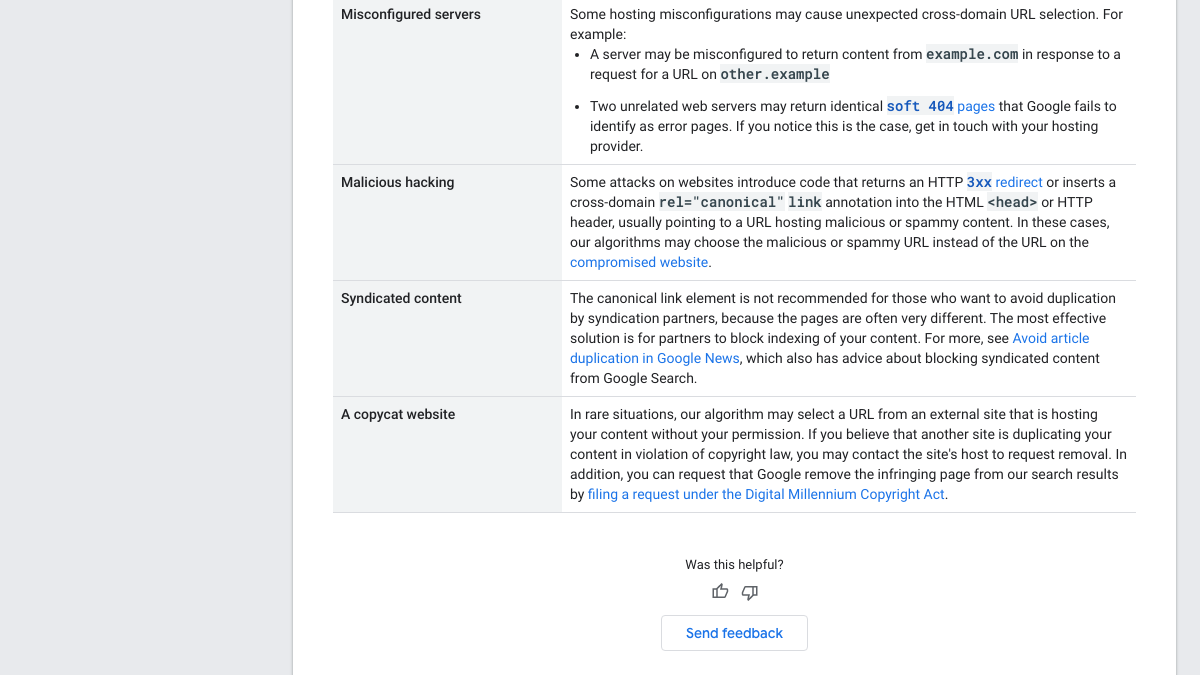
In practice, many partners don't, and plenty of republishing deals never ask them to. Then Google has to work out the original on its own, and our post on duplicate content covers how it picks one page from a group of copies.
We'll show you exactly where your brand stands in AI search.
No commitment. $0 due today, cancel anytime. See how ChatGPT, Perplexity, Claude, Gemini, Grok, Google AI Mode, and Google AI Overviews talk about your brand today.
Our test: 20 republished articles
We needed articles that are syndicated widely and on purpose. The Conversation is ideal. It publishes academic writers under a Creative Commons license, and its republishing guidelines let any site run its articles for free if they credit the author and link back. They don't require a canonical tag.
On October 19, 2026, we took 20 articles The Conversation published between October 13 and 16. For each, we searched the exact title on Google, and we asked ChatGPT and Google AI Mode the title as a question, through a data provider's live US feed. Then we checked which version of the article each one showed.
| What we checked | Google page one | ChatGPT | Google AI Mode |
|---|---|---|---|
| Showed a version of the article | 14 of 20 | 10 of 20 | 17 of 20 |
| Credited the original | 8 (always ranked first) | 1 | 17 |
| Showed only other versions | 6 | 9 | 0 |
The three engines behaved very differently.
Google Search: the original usually wins, when it shows up
When the original made page one, it was always first. But in 6 of the 14 searches that showed the article, the original was missing and other versions took its place. Those were full copies on UPI, a local paper and a Canadian site, plus a university press release and Facebook and LinkedIn posts.
Across the 20 searches, page one held 39 other results matching the articles' titles, not counting social posts, many of them full copies. One article about young voters had 9 of them, most of them local newspapers running the same text. The articles were only 3 to 6 days old, which may explain why Google hadn't settled on the original for some of them.
ChatGPT: mostly the copies
ChatGPT used one of the articles in 10 answers. Only one of them cited theconversation.com, and that answer also cited a copy on the Greenwich Time.
The other 9 cited only republished versions. They included the Washington Post, Yahoo Finance, phys.org, Nautilus, the University of Maine, and local news sites like the Seattle PI, KHQ and the CT Post. The link, and any click from it, went to the republisher.
Google AI Mode: always the original
AI Mode used the article in 17 answers and linked the original every time. In 14 of those, it also linked one or more copies alongside it, like Yahoo, CT Insider or Medical Xpress.
That fits what Google says about its AI features, which pull from the same index and ranking systems as Search. Once Google has decided which page is the original, AI Mode seems to follow that choice. ChatGPT runs its own searches and doesn't share it.
Do canonical tags help?
We tried to open every republished copy from the test to check its canonical tag. Most blocked our requests, so we could read 23. Of those, 10 pointed a canonical tag at the original, including all five Yahoo copies. The other 13 pointed at themselves or had none.
The tag didn't stop ChatGPT. Two of the copies it cited, on Yahoo Finance and NBC Right Now, pointed their canonical tags at The Conversation, and ChatGPT cited them anyway. A canonical tag is a hint to search engines, and ChatGPT's answers don't seem to read it.
Know exactly what AI says about your competitors.
RankControl's Recon Agent monitors competitor citations across ChatGPT, Perplexity, Claude, Gemini, Grok, Google AI Mode, and Google AI Overviews. See where they show up and you don't.

So does syndication help or hurt?
It depends on what you need from the article.
It helps with reach. A copy on Yahoo or a local news site puts your name in front of readers you'd never reach, and AI engines read those copies too. If your brand or author name is in the article, a cited copy still counts as a mention. Our post on brand mentions vs backlinks covers why mentions count in AI answers.
It hurts when you need the traffic or the citation link itself. In our test, ChatGPT's link went to the copy 9 times out of 10. If that article was your best page for a buyer question, the click went to someone else.
How to syndicate without losing the credit
- Publish on your own site first, and wait until Google has indexed it before anyone republishes it.
- Ask partners to noindex their copy, which is Google's recommendation. If they won't, ask for a canonical tag pointing to your original.
- Ask for a link to your original near the top of the copy, where readers and crawlers see it first.
- On Medium, use the import tool. Medium's help page on importing covers it, and imported stories get a canonical link to your original.
- Give self-syndicated versions a different angle, like a shorter take or a summary with a link, so they don't compete with your page.
- Ask ChatGPT and AI Mode the questions your article answers, and check which version they cite.
The last step is the one teams skip. A syndication deal can look fine in Google and still send ChatGPT's citations somewhere else.
Limits of our test
We tested 20 articles from one publisher, a few days after they came out, and asked each question once on one day. The Conversation's articles are news and research, and a company blog may behave differently. We matched versions by title words, and we couldn't read the canonical tags on most copies because their sites blocked our requests.
What this takes by hand
Here's a rough budget for running syndication carefully, by our estimate.
| Task | Hours a month |
|---|---|
| Agreeing terms with partners (noindex or canonical, links) | 1 to 3 |
| Checking each copy's tags and links after it goes live | 1 to 2 |
| Asking AI engines your article's questions and logging which version they cite | 2 to 4 |
| Writing alternate versions for Medium or LinkedIn | 3 to 6 |
Doing it by hand or with help
You can manage syndication yourself. Or RankControl can take on the part that matters most every month while you focus on your product. Its content engine publishes each article first on your own site, as a native post, after your approval. Its AI visibility tracking checks 50 of your buyer questions every week on ChatGPT, Perplexity, Claude, Gemini, Grok, Google AI Mode and Google AI Overviews and shows which sources each engine cites, so you can see whether your page or someone's copy gets the credit.
26 content formats. Published on your domain. Matched to your brand.
Guides, comparisons, listicles, case studies, and more. RankControl generates content that gets cited by ChatGPT, Perplexity, Claude, Gemini, Grok, Google AI Mode, and Google AI Overviews.