
The advice to write 3,000-word blog posts has been around for a decade. Plenty of teams still treat it as a rule. So we checked it.
On October 19, 2026, we ran 14 Google searches across different kinds of intent, from quick facts to buyer comparisons. We measured the length of every page in the top 10 and every page Google's AI Overviews cited, 91 pages in all. The answer to whether long form content wins was clear, and it depends almost entirely on what the searcher wants.
Google doesn't count words
Start with what Google says. Its guidance on creating helpful content, updated October 5, 2026, lists warning signs that a page was made for search engines rather than people. One of them is about word count.
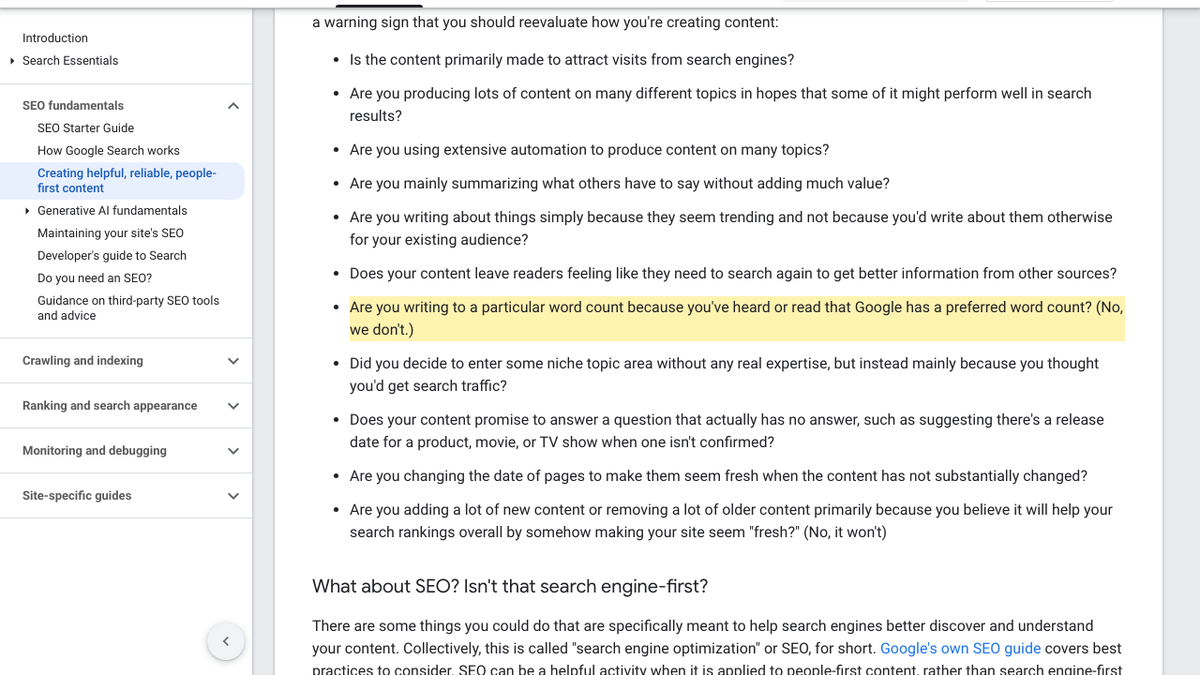
So length isn't a ranking factor on its own. But length often comes with what does matter, like covering every step, comparing every option and answering the follow-up questions. That's why long pages win some searches and lose others.
What we measured
For each search we pulled the top 10 results and the AI Overview's sources, then counted the words on each page. A quick note on method. The counts are the full text of each page, including menus and footers, so a page's article is a little shorter than its count. We got counts for 91 of 124 pages. Video, social and a few blocked pages couldn't be measured.
| Type of search | Search | Length of the #1 page | Median of the top 10 |
|---|---|---|---|
| Quick fact | how many ounces in a cup | 655 | 1,242 |
| Quick fact | when is daylight saving time 2026 | 692 | 692 |
| Definition | what is a 401k | 479 | 962 |
| How-to | how to change a car battery | 641 | 1,426 |
| Comparison | roth ira vs traditional ira | 291 | 1,079 |
| Best-of | best crm for small business | 3,531 | 2,877 |
| Comparison | notion vs obsidian | 4,057 | 3,175 |
| Guide | how to write a business plan | 4,381 | 3,768 |
| How-to | how to start a podcast | 4,951 | 5,937 |
| Product | invoicing software | 1,484 | 1,682 |
Four searches had a #1 result we couldn't measure, so they're left out of the table but kept in the totals below.

Built by the team that got cited in 48 hours.
Content generation, backlink building, AI visibility tracking, and Google rankings. One platform, zero guesswork.
Finding 1: Short pages win short questions
For quick facts and simple definitions, the winners were short. A National Institutes of Health page ranked first for ounces in a cup at 655 words. Investor.gov ranked first for "what is a 401k" at 479. AAA's car battery guide was 641 words, and a USA Today article won the daylight saving search at 692.
These searchers want one answer fast. A long page makes them scroll for it, and Google seems to know that. Even "roth ira vs traditional ira" was won by a bank's 291-word calculator page, because the searcher's real question is which one suits them.
Finding 2: Long pages win guides and comparisons
Flip to searches where the reader needs to learn a process or choose between options, and the winners got long. Shopify's business plan guide ranked first at 4,381 words. Buzzsprout's podcast guide was 4,951. The top "notion vs obsidian" page was 4,057, and the top "best crm for small business" page was 3,531.
These are the searches the 3,000-word rule was made for. Someone starting a podcast needs equipment, hosting, recording, editing and launch steps. Someone choosing a CRM wants prices, features and a verdict for their kind of business. You can't do that well in 800 words.
Finding 3: Longer didn't mean higher
Across all 14 searches, the top three results had a median length of 1,758 words. Positions four to ten had a median of 2,141. So within the same search, being longer than the pages around you didn't push you up.
That matters for the common habit of checking competitors and writing 20% more. If the top result is 1,500 words and complete, a 3,000-word page with padding won't beat it. A more useful page might.
What AI Overviews cited
The 19 measurable pages cited in AI Overviews had a median of about 2,500 words, a little longer than the ranking pages. But the range was huge, from the IRS's 777-word page on IRAs to Moz's 11,272-word SEO audit checklist. In the Roth IRA answer, the AI cited a 5,009-word Vanguard guide, a 1,697-word Schwab page and that short IRS page, side by side.
So AI answers don't reward length either. They reward a passage they can lift. One r/seogrowth reply put it simply, saying a 700-word page with the exact answer and evidence can be more cite-worthy than a 3,000-word article that takes forever to get there.
Do you think long-form or short-form blog articles are better to get cited by AI?
What are some GEO strategies that have worked for you?
Another reply in the same thread said dense long posts get cited a lot, while inflated ones don't, because the AI has to dig past paragraphs of preamble and grabs a cleaner version from someone else.
What other site owners report
Our numbers come from 14 searches, so it helps to compare them with what people see on their own sites.
In August, a blogger posted in r/content_marketing that 37 of their 80 articles were showing up in Google's AI Overviews or AI Mode, according to Search Console's generative AI report. They wrote that their best performers were long explainer pieces that answer questions directly.
37 of my 80 blog posts are actively performing in Google's AI Overviews
Been running my site for about 20 months, and I finally dug into Google Search Console's "Generative AI features" report to see how my content shows up in AI Overviews / AI Mode. Turns out 37 out of 80 articles I've written are actively sho...
The replies pushed on the next question. One said being cited in an overview and being visited are different outcomes, so the clicks on those 37 pages matter more than the count. Our post on AI visibility metrics covers which of those numbers to watch.
A thread in r/b2bmarketing asked whether 3,000-word posts are dead. The top reply said they aren't, fluffy ones are. If a topic needs 3,000 words, write it. If it needs 600, stop there. That's the same pattern our data showed, said more briefly.
When 3,000 words wins
Go long when the search needs it. These are the usual cases.
- Step-by-step guides with many stages, like starting a podcast or writing a business plan.
- Comparisons and best-of lists, where each option needs prices, features and a verdict.
- Topics where people have several follow-up questions in a row.
- Original research, where the data and method need room.
- Pillar pages that link out to a cluster of smaller pages.
Our guide to AI content creation covers how to research and fact-check pages this size.
When it doesn't
Stay short when the question is short.
- Quick facts, conversions and dates.
- Simple definitions where the searcher wants one clear paragraph.
- Calculators, tools and pages where the answer depends on the reader's own numbers.
- Local service pages, where a phone number and price range matter more than history.
For these, a short page that answers in the first line, then adds a little useful context, will usually beat a long one.
How to choose the length for a page
You don't need a word count target. You need a method.
- Search your keyword and open the top three results.
- Note what they cover, not how long they are. List the steps, options or questions each one answers.
- Count roughly how long they are, just to see whether the search wants a short answer or a full guide.
- Write a page that covers everything they cover, plus what they missed, and nothing else.
- Stop when the reader's question is fully answered.
If you're unsure which kind of search you have, our guide to long tail keywords covers how intent changes what a page needs.
See your first AI citation report in under 5 minutes.
No setup calls. No onboarding meetings. Connect your domain and see where AI mentions your brand right now.

Writing long pages that AI can lift from
If a page needs to be long, make every section stand on its own. The retrieval systems behind AI answers often split long pages into chunks and pick the clearest one. One SEO shared a free prompt on X that splits a page into chunks of about 300 tokens, the way a retrieval system does, and checks whether each makes sense alone.
BRAND NEW AI SEO TIP THAT COSTS $0 AND TAKES UNDER 15 MINUTES 🚨 Use MY EXACT PROMPT in any (good) AI - Then upload or paste your page, and the AI will split it into ~300 token chunks the way a retriever would, then checks each chunk in isolation: Does the claim survive without https://t.co/ezSZ6qyEYU
 Charles Floate 📈@Charles_SEOAug 5, 2026
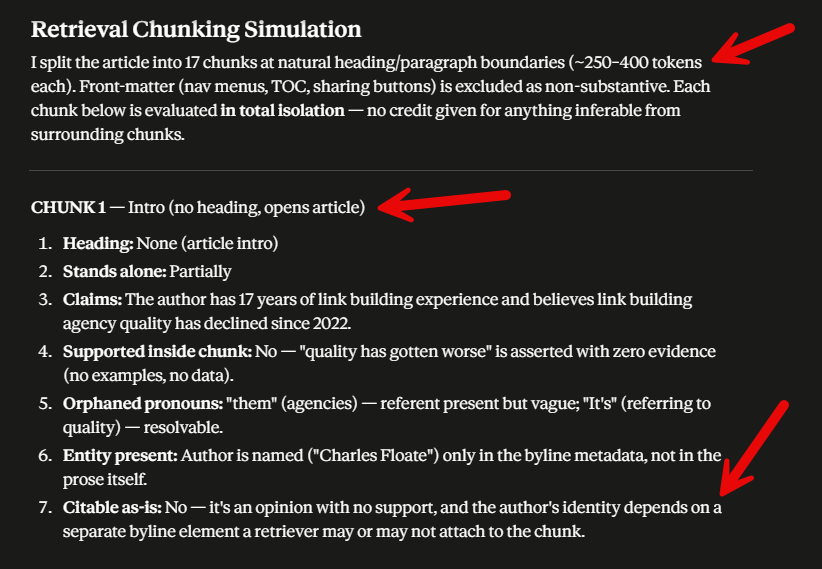
In practice, that means a few habits. Open each section with the answer to its heading. Repeat the subject by name instead of "it" at the start of a section. Put numbers next to their sources. And keep the preamble short, because the intro is the part readers and AI both skip.
What this costs in hours
A 3,000-word guide takes about 8 to 12 hours to research, write, fact-check and format properly. A 700-word answer page takes two or three. Checking the top three results for each search before you start adds 20 to 30 minutes per page, and it's the step that stops you writing the wrong length.
You can do all of this by hand. Or RankControl can do it for you, planning each article from what your buyers search, writing it at the length the topic needs and checking seven AI engines every week to see which pages they cite, while you focus on your product.
Your competitors are building backlinks while you read this.
Organic outreach, social mentions, and citations from Editorial Circle member sites, with managed backlinks available as an add-on. Grow your domain authority without running the campaign yourself.