
Paste "invoicing software" into a keyword tool and you get a long tail. Our keyword data returned 666 related searches on October 19, 2026. That looks like 666 chances to rank.
It isn't. When we looked closer, nearly half of those keywords were the same search with the words shuffled. Most of the rest got 10 searches a month or fewer. The useful long tails were a short list hiding inside, and they were worth far more per click than the head term.
This guide shows how to find long tail keywords that buyers actually search, using that invoicing software data as the worked example. It also covers where tools fall short, and why Reddit and your own Search Console fill the gap.
What a long tail keyword is
A long tail keyword is a longer, more specific search. Each one gets fewer searches than the broad head term, but together they add up, and each says more about who is searching.
Here's the difference in the invoicing data.
| Search | US searches a month | Cost per click | Keyword difficulty |
|---|---|---|---|
| invoicing software | 5,400 | $65.64 | 47 |
| invoicing software for freelancers | 720 | $48.80 | 10 |
| invoicing software for contractors | 390 | $91.38 | 1 |
| invoicing software for lawyers | 210 | $292.33 | 10 |
| invoicing software for electrical contractors | 70 | $137.74 | 11 |
Advertisers pay $292 a click for the lawyer version, more than four times the head term. That's because a lawyer searching it has already decided what they need. And the difficulty scores of 1 to 11 mean a smaller site has a real shot.
What the long tail looks like in a tool
Here's what the full list of 666 keyword ideas built around "invoicing software" looked like.
- 411 of them, or 62%, got 10 or fewer searches a month.
- 112 showed zero.
- Of the 554 with any volume, many shared the exact same volume, cost per click and difficulty. "Free invoicing software", "invoicing software free" and "free software for invoicing" all showed 4,400.
That last point matters. Google's keyword data groups close variants together, so a tool repeats one search under many wordings. The 554 keywords collapsed into 298 distinct searches. Their combined volume dropped from 160,750 to 92,920 once we counted each search once.
So if you build a content plan by sorting a long list, you'll plan pages for the same search over and over. One page can rank for all the variants. Our guide on how many keywords to target per page covers how to group them.
How often does ChatGPT mention your brand?
Most founders have no idea. The answer might surprise you.

Step 1: Start from who buys, not from the head term
The best long tails in the data followed a few patterns. Each one adds a word that says who is buying or what they need.
| Pattern | Example | Median cost per click |
|---|---|---|
| for [audience] | invoicing software for contractors | $46.25 |
| best [product] | best invoicing software for small business | $57.66 |
| [product] with [feature] | project management software with invoicing | $63.86 |
| free [product] | free invoicing software | $25.64 |
The "free" searches had the most volume and the lowest value, which makes sense. If you sell a paid product, those searchers are often not your buyers. The "for [audience]" searches are where most small and mid-size businesses should start, because you can usually name your best customer types from memory.
Write down the five types of customer who buy from you most. Then add each one to your main term. That's your first long tail list, before you open any tool.
Step 2: Mine Google's own suggestions
Google shows you the long tail for free. Type your main term plus "for" and look at the suggestions.
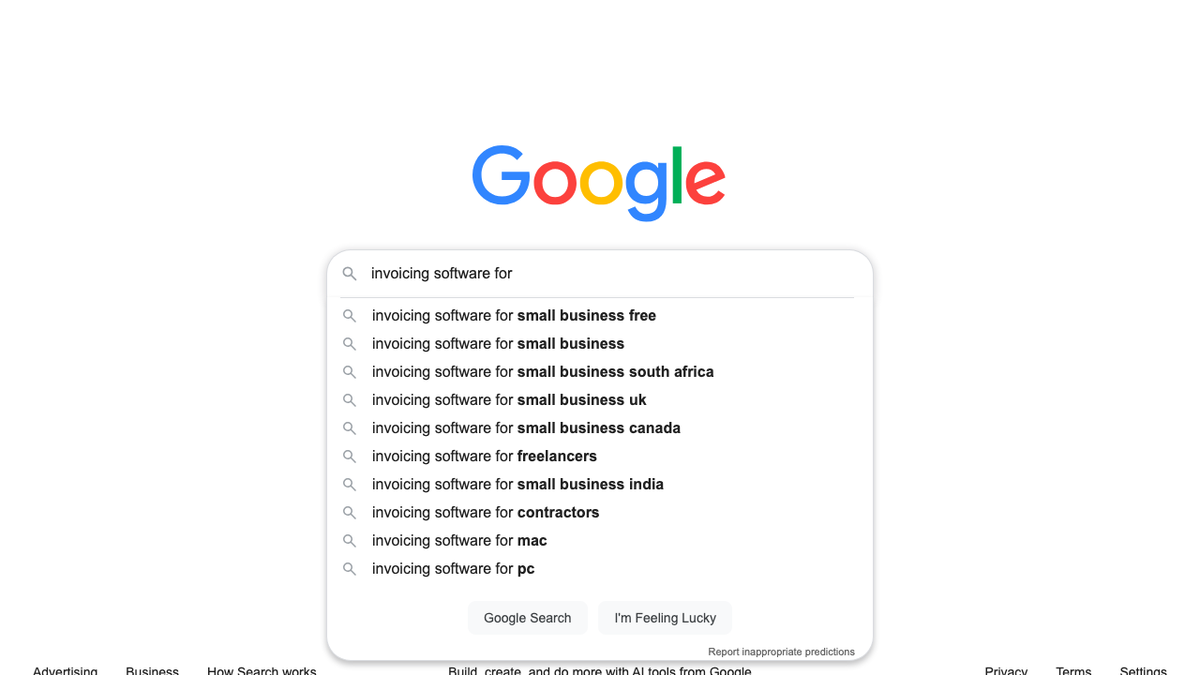
Those suggestions come from what people actually type. Freelancers and contractors both showed up, matching the keyword data. Then search a few of them and note the People Also Ask questions, which give you the question-shaped long tails.
This works at scale too. One programmatic SEO thread on X described scraping autocomplete and People Also Ask, then spotting patterns like "best {tool} for {industry}" and turning each into a page.
📂 programmatic SEO system explained: ┃ ┣ 📂 1. keyword patterns ┃ ┣ scrape Google autocomplete + “People also ask” ┃ ┣ use Ahrefs to export thousands of long-tail keywords ┃ ┣ spot patterns like “best {tool} for {industry}” ┃ ┗ group into scalable templates (we found
 deno@denohawariMay 2, 2026
Step 3: Read how buyers ask on Reddit
Keyword tools only list searches that clear a volume threshold. Real buyers phrase things in ways the tools never show.
In October, the owner of an event rental business in Nevada asked r/Invoice for one tool that could hold their rental items, send a quote, turn it into an invoice, attach a rental agreement and take payment.
Is there affordable invoice and contract software that handles everything in one place?
My little system of Google Docs + spreadsheets + folders was fine when I had four clients. It’s becoming a mess now. I run a small event rental business in Nevada. We rent things like tables, chairs, backdrops, lighting and decor for weddin...
We checked that phrasing. "Invoicing software for event rental business" showed no volume at all. But "event rental software" gets about 210 searches a month at $67.82 a click, and "invoice and contract software" gets 30 at $84.48. The buyer's words point you to a topic the tool lists under a different name.
Search Reddit for your product category plus "recommend" or "what do you use". Read whole posts and the replies under them. The details people list, like "save rental items once" or "works offline at the job site", are the features your long tail pages should cover.
Step 4: Pull long queries from Search Console
If your site already gets traffic, your best long tails may already be in Search Console. Open the Performance report, add a query filter, choose Custom (regex) and use this pattern.
^(\S+\s+){5,}\S+$
That shows queries of six words or more. They're often questions you rank for by accident on a page that wasn't written for them.
One r/SEO poster ran this kind of check this month and found their site showing for 218 long queries, all with zero clicks. They checked each one and found their site appeared in the AI Overview for 88 of them. That's a list of questions people already connect with your site, and a page that answers each one properly is the obvious next step.
Step 5: Check who ranks before you write
Before writing, search the long tail and look at what ranks. We ran 10 invoicing software searches on October 19, 2026. Our follow-up on low competition, high intent keywords checked 164 more and found the topic mattered more than the difficulty score.
For the four audience searches, lawyers, contractors, electrical contractors and freelancers, 17 of the 20 top-five results were pages built for that exact audience. Xero had a page called "Invoicing Software Built for Contractors". Zoho had one for legal firms. Smaller tools ranked too, like a list of electrical contractor invoicing tools from a payments company.
That tells you two things. Big brands build pages for these long tails, because they convert. And a smaller site can still rank if its page is clearly the best match.
Reddit showed up in the top five for 7 of the 10 searches. If a Reddit thread ranks for your long tail, the people searching it want honest comparisons and real experience. Write that, not a sales page.
Step 6: Write one page per need, and answer it fully
Nine of those 10 searches showed a Google AI Overview, including "invoicing software for electrical contractors". The AI answer for the lawyer search cited Reddit, LawPay and Thomson Reuters.
Our guide to long form content covers how long each page should be. So a long tail page has two jobs now. It has to rank, and it has to give an AI answer something clear to quote. For "invoicing software for lawyers", that means covering trust accounting, billable hours and the rules lawyers care about, with real prices and a plain verdict. Our post on commercial intent keywords covers how to judge which of these searches lead to sales.
15 hours a week manually. Or 15 minutes with RankControl.
Track citations, monitor competitors, and fix content gaps across every AI search engine. Automatically.

Long tails to skip
Not every long tail deserves a page.
- Skip reworded duplicates. If two searches share the same volume, cost and difficulty, one page covers both.
- Skip searches outside your market, like "invoicing software for small business south africa" if you don't sell there.
- Skip "free" searches if you have no free plan, unless you can be honest about it on the page.
- Skip anything you can't answer better than the current top result.
Our guide to the types of keywords covers the other ways to sort a list, by intent and by brand.
What this costs in hours
A first pass takes about 8 to 10 hours. Listing customer types and building the first list takes an hour. Mining autocomplete, People Also Ask and Reddit takes three or four. Pulling Search Console data, removing duplicates and checking who ranks for the shortlist takes another three to five. Then each page takes three to five hours to research and write, and you'll want to recheck the shortlist every quarter.
You can do all of this by hand. Or RankControl can do it for you, finding the questions your buyers ask, writing a page for each one and checking six AI engines every week to see which pages they use, while you focus on your product.
AI search traffic grew 835% this year. Is your content ready?
RankControl generates 26 content formats optimized for ChatGPT, Claude, and Perplexity. Published on your domain, matched to your brand.