
Every keyword is a guess at what someone wants. Sorting keywords into types makes that guess easier, because each type tends to want a different kind of page. In 2026, each type also tends to get a different kind of results page. Some bring up an AI Overview, some a product carousel and some a map.
This guide covers the main types of keywords in SEO and what Google shows for each one now. On October 19, 2026 we pulled live Google results for four searches on one topic, running shoes, to see how the type changes the page.
What we saw for one topic, four ways
Here's the check. Same topic, four keyword types.
| Search | Type | What Google showed | AI Overview |
|---|---|---|---|
| running shoes | Short head term | Product carousels, images, organic results | No |
| best running shoes for flat feet | Long-tail question | AI Overview, People Also Ask, organic results | Yes |
| buy running shoes online | Transactional | AI Overview, organic results | Yes |
| running shoe store near me | Local | Map with local stores, People Also Ask | No |
It's a small sample, so treat it as a picture, not a statistic. But it shows the point of this whole guide. The words someone types change what they see, and what you need to rank.
Keywords by intent
Intent is the most useful way to sort keywords, because it tells you what kind of page to make. Ahrefs' guide to keyword intent splits it into four types.
| Intent | What the searcher wants | Example |
|---|---|---|
| Informational | An answer or explanation | how to grow tomatoes |
| Commercial | To compare options before buying | best garden hose |
| Transactional | To buy now | buy garden hose online |
| Navigational | A specific site or brand | RHS plant finder |
Informational searches look for "answers, explanations, or how-to guidance," in Ahrefs' words. They're the type most likely to bring up an AI Overview. Seer Interactive's study, published in April 2026, tracked 5.47 million queries across 53 brands. It found AI Overviews on 36% of informational queries.
Commercial searches come from people who are "evaluating options but isn't ready to buy yet." Seer reported AI Overviews on 8% of them. These are the "best" and "X vs Y" searches, and they're often where buying decisions start. Our guide to commercial intent keywords covers how to find them.
Transactional searches "signal immediate purchase intent." Seer reported AI Overviews on just 5%, a gap it called seven times smaller than informational. Our "buy running shoes online" search did show one, which is a reminder that averages hide a lot.
Navigational searches look for a specific brand or destination. The searcher already knows where they want to go.
Seer Interactive is an agency, not a neutral researcher, but its sample is large and its method is published.

Your competitors are getting cited by AI. You're not.
Every day without citation tracking is a day your competitors pull ahead in ChatGPT, Perplexity, and Claude.
Keywords by length
Short head terms are one or two words, like "running shoes." They have the most volume and the most competition. They're also vague. Someone typing "running shoes" might want to buy, compare, or just browse, so Google often fills the page with product carousels and images rather than one answer.
Long-tail keywords are longer and more specific, like "best running shoes for flat feet." Each one has less volume, but they're easier to rank for, and they say clearly what the searcher wants.
Seer's study found AI Overviews showing slightly more often on longer queries. Four-word-plus informational searches showed them 35.5% of the time, against 27.3% for single words. Our check fits that. The head term had no AI Overview, while the long-tail one did.
For most sites, long-tail keywords are where the traffic is won. A page that answers one specific question well beats a vague page chasing a head term. Our guide to long tail keywords shows how to find the ones buyers search.
Branded and non-branded keywords
Ahrefs defines branded keywords as "any search queries that are directly associated with your brand, products, or services." Searches like "Ahrefs blog" are branded. Non-branded keywords are everything else.
The difference matters for planning. Branded searches come from people who already know you. Non-branded searches, like "how to find backlinks," are how new people find you in the first place.
Branded searches now usually bring up an AI Overview too. Our post on whether AI recommendations lift branded search covers what that means, including Ahrefs' finding that AI Overviews showed on 82.91% of branded searches by late September 2026.
Question keywords
Question keywords start with words like how, what, why or which. They're a kind of informational keyword, and they're the type AI Overviews answer most often. Seer found AI Overviews on 85.9% of question-format queries across 1.4 million impressions.
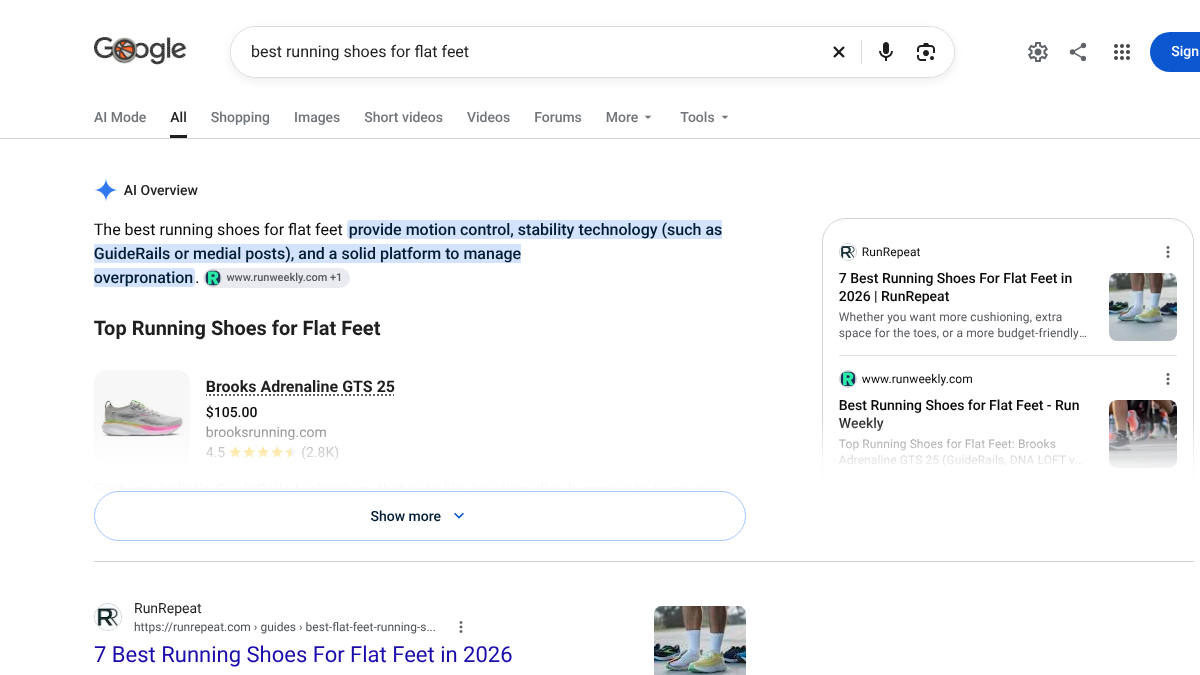
That sounds like bad news, but question keywords are still valuable. They show exactly what people want to know, and a page that answers the question clearly near the top is the kind AI Overviews cite. Use them as headings and FAQ questions. People Also Ask boxes are a free source of them.
Comparison queries, the "X vs Y" kind, were even higher in Seer's data, at 95.4%. If you write comparison pages, assume an AI summary will sit above you, and make your page the one it draws from.
200+ SaaS teams already track their AI citations.
They know exactly when ChatGPT mentions their brand, and when it stops. Do you?

Local keywords
Local keywords include a place or "near me." For these, Google usually shows a map with a short list of businesses instead of an AI Overview, as our "running shoe store near me" search did.
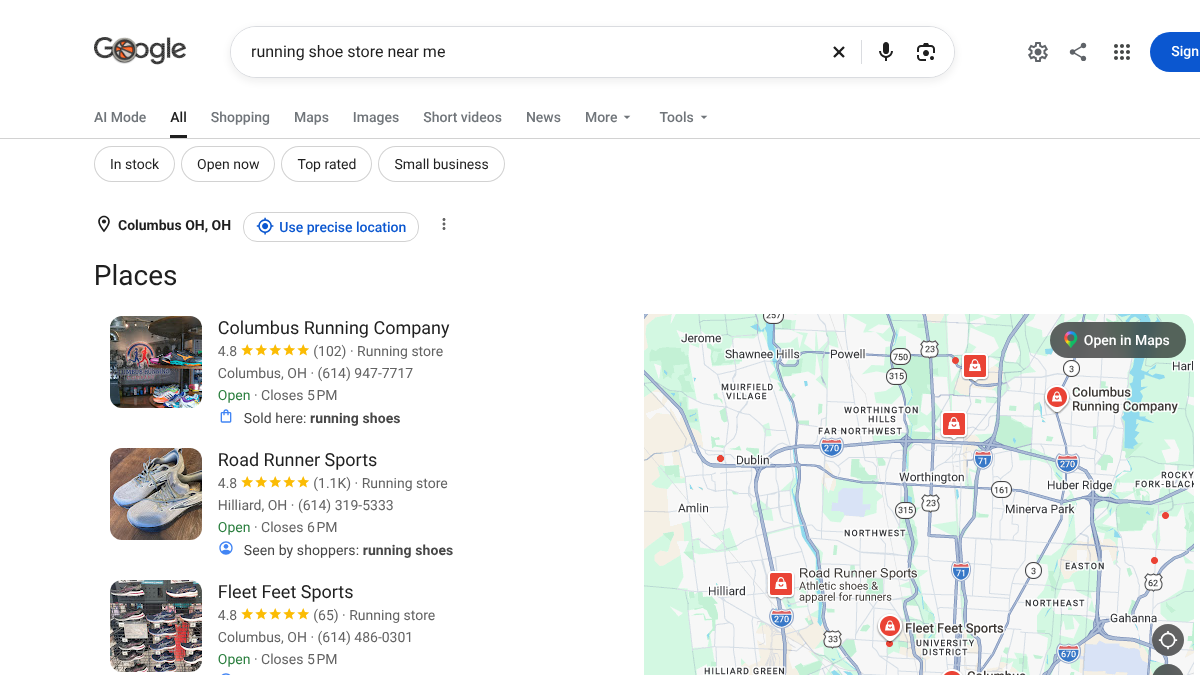
Google's Business Profile help page says local results depend on three things. "Relevance is how well a Business Profile matches what someone is searching for." Distance is how far the business is from the searcher. And "prominence means how well-known a business is."
So for local keywords, your Business Profile and reviews matter more than a blog post. Content still helps with relevance and prominence, but it's not the first lever.
How to use keyword types
Knowing the type tells you what to build. Here's a quick map.
| Keyword type | Page to build |
|---|---|
| Informational and question | A guide that answers the question in the first paragraph |
| Commercial | A comparison or "best" page with a clear verdict |
| Transactional | A product or pricing page that makes buying easy |
| Navigational | A clear homepage and brand pages |
| Local | A complete Business Profile, plus location pages |
A thread on r/SEO asked how people choose keywords. The top reply described a practical process. Pull keyword ideas, cut anything with very little volume, sort by difficulty and volume, then check the top results by hand to see what the searcher really wants.
How do you choose keywords for SEO?
So, I have been doing work for my work agency clients websites and I was looking for keywords to rank for SEO, my agency uses semrush ( me personally not a big fan of keyword magic tool and too much data irrelevant in my POV) in terms of qu...
That last step is the important one. We call it the results-page test. Before you write, search the keyword and look at what Google shows. If the page is all product carousels, a blog post won't fit. If it's an AI Overview and People Also Ask, a clear answer near the top will.
Mixed keywords and how to classify them
Plenty of keywords fit more than one type. "Best running shoes for flat feet" is long-tail, a question in spirit and commercial in intent. That's normal. Pick the type that best describes what the searcher wants to do next, and build for that.
When you're not sure, three quick checks help. First, look at the words. "Buy," "price" and "near me" point one way, while "how," "why" and "what is" point another. Second, look at the results page, since Google has already guessed the intent for you. Third, ask what a good answer would look like. If it's a list of products, it's commercial. If it's an explanation, it's informational.
A spreadsheet column for intent and one for format, like question, comparison or local, is enough for most teams. Fancier labels rarely change what you'd write.
What about AI chatbots?
ChatGPT, Perplexity and Claude don't use keywords the way Google does. People type full questions, often longer and more detailed than a search. But the types still apply. Someone asking ChatGPT to compare two tools has commercial intent, and someone asking how to do something has informational intent.
The practical change is to think in questions as well as keywords. Our guide to turning keywords into ChatGPT prompts covers how. And if you want the argument that prompts are replacing keywords altogether, our post on prompt research makes it.
Doing it yourself or handing it off
Sorting keywords by type takes an afternoon for a few hundred keywords. The slow part is writing the right page for each one, which is where most of the hours go.
RankControl does that part. We find the questions buyers ask, plan titles onto a calendar, and write each article against the pages already ranking for its keyword. We score each draft for how easily AI engines can quote it, with a list of fixes. Our AI visibility tracking then checks up to 50 buyer questions every week across seven AI engines. Expect traffic from Google and AI search first, with citations following more slowly as other sites link to and mention you.
How often does ChatGPT mention your brand?
Most founders have no idea. The answer might surprise you.