
Open any search and look at the top three results. Quite often they're three different kinds of page, a company's own site, a Reddit thread and a video, all answering the same words. I sorted every result from our November 4, 2026 pull of 336 live Google searches by the kind of page holding each spot, and in only 27% of the searches were all three spots the same kind.
That's the part most intent guides skip. They hand you four labels and tell you to match your page to one, but the results page often can't agree on what the searcher wants. So this guide is about mapping a page to a results page, and it starts with what those pages looked like across 12 query formats, 28 searches each.
What is search intent mapping, and which words does Google use?
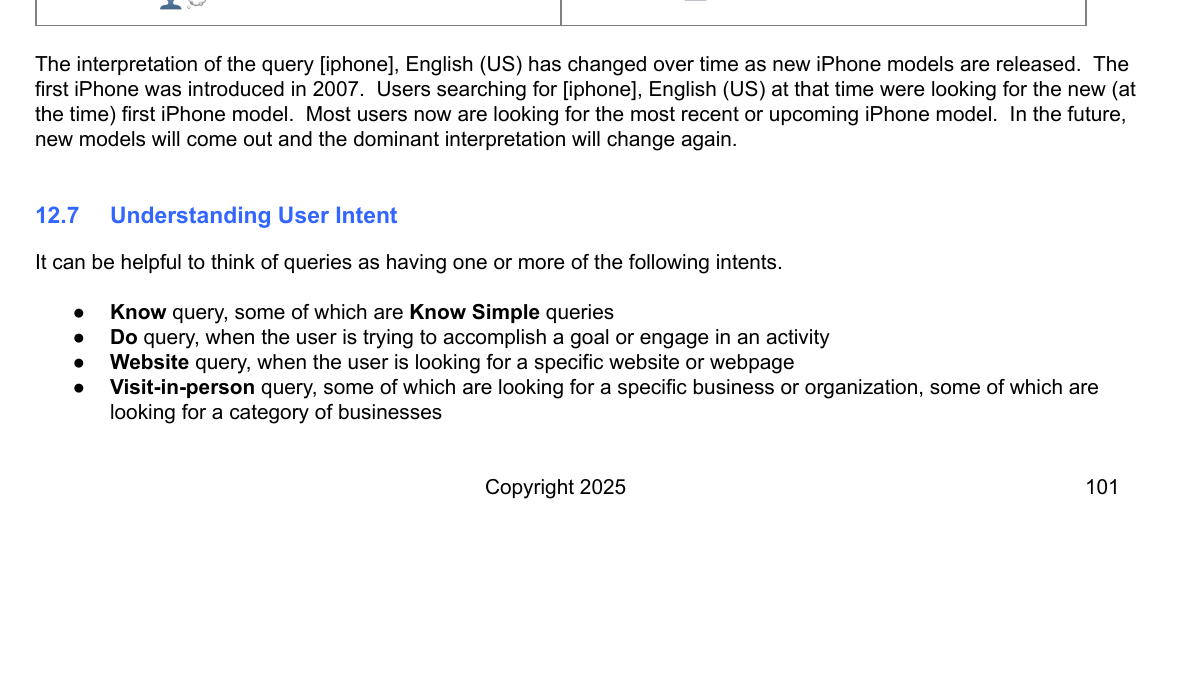
It means deciding which job a query needs done and giving that job to the right page, whether the page exists yet or not. Google's own words for the jobs are plainer than the SEO ones. The September 11, 2025 edition of its rater guidelines tells raters to think of a query as having "one or more" of four intents, Know, Do, Website and Visit-in-person.
Informational, commercial and transactional are the labels SEO tools added, and Broder's 2002 paper had three classes of its own, navigational, informational and transactional. Our posts on types of keywords and commercial intent keywords cover those labels, so I'll leave them there.
Which kind of page ranks for each kind of query?
Here's who held the top three organic spots, 84 slots per format. I sorted each page into a class, and the formats stand in for intent, which is my mapping and not Google's.
| Query format (my intent label) | Company or publisher | Forum or Reddit | Video | Tool |
|---|---|---|---|---|
| Definition (informational) | 77% | 10% | 5% | 0% |
| Statistics (informational) | 75% | 7% | 0% | 0% |
| How-to (informational) | 45% | 17% | 20% | 2% |
| Comparison (commercial) | 61% | 28% | 5% | 2% |
| Best-of (commercial) | 65% | 25% | 0% | 8% |
| Pricing (commercial) | 57% | 36% | 4% | 0% |
| Alternatives (commercial) | 56% | 40% | 2% | 0% |
| Review (commercial) | 50% | 42% | 4% | 2% |
| Calculator (task) | 7% | 1% | 0% | 77% |
| Template (task) | 63% | 19% | 2% | 7% |
| Troubleshooting (support) | 48% | 38% | 10% | 1% |
| Brand login or pricing (navigational) | 74% | 10% | 8% | 1% |
Two rows tell most of the story. Calculator searches belong to tool pages, which held 77% of those slots and almost none anywhere else. Pricing, alternatives, review and troubleshooting searches are where forum threads move in, taking about four slots in ten, so a company page that wants to rank there is sharing the top with threads whether it likes it or not.
| Limit | What it means |
|---|---|
| One day, US English | The pull isn't a sample of every search |
| Phrasings I wrote | The 28 searches per format are natural, but they're mine |
| Intent labels are mine | Google doesn't label formats this way |
| Small gaps | A few points between rows, such as review and alternatives, mean nothing |
How often does the top result match, and how often does the page disagree with itself?
Next I asked a simpler question. If the search was "x vs y", did the first result say "vs" in its title or URL? If it was a calculator search, did it say calculator? I also counted how often a company page and a forum thread landed in the same top three.
| Query format | First result carries the format word | Company page and forum thread both in the top three |
|---|---|---|
| Comparison | 86% | 64% |
| Calculator | 86% | 4% |
| Brand | 86% | 21% |
| Best-of | 82% | 57% |
| Statistics | 82% | 21% |
| Pricing | 79% | 75% |
| Template | 75% | 46% |
| Review | 68% | 86% |
| Troubleshooting | 57% | 68% |
| Alternatives | 50% | 89% |
| Definition | 43% | 25% |
| How-to | 43% | 43% |
| All 336 searches | 70% | 50% |
I read 90 of those slots by hand to see how well the word test worked. About one in ten was wrong, and nearly all the errors were misses, where the page was plainly the right format but never used the word. So read the first column as a floor.
You're getting AI traffic. But do you know where it comes from?
RankControl credits every visit to the assistant that sent it: ChatGPT, Perplexity, Claude, Gemini, Copilot, or Grok. Full source attribution, next to your Google traffic.
The takeaway is that one page can't match a mixed results page, so pick the slot you can win. And look at the pattern by format, never at a single search. When I pulled 24 searches again about an hour later, the top-three sites had changed on 23 of them, while the class shares stayed put.
How do you audit each page against its intent?
Do it per URL, with a spreadsheet and the live results open side by side.
- List each indexable URL next to the one query it should win. If Search Console shows two of your URLs getting impressions for the same query, you've found a conflict before you've looked at anything else.
- Label the query in Google's words, Know, Do, Website or Visit-in-person, and note which one is the main job.
- Pull the top ten and tag each result as a company page, forum thread, video, review site, reference page or tool.
- Check whether your page's type shows up in the top three, and whether the top titles use a format word.
- Call the results clean if one type dominates and mixed if not, then decide which slot you're after.
- Decide what to do with the page. Keep it, rewrite it to the format, split it in two, merge and redirect it, or retarget it to a query it already fits.
On r/SEO, a site owner described this exact trap. An older post slowly lost rankings, and the owner traced it to the results moving from how-to guides to comparison pages and tools, so the content wasn't worse, it was the wrong type of page now.
How do you check if search intent changed for a keyword you rank for?
One of our older posts slowly lost rankings over a few months. Nothing changed on our side. When I finally looked at the results page, it was completely different: it used to show how-to guides, now it's mostly comparison pages and tools. S...
One reply suggested a monthly habit, saving the top ten URLs for 20 to 30 money keywords and tagging each by type, then watching the mix and not the positions. That's one person's routine and not a rule, but it costs an afternoon. Our posts on reading a SERP and the ten-link test for one page or two cover the two steps people tend to skip.
A freelance SEO boiled the shortcut down on X, saying that if Google keeps ranking one page type for a keyword, that's the format it thinks satisfies the query.
Here's a free way to identify search intent: Google the keyword. Look at the first 10 results. If you see: -8 blog posts → informational -8 product pages → commercial -8 category pages → transactional -8 comparison pages → commercial investigation Don't fight Google.
 Bint E Jamil ( Technical SEO Specialist)🐈@seo_bint_ejamilOct 4, 2026
How do you fix a page that doesn't match?
| Symptom | What the results show | Fix the page, or change the query |
|---|---|---|
| A blog post behind a pricing query | 57% company pages, 36% forum threads, and 79% of first titles say price or cost | Add a plain price table and the word in the title, or drop the query |
| A guide behind a "best" query | 82% of first titles say best or top | Rewrite it as a ranked list with criteria, or target the how-to |
| A feature page on an alternatives query | A forum thread in the top three on 89% | Write a fair alternatives page, and expect threads to take about 40% of slots |
| An article on a calculator query | Tool pages hold 77% of slots | Build or embed the tool, or retarget to how to calculate it |
| A product page on a "what is" or statistics query | Company and publisher pages hold 75% to 77% | Write it definition-first or data-first, and keep the product page for the buying query |
| A text-only how-to | Video holds 20% of slots | Add steps and a video, or pick a narrower how-to |
| A page for someone else's brand query | The brand's own site is first on 86% | Change the query |
Most of these fixes are small edits to a title and an opening, which our guides to fixing an existing page and to page-two rankings walk through.
We'll show you exactly where your brand stands in AI search.
No commitment. $0 due today, cancel anytime. See how ChatGPT, Perplexity, Gemini, Google AI Mode, DeepSeek, Google AI Overviews, and Bing AI Summary talk about your brand today. Add Claude and Grok with your own API keys.

Does intent mapping still matter when an AI Overview answers the question?
Yes, because the page type still shows in what the overview cites. An overview appeared on nearly every search I pulled, so I checked who it linked to.
| Overview on | It cited |
|---|---|
| Calculator searches | A tool page in 25 of 26 |
| Every other format | A company page in 96% to 100% |
| Review, comparison, how-to and alternatives searches | A video in 89% to 100% |
How often an overview shows depends on intent too, and the studies measure that differently.
| Source | What it counted | Finding |
|---|---|---|
| Seer Interactive, April 2026 | 53 brands, intent classed by SERP features | Overviews on 36% of informational, 8% of commercial and 5% of transactional queries |
| Ahrefs, November 2025 | 146 million desktop results, mapped to rater labels | Overviews on 21.4% of Know keywords, 13% of Do and 0.9% of Website |
| NBER paper on ChatGPT, September 2025 | Messages on consumer plans | About 49% asking and 40% doing |
That last row is the one to remember when you map pages, since about four in ten ChatGPT messages asked for a task and not an answer. Our post on conversational search intent goes further into that shift.
How do you keep the map current, and where does RankControl fit?
Repeat step 3 every month for your money keywords and note what moved. If three or more of the top ten switch type, as that r/SEO reply put it, the search probably wants a different page now.
RankControl plans each title from live search data and the pages already on your site, gives it a content format such as a guide, listicle or statistics page, and our Content Engine page says we sort queries by buyer intent.
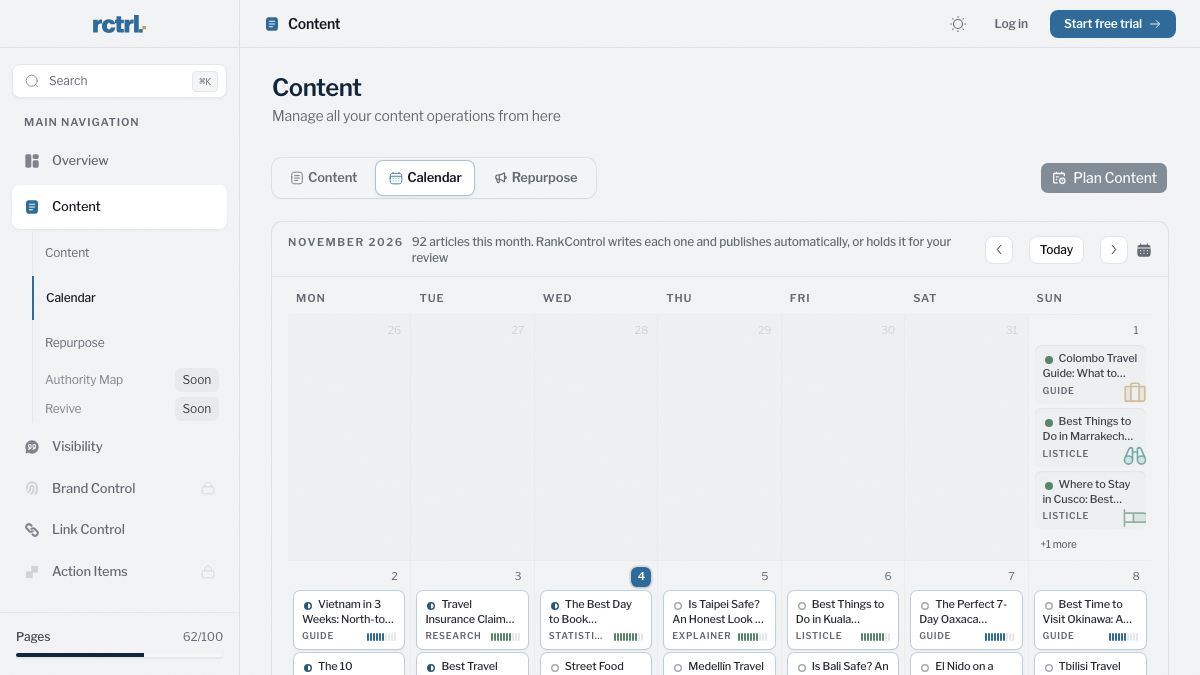
You can run the audit by hand with a spreadsheet and the search results. Or RankControl's agents can plan, write and publish the right format for each query while you work on your product.
Know exactly what AI says about your competitors.
RankControl's Recon Agent monitors competitor citations across ChatGPT, Perplexity, Gemini, Google AI Mode, DeepSeek, Google AI Overviews, and Bing AI Summary, plus Claude and Grok on your own API keys. See where they show up and you don't.