
"Relevant content" is one of those phrases everyone uses and few people define. Google uses it. AI engines depend on it. SEO advice repeats it.
This guide sticks to what the systems themselves say relevance means, using Google's own documentation and the best data on how AI engines search. Then it checks one popular piece of relevance advice against pages that actually rank.
What Google says relevance is
Google's How Search Works pages list five kinds of signals. Meaning, relevance, quality, usability and context. Relevance gets its own section.
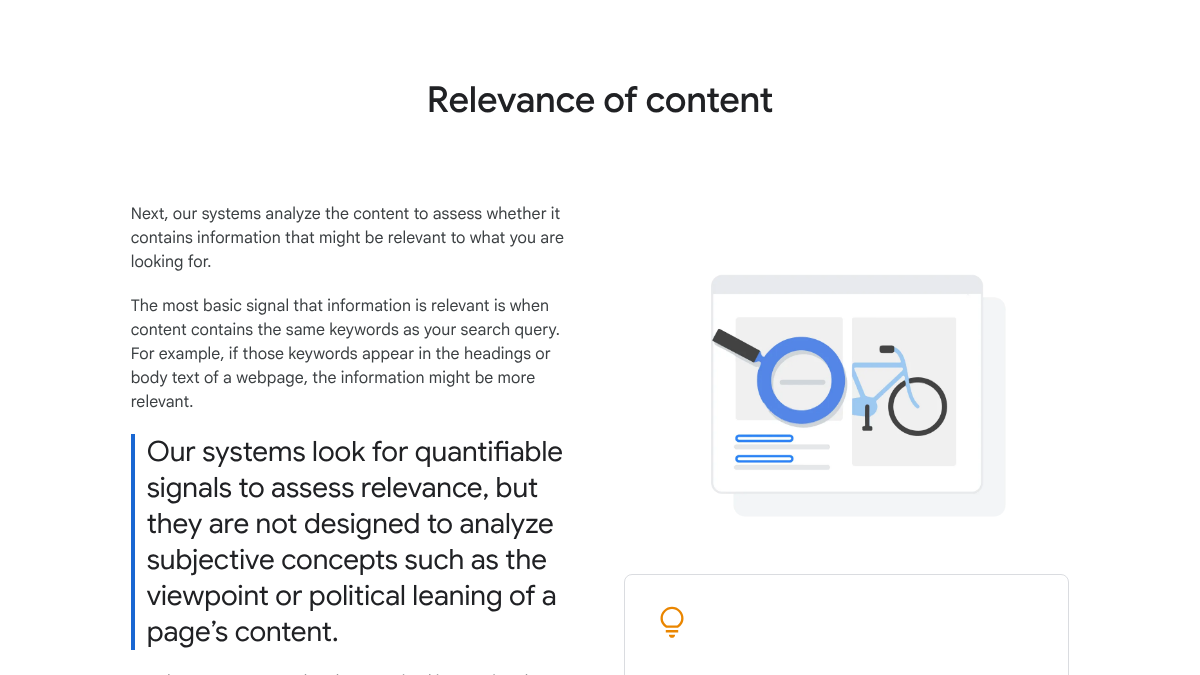
Google describes three layers.
Matching keywords. "The most basic signal that information is relevant is when content contains the same keywords as your search query. For example, if those keywords appear in the headings or body text of a webpage, the information might be more relevant."
Content beyond the keyword. Google gives an example. When you search for "dogs," you "likely don't want a page with the word 'dogs' on it hundreds of times." Instead, "algorithms assess if a page contains other relevant content beyond the keyword 'dogs' - such as pictures of dogs, videos, or even a list of breeds."
Interaction data. "We also use aggregated and anonymized interaction data to assess whether search results are relevant to queries. We transform that data into signals that help our machine-learned systems better estimate relevance."
Google also draws a line around what relevance isn't. Its systems "look for quantifiable signals to assess relevance, but they are not designed to analyze subjective concepts such as the viewpoint or political leaning of a page's content."
We call these the three relevance layers. Words that match the search, content that covers what the searcher needs around those words, and evidence from real searchers that the page satisfied them.
Relevance works at the passage level
Google doesn't only judge whole pages. Its ranking systems guide lists passage ranking, launched in February 2021, which identifies "individual sections or 'passages' of a web page" to judge relevance.
That means a long page can rank for a specific question because one section answers it well, even if the page as a whole is about something broader. It also means a section that wanders off-topic doesn't help, because it's judged on its own.
So write each part as if it's the only part a reader will see. Often, it is.
Our post on LSI keywords covers the other named systems Google uses to understand meaning, like BERT and neural matching.
26 content formats. Published on your domain. Matched to your brand.
Guides, comparisons, listicles, case studies, and more. RankControl generates content that gets cited by ChatGPT, Perplexity, Claude, Gemini, Grok, Google AI Mode, and Google AI Overviews.

How AI engines judge relevance
AI engines add a step. Before they decide what's relevant, they decide what to search for.
Google AI Mode. In March 2025, Google said AI Mode "uses a 'query fan-out' technique, issuing multiple related searches concurrently across subtopics and multiple data sources and then brings those results together to provide an easy-to-understand response."
So one question becomes several searches. A page doesn't need to match the original question word for word. It needs to answer one of the sub-questions well.
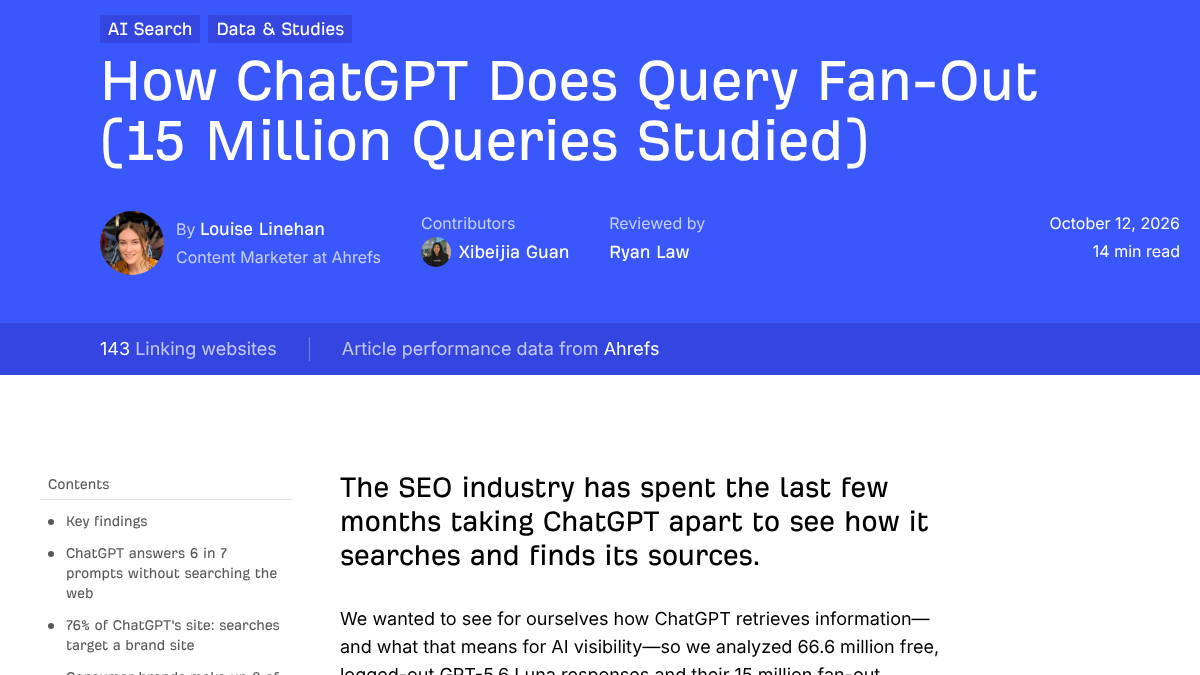
ChatGPT. Ahrefs studied 66.6 million ChatGPT responses from August and September 2026, along with 15 million fan-out searches.
| Finding | Figure |
|---|---|
| Responses that searched the web | 14.4% |
| Searches per response, when it searched | About 1.6 |
| Fan-out searches using a site: operator | 6.8% |
| Most common site: searches pointing at a brand's own site | 75.9% |
Two things follow. First, most ChatGPT answers don't search at all, so relevance there comes from what the model already learned. Second, when it does search, it sometimes goes straight to a brand's own site with a site: search, which makes your own pages the source for questions about your product.
Our post on how ChatGPT decides which websites to recommend covers recommendation questions in more depth.
The same idea, two systems
| Google Search | AI engines | |
|---|---|---|
| First step | Match the query to pages | Turn the question into several searches |
| Unit judged | Pages and passages | Passages, pulled into an answer |
| Basic signal | Matching words in headings and body | Matching a sub-question clearly |
| Beyond the words | Related content, like images and lists | Facts that fill the answer |
| Feedback | Aggregated interaction data | Whether the passage helps answer the question |
The overlap is large. A page that clearly answers specific questions, with headings that name those questions, works for both.

Your competitors are getting cited by AI. You're not.
Every day without citation tracking is a day your competitors pull ahead in ChatGPT, Perplexity, and Claude.
What we found on ranking pages
A common piece of advice says to put the answer in the first 100 words. We wanted to see whether that separates top results from lower ones.
On October 19, 2026, we ran three searches in the US and compared the first organic result with the tenth for each. In all three, an AI Overview took the top spot, so the first organic result sat in position two.
| Search | Page | Answer in first 100 words? | Headings phrased as questions? |
|---|---|---|---|
| How Google decides content relevance | Top result (Google's own doc) | Yes | Yes |
| How Google decides content relevance | Tenth result (a glossary page) | Yes | Yes |
| How AI search engines pick pages to cite | Top result | No, opens with a hook | Yes |
| How AI search engines pick pages to cite | Tenth result | No, opens with a story | Yes |
| How Google determines search intent | Top result | No, opens with background | Yes |
| How Google determines search intent | Tenth result | No, opens with a hook | Yes |
The first-100-words rule didn't separate the top from the tenth. Where both pages answered fast, they were definition pages. Where neither did, they were explainers that opened with a story or a hook, and one still ranked near the top.
What every page had in common was headings phrased as the questions a reader would ask, like "What is search intent?" That fits how the systems work. Google matches words in headings. AI engines fan out into sub-questions. A heading that names the sub-question is a clear match for both.
Six pages is a small sample, and pages rank for many reasons. But it suggests headings matter more consistently than the opening paragraph.
What practitioners notice
In r/GenEngineOptimization, one user looked at 20 pages ChatGPT cited and called it "an observation exercise, not a scientific study."
I analyzed 20 ChatGPT citations - Here’s what I found
I've been looking into why certain websites get cited by ChatGPT, so I analyzed 20 citations to see if any patterns stood out. This wasn't a scientific study just an observation exercise to identify common signals. A few things showed up re...
The poster listed what the cited pages had in common. The answer came quickly with little fluff, the headings were clear, the expertise was obvious, the brand was mentioned on other sites and the pages had original data. A reply added a useful idea. Pages get cited for different jobs, like a definition, a statistic or a comparison, so what makes a passage relevant depends on which job it's doing.
Experts still rank relevance near the top. Barry Schwartz of Search Engine Roundtable shared the 2026 ranking factors expert survey, which put content relevance first, alongside backlinks and content quality.
A new Google ranking factors expert survey is out and it says content relevance, backlinks, and content quality are the most important factors https://t.co/zLuAK5TjB7 via @CyrusShepard @ZyppySEO https://t.co/rAgpqgGFBp
 Barry Schwartz@rustybrickSep 10, 2026
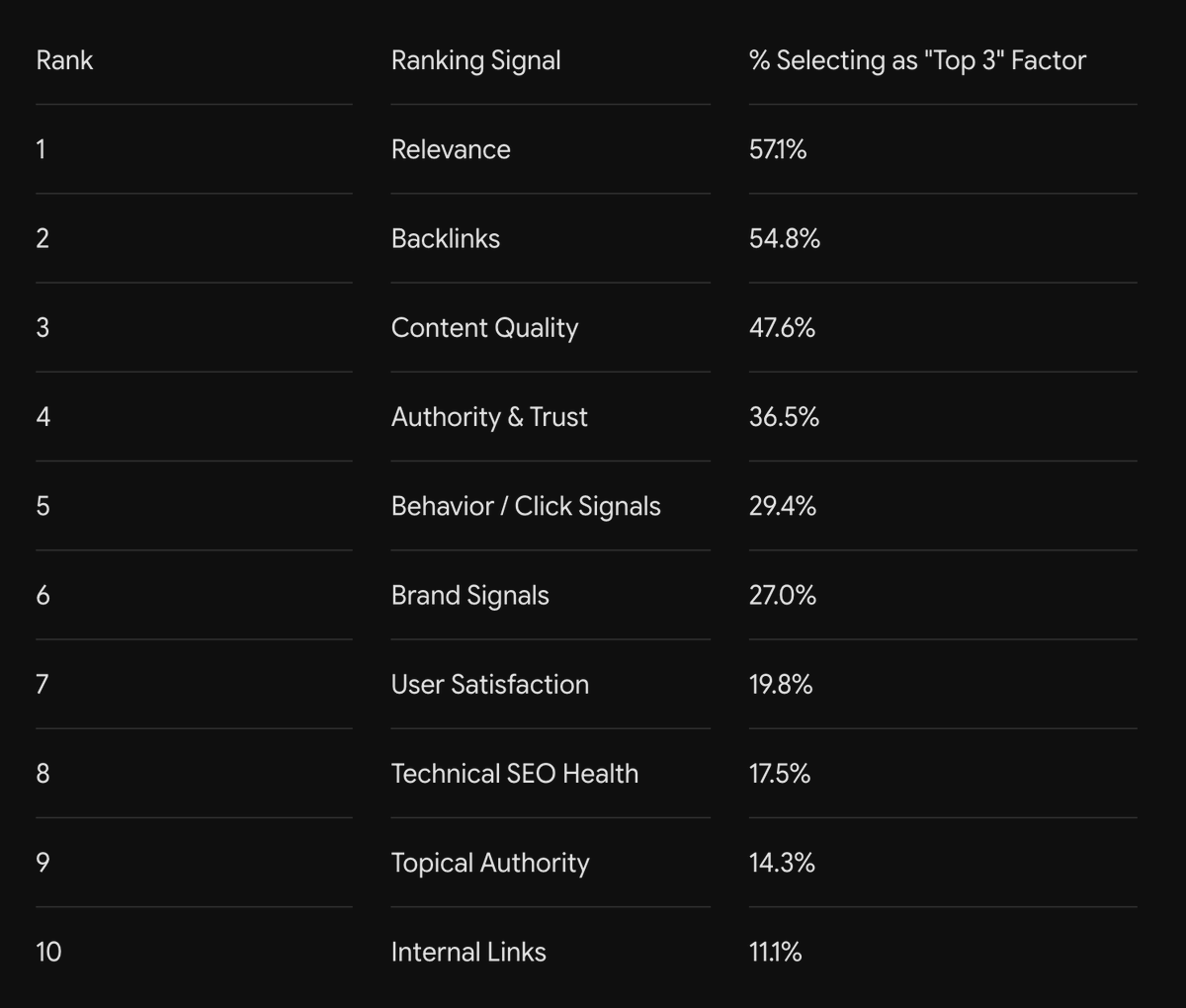
Our roundup of Google ranking factors covers what the research says about the others.
How to check a page's relevance
- Name the question. Write down the exact question the page answers. If you can't, the page isn't focused enough.
- Check the headings. Each main heading should name a sub-question a reader would ask.
- Check what's around the keyword. Add the content the searcher needs, like steps, examples, numbers, images or a table.
- Check each section alone. Since passages are judged on their own, every section should answer its heading without the rest of the page.
- Compare with the results. Search the question and see what the top pages cover that yours doesn't. Our guide to SERP analysis covers how.
- Watch the queries. In Search Console, check which searches the page actually shows up for. If they're not the ones you meant, the page is relevant to something else.
Our guide to primary keywords covers picking one focus per page, and our content optimization guide covers fixing pages that miss their intent.
Doing it yourself or handing it off
Relevance comes from focus. One question per page, headings that name the sub-questions, and the details a searcher needs around them.
RankControl builds pages that way. We find the questions your buyers search, write each article against the pages already ranking for it and publish it to your site. We track your Google and Bing rankings, plus up to 50 buyer questions every week across seven AI engines. Expect traffic from Google first, with AI citations following more slowly as links and mentions build up.
200+ SaaS teams already track their AI citations.
They know exactly when ChatGPT mentions their brand, and when it stops. Do you?