
Most lists of Google ranking factors stop at Google. Most AI citation guides start fresh, as if Google didn't exist. The useful question sits between them: which of the things that help you rank in Google also help you get cited in AI answers?
This guide takes the factors Google itself confirms, one at a time, and puts each next to what AI citation research found for the same factor. Where we've covered a factor in depth elsewhere, we link to it rather than repeat it.
The crosswalk
| Factor | What Google says | What AI citation research found |
|---|---|---|
| Rank position | The output of all the factors below | The strongest single predictor of ChatGPT and Gemini citations in one preprint |
| Links | PageRank and link analysis are core systems | Brand mentions correlated with AI visibility about three times as strongly as backlinks |
| Freshness | "Query deserves freshness" systems for time-sensitive searches | Cited pages ran 25.7% fresher than organic results, varying a lot by engine |
| Helpful content, E-E-A-T | Folded into core ranking in March 2024 | Hard to measure directly; no study we found isolates it |
| Schema | Helps Google understand pages and show rich results | No measurable effect overall, except detailed Product and Review data |
We call this the shortlist effect. Google's ranking factors mostly decide which pages make the shortlist an AI answer picks from. They help less with which page on that shortlist gets picked.
Rank position
Start with the factor that sums up all the others. Kurt Fischman, of the consultancy Growth Marshal, studied 730 citations from ChatGPT and Gemini across 75 commercial queries, using Google's top 10 for the same queries as the comparison. The paper was posted to SSRN in April 2026.
Rank was the strongest predictor of citation by far. Each position lower cut the odds of being cited by about 24%. "Position-1 pages were cited in 43% of queries in which they appeared, declining to 5% at position 7."
That's why classic ranking work still matters for AI search. Engines that search the web start from search results. Our post on why ranking first doesn't guarantee a ChatGPT citation covers the steps between ranking and being quoted.
We'll show you exactly where your brand stands in AI search.
No commitment. $0 due today, cancel anytime. See how ChatGPT, Perplexity, Claude, Gemini, Grok, Google AI Mode, and Google AI Overviews talk about your brand today.
Links and mentions
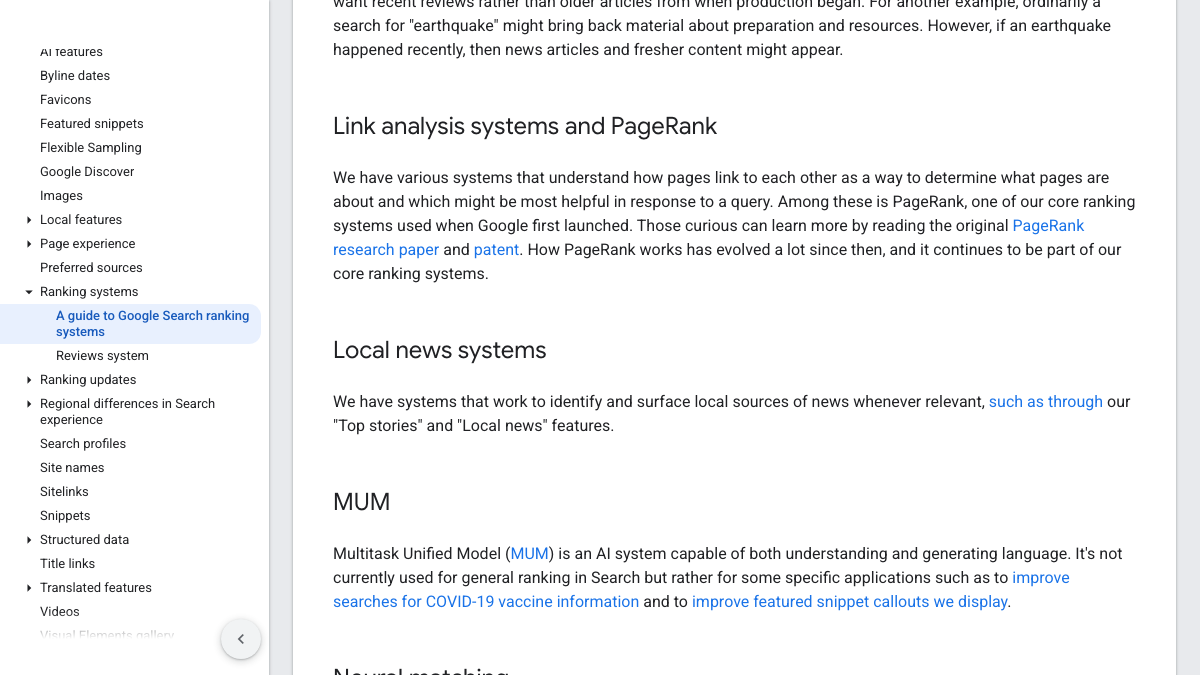
Google is direct about links. Its ranking systems guide says it has "various systems that understand how pages link to each other as a way to determine what pages are about and which might be most helpful in response to a query." PageRank is still part of its core ranking systems.
For AI visibility, mentions matter more than links. Ahrefs looked at 75,000 brands and checked which signals tracked with visibility in Google's AI Overviews. Branded web mentions came out at 0.664, about three times the 0.218 for backlinks. Branded search volume landed between them at 0.392.
It's a correlation, and brands with many mentions also tend to have more search demand and better-known products. But the direction is clear. Links help you rank, which gets you on the shortlist. Being talked about across the web seems to help you get picked. Our post on brand mentions vs backlinks goes through the data, and our 20-site test of backlinks and AI citations shows what we saw ourselves.
Freshness
Google has "various 'query deserves freshness' systems designed to show fresher content for queries where it would be expected." Freshness is a ranking factor for some searches, not all.
AI engines lean on it more, and unevenly. Ahrefs' study of 17 million citations, from July 2025, found cited pages were 25.7% fresher on average than organic search results.
| Engine | Median age of cited pages |
|---|---|
| ChatGPT | 958 days |
| Gemini | 1,118 days |
| Perplexity | 1,166 days |
| Google AI Overviews | 1,432 days |
Google AI Overviews sat close to the age of normal search results, while ChatGPT leaned clearly toward newer pages. About half of all citations went to pages published or meaningfully updated in the previous 13 weeks. Our breakdown of what highly cited articles have in common covers the rest of that study.
So updating important pages every quarter helps on both fronts, with a bigger effect in chat engines than in Google's own AI answers.
Helpful content and E-E-A-T
Google folded its helpful content system into core ranking in March 2024. There's no separate filter now. The core systems try to reward content written for people, from sources with real experience and expertise.
This one is harder to measure for AI citations, because there's no single number for "helpful," and no study we found isolates it. Our own check below points the same way as Google's guidance, though: the AI Overview leaned on Google's own documentation and well-known publications. Our guide to E-E-A-T covers what Google looks for, and the same signals of who wrote a page and why they're credible are what AI answers repeat when they describe a source.
Know exactly what AI says about your competitors.
RankControl's Recon Agent monitors competitor citations across ChatGPT, Perplexity, Claude, Gemini, Grok, Google AI Mode, and Google AI Overviews. See where they show up and you don't.

Schema
Google uses structured data to understand pages and show rich results. It doesn't call schema a ranking factor.
For AI citations, the research mostly finds no effect. In Fischman's data, pages with schema first looked less likely to be cited, but that turned out to be an artifact. Within Google's top results, cited and uncited pages had almost the same share of schema, 43.1% against 44.8%. The one exception was Product and Review schema with real details filled in, like price, rating and specifications, which were cited 61.7% of the time against 41.6% for generic types.
Our post on schema and AI citations covers both big studies. Add schema for Google's rich results and keep it accurate. Don't expect it to get you cited by itself.
What about the 2024 leak?
In 2024, internal documentation for Google's Content Warehouse API was published by mistake to a public code repository. Mike King of iPullRank, who analyzed it on May 27, 2024, counted "2,596 modules represented in the API documentation with 14,014 attributes (features)." The commit was dated March 27, 2024, and it was removed on May 7.
The leak listed attributes, not how much each one counts, or whether it's used at all. So it's evidence of what Google can measure, not proof of what it ranks on. Treat any "ranking factor confirmed by the leak" claim with that in mind, and treat it as having even less to say about AI citations.
Our check: does AI Overview cite the top results?
If rank matters so much, you'd expect Google's own AI Overview to cite the pages ranking below it. We checked two queries in Google's US results on October 19, 2026.
| Query | Top organic domains checked | AI Overview sources | Overlap |
|---|---|---|---|
| how to improve google rankings | 7 | 11 links from 5 domains, including 6 YouTube videos | 1 domain, youtube.com, ranked 5th |
| google ranking factors | 9 | 7 domains, including Google's own docs, Semrush and Search Engine Journal | 0 |
For "google ranking factors," the AI Overview cited a completely different set of sites from the nine domains ranking under it. For the other query, only YouTube appeared in both, and none of the top four organic domains were cited.
That's two queries on one day, so treat it as a snapshot, not a rule. But it fits the shortlist effect. The AI Overview drew on sources Google trusts for the topic, like its own documentation and well-known publications, rather than simply the top organic results. Our post on the share of sites that never get cited shows how concentrated citations are.
What to work on
Taken together, the order of work looks like this.
- Rank for the specific questions buyers ask. It's the strongest single factor in the research. Narrow questions are easier to rank for than broad terms.
- Get mentioned as well as linked. Reviews, comparisons, community threads and coverage that name you.
- Update important pages each quarter. It helps with freshness-sensitive searches and AI engines that favor newer pages.
- Show who's behind the content. Real authors, real expertise and an about page that proves the business is real.
- Keep schema accurate, especially on product and review pages, but don't lean on it.
For how Google's ranking fits with the AI layer on top, see our guide to how Google's search algorithm works.
Doing it yourself or handing it off
Most of this list is steady work: articles that answer specific questions, kept current, plus the outreach that gets you mentioned elsewhere.
RankControl does that work. We find the questions your buyers search, write each article against the pages already ranking for it and publish it to your site. We find link prospects for each published article and draft outreach from your own mailbox, with nothing sent until you approve it. Our AI visibility tracking checks up to 50 buyer questions every week across seven AI engines. Expect traffic from Google first, with AI citations following more slowly as links and mentions build up.
26 content formats. Published on your domain. Matched to your brand.
Guides, comparisons, listicles, case studies, and more. RankControl generates content that gets cited by ChatGPT, Perplexity, Claude, Gemini, Grok, Google AI Mode, and Google AI Overviews.