
Ask an SEO what E-E-A-T is and you'll get a confident answer. Ask where in Google's documents that answer comes from, and things get quieter.
When we pulled Google's top results for "google eeat" on October 18, 2026, two of the five highest-ranking explainers that weren't Google's own pages didn't link to a single Google source. So this guide does it the other way around. Everything below comes from Google's own words: the rater guidelines, Google's blog and its help docs. That covers what E-E-A-T means, whether it affects rankings, and what it means now that AI answers sit on top of results.
What E-E-A-T stands for
E-E-A-T stands for Experience, Expertise, Authoritativeness and Trust. It comes from Google's Search Quality Rater Guidelines, a 182-page document whose current edition is dated September 11, 2025. Each letter has a one-line definition there.
| Letter | Google's definition, from the rater guidelines |
|---|---|
| Experience | "the extent to which the content creator has the necessary first-hand or life experience for the topic" |
| Expertise | "the extent to which the content creator has the necessary knowledge or skill for the topic" |
| Authoritativeness | "the extent to which the content creator or the website is known as a go-to source for the topic" |
| Trust | "the extent to which the page is accurate, honest, safe, and reliable" |
The four aren't equal. The guidelines say "the most important member at the center of the E-E-A-T family is Trust." A page can show plenty of expertise and still fail if it's wrong or misleading.
Where the extra E came from
Until late 2022 it was E-A-T, three letters. Google added Experience in a blog post on December 15, 2022, written by Elizabeth Tucker, which opened by joking that you could call it "Double-E-A-T" if you liked.
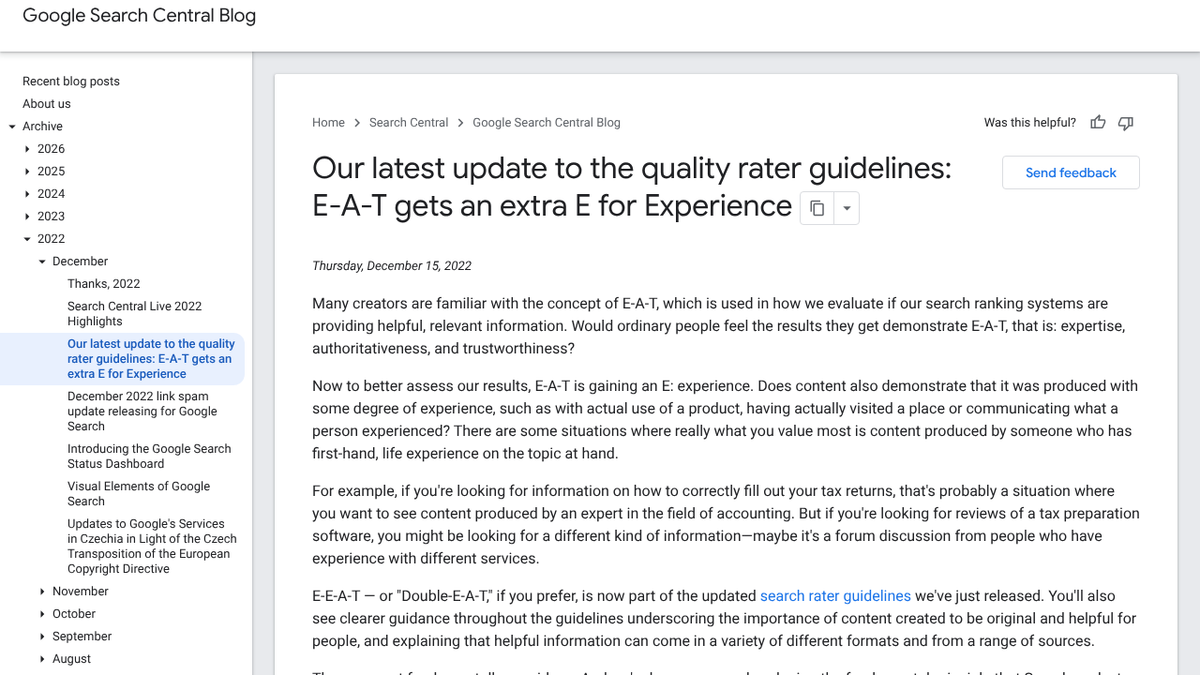
The change mattered for anyone without formal credentials. Experience means doing the thing yourself, so someone who has used a product for a year can be worth reading on it even without a degree. The guidelines even give examples of topics where lived experience is what readers want, like sleep problems during pregnancy, next to topics where only expert advice should count, like liver cancer treatment.
The same 2022 post said something people still miss about the guidelines. They're "used by our search raters to help evaluate the performance of our various search ranking systems, and they don't directly influence ranking."
Who reads the rater guidelines
Google pays human quality raters to look at sample results and judge them. Their ratings test whether Google's ranking systems are doing a good job. They don't feed straight into the rank of the page being rated.
The guidelines say so plainly. "No single rating can directly impact how a particular webpage, website, or result appears in Google Search," they read, and ratings are instead "used to measure how effectively search engines are working."
That's why the September 2025 edition is worth reading even though raters don't touch your rankings. It shows what Google wants its systems to reward. One correction while we're here: some SEO blogs claimed that edition added guidance for rating AI Overviews. The research for this post searched the full document, and there's no mention of AI Overviews or AI Mode in it. The change log lists updated definitions of Your Money or Your Life topics, more examples and small fixes.

You're getting AI traffic. But do you know where it comes from?
RankControl credits every visit to the assistant that sent it: ChatGPT, Perplexity, Claude, Gemini, Copilot, or Grok. Full source attribution, next to your Google traffic.
Is E-E-A-T a ranking factor?
Google's answer has been the same for years, and it has two halves. E-E-A-T itself isn't a score Google computes. But Google's systems look for signals that line up with it.
The clearest version is on Google's helpful content page, last updated on October 5, 2026. "While E-E-A-T itself isn't a specific ranking factor, using a mix of factors that can identify content with good E-E-A-T is useful," it says. It adds that Google's systems "give even more weight to content that aligns with strong E-E-A-T" on topics that could affect people's health, money or safety.
Back in October 2019, Danny Sullivan of Google gave a similar answer on X, in a post that has since been deleted. Asked if E-A-T was a ranking factor, Sullivan said not if you mean a technical thing Google measures directly, like speed, but that Google uses "a variety of signals as a proxy" for how humans would judge it. In 2024, Google said it would make that point clearer in its own documentation.
Google will clarify its E-E-A-T and Quality Rater documentation so it is super clear that E-E-A-T is not a ranking factor https://t.co/9K7OW4I1sa via @searchliaison @lilyraynyc @Griffo_ https://t.co/rjrDO8i37F
 Barry Schwartz@rustybrickFeb 6, 2024

We call this the rater-to-ranker gap. Raters judge E-E-A-T the way a person would, by reading. The ranking systems can't read a page that way, so they use proxies that tend to match what raters would say. Nobody outside Google knows the exact proxies, which is why lists of "E-E-A-T ranking signals" are guesswork.
What Google says to check on your own pages
Google's helpful content page turns the concept into questions you can ask about any page. The most practical set is "Who, How, and Why."
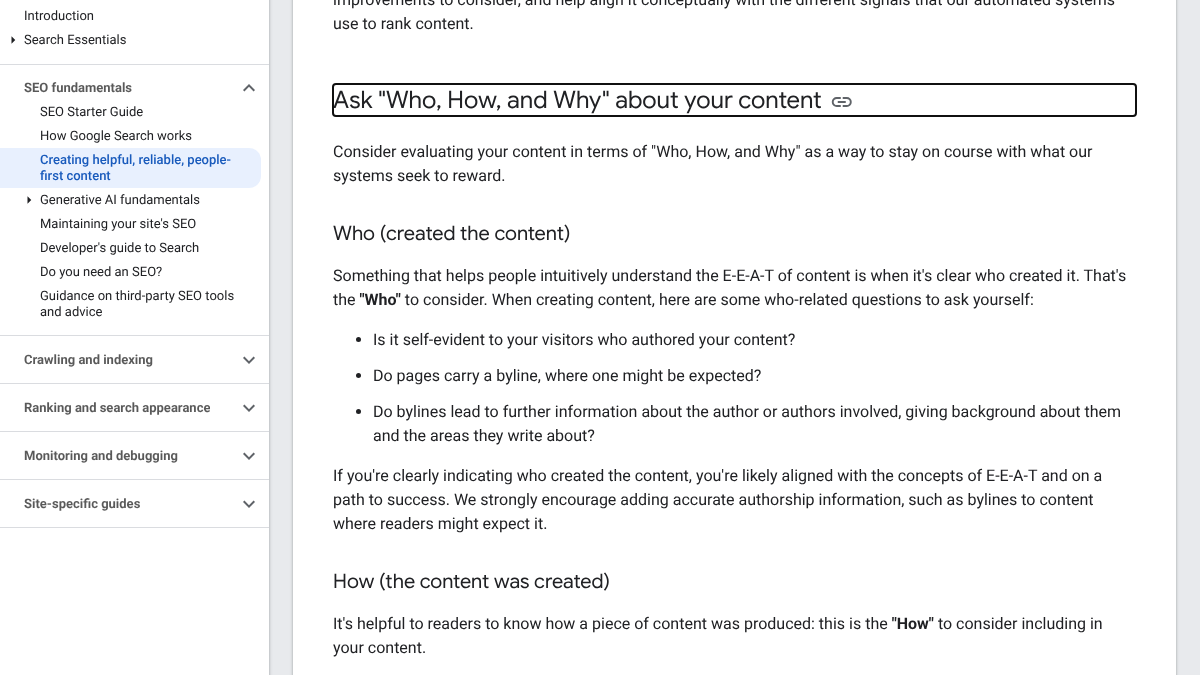
On "who," Google says it helps when "it's clear who created it," and it encourages accurate bylines where readers expect one. On "why," it calls that question "perhaps the most important." Content should exist mainly to help people, not mainly to attract search visits.
In practice, these are the checks we'd run on any page that matters:
- A named author, linked to a page saying who they are and why they know the topic.
- Facts that are correct and dated, with a link to where each number came from.
- At least one detail that shows first-hand use, like a real limit, a price paid or a setting that tripped you up.
- A plain answer near the top, so readers don't have to dig.
If you want to go further on the first point, our guide to author pages for AI search covers how to build them, and the author schema deep dive covers the markup.
Why YMYL topics get more scrutiny
Your Money or Your Life, or YMYL, is Google's label for topics where a wrong answer can hurt someone. That covers health, money and safety, plus big civic topics like voting. Google says its systems lean harder on E-E-A-T signals for these topics.
The rater guidelines spend real space on this, and their September 2025 update rewrote the YMYL definitions. For a finance or health site, the bar is higher on every letter, and Trust most of all. A lifestyle blog can get away with a thin author bio. A page on tax forms usually can't.
We'll show you exactly where your brand stands in AI search.
No commitment. $0 due today, cancel anytime. See how ChatGPT, Perplexity, Claude, Gemini, Grok, Google AI Mode, and Google AI Overviews talk about your brand today.

What E-E-A-T means for AI answers
This is where people overreach, so stick to what Google has said. Google's guide to AI features says that "the best practices for SEO remain relevant for AI features in Google Search (such as AI Overviews and AI Mode)." It also says there are no "special optimizations necessary" to appear in them.
So for Google's own AI answers, the same work that shows E-E-A-T in ordinary search is the work to do. There isn't a separate E-E-A-T for AI Overviews, and nothing in Google's documents describes one.
Other AI engines, like ChatGPT and Perplexity, don't use Google's rater guidelines at all. They pick sources by their own rules. Clear authorship, accurate facts and plain answers still help there, because those are the things any system can check. Our piece on expert bylines AI trusts looks at that side.
What the community gets right
Reddit threads on E-E-A-T swing between "it's everything" and "it's a myth." The most useful answer we found was in an r/SEO thread from a new recipe blogger with no food-industry credentials, asking how to show E-E-A-T. The top reply said it isn't a factor you optimize directly, and that Google's algorithm doesn't read your bio and hand out an authority score.
E-E-A-T where I don't have the authority
I'm starting a recipe website/blog where I have no authority on content as I have no formal education in food industry. How do I justify E-E-A-T in this scenario?
That matches Google's own wording closely. It also points to the right move for that blogger, which is to show the cooking itself. Real photos, real failed batches and real timings are the experience part of E-E-A-T, and nobody needs a degree for them.
A second thread on r/seogrowth argued that engagement matters more than any E-E-A-T signal, based on a two-page test. The top reply pushed back that one uncontrolled test proves very little, and that's fair. Treat single-site experiments on this topic as stories, not evidence.
Doing it yourself or handing it off
Most of E-E-A-T is ongoing work, not a one-time fix. Every new page needs a real author, correct facts, a plain answer and some first-hand detail. That takes about two to three hours per article if you do it properly, and longer on YMYL topics.
RankControl can take the volume. It writes each article against the pages already ranking for its keyword, matched to your brand voice, and publishes it on your own domain. You add the first-hand detail and the name on the byline, which is the part only you can supply. Its AI visibility tracking then checks up to 50 buyer questions every week across seven AI engines, so you can see which pages start bringing visits from Google and AI search first, with citations usually following later as other sites link to you.
Know exactly what AI says about your competitors.
RankControl's Recon Agent monitors competitor citations across ChatGPT, Perplexity, Claude, Gemini, Grok, Google AI Mode, and Google AI Overviews. See where they show up and you don't.