
On September 26 we ran six related questions about SOC 2 compliance through OpenAI's API and Perplexity's API, with web search on. The questions ran from the basics through costs and audit timelines, ending with whether you need ISO 27001 instead. That gave us 12 answers to look at as a set.
The domain cited most often across them wasn't a big security brand. It was soc2auditors.org, a site that does one thing: it compares 192 SOC 2 audit firms and explains the audit process. It appeared in 6 of the 12 answers. Palo Alto Networks and Microsoft each appeared once.
That's topical authority in one result, and it's why the idea matters more for AI search than it did for classic rankings. This guide explains what it means, what Google has said about it, how it shows up in AI answers and how to build and measure it. Sources were checked on September 26, 2026.
What topical authority means
Topical authority is the degree to which search engines and AI systems treat a site as a reliable source across a whole topic, rather than for one keyword. No engine publishes a topical authority score. It's a description of the result you get when a site covers a subject thoroughly and gets cited by others for it.
Google has been more explicit about this than people assume. In May 2023 it described a "topic authority" system for news that looks at signals such as how notable a publication is for a topic or location and how often other publishers cite its original reporting. That system is about news, but the signals map closely onto what AI engines seem to reward.
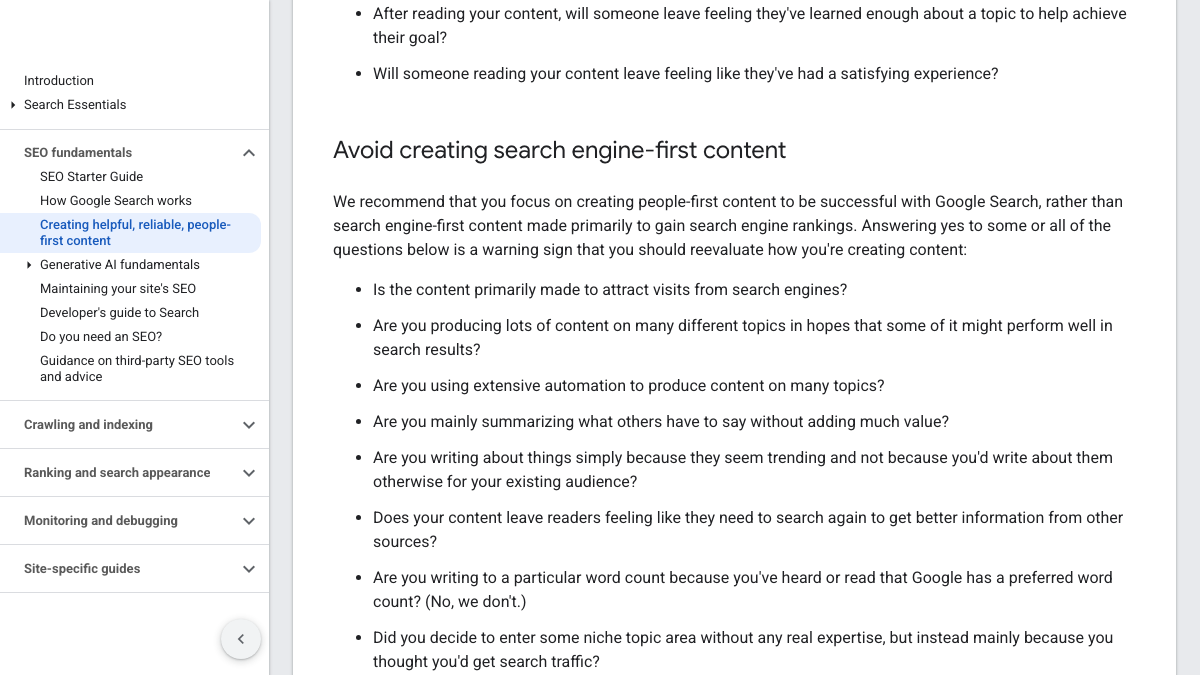
Google's guidance on helpful content goes further for every site. It asks whether a site has a primary purpose or focus, and it lists warning signs that include producing lots of content on many different topics in the hope that some of it performs.
There's also indirect evidence. The 2024 leak of Google's internal API documentation included attributes named siteFocusScore and siteRadius, which analysts read as measures of how focused a site is and how far a given page strays from that focus. Google hasn't confirmed how they're used, so treat that as a hint.
Why it matters more in AI search
AI engines rarely answer from a single search. They split a question into several sub-searches, a process Google calls query fan-out, and build the answer from the pages those searches return. A site that covers the whole topic has a page ready for more of those sub-searches.
The data points the same way. A content optimization company's December 2025 study of 173,000 URLs found that pages ranking for the fan-out sub-queries behind a question were 161% more likely to be cited in Google's AI answers. The same study found only about 27% of fan-out queries recurred across runs, so you can't chase a fixed list of sub-queries. The practical target is covering the topic's questions broadly.
Our SOC 2 test showed the mechanics clearly. Almost every page cited from the two most-cited domains was a dedicated page for the exact sub-question, such as a page on audit timelines or on SOC 2 versus ISO 27001. The one exception was Vanta's guide to SOC 2 for startups, cited for the timeline and cost questions, which both asked about small companies.
200+ SaaS teams already track their AI citations.
They know exactly when ChatGPT mentions their brand, and when it stops. Do you?
The cluster hit rate
We call the measure that matters here the cluster hit rate: the share of answers across a whole topic in which a domain is cited. It's a better test of topical authority than any single question, because it shows who the engines trust across the subject. Here's how the SOC 2 set came out:
| Domain | What it is | Answers citing it (of 12) |
|---|---|---|
| soc2auditors.org | A site about SOC 2 auditors and audits | 6 |
| Vanta | Compliance software with a large SOC 2 library | 5 |
| Secureframe | Compliance software | 4 |
| Scrut | Compliance software | 4 |
| AICPA | The body that owns the SOC 2 standard | 3 |
| Drata | Compliance software | 2 |
The two engines took different routes to authority. OpenAI's API leaned on the AICPA, which owns the standard, for three of its six answers, while Perplexity's answers drew mostly on vendors with deep SOC 2 libraries. That split matches what we've seen elsewhere: ChatGPT has leaned harder toward official sources since GPT-5.6, and Perplexity tends to reward the most complete, most recent explainer.
So there are two ways to be an authority on a topic. You can be the official source, which few companies are, or you can be the most complete and most useful library on it, which any focused company can build.
What a topical authority site looks like
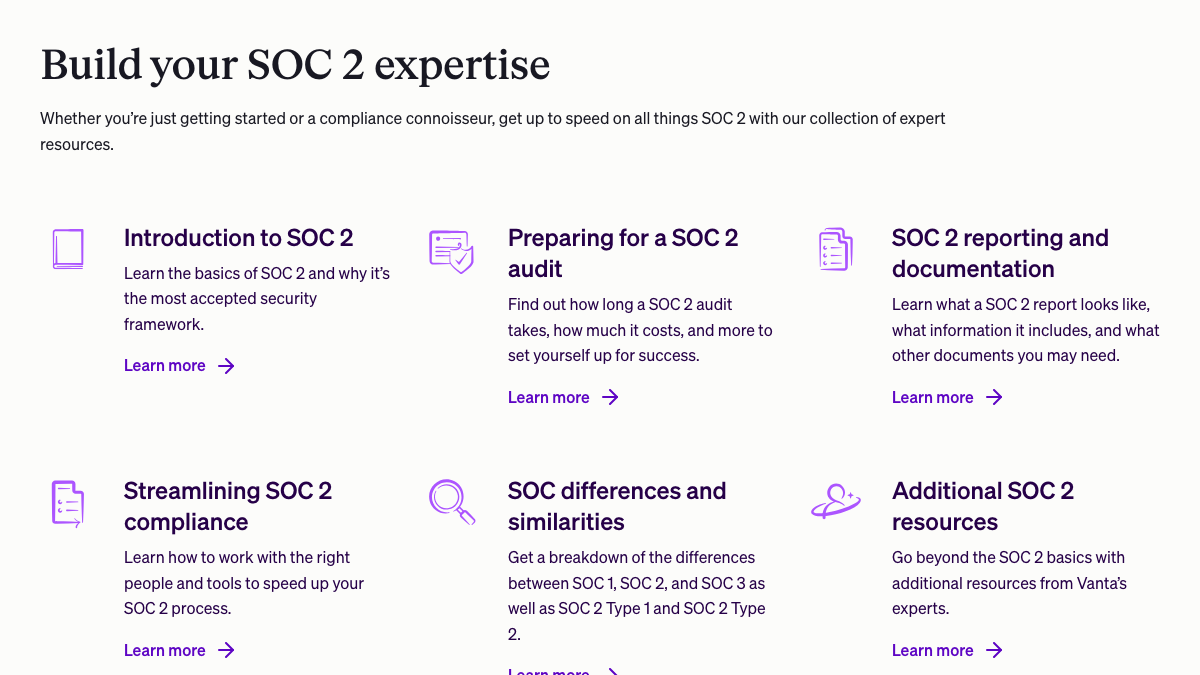
Vanta's SOC 2 hub is a clear example of the second route. It groups its resources by stage, from an introduction through audit prep, and each group links to pages that answer one question each.
The smaller site got there differently. Google shows about 250 indexed pages for soc2auditors.org, all on one subject, including a comparison of 192 audit firms and an audit cost calculator. OpenAI's API cited both the cost guide and the calculator for the cost question, which is the kind of first-hand material a general security site doesn't have.
Size isn't the point. A poster on r/seodiscovery2026 noticed the same pattern in September: smaller niche sites going deep on one area were ranking above much bigger websites. One reply described sites with 20 useful pages beating bigger sites with hundreds of weak ones.
Is topical authority becoming less important? what do you think?
I've been noticing some smaller niche sites ranking above much bigger websites lately. They don't cover hundreds of topics but they seem to go really deep into one specific area and still perform well. Is Google starting to favor sites that...
Our guide to pillar pages for the AI search era covers how to structure the hub itself.
More pages won't get you there
The most common mistake is treating topical authority as a publishing target. Koray Tuğberk Gübür, who popularized the term in SEO, described a July case study in which deleting millions of unnecessary pages from a client's site brought 600,000 additional clicks.
My second Search Engine Land case study is live. We deleted millions of unnecessary pages from one client’s website. The result: 600,000 additional clicks while impressions remained almost unchanged. The central lesson is simple: Topical authority is not a publishing-volume
 Koray Tuğberk GÜBÜR · Topical Authority@KorayGuburJul 22, 2026
His framing is that every unnecessary URL spreads relevance and ranking signals across pages that shouldn't exist separately. A thread on r/WebsiteSEO in June made the same point from the other side. The poster had watched sites publish 200 posts and go nowhere, and the top reply described topical authority as five tightly clustered, interlinked posts that cover the questions users actually ask.
I’ll say it: “topical authority” is overrated. Convince me otherwise
I’ve seen sites publish 200 posts and go nowhere. What’s the real difference maker? Internal links, entities, quality, links, brand, updates? Give me your strongest argument.
That's also where AI-generated content goes wrong. Publishing hundreds of near-identical pages across loosely related topics is exactly what Google's warning list describes, and it can drag down the pages that were working. Our piece on dashboards versus pipelines covers the scaled-content risk in more detail.
How to build topical authority for AI search
Most of the work is choosing the topic well and then finishing it. This is the order we'd follow:
- Pick a topic narrow enough to own. "SOC 2 for startups" is winnable for a focused company, and "cybersecurity" isn't.
- Map the questions. List what buyers ask at each stage, then ask an AI engine which searches it would run to answer them. Our ChatGPT prompts for keyword research include a prompt for that.
- Give each distinct question one page, and merge near-duplicates. Link every page to a hub and to its closest neighbors.
- Add material others can't copy, such as a calculator, a dataset, prices or a comparison you built from real work.
- Earn corroboration. Mentions on the sites the engines already trust tell them your library is worth citing.
- Keep pages current. An analysis of 3.5 million citation events found half of ChatGPT's citations in a given week were gone within about 3.4 weeks.
Aleyda Solis summed up the balance in June: build topical authority with content AI systems can easily retrieve and cite, then strengthen brand authority through third-party corroboration.
🤖 How to Optimize for AI Visibility and Prepare for Agentic Search 👇 I share Three principles to prioritize AI search optimization: 1. Stop using traffic as the main KPI for AI search impact 2. Build topical authority with content that AI systems can easily retrieve, https://t.co/NiKkEUoTuJ
 Aleyda Solis 🕊️@aleydaJun 4, 2026
How often does ChatGPT mention your brand?
Most founders have no idea. The answer might surprise you.

How to measure it
Measure across the whole topic. Choose 20 to 50 questions that together make up the topic you want to own, run them on each engine every week or two, and record which domains are cited. Your cluster hit rate, and the domains ahead of you, tell you where the library has gaps.
Done by hand, checking 50 questions on seven engines takes about six hours a week, and publishing eight solid articles a month takes 16 to 24 hours more. Those are rough estimates.
RankControl is built around topics. You set the topics you want to be known for, and the Radar agent finds the questions your buyers actually search within them, checks them against real search data and plans titles onto your content calendar. The content engine writes each article against the pages already ranking for its keyword and publishes it on your own domain, and AI visibility tracking runs your 50 questions every week on seven engines and marks each one as mentioned, cited or both.
You can run the cluster hit rate yourself with a spreadsheet and an hour a week. Or RankControl's agents can build and check the library every week while your team adds the first-hand material only it has.
15 hours a week manually. Or 15 minutes with RankControl.
Track citations, monitor competitors, and fix content gaps across every AI search engine. Automatically.