
On September 26 we asked Perplexity's API a question a small business owner might type: "How do I choose a good accountant for my small business?" It came back with 16 sources. Seven were from accounting software companies, and the rest included a business bank, an insurer, a chamber of commerce and two national online accounting services. Not one local accounting firm made the list.
Picture a CPA firm tracking that question on an AI visibility dashboard. The chart would show zero every Monday, accurately, for as long as the firm kept paying. Nothing on the dashboard would change until someone at the firm wrote a better answer to that question and published it, which is the part no chart does.
That's our whole argument, and we'll say up front that we sell the other side of it. Knowing where you stand in AI answers is useful, but knowing isn't fixing, and plenty of teams buy the knowing part first.
What a dashboard is good at
We'll be fair to dashboards before we argue with them. An AI visibility dashboard runs a set of questions on engines like ChatGPT, Perplexity and Google's AI Mode, then reports how often your brand is named, how often your pages are cited, which competitors show up and how the engine describes you. Semrush and Ahrefs both sell versions of this now, and our own roundup of the AEO tool market found prices anywhere from free to $4,500 a month.
That data has real uses. It tells you which competitors keep appearing where you don't, and whether the engines describe your product correctly. That second one matters more than it sounds: a founder in an r/GrowthHacking thread this year found ChatGPT describing their employee growth product as a project management tool, which no amount of new content fixes until someone notices it. Before tracking tools existed, most marketing teams had no idea what ChatGPT said about them at all.
The trouble starts on the Monday after the first report, when the team has a list of gaps and nobody assigned to close them.
The numbers wobble more than the charts suggest
Every dashboard number is a sample. In January, SparkToro asked AI tools for brand recommendations hundreds of times and found that almost every answer differed in which brands it listed and in what order.
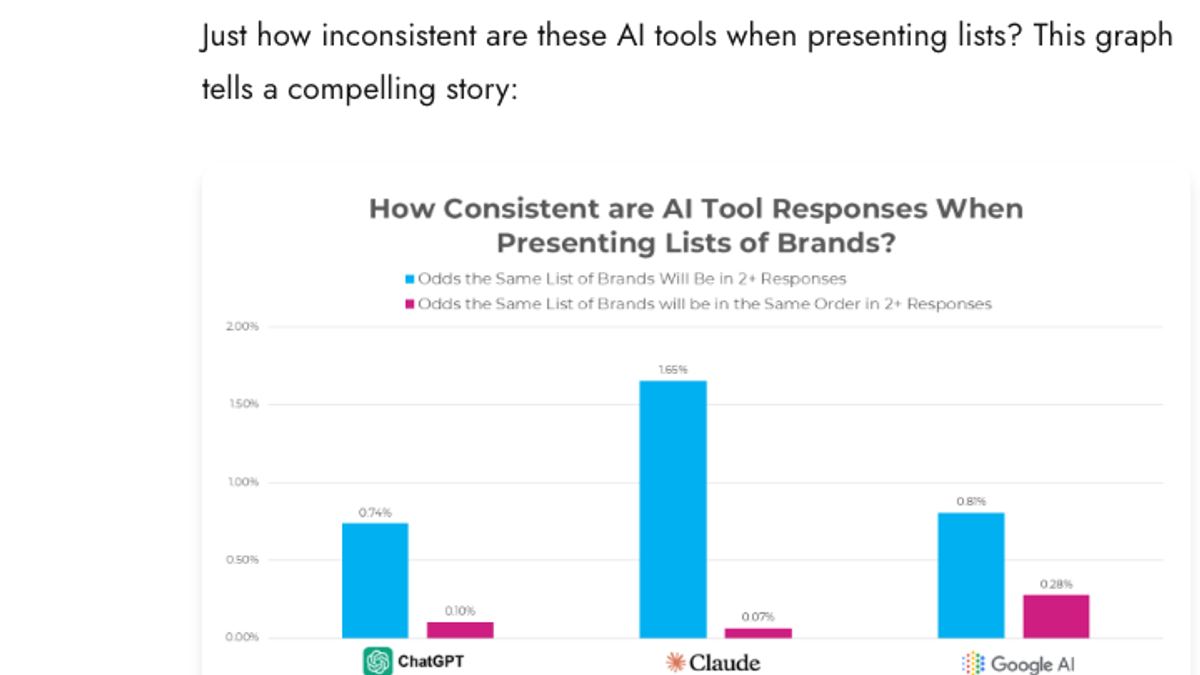
The odds of ChatGPT or Google's AI giving the same list of brands twice in 100 runs were under 1 in 100, and the same list in the same order was closer to 1 in 1,000. So when a dashboard says your "AI rank" dropped from third to fifth this week, it may be showing run-to-run variation more than a real change.
A poster on r/seogrowth put the sensible middle ground well in August. A fixed set of buyer-style prompts, run the same way over time, can show whether a brand appears more often and which competitors keep turning up. The poster's objection was to the leap from "we appeared in 18% of sampled answers" to "buyers see us more."
Do AI-visibility trackers measure anything useful — or just create an impression of authority?
I keep looking at AI-visibility dashboards and getting stuck on what the numbers actually represent. They give you clean metrics: mention rate, share of voice, citations, sentiment, sometimes an estimated audience. It all looks reassuringly...
We agree with that line. Trends across a stable question set are useful. Single-week movements are mostly noise, and reacting to one week's drop usually means rewriting a page that was fine.
The Tuesday test
Here's the check we'd run on any AI visibility report, including ours. Call it the Tuesday test: if Monday's report doesn't change what someone on your team does on Tuesday, it's a dashboard. If it puts a specific page or correction on someone's list for the week, it's the start of a pipeline. What would anyone on your team do differently because of last week's report?
Most reports fail it, and not because the data is bad. A business owner on r/GEO_optimization posted a textbook case in April after running a free audit on their Las Vegas tour company. They had a 23.7% AI visibility figure, a 12.9% share of voice and a list of queries where Viator and TripAdvisor dominated. Their question was the one every dashboard eventually leaves you with: what should I do next?
Can someone help me make sense of my GEO data? What should I do next?
I recently ran my brand through a free GEO tool and got the data back, but honestly I am not sure how to turn it into anything useful. I ran a GEO audit for my site and got these numbers: GEO pre-audit score: 63/100 AI visibility: 23.7% AI...
The replies were more useful than the report. Get into the "best food tours in Las Vegas" roundups the engines already cite, and write answer-first pages for the tours they're missing from. Those are both jobs for a person or a pipeline, and neither shows up as a number.
In a separate thread about which AI visibility tools people renew, one commenter summed up the buying decision: they cancelled a tool that gave vanity metrics without clear actions, and they won't renew a report that doesn't help them decide what to improve next.
How often does ChatGPT mention your brand?
Most founders have no idea. The answer might surprise you.

Why the fix is almost always a page
When we look at what engines actually cite, the pattern keeps pointing at pages on the brand's own site or on sites the engines trust.
On the same day, we ran four software buying questions through OpenAI's API with web search on. It consulted 162 sources and cited 14 URLs, and 13 of those 14 came from companies describing their own products. For a question about SOC 2 costs, the only two pages that made the answer were a startup guide from Vanta and a cost page from Drata. Both companies had published a page that answered that exact question.
Citations also expire. An analysis of 3.5 million citation events found that half of the citations ChatGPT gives in a week are gone within about 3.4 weeks. A page that earned its spot in March needs updating by summer, so the work keeps going after the first page ships.
So the fixes that move AI visibility look like this:
- A page on your site that answers the question better than the pages currently cited.
- An update to an old page that engines cite with stale facts.
- A mention on a roundup, review site or forum the engines already use for that question.
- A correction to how your product is described, repeated consistently across your site and profiles.
None of those happen inside a dashboard. Our breakdown of what AI search engines trust covers the third and fourth in more detail.
What a pipeline looks like
A pipeline is the dashboard plus everything that has to happen after Monday. It starts with the questions your buyers actually ask, turns each gap into a piece of work, ships that work on your domain and checks the same questions again a few weeks later.
The difference in practice looks like this:
| Dashboard | Pipeline | |
|---|---|---|
| What you get on Monday | Scores and a competitor list | The same data, plus the pages planned or shipped because of it |
| Who acts on it | Whoever has time that week | A defined step, handled by a writer, an agency, software or a mix |
| Time from gap to fix | Open-ended | Days to weeks, depending on the page |
| What it costs | The subscription | The subscription plus writing and publishing time |
A pipeline doesn't have to be software. For some teams it's one writer with a weekly slot and a tracking sheet, and for others it's an agency on retainer. What makes it a pipeline is that every gap on the list has an owner and a deadline, and that someone checks the same questions again afterwards.
The last row is the honest one. A pipeline costs more hours or more money, because the work that changes answers is writing. Done by hand, publishing eight solid articles a month takes 16 to 24 hours, and checking 50 questions on seven engines takes about six hours a week. Those are rough estimates.
Pipelines can make things worse
We'd be leaving out the uncomfortable part if we stopped there. A pipeline that publishes thin or self-promoting pages at scale can hurt the whole domain. Lily Ray made that case in July, after tracing more than 70 companies hit by Google's January update to the same pattern of scaled SEO and GEO content built mainly to promote the brand.
One of the biggest mistakes I see site owners make when chasing SEO/GEO performance: they don't realize that certain page types - especially when published at scale - can be more of a liability than an asset. This is especially true right now with AI tools that recommend new
 Lily Ray 😏@lilyraynycJul 21, 2026
Her warning is aimed at exactly the kind of tool that recommends new pages to build, which includes the category we're in. We think she's right about the risk. The safeguard is making every page carry things a model can't invent: your real prices and limits, customer language, first-hand results and a point of view. Our piece on better AI content coming from better context covers how to build that material.
Google's own rules draw the line in the same place. Its spam policies name using generative AI to create many pages without adding value for users as scaled content abuse.
15 hours a week manually. Or 15 minutes with RankControl.
Track citations, monitor competitors, and fix content gaps across every AI search engine. Automatically.

Turn the report you already have into a work list
If you're paying for tracking today, you don't need a new tool to pass the Tuesday test. You need a short routine that turns each gap into a named job. This is the one we'd use:
- Pick the ten questions closest to a purchase and ignore the rest for now.
- For each one, open the answer and note which pages the engines cite and what they say about you.
- Assign one fix per question from the list above, with an owner and a date, and write down which page or mention you expect to change the answer.
- Recheck the same ten questions three to four weeks after each fix ships, and count how often you appear across several runs instead of trusting one screenshot.
Ten questions is a list one person can finish in a month. Once those ten have owners, add the next ten. Our guide to turning AEO tracking reports into content actions gives each question one of five action codes.
When a dashboard is all you need
Some teams really should buy only the dashboard. If you already have writers or an agency publishing every week, a tracking report can feed their plan directly, and adding another content tool would just duplicate them. PR teams measuring earned coverage are another good fit, since their work happens off-site anyway.
A dashboard also makes sense for a short diagnostic. If you want to know whether AI search matters for your category at all before you commit a budget, a month of tracking will answer that.
Part of that dashboard is now free. Google added generative AI performance reports to Search Console in June 2026, and Bing Webmaster Tools has an AI Performance report showing which of your pages Copilot and Bing's AI summaries cite. Neither covers ChatGPT or Perplexity, but for a first look at Google and Microsoft they cost nothing.
The trouble is the in-between team: a small marketing department that buys tracking, finds 40 gaps in the first report and has no one free to fix them. That team ends up paying monthly to watch the same gaps, and by renewal nobody can say what the tool changed.
Where RankControl sits
RankControl is built as a pipeline for that in-between team. The Radar agent finds the questions your buyers actually search and checks them against real search data, then plans titles onto your content calendar. The content engine writes each article against the pages already ranking for its keyword and publishes it on your own domain. AI visibility tracking then runs your 50 questions every week on seven engines and marks each one as mentioned, cited or both, so you can see whether the pages are working.
If you already have a content team you trust, a dashboard may be enough, and we'd rather you knew that before you buy. If the gaps in your last report are still sitting there, run the Tuesday test on it. Then decide whether you need another report or the people and pages that act on the one you have.
AI search traffic grew 835% this year. Is your content ready?
RankControl generates 26 content formats optimized for ChatGPT, Claude, and Perplexity. Published on your domain, matched to your brand.