
On September 26 we ran the same keyword request through GPT-5.5 twice, a few minutes apart. The first version was one line asking for 20 keywords for time tracking software, and it came back with "time tracking software" and "employee time tracking," the same list every competitor in that category already has. The second version was a short brief with seven phrases real agency owners had used on Reddit, and it came back with "agency project costing by client."
It was the same model on the same afternoon. The only thing that changed was what we handed it, and that's the whole argument of this piece: better AI content comes from better context, and most teams are still polishing prompts instead. We've written up the full keyword prompt test separately; this is about what it taught us.
The prompt is the smallest part of what the model sees
Most content teams treat the prompt as the lever. They collect prompt libraries and tweak word order when a draft comes back flat.
The people who build AI products moved past that last year. In June 2025, Andrej Karpathy argued that "context engineering" is the better name for the real work, which he described as filling the context window with just the right information for the next step.
+1 for "context engineering" over "prompt engineering". People associate prompts with short task descriptions you'd give an LLM in your day-to-day use. When in every industrial-strength LLM app, context engineering is the delicate art and science of filling the context window
 Andrej Karpathy@karpathyJun 25, 2025
His list of what goes into that window is telling. Task descriptions are on it, but most of the list is material: examples, retrieved data, history and state. The instruction is one line item out of many.
For a content team, the split looks like this. The prompt is the 50 words telling the model to write a comparison page in your brand voice. The context is everything the model knows when it starts: your prices, your customers' complaints, the test you ran last month, the claim a competitor keeps making that you think is wrong. Give a model a perfect prompt and none of that material, and it has only its training data to draw on.
Generic is what a model writes when it has nothing specific
When a model lacks a fact, it doesn't leave a blank. It fills the gap with the most likely version of the topic, which is also the version everyone else gets.
Researchers have measured this. In a study published in Science Advances in 2024, Anil Doshi and Oliver Hauser had 300 people write short stories, some with story ideas from a language model and some without. The AI-assisted stories were rated as more creative on average, especially for the weaker writers.
The catch showed up across the group. Stories built on a single AI idea were 10.7% more similar to each other than stories written without one. The authors described it as a gain in individual creativity at the risk of losing collective novelty.
That pile is now most of the web. When Ahrefs ran its own AI detector over 900,000 pages published in April 2025, 74% contained some AI-generated content, and only 2.5% were pure AI with no human editing. Detectors make mistakes, and it's Ahrefs' own model doing the classifying, so treat the exact share with some care. The shape is clear enough: most new pages are a person and a model working together, so the sameness can't be blamed on pure AI pages alone.
One r/ChatGPT poster put the consequence bluntly this summer: brands are using AI to publish more of the exact same hooks and formats, and if a brand doesn't have a point of view, AI just helps it "say nothing... faster."
Generic AI content is the problem.
ok so everyone keeps panicking about AI flooding the internet with content. Almost everything is now labelled “ai slop”. but like... that already happened? scroll linkedin for 5 minutes and tell me it didn't. The real issue isn't that AI is...
Why a longer prompt doesn't fix it
The usual response to a flat draft is a longer prompt, with more instructions and a paragraph about the brand's personality. It rarely works, and a thread in r/content_marketing explains why better than we could.
The poster described AI drafts that were "technically fine but completely voiceless," then pointed out that rewriting them into the brand's voice ate the time the AI was supposed to save. The top reply blamed the tone doc. Most brand voice docs describe a personality with words like warm and confident, and words like that fit ten thousand brands. What worked for that commenter was a list of words the brand would never use, plus a handful of sentences the brand had actually written. Our guide to editing SEO content with AI without losing your voice turns that into a repeatable process.
How do you keep AI content actually sounding like the brand and not like default-AI?
For those of you producing content with AI in the mix, how do you deal with the output being technically fine but completely voiceless? It reads clean, it's on-topic, but it sounds like no one in particular, definitely not the brand I'm wri...
That fix swaps a description for material, and it's the same thing our keyword test showed.
More context isn't automatically better, though, and our own test showed the failure. Our brief included the phrase "screenshots or activity tracking (not sure yet)" from a Reddit post, and the model turned it into a keyword idea word for word, even though nobody would ever type that into Google. Anthropic's engineering team calls the goal "the smallest possible set of high-signal tokens" in its guide to context engineering, and it warns that models get worse as the window fills with noise.
So the target is a floor. We call it the fact floor: the minimum set of specific, true material a piece needs before a model writes it. Below the floor you get the average of the internet. Well above it, with every transcript and doc pasted in, the model starts to lose the thread.
15 hours a week manually. Or 15 minutes with RankControl.
Track citations, monitor competitors, and fix content gaps across every AI search engine. Automatically.

What the fact floor contains
For a B2B software company, the fact floor has five parts. Each one lives somewhere in the company already, and each changes the draft in a way no prompt wording can.
| Kind of context | Where it lives | What it changes in the draft |
|---|---|---|
| Product facts | Pricing page, docs, changelog | Real prices, limits and integrations instead of "flexible pricing" |
| Customer language | Sales calls, support tickets, reviews | The buyer's words for the problem, which are also what they search |
| First-hand experience | Tests, launches, mistakes, numbers you tracked | Details no other page has, which is what Google calls non-commodity |
| Point of view | Founder opinions, what you'd never say | A position the reader can agree or argue with |
| Proof | Data you can publish with a source | Claims a reader or an AI engine can check and quote |
The first two are the cheapest, and in our view the most often skipped. A product fact sheet takes an afternoon to write and a few minutes a month to keep current, and it stops the model from inventing a feature or quoting last year's price.
Customer language takes longer to collect, but it's the part that makes a page sound like it was written for someone. It also doubles as keyword research, since the phrase a buyer uses on a sales call is often close to what they type into Google or ask ChatGPT.
First-hand experience is the hardest to fake, and that's the point of it. A model doesn't know about the test you ran, and if you let it make one up, you've published a claim you can't defend.
Point of view is the part a model can't supply at all. It can argue either side of any question on request, so unless you tell it which side your company is on, it'll write the balanced summary that every other page already offers. Proof works the same way: a number only helps if you can name where it came from.
Google and the AI engines want the same thing
This isn't only a style preference. Google's guide to succeeding in AI search, last updated in July 2026, has a section titled "Create valuable, non-commodity content for your audience," and it's unusually direct. Our AI content creation guide turns that section into a seven-step process.
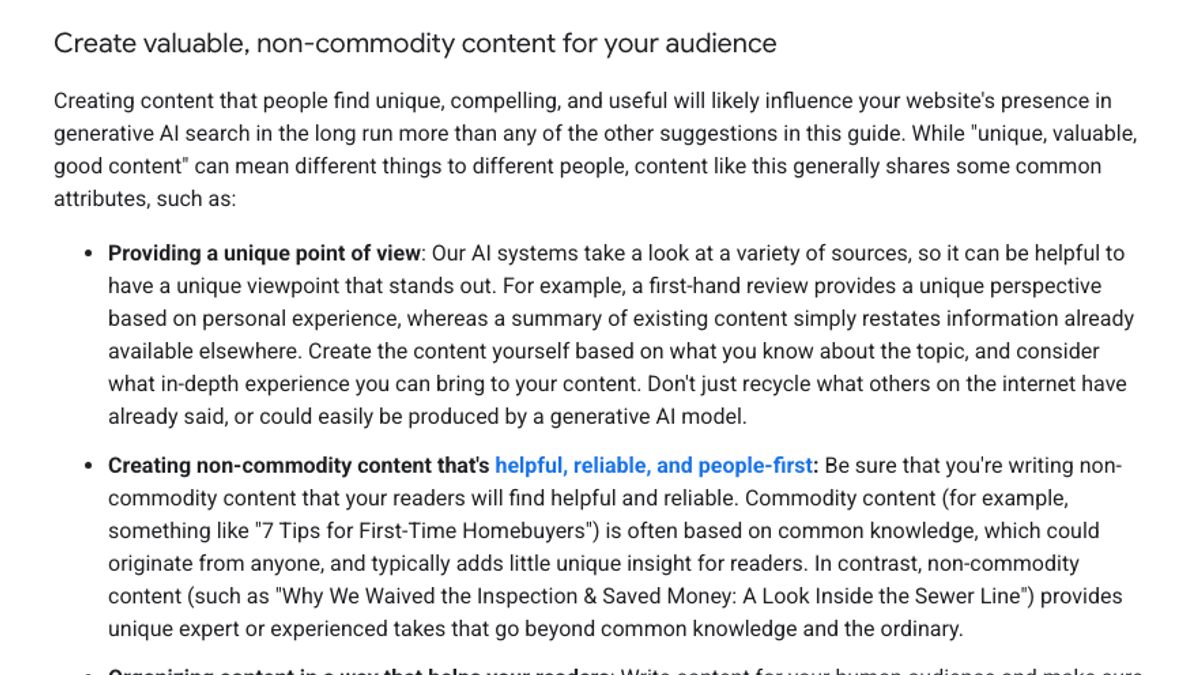
It contrasts "7 Tips for First-Time Homebuyers," which it calls commodity content, with a first-hand piece about waiving an inspection and inspecting the sewer line. Then it says, in so many words, not to recycle what others have already said "or could easily be produced by a generative AI model." Google's guide is describing the output of a model with no context.
AI engines lean the same way for their own reasons. They quote pages that contain something specific to quote. The Princeton GEO paper found that adding statistics or quotations to a page raised its visibility in generative engine answers by up to about 40% in its tests, and a sentence like "flexible pricing for teams of all sizes" gives an engine nothing to lift.
Readers notice too. In a 2025 survey of 3,000 US adults by the ad company Raptive, content that readers suspected was AI-made lost nearly half of their trust. Purchase consideration for the brands advertised next to it dropped 14%, which is a cost that lands on the brand, even when the page ranks.
Prompts still matter, just less than you think
None of this makes prompts irrelevant. A good prompt sets the format and tells the model who it's writing for, and a bad one can waste good context. Shopify's CEO put the balance well when he picked up the term.
I really like the term “context engineering” over prompt engineering. It describes the core skill better: the art of providing all the context for the task to be plausibly solvable by the LLM.
 tobi lutke@tobiJun 19, 2025
Tobi Lütke's version is that the skill is providing all the context for the task to be plausibly solvable by the model. That's a useful test for any content request: could a smart freelancer who has never met your company write this page well from what you've given them? If the answer is no, a better prompt won't close the gap.
It's telling how often prompt advice turns out to be context advice. An r/PromptEngineering post in September listed six reasons AI output comes back flat, including no defined reader, no goal beyond the topic, a tone label instead of a real reference and no concrete detail. At least four of the six describe missing material rather than badly worded instructions.
AI search traffic grew 835% this year. Is your content ready?
RankControl generates 26 content formats optimized for ChatGPT, Claude, and Perplexity. Published on your domain, matched to your brand.

How to build your fact floor this week
You don't need a new tool to start. You need a shared document that every AI-assisted piece draws from, kept short enough that someone actually maintains it.
- Write a one-page product fact sheet: current prices, plan limits, integrations, and the three questions sales hears most. Date it and update it monthly.
- Collect 20 to 30 customer phrases from sales calls and support tickets, each with where it came from. Use them as material, and don't paste them in as keywords.
- Write five sentences your brand believes that a competitor wouldn't say, and a list of 10 words you'd never use.
- Keep a proof bank of numbers you can publish, each with its source and date.
- For every piece, add one first-hand detail before drafting: a test, a screenshot, a mistake or a customer result you can name.
The last step is the one teams skip, and it's the one Google's guide and the AI engines reward most directly. A draft that starts from one real detail tends to end up with a point of view, because the detail forces the model to write about something in particular.
Keeping the context current is the real work
Building the fact floor once is an afternoon. Keeping it current while publishing is the job: prices change and new objections turn up on sales calls. Done by hand, publishing eight solid articles a month takes 16 to 24 hours, and checking 50 questions on seven engines to see whether the pages get cited takes about six hours a week. Those are rough estimates.
RankControl is built around keeping that context in one place. In Brand Control, you define your products, voice and competitors once, and when you correct a claim, the writer carries the correction into every article after it. The content engine then writes each article against the pages already ranking for its keyword and publishes it on your own domain, and AI visibility tracking checks your 50 questions every week to see whether those pages get cited. Our look at whether Google is targeting AI content or low-quality content covers the ranking side of the same question.
You can keep the fact floor in a shared doc and paste it into every prompt yourself. Or RankControl's agents can carry it into every article, every month, while your team adds the first-hand details only it can supply.

Built by the team that got cited in 48 hours.
Content generation, backlink building, AI visibility tracking, and Google rankings. One platform, zero guesswork.