
In June, a content marketer asked r/content_marketing how others keep AI-assisted content sounding like the brand. The drafts read clean and stayed on topic, but they sounded like no one in particular. Rewriting them into the brand's voice could eat all the time the AI was supposed to save.
How do you keep AI content actually sounding like the brand and not like default-AI?
For those of you producing content with AI in the mix, how do you deal with the output being technically fine but completely voiceless? It reads clean, it's on-topic, but it sounds like no one in particular, definitely not the brand I'm wri...
One reply put the tradeoff plainly: AI saves the time spent staring at a blank page, and the voice work still has to happen. Another explained why most voice documents fail. They describe a personality in adjectives like warm, confident and approachable, and those words fit ten thousand brands.
This guide covers how to use AI for editing SEO content while keeping the voice that makes it yours. It starts with what the pages that rank actually sound like. Sources were checked on September 27, 2026.
Why AI edits flatten a voice
A language model writes the most likely version of a sentence. Ask it to improve or polish a draft, and it nudges your phrasing toward the common one. When we asked an AI generator for the same SaaS introduction ten times, the drafts came out nearly identical, down to the same opening words.
Editing has the same pull. Each small change looks reasonable, and after a full pass the piece reads like everyone else's.
Survey data suggests the human side matters. Orbit Media's 2026 survey of 1,042 content marketers found that using AI for blogging didn't correlate with results either way. Replacing human editors with AI was one of the practices the survey linked with weaker results, and it was becoming more common. Ann Handley, quoted in the report, described human editing as one of the places where the greatest value enters the work.
What the pages that rank sound like
We wanted to know how much stock phrasing appears in content that already ranks. On September 27 we pulled Google's top 10 results for 10 B2B how-to searches, such as "how to write a case study." Then we counted 20 phrases often associated with AI-style writing in the 52 pages we could read in full.
| Phrase | Pages using it (of 52) |
|---|---|
boost | 20 |
crucial | 19 |
leverage | 11 |
empower | 9 |
seamless | 7 |
streamline | 7 |
delve | 1 |
Most pages used at least one of these words, since several are ordinary English. What stood out was how lightly they were used. The median page had about one per 1,000 words, and only 3 of the 52 pages used three or more per 1,000. The word delve appeared on one page.
The content that ranks for these searches mostly reads plainly. An edit that adds the familiar AI vocabulary moves a page away from what's ranking.
Know exactly what AI says about your competitors.
RankControl's Recon Agent monitors competitor citations across ChatGPT, Perplexity, Claude, Gemini, Grok, Google AI Mode, and Google AI Overviews. See where they show up and you don't.

Step 1: Build a voice kit
Before any AI edit, give the model something concrete to copy. We call it the voice kit: the small set of materials an AI editor needs to keep your voice. It has four parts.
The first is examples. Collect five to ten paragraphs you've already published that sound exactly right. Real sentences give the model rhythm and word choice to imitate, which adjectives can't. Your customers' own words belong in the kit too, as our guide to using customer language in AI content explains.
The second is a never-say list. Write down the words and phrases your brand doesn't use. A reply in the r/content_marketing thread described this as what finally worked: a list like "we'd never say unlock, seamless or delve," plus real shipped sentences.
The third is rules. Keep them short and checkable, covering sentence length, first or third person, contractions and how you name your product and customers. Public style guides show what useful principles look like. Mailchimp's is one of the best known:
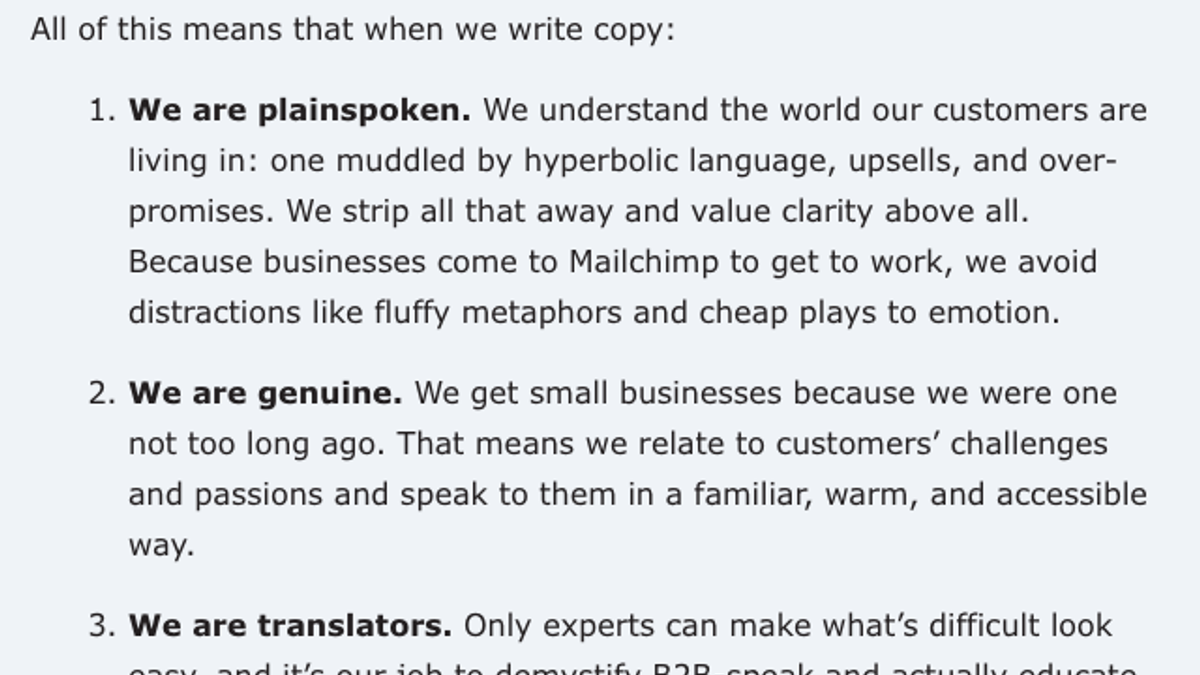
Notice that each principle comes with a behavior, such as avoiding fluffy metaphors or stripping out hyperbole. That's what makes it usable by an editor, human or AI.
The fourth is facts. List the product names, prices, claims and numbers the AI must never change, so an edit for style can't quietly break accuracy.
Here's what a kit might contain, as a template:
| Kit part | Example entry |
|---|---|
| Examples | Five to ten paragraphs copied from your best published posts |
| Never-say list | unlock, game-changer, "in the world of" |
| Rules | Sentences under 25 words, contractions always, "customers" and never "users" |
| Facts | Plan names and current prices, with the date you checked them |
Step 2: Give the AI one editing job at a time
A single "edit this" request invites a full rewrite. Split the work into passes, and tell the AI what to leave alone in each one:
| Pass | What the AI does | What it must not touch |
|---|---|---|
| Clarity | Cuts filler and splits long sentences | Opinions, examples and quotes |
| Structure | Suggests heading changes and paragraph breaks | The wording inside paragraphs |
| SEO | Suggests FAQ questions and drafts the meta description | Headings and sentences, to fit in keywords |
| Accuracy | Lists claims that need a source or a date | The claims themselves, which a person checks |
| Consistency | Flags terms used two different ways | Anything already consistent |
Ask for a list of suggested changes, or tracked changes, instead of a rewritten draft. You keep the edits that improve the piece and skip the ones that change its voice.
Step 3: Keep SEO edits from changing the voice
SEO is where AI editing most often goes wrong. Asked to "optimize for a keyword," a model will work the phrase into headings and sentences where no person would put it.
Google's own guidance says that isn't needed. Its May 2026 guide to optimizing for generative AI features says you don't need to rewrite content just for AI systems, because they understand synonyms and general meaning. So keep the keyword in the title and the opening answer, and let the rest read naturally.
The SEO edits AI does well are narrow. It can check whether the introduction answers the question within the first few sentences and suggest questions for an FAQ section. It can also draft meta descriptions within a character limit. Our guide on whether AI-written posts can rank in AI search covers what makes a page worth citing in the first place.
26 content formats. Published on your domain. Matched to your brand.
Guides, comparisons, listicles, case studies, and more. RankControl generates content that gets cited by ChatGPT, Perplexity, Claude, Gemini, Grok, Google AI Mode, and Google AI Overviews.

Step 4: Check the output against the kit
Improving the prompt isn't enough. Check what comes back.
Run the never-say list as a search across the edited draft, since it's a hard check that either passes or fails. Then read the piece aloud. One commenter in the thread noticed that a banned word removed from the output came back as a synonym with the same rhythm. Cadence, meaning sentence length and the reflex to list things in threes, is what a word list can't catch.
Compare the edited draft with the original side by side, and reject changes that add stock phrasing or remove specifics. You can also measure it. Count never-say phrases per 1,000 words before and after each AI pass. The ranking pages in our check used about one of our 20 phrases per 1,000 words, so an edit that pushes a draft well above that is moving it toward the generic voice.
Keep a log of the fixes you make repeatedly. When the same correction comes up three times, add it to the voice kit, so the next edit starts closer to right.
What to keep human
Some parts of a piece should never go through an AI edit without a person deciding. Opinions, first-hand examples and the reading of your own data are where the voice lives. Humor and the final read before publishing belong there too.
Those are also the parts engines and readers value most. A page that sounds like everyone else gives neither a reason to pick it. Our guide on why "make it sound more human" is a bad AI prompt covers why the fix is better input. Our piece on better AI content through better context covers what to feed the model.
Done by hand, publishing eight solid articles a month takes 16 to 24 hours, and checking 50 questions on seven engines takes about six hours a week. Those are rough estimates.
RankControl's content engine writes each article against the pages already ranking for its keyword, matched to your brand voice, and publishes it on your own domain. AI visibility tracking runs your 50 questions every week on seven engines and marks each one as mentioned, cited or both.
You can run this editing process with a voice kit and any AI tool. Or RankControl's agents can handle the drafting and publishing while your team keeps the final read.

Your competitors are getting cited by AI. You're not.
Every day without citation tracking is a day your competitors pull ahead in ChatGPT, Perplexity, and Claude.