
On September 27 we asked OpenAI's API, with web search turned off, to write five short blog posts answering questions a help desk buyer might ask. All five gave Freshdesk's starting price as about $15 per agent a month. Freshdesk's pricing page said $19.
The drafts read well. They hedged their prices with words like "typically" and "around," and one even suggested checking the vendor's page. They were also out of date on every Freshdesk and Help Scout price we checked.
So can AI-written blog posts rank in AI search? Yes, and plenty already do. The studies below show AI-written text all over the pages ChatGPT, Perplexity and Google's AI Overviews cite. What decides it is whether the post contains anything the engine couldn't get from the model itself. This guide covers the evidence and what Google says, then how to use AI for posts that engines actually cite. Sources were checked on September 27, 2026.
The short answer: yes, AI content gets cited
Four large studies from 2025 measured AI-generated text in search results and AI citations:
| Study | What was measured | Result |
|---|---|---|
| Ahrefs, July 2025 | 600,000 pages ranking in Google's top 20 | 4.6% pure AI, 81.9% mixed, 13.5% pure human |
| Ahrefs, July 2025 | Top three citations in 1 million AI Overviews | 3.6% pure AI, 87.8% mixed, 8.6% pure human |
| An SEO agency, October 2025 | Articles cited by ChatGPT and Perplexity | 18% AI-generated, 82% human-written |
| An AI detection company, October 2025 | AI Overview citations for 29,000 health, money and similar queries | 10.4% AI-generated, 74.4% human, 15.2% unclassified |
The studies define AI content differently, so the numbers don't line up exactly. Ahrefs counted any AI-written passage on a page, which is why most pages came out mixed. The other two classified whole articles.
Mixed is also how many teams work now, with a model producing a draft that a person edits and extends. By Ahrefs' count, 86.5% of top-ranking pages contained at least some AI-generated text.
What they agree on is the part that matters. AI involvement doesn't stop a page from ranking or being cited. Ahrefs found the correlation between the share of AI text and ranking position was 0.011, and the correlation with AI Overview citation order was 0.017. Both are effectively zero.
Fully AI-generated articles do show up less often at the very top, though. The agency study found only 7% of the articles ranking first in Google were AI-generated.
What Google says about AI content in AI search
Google's position hasn't changed in substance since 2023: how content is made matters less than whether it's useful. Its AI features draw on the same core ranking and quality systems as regular search. A page has to be indexed and eligible for a snippet before AI Overviews or AI Mode can use it.
In May 2026, Google published a guide to optimizing for its generative AI features. One passage speaks directly to AI-written posts:
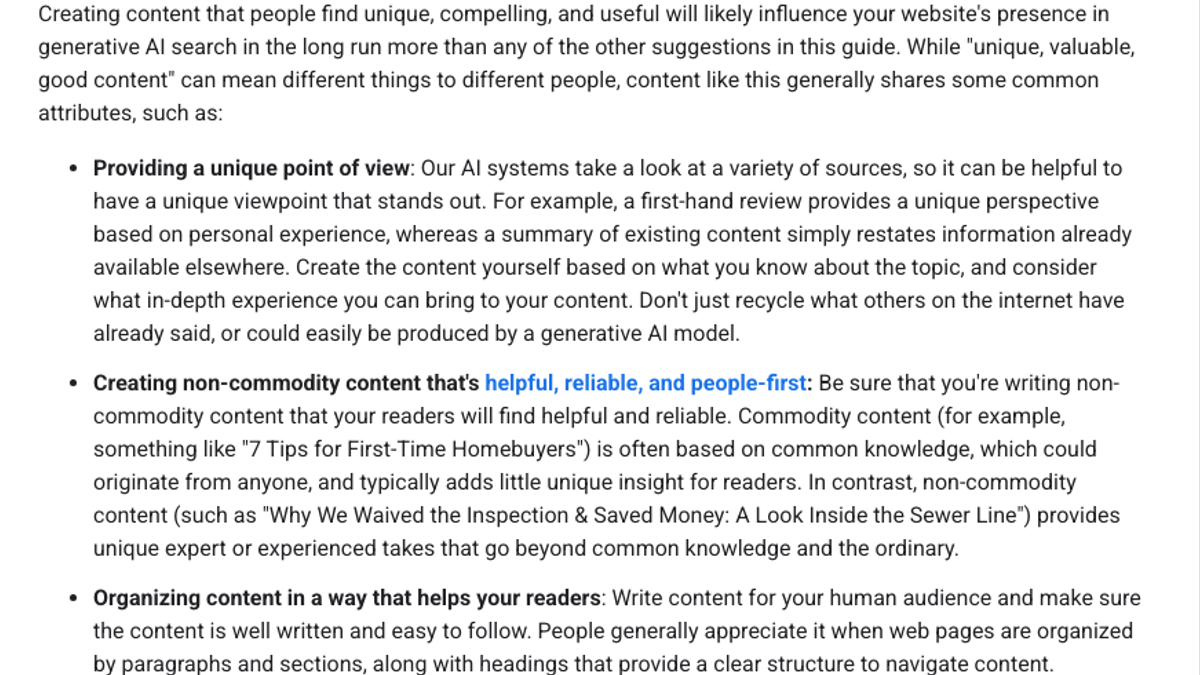
Google calls the problem commodity content: pages based on common knowledge that add little insight. Its separate guidance on generative AI says AI can be useful for researching a topic and structuring original content. Generating many pages without adding value, however, may violate its scaled content abuse policy.
That's consistent with our earlier look at whether Google targets AI content or low-quality content. The policy targets a pattern, and AI makes that pattern cheap to produce.
26 content formats. Published on your domain. Matched to your brand.
Guides, comparisons, listicles, case studies, and more. RankControl generates content that gets cited by ChatGPT, Perplexity, Claude, Gemini, Grok, Google AI Mode, and Google AI Overviews.

What our AI drafts got wrong
Here's how the five no-search drafts compared with the vendors' own pricing pages:
| Detail | What the drafts said | Pricing page, September 27 |
|---|---|---|
| Freshdesk starting price | About $15 per agent a month (all five drafts) | $19 per agent a month, billed annually |
| Freshdesk free plan | Free for up to 10 agents (two drafts) | No free plan listed |
| Freshdesk Pro | About $49 (one draft) | $55 |
| Help Scout Standard | About $20 per user a month (three of four drafts) | $25 per user a month, billed annually |
| Help Scout Plus | About $40 (two drafts) | $45 |
The fourth draft that priced Help Scout gave a range of $20 to $25. Here's what Help Scout's plan page showed that day:
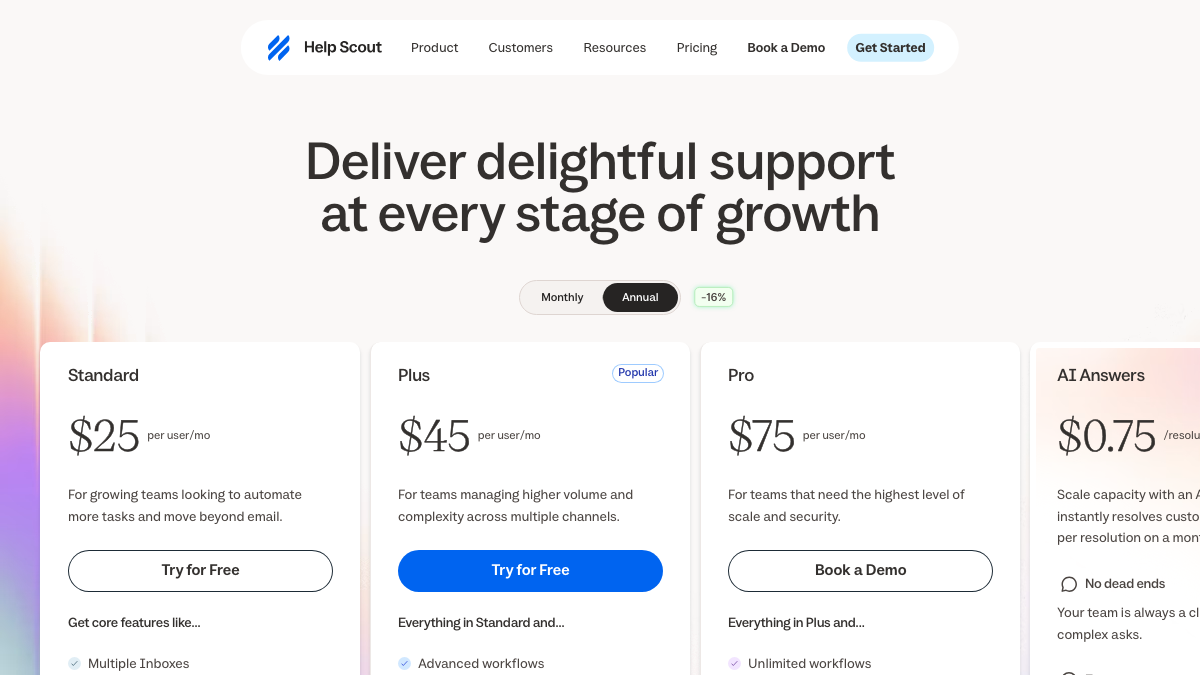
The engines themselves did better, because they search. In our September 26 runs of the same questions, the one search-enabled OpenAI answer that priced Freshdesk said $19. And when we checked Google's AI Overviews for pricing searches, the overview for Help Scout pricing listed $25, $45 and $75.
That's the core problem with posts written from model memory. A model without search repeats what it learned in training, and that can be many months old. The engines retrieve live pages, so they already know what your unresearched draft knows, usually in a more current version. Why would they cite your page for it?
The no-search test
We call the check that follows from this the no-search test. Before publishing, look at each important paragraph and ask whether a model with no web access could have written it. If it could, the engines don't need your page for that information.
A quick way to run it is to ask a model with web search turned off to write the same post, then compare the two. Anything in your draft that also shows up in the model's version adds nothing the engines don't already have.
Paragraphs that pass the test usually contain one of these:
| What passes | Example |
|---|---|
| Facts checked on the day | A price confirmed on the vendor's page, with the date |
| Your own data | A test you ran, a survey of your customers, results from your product |
| First-hand detail | What happened when you migrated, set up or used something |
| Screenshots and specifics | The exact screen, setting or error message |
| Named sources | A quote or figure attributed to a person or study |
AI can help with every one of these. It can structure the research and draft around your data. What it can't do on its own is supply the new information. Our guide to better AI content through better context covers how to feed it that information.
When AI content at scale backfires
The risk grows with volume. In April, Google applied a manual action to a site with a directory of more than 850,000 AI-generated local news articles. Glenn Gabe looked at what happened to its ChatGPT citations:
What happens to ChatGPT citations when a site gets nuked by Google via a manual action for 'Scaled content abuse'? That's the topic of my latest blog post. I dug into the National Today situation where it scaled to 850K+ AI-generated local news articles only to get smoked a few
 Glenn Gabe@glenngabeApr 20, 2026
The directory had been appearing in AI Overviews and AI Mode, and it dropped out of both after it was removed from Google's index. When he retested prompts where ChatGPT had cited the directory, most of those citations were gone too.
The early part of that pattern shows up on ordinary company sites too. In September, someone posted in r/SEO that a colleague had started publishing daily AI-generated incident reports that summarized what other sites had already said, and they were ranking surprisingly well.
Someone at my company started publishing daily AI-generated reports. They’re ranking surprisingly well. What would you do?
One of the most upvoted replies was blunt: "Until the next spam update." The poster also mentioned the pages had brought in zero new users, and later said they'd removed them.
In September, Lily Ray said she was preparing a presentation on AI content case studies that succeeded at first and tanked months later. She noted how many of them had claimed unique content and proprietary data:
Working on a presentation about AI content case studies that succeeded at first, but backfired and tanked m several months later Incredible how many of them talk about “unique content” “E-E-A-T” “proprietary data,” etc. It doesn’t seem to save them…
 Lily Ray 😏@lilyraynycSep 15, 2026
The early gains are real, which is what makes this tempting. The losses tend to arrive months later, and they can take AI search visibility down with them.

Your competitors are getting cited by AI. You're not.
Every day without citation tracking is a day your competitors pull ahead in ChatGPT, Perplexity, and Claude.
How to use AI for posts that get cited
Start with research on live pages. Collect current prices and specs from primary sources before drafting, and record the date you checked them. Our AI content creation guide shows what 171 AI Overview citations had in common.
Add at least one thing only you have. That might be a small test, a count from your own data, a screenshot or a detailed example from a customer conversation. Our earlier look at AI content generators for SaaS marketing found ten drafts from the same prompt came out nearly identical. Your own material is what separates your post from everyone else's.
Have someone review every number and claim before publishing. Then keep the facts current, since prices and plan limits change and a post that goes stale loses its advantage.
Publish at a pace you can review. Volume on its own won't earn citations, and a large batch of thin pages is the pattern Google's scaled content abuse policy exists to catch. If posts are already live and getting no traction, our guide on why AI SEO content gets no traffic walks through the usual causes.
Done by hand, publishing eight solid articles a month takes 16 to 24 hours, and checking 50 questions on seven engines takes about six hours a week. Those are rough estimates.
RankControl's content engine writes each article against the pages already ranking for its keyword and publishes it on your own domain. AI visibility tracking runs your 50 questions every week on seven engines and marks each one as mentioned, cited or both, so you can see which posts engines actually use.
You can run the no-search test on your own drafts with a spreadsheet and a browser. Or RankControl's agents can handle the writing and tracking while your team adds the data only you have.
200+ SaaS teams already track their AI citations.
They know exactly when ChatGPT mentions their brand, and when it stops. Do you?