
A team in r/DigitalMarketing had been tracking AI visibility across ChatGPT, Google's AI Overviews and Gemini for several months. They'd seen gains, and they asked other SEOs a simple question: what are you actually doing week to week?
What are you actually doing to increase AI visibility?
We've been tracking AI visibility across ChatGPT, Google AI Overviews, Gemini, etc. for several months and have seen some pretty significant improvements across a number of client sites. But we're curious what other SEOs are actually doing...
That's the question most AEO tracking reports leave open. They show where you're named and where you're missing, and they stop there. This guide covers how to read a report one question at a time and a set of five action codes that turn each question into a content job. It also walks through a worked example from real Google AI Overviews and shows how to check that the work paid off. Sources were checked on September 27, 2026.
Read the report one question at a time
Most dashboards open with a score. Skip it. The useful part of any AEO tracking report is the row for each question on each engine, and four fields in that row:
- whether your brand was named in the answer
- whether one of your pages was cited
- which pages the engine cited instead
- which competitors were named
The third field matters most, because it tells you what the engine reads before it answers. If your tool doesn't show cited URLs, the rest of this guide gets much harder. Our checklist for choosing an AEO tool puts raw answers and URLs near the top for that reason.
Some engines report part of this directly. Bing's AI Performance report shows which of your pages Copilot cited and the grounding queries it ran to find them:
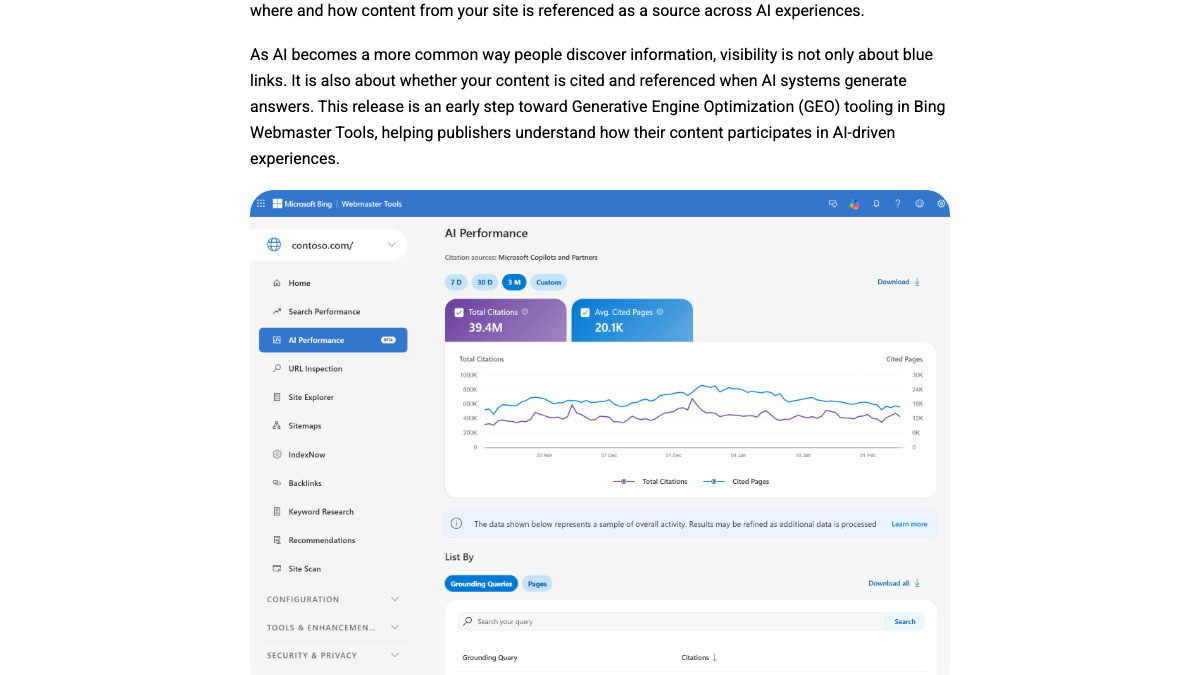
Grounding queries are worth reading closely. They're the searches the engine ran for the buyer, so each one is close to a page brief.
Five action codes
Give every question one code. We use five, and together they cover almost every row we've seen:
| Code | What the row shows | Content action | Rough time |
|---|---|---|---|
| Create | The engine cites a page type you don't have | Write that page: alternatives, pricing, integration, comparison | 2 to 4 hours a page |
| Refresh | Your page is cited but you're not named, or you were cited and dropped | Update facts and dates, answer the question in the first paragraph | 1 to 2 hours |
| Earn | The cited pages are third-party roundups, threads or videos | Pitch roundup authors, ask for reviews, answer in the thread, make a video | Weeks |
| Correct | You're named but described wrong | Fix your own pages, then the third-party pages carrying the error | About a day |
| Wait | The change sits inside normal run-to-run noise | Do nothing and recheck in two to three weeks | None |
Wait is the code teams forget. AI answers change so much between runs that a single week's drop is often noise. Our guide to reading AI visibility benchmarks shows how big a change has to be before it means anything.
Correct is the easiest to underrate. A reply in that r/DigitalMarketing thread said one of their steadiest gains came from describing the product the same way everywhere. That meant website copy and help docs, plus integration pages and partner listings. Our response plan for wrong AI answers covers that job in order.
See your first AI citation report in under 5 minutes.
No setup calls. No onboarding meetings. Connect your domain and see where AI mentions your brand right now.
A worked example from real AI Overviews
On September 27 we checked Google's AI Overviews for 30 B2B software searches and recorded every cited source. Here's how four of those answers would read for a smaller brand in each category:
| Search | What the AI Overview cited | Codes |
|---|---|---|
| best help desk software | One r/sysadmin thread, a PCMag roundup and four other help desk vendors' own "best of" lists | Create, Earn |
| zendesk alternatives | Two r/SaaS threads and three vendors' alternatives or comparison pages | Create, Earn |
| hubspot vs salesforce | Forbes Advisor, an r/salesforce thread, four comparison posts from vendors and consultancies, three YouTube videos | Create, Earn |
| best live chat software | Zapier's roundup, G2's category page, three YouTube videos, a Reddit thread, one vendor's product page and two more roundups | Earn |
The first row is the one that surprised us. Four of the six sources for "best help desk software" were lists written by companies selling help desk software. The engine treated them as ordinary sources, the same pattern we saw in our test of AI software recommendations.
For a help desk company missing from that answer, one Create job is a fair roundup of its own category, one that names competitors honestly. The Earn job is a pitch to the PCMag roundup and a useful reply in threads like the r/sysadmin one.
The second row is the clearest Create case. Every vendor page cited for "zendesk alternatives" was an alternatives or comparison page, so a brand without one isn't eligible for that answer at all. Our guide to alternatives pages that win citations covers how to write one that holds up.
The third and fourth rows point at video. Three of the nine sources for "hubspot vs salesforce" and three for "best live chat software" were YouTube videos, two of them short clips. If your plan is all blog posts, you can't compete for a third of those sources. Our count of Reddit, YouTube and Wikipedia citations found YouTube supplied about 28% of AI Overview sources across all 30 searches.
The same question can need different codes on different engines
A report that splits results by engine will often show one question in good shape on one engine and missing on another. That usually means the engines are reading different kinds of sources, and the code should follow the source, not the question.
Ahrefs' September lists of the sites each engine cites most make the split visible. YouTube held 22.9% of the citations to the top 50 sites in Google's AI Overviews and 20.8% on Perplexity, but 2.5% on ChatGPT. Reddit led on Perplexity and Gemini. Claude sits at the other end: one study of 379,321 Claude citations from June found company and product sites took 64% of them, and Reddit none.
In practice, a question you're missing on Perplexity or Google often needs Earn work, a video or a thread or a roundup. The same question missing on Claude or ChatGPT more often needs Create or Refresh work on your own site. ChatGPT has also leaned harder on official brand pages since its August update.
So code each engine's row separately, then combine. If three engines point to Earn and one to Create, both jobs go on the list, and the Create job is usually faster.
Turn the codes into a monthly plan
Once every priority question has a code, the plan almost writes itself:
- Start with the 20 questions closest to a purchase. Leave the rest for next month.
- Sort them by code. Create and Refresh jobs go to your writers, Earn jobs to whoever handles PR or partnerships, and Correct jobs to whoever owns the website copy.
- Cap the month. Four new pages and four refreshes is a realistic load for a small team, and it matches the eight articles a month most small teams can keep up.
- Write down, for each job, which question it should change and on which engine. A page with no target question can't be judged later.
- Put the Wait questions on a list to recheck, so they don't get forgotten.
Budget about two hours to code 20 questions the first time, and under an hour once it's routine.
Your competitors are building backlinks while you read this.
Organic outreach, social mentions, and citations from Editorial Circle member sites, with managed backlinks available as an add-on. Grow your domain authority without running the campaign yourself.

Check that the action worked
This is where most teams stop measuring. A commenter in an r/aeo thread about proving AEO works made the point well: every metric people suggested was a number, and none was a comparison. Branded search, direct traffic and AI referrals all move for reasons that have nothing to do with a page you shipped.
So build the comparison in from the start. For each month's actions, keep a few similar questions you didn't act on as a hold-out group. Four to six weeks after the pages go live, rerun both groups several times and compare the averages. If the questions you acted on moved and the hold-outs didn't, the work probably caused it. If both moved together, look for an engine change before taking credit.
Engines also take time to re-read pages, so a flat result after one week isn't a failure. We'd give a new page at least a month before judging it, and a refresh about three weeks.
Keep the codes from month to month, too. A question that was Create in September and is now Refresh has moved. A question that has been Earn for three months running may need a different angle, such as a video instead of another roundup pitch.
Running the loop by hand or not
The loop is simple: read, code, publish, compare. The hard part is doing it every month without the reading taking a whole day.
Done by hand, checking 50 questions on seven engines takes about six hours a week, and publishing eight solid articles a month takes 16 to 24 hours more. Those are rough estimates.
RankControl's AI visibility tracking runs your 50 questions every week on seven engines, marks each one as mentioned, cited or both, and records which competitors and sources each engine used. The content engine writes each article against the pages already ranking for its keyword and publishes it on your own domain.
You can code your report and run the plan yourself with a spreadsheet. Or RankControl's agents can run the weekly checks and publishing while your team handles the Earn and Correct jobs that need a person.
You're getting AI traffic. But do you know where it comes from?
RankControl credits every visit to the assistant that sent it: ChatGPT, Perplexity, Claude, Gemini, Copilot, or Grok. Full source attribution, next to your Google traffic.