
The advice in every AI search playbook right now is to be where the conversations are. Plenty of teams have translated that into "post on Reddit", and moderators have noticed. First came a wave of brand accounts dropping product links into threads, and then came a wave of bans.
I do think community content can help your AI search visibility, as long as it's the kind the communities allow. Every platform has put that in writing. So this guide works from the rulebooks themselves, platform by platform and in their own words, and ends with a weekly routine that fits inside all of them.
Where community content shows up in AI answers
Community work pays off most on buying questions, and "community" covers more than Reddit. I got there by pulling Google's AI Overviews for 14 B2B software questions and going through every source they cited. We ran the pulls on September 26 and 27, 2026.
YouTube led by a wide margin, cited in 12 of the 14 overviews. That's worth remembering if your team hears "community" and thinks only of Reddit. Reddit showed up in 6. Quora and LinkedIn appeared once each, and neither Stack Overflow nor any vendor-hosted community forum turned up at all.
Which searches Reddit showed up in told me more than the count. It appeared in 5 of the 7 "which tool should I buy" searches, like "best crm for small business". On the 7 how-to or definition searches, it appeared just once. My read is that AI Overviews pull in community voices when the question is a judgment call, and lean on published pages for definitions and formulas.
Google has built its own route for forums as well. Its documentation says that when forums add discussion forum markup, "Google Search can better identify online discussions across the web and make use of this markup in features such as Discussions and Forums." How that grew is in our post on Reddit as an AI search source.
The test every platform applies
If I could give a team one rule for every platform, it would be a test a Reddit commenter described better than most policy pages. In an r/SaaS thread about how strict communities are with self-promotion, one reply said moderators don't check Reddit's written ratio. They check whether the comment still stands once the product line is deleted. A comment that's 90% advice and 10% promotion fails if the advice only exists to carry the promotion.
Reddit Marketing Doesn't Work, How to first 1-100 users when communities is so strict on any type of self-promotion direct or indirect?
Everyone's talking about marketing on Reddit, but every community is so strict when it comes to dropping links or even mentioning your product in the comments. Even if its 90% value and 10% promotion, they don't let it slide. It probably wo...
We call it the plug-deleted test, and I'd make it a habit for everyone on your team. Before posting, they delete the sentence that mentions your product and read the comment again. If it still helps the person who asked, it goes up, with the mention or without it. If it doesn't, nobody posts it.
Reddit: the site rules, then the subreddit's
Reddit's sitewide rules are short, and for this kind of work only Rule 2 really matters.
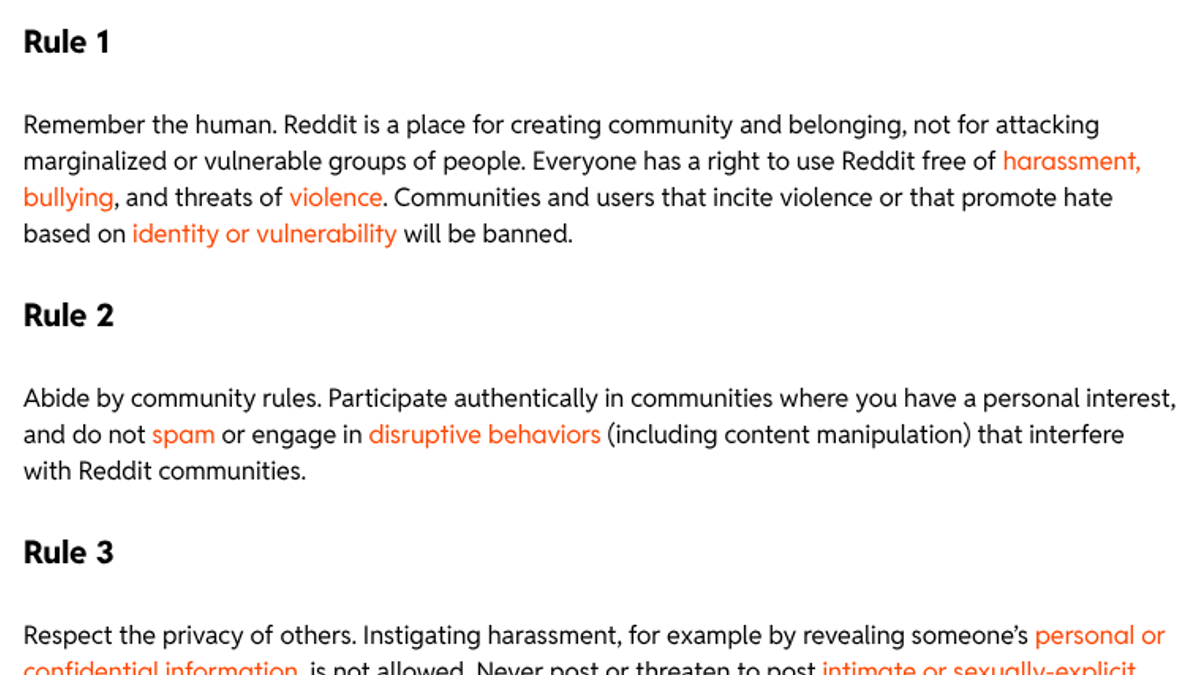
The rule reads: "Participate authentically in communities where you have a personal interest, and do not spam or engage in disruptive behaviors (including content manipulation) that interfere with Reddit communities." Breaking it can get you anything from a polite request to stop, through suspensions, to community bans.
The number people quote comes from Reddit's older Reddiquette page: "A widely used rule of thumb is the 9:1 ratio, i.e. only 1 out of every 10 of your submissions should be your own content." I'd read that as the most you should ever do, and stay well below it.
The phrase in Rule 2 I'd pay the most attention to is "where you have a personal interest", because it settles who should be posting. A brand account doesn't have a personal interest. A product manager who's spent years in the field does. Put the people with real expertise on their own accounts, and have them say where they work when it's relevant.
Every subreddit then adds rules of its own, and many ban self-promotion outright. In one r/ModSupport thread, a moderator asked whether banning a self-promoter had been the right call. Moderators from other subreddits said yes if the rules prohibit it, and one said they remove promoters several times a day. Read a subreddit's sidebar rules before your first comment there.
How often does ChatGPT mention your brand?
Most founders have no idea. The answer might surprise you.

Stack Overflow and Q&A sites
Stack Overflow worries less about whether you mention your product than about whether you say who you are. Its help center says that if some of your answers happen to be about your product, "that's okay," but "if you mention your product, website, etc. in your question or answer (or any other contribution to the site), you must disclose your affiliation in your post."
It's equally direct about motive: "If the only reason you're here is to sell something or drive traffic to your site, then please avoid posting answers." If that's you, it suggests buying an ad.
So for a B2B SaaS team, I'd make Q&A sites a job for your engineers and support people. They answer technical questions under their own names, and they disclose the connection whenever your product comes up.
LinkedIn's professional community policies close off the two shortcuts teams reach for most. Untargeted and repetitive promotional content is banned as spam, and members are told not to use invitations "to send promotional messages to people you don't know." On engagement, the policy says: "Respond authentically to others' content and don't agree with others ahead of time to like or re-share each other's content."
That second line rules out engagement pods, where employees agree to like and share every company post. What you're left with is a person's own useful post, and that's also the kind that got cited. The one LinkedIn post an AI Overview cited in our check was someone explaining what customer acquisition cost is and how to calculate it.
Your own community forum
I wouldn't build a forum to win AI citations. In our check, not one vendor forum was cited in any of the 14 overviews. Build one because your customers need a place to help each other.
Running a forum on your own site also puts you on the other side of the rules. Google's spam policies define user-generated spam as spammy content added "through a channel intended for user content," which is what a forum is. Its link spam examples include "forum comments with optimized links in the post or signature." Left unmoderated, that counts against your site. If you do run a forum, moderate it and add the discussion forum markup Google documents.
Slack and Discord groups
These are worth your time, just not for citations. Most Slack and Discord communities are private, and search crawlers can't read content behind a login. The answers you give there won't be cited.
What you get instead is the exact questions buyers ask, in the words they use. When the same question keeps coming back, write a public answer on your own site. That page can be cited, and the next time someone asks, you can share it, if the group's rules allow links.
Disclosure follows you everywhere
Disclosure is the rule I'd never let anyone on the team skip, because it goes with you onto every platform. The FTC's endorsement guidance applies whenever employees talk about your product on social platforms. Its answer to a common question is blunt: if you mention your company's products, "you should disclose your relationship to the company," and "Listing your employer on your profile page isn't enough."
The company carries part of the burden too. The FTC says companies should have "a formal program to remind employees periodically of your policy." On a small team, that can be one paragraph in your onboarding doc. It tells people to say where they work in the comment itself, every time your product comes up.
15 hours a week manually. Or 15 minutes with RankControl.
Track citations, monitor competitors, and fix content gaps across every AI search engine. Automatically.

A weekly routine that passes every rulebook
Before anyone's first post in a new community, I'd have them do four quick things. They read that community's rules and check whether it allows links or product mentions at all. They write the disclosure line they'll use, like "I work at [company], so take this with that in mind." They spend a week reading first, so they know what a good answer looks like there. Then they run the plug-deleted test on their first draft.
After that, one person can run this routine in about two and a half hours a week:
| When | What | Time |
|---|---|---|
| Monday | Read the communities where your buyers ask questions and note new ones | 30 minutes |
| Tuesday to Thursday | Answer three to five questions fully, applying the plug-deleted test to each | 1 hour 30 minutes |
| Friday | Turn the question that keeps coming up into a public page on your site | 30 minutes |
Your product comes up only when it's the direct answer, with the connection disclosed every time. A link to your own page goes in only when the thread asks exactly what that page answers and the community allows links. And your ratio stays well under Reddit's 1 in 10.
Once a month, check whether the AI answers for your buyer questions have changed. For the wider view of which platforms each engine trusts, our guide on what AI search engines trust goes through it engine by engine.
Doing it yourself or handing it off
This routine is manual on purpose. Nobody can automate the judgment about when a reply helps, and the posting should always come from a real person.
RankControl can take on the searching and drafting. Our Backlinks finds the Reddit and X threads your buyers are in, reads the subreddit's rules before you ever post, and drafts a reply that fits the conversation. You decide whether to post it. Our content engine writes the public pages those threads keep asking for and publishes them on your own site. Its AI visibility tracking checks up to 50 buyer questions every week across seven AI engines and records every source each answer cited.
AI search traffic grew 835% this year. Is your content ready?
RankControl generates 26 content formats optimized for ChatGPT, Claude, and Perplexity. Published on your domain, matched to your brand.