
We went to check ContentShake AI's pricing for this RankControl vs ContentShake AI comparison on September 26, and landed on a page that never uses the name. Every semrush.com/contentshake address, including its old comparison pages against Jasper and Surfer, now redirects to Semrush Content Toolkit. The only trace left is Semrush's WordPress plugin, which still sits at the "semrush-contentshake" address under its new name, last updated on June 25.
So the comparison is now RankControl vs Semrush Content Toolkit, which kept ContentShake's job of writing articles with Semrush data behind them. We'll use the current name from here, since it's what you'll see on the pricing page and the invoice.
RankControl vs ContentShake AI: the short answer
Content Toolkit is a $60-a-month writing tool. It finds topics and builds briefs from Semrush data, then drafts articles, scores them for Google and AI search, and sends them to WordPress or Google Docs one at a time.
RankControl is a pipeline for getting cited. It plans the articles, writes them, publishes them to your CMS once you approve, drafts link outreach and checks six AI engines every week to see whether the pages show up in answers. If the pages you already write aren't getting cited, the second job is the one you're missing.
Side by side
| Semrush Content Toolkit (ContentShake AI) | RankControl | |
|---|---|---|
| Price | $60/mo, 7-day trial, no annual price listed | $400/mo or $4,000/yr, 7-day free trial |
| Articles | Unlimited standard, 5 SEO-boosted a month | 100 pages a month |
| AI search | Scores drafts for AI search readiness | Checks 50 queries weekly on 6 AI engines |
| Publishing | WordPress (one at a time), Google Docs, share link | WordPress, Webflow, Shopify, Ghost, Notion, Wix, Framer, webhooks, Content API |
| Brand voice | Up to 50 voices from writing samples | Brand profile from your site, rules and up to 3 style references |
| Links | Not in the toolkit | Prospects and drafted outreach for each article |
| Seats | Extra Semrush users from $45/mo | 5 included |
What ContentShake AI became
The Content Toolkit landing page lists five tools. Topic Finder suggests ideas from Semrush data, the SEO Brief Generator does keyword and SERP research, and the AI Article Generator turns a chat prompt into headline options, an outline and a full draft. The other two are Content Optimizer and a repurposing tool for social posts and email.
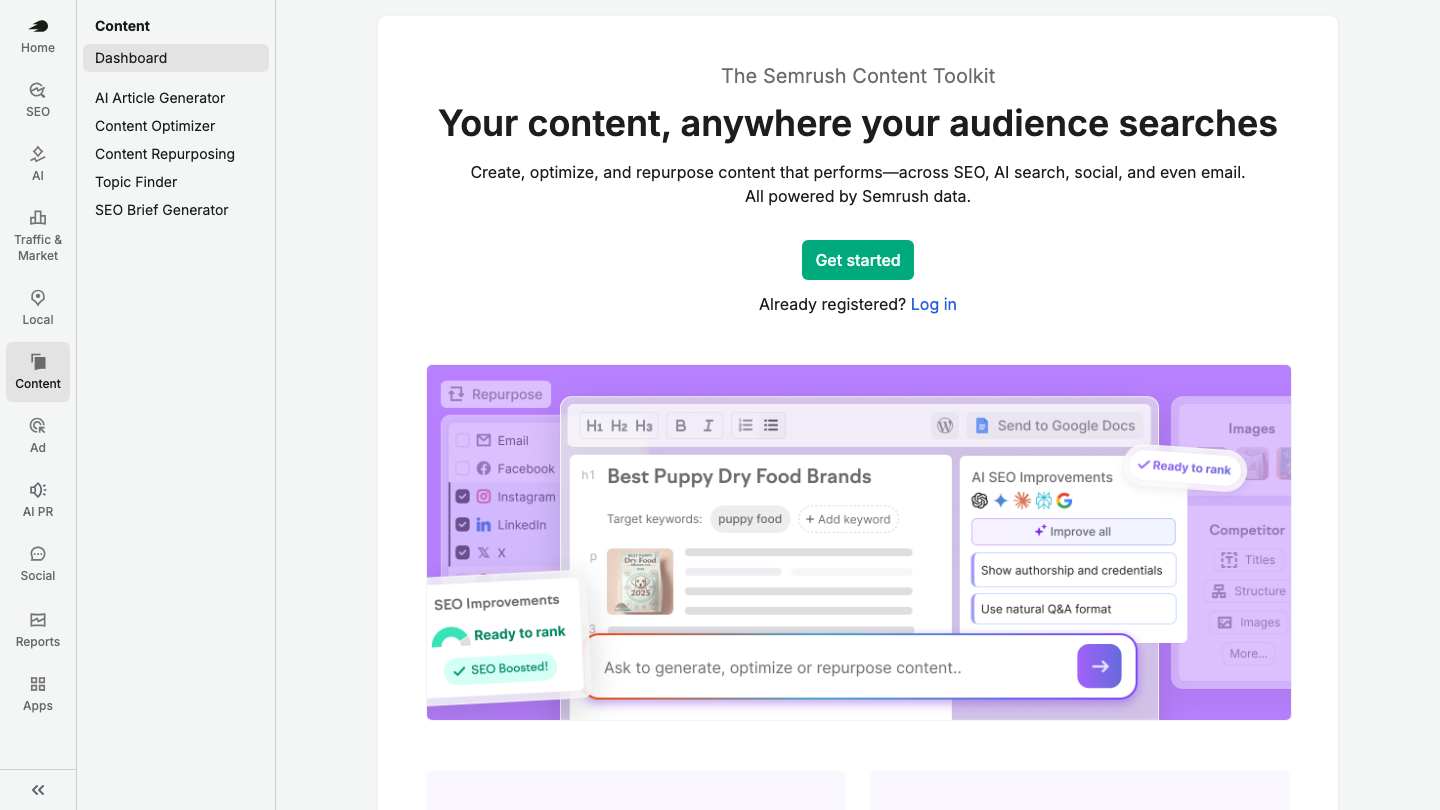
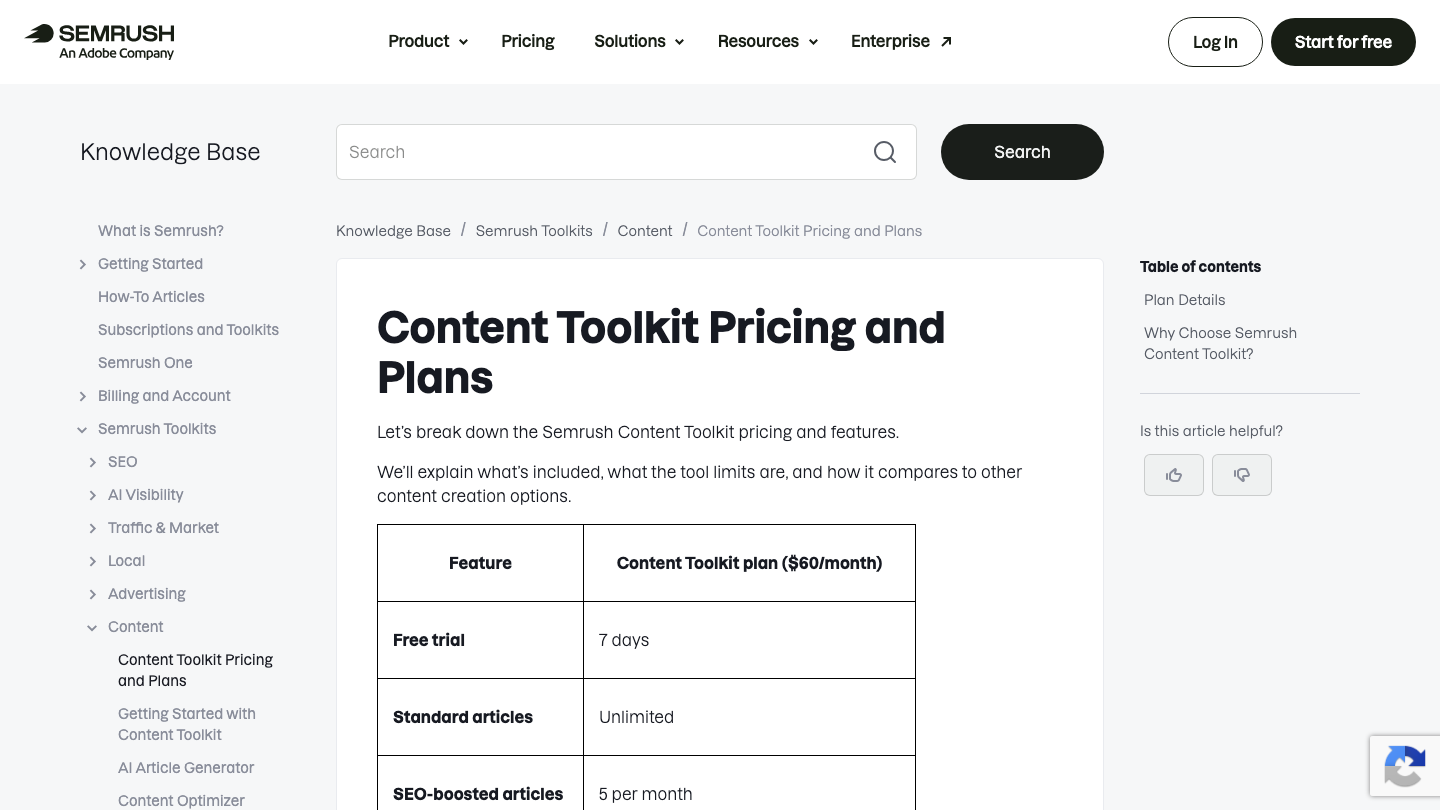
The pricing is generous on volume. Standard articles are unlimited, and the "SEO-boosted" articles, which add deeper SERP analysis, come five a month with ten more for $30. Brand voice learns from a writing sample, and you can keep up to 50 of them.
That volume is the one place Content Toolkit clearly beats RankControl. If your team wants a lot of drafts cheaply, with Semrush's keyword data behind each brief, $60 a month is hard to argue with.
The scorecard gap
Content Optimizer gives each draft two scores, one for SEO and one for AI search. Semrush's knowledge base says the AI search side checks structural points like authorship credentials, natural Q&A formatting and summaries, so the page is "easily surfaced" by models like ChatGPT and Perplexity. The score only runs when you ask for it.
We call the space between that score and a real citation the scorecard gap. A score predicts whether a page looks quotable, and it's worth having. It can't tell you whether Perplexity quoted the page last Tuesday, or whether a competitor's page replaced it this week, because nothing in Content Toolkit asks the engines.
RankControl scores the articles it writes too, with a fix list for anything that makes them hard to quote. The difference is the weekly check that follows. AI visibility tracking asks your 50 queries every week on six engines, including Claude and Grok, and keeps a history per engine so you can see a rate instead of one snapshot.
Your competitors are building backlinks while you read this.
Organic outreach, social mentions, and link exchanges, with managed backlinks available as an add-on. Grow your domain authority without running the campaign yourself.

Where the topics come from
Content Toolkit starts from Semrush's data. Topic Finder suggests "personalized content ideas" and shows what's trending in your location, and the SEO Brief Generator adds keywords, a title and a structure from live SERP analysis. You pick the topic and run the chat prompt, one article at a time.
RankControl starts from the questions buyers ask. Its Radar agent finds them for your category, scores and dedupes the ideas, and plans titles onto a calendar across 26 content types, from how-to guides to comparisons. You can add or remove queries yourself, and each approved title becomes an article on its own schedule rather than a prompt someone has to remember to run.
Brand voice, two ways
Content Toolkit learns voice from samples. You give it a writing sample, it applies that voice to each new piece, and Semrush says it keeps learning from your edits and prompts. Up to 50 voices fit on one account.
RankControl's Brand Control starts from your live site instead. It reads your pages and drafts your voice, products, buyers and competitors, and you correct the draft rather than write it from scratch. You can add guideline rules and up to three style reference articles, and every article the writer produces draws on that profile.
What happens after the draft
In Content Toolkit, a finished article goes to WordPress through Semrush's plugin, to Google Docs, or out as a read-only link. WordPress is the only CMS, and each article is sent on its own. If your site runs on Webflow, Shopify or a headless setup, the last step is copy and paste.
RankControl's content engine publishes to nine destinations as native posts on your own domain, including WordPress, Webflow, Shopify and Ghost. Auto-publish is off by default, so nothing goes live until you approve it. After publishing, Link Control looks for link prospects for each article and drafts outreach that goes out from your own mailbox once you approve it.
That last part matters more than it sounds. Links still decide much of what ranks on Google, and Content Toolkit's tool list has no link building in it; Semrush sells that in its separate SEO toolkit.
What matching the bundle costs
The $60 price is real, but it isn't the price of the same job. To see whether AI engines cite you, you'd add Semrush's AI Visibility Toolkit, which sells on its own from $99 a month and updates its reports weekly. That pair comes to about $159 a month, and the Starter plan at $199 bundles the same AI tracking with Semrush's SEO tools if you want those too.
| Content Toolkit + AI Visibility Toolkit | RankControl | |
|---|---|---|
| Monthly price | About $159 | $400 |
| AI engines tracked | ChatGPT, Perplexity, Gemini, Google AI Overviews, Google AI Mode | ChatGPT, Perplexity, Gemini, Google AI Mode, Claude, Grok |
| Publishing | WordPress only | 9 destinations |
| Link outreach | Separate SEO toolkit | Included |
| Extra seats | From $45/mo each | 5 included |
The Semrush pair is cheaper by about $240 a month. What the difference buys is the work between the two toolkits: articles planned and published beyond WordPress, Claude and Grok in the checks, and outreach drafted for each article. Extra Semrush users start at $45 a month each, where RankControl includes five seats.
Volume changes the math a little. Five SEO-boosted articles a month is about one a week, so a team publishing twelve boosted articles would add the $30 pack for ten more, which brings the Semrush pair to about $189. RankControl's 100 pages a month don't split into standard and boosted tiers; every article gets the same research against what already ranks.
Languages and markets
Semrush's Content Toolkit FAQ names eight language variants, from American and British English to Dutch and Portuguese, though the feature list on the same page says "6+ languages." If you write for one or two Western European markets, either count covers you.
RankControl writes natively in 23 languages across 33 markets, and its multilingual content is written in each language rather than translated from English. That gap matters most for teams selling into Asia or Eastern Europe, where the toolkit's language list stops.
Trials, refunds and cancelling
Both products start with a 7-day trial, and the terms after that differ more than the pricing pages suggest. Semrush's refund policy says month-to-month subscriptions aren't eligible for its 7-day money-back guarantee, and neither are trials of standalone products that convert to paid. Content Toolkit is sold monthly, so a charge after the trial generally stays charged.
Cancelling Semrush takes two steps: a cancellation form, then a confirmation email with a link that's valid for 24 hours. Semrush's knowledge base says that if you don't confirm, "it will not be processed, and billing will continue." Missed confirmation emails were the most repeated complaint we found across at least six Semrush billing threads on Reddit and X this year. One r/SEMrush user who assumed the dashboard step was enough found a $211 charge and called it "a revenue strategy built on dark patterns."
RankControl's trial is also 7 days with a card up front, and cancelling from billing settings stops the plan at the end of the current period. Already on Content Toolkit? Our guide to switching from ContentShake AI covers exporting each article and cancelling without a surprise charge.
An awkward data point for AI writers
In August, Semrush's own account on X shared an analysis of 42,000 blog posts run through an AI detector. Posts the detector classed as fully human-written outperformed AI-generated or mixed posts across the top 10 positions.
A detector's label is a rough proxy, and a ranking correlation doesn't prove the writing caused it. Still, it's an odd result to publish while selling an AI writer, and it points at what matters for both products: drafts that read like a person wrote them, and a way to check what happens after they go live. RankControl writes each article against what already ranks for its keyword and checks the result weekly, so a page that isn't earning citations shows up in the history instead of staying invisible.
What Reddit says about Semrush's AI writer
Not much, and that surprised us. We ran a dozen Reddit searches and seven on X for ContentShake and Content Toolkit, and almost none of the results were people describing their own use. The writer turns up mostly in templated "top AI tools" posts that give it one generic sentence.
What people do talk about is Semrush itself. Beyond the billing threads, several commenters pointed to Adobe's purchase of Semrush with the same unease. None of that says anything about article quality, and Semrush's pricing page now carries the line "An Adobe Company" under its logo.
Which one wins AI search visibility?
Content Toolkit is a capable $60 drafting tool for WordPress sites, and it stops at the draft. AI search visibility is decided after it: whether the page gets published where it should, earns links and shows up when buyers ask ChatGPT or Claude.
For teams that want that whole job done, RankControl wins. It plans from the questions your buyers ask, publishes to your CMS, drafts the outreach and checks six engines every week, for one price with five seats. If you're comparing other writing tools too, our Jasper alternatives list sorts six of them by how much of that job each one covers.

You're getting AI traffic. But do you know where it comes from?
RankControl credits every visit to the assistant that sent it: ChatGPT, Perplexity, Claude, Gemini, Copilot, or Grok. Full source attribution, next to your Google traffic.
You can run the whole loop by hand. Someone drafts in Content Toolkit, pastes each article into the CMS, pitches it for links, and asks the same questions in six AI engines every week to see what changed. Or RankControl can run that loop every month, while your team spends its time on the parts only people can do.
We'll show you exactly where your brand stands in AI search.
No commitment. $0 due today, cancel anytime. See how ChatGPT, Perplexity, Claude, Gemini, Grok, and Google AI Mode talk about your brand today.