
Byword sells articles by the credit. One credit is one article, whatever its length, and the Scale plan buys 300 of them a month. For a team that measures SEO in pages published, it's one of the most direct tools on the market, and RankControl vs Byword looks at first like a question of who writes more for less.
The comparison gets interesting after the articles are live. Byword has no AI citation tracking of its own, and nothing in it finds sites to pitch or sends outreach. It writes, optimizes and publishes, and it leaves the question of whether ChatGPT or Perplexity ever cites those pages to other tools.
Everything below about Byword comes from its own site, docs and terms. I read them on September 26, 2026. If you're already moving, our guide to switching from Byword covers the exports and the cancel steps.
RankControl vs Byword at a glance
| Byword | RankControl | |
|---|---|---|
| Price | $99, $299 or $999 a month ($83, $249 or $833 billed yearly) | $400 a month or $4,000 a year |
| Articles | 25, 80 or 300 a month; one credit per article | Up to 100 pages a month |
| AI citation tracking | None built in; links out to Trakkr | 7 engines, 50 queries, weekly |
| Programmatic pages | Templates plus a spreadsheet | Not offered |
| Publishing | WordPress, Webflow, Ghost, HubSpot, Medium, plus Shopify and GoHighLevel per its homepage | 9 destinations, as native posts |
| Backlink outreach | None | Contacts found, emails sent from your mailbox after approval |
| MCP default | Autonomous unless you turn on review | Publishing is a dry run until you confirm |
| Seats | 1, 3 or 10 | 5 |
| Trial | 5 free articles, no card | 7 days, card up front, $0 charged |
What Byword is in 2026
Byword AI Ltd is a London company, founded in 2022 by two people, and its pricing page claims more than 85,000 users. The product was rebuilt in a relaunch on January 19, 2026. That release brought a new writing engine, voice matching and real-time scoring, along with the current programmatic SEO system. A YouTube-to-article converter followed four days later, and in April the exports were rebuilt to produce clean HTML, Markdown, PDF and DOCX files.
The editor shows its homework next to the draft. While you write, a side panel compares your word count with the top 10 results, ticks off the topics you've covered and flags structure that's missing, such as a conclusion.
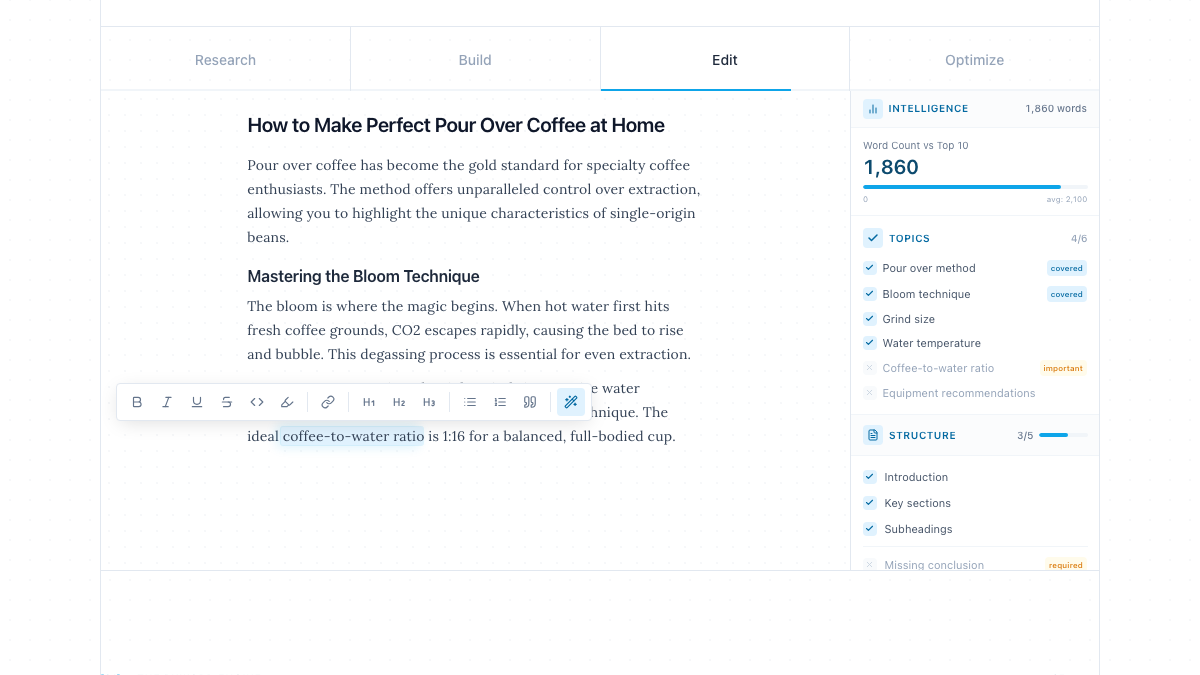
Byword names its models in its own marketing, currently GPT-5.4, Claude Opus 4.6 and Gemini 3.1 Pro, and writes in 47 languages. The public record around it is thin. Its Trustpilot page holds seven reviews averaging 2.8, and two of them mention CMS publishing problems and refund friction, which is too small a sample to prove a pattern and worth asking about in a trial.
Week one on each tool
A new Byword account gets five free articles and asks for no card. You connect WordPress with an application password in a couple of minutes, set up voice matching from sample content, and generate a first article in the editor. If you're ready for volume, a campaign takes a list of keywords or titles and writes them in parallel; Byword's docs say a batch of 20 takes about as long as seven written one after another.
RankControl's trial runs seven days, with a card up front and $0 charged that week. Setup starts from your website, where Brand Control drafts your products, buyers and competitors for you to correct, and the first check across all seven AI engines runs during setup. The planner then puts titles on a calendar from the questions you're losing, and articles arrive in your review queue with auto-publish off by default.
By the end of the first week, a Byword user is likely to have more articles, and a RankControl user fewer articles plus a baseline of who each engine cites for their buyers' questions, which is the number the rest of this comparison keeps coming back to.
How often does ChatGPT mention your brand?
Most founders have no idea. The answer might surprise you.

Volume and the programmatic question
Byword is built for volume in a way RankControl isn't. Its Scale plan writes 300 articles a month, and its programmatic SEO system turns a template and a spreadsheet into hundreds of pages, something RankControl doesn't offer.
Byword's own docs draw a line between the two bulk modes. Campaigns are for related articles that each need to stand on their own, while programmatic SEO is for strictly templated pages such as city pages or product comparisons, where one layout repeats with different data.
Volume carries its own risk, though. In an r/bigseo thread from May, a site owner reported that 60% of about 800 templated pages had been deindexed by month four. The pages that survived had data found nowhere else on the web, internal links from at least two hand-written pages, and search intent that wasn't already saturated.
ran programmatic SEO for 5 months. 60% of the pages got deindexed. here's what actually survived.
so we tried the classic pSEO play earlier this year. take a template, plug in a database, generate ~800 pages overnight, wait for the long tail to roll in. very 2019 of us. results after 5 months: roughly 60% of pages got pulled from the in...
RankControl writes individual articles rather than template runs. The content engine plans each one from a question your buyers ask, writes it against the pages already ranking for its keyword and scores it for how easily AI engines can quote it, with a fix list. The content engine covers 26 content types and up to 100 pages a month.
The borrowed dashboard
Byword's footer has a link labeled AI Visibility. It leads off Byword's site to Trakkr, a separate product, with a referral tag in the address. Byword's MCP documentation confirms the arrangement from the other side: its performance snapshot covers "GSC, GA4, Trakkr, and impact." I'd call that the borrowed dashboard, where the tool that writes your content borrows its AI search data from someone else's product. Our RankControl vs Trakkr comparison looks at that tracker on its own.
That matters for AI search because citations are the result you're paying for. A team on Byword that wants to know whether ChatGPT, Perplexity or Claude cites its articles needs a second subscription, a second login and a second set of prompts, and the writer never sees which questions it's losing.
RankControl's AI visibility tracking is part of the one plan. We check 50 queries weekly on seven engines, Claude, Gemini and Grok among them, with Google AI Mode reported on its own and up to 10 competitors in your share of voice. A new citation triggers a notification, and the questions you're losing feed straight into the titles the planner puts on your calendar.
Publishing and the Search Console side
Byword's integrations docs list five publishing destinations: WordPress, Webflow, Ghost, HubSpot and Medium. Its homepage and MCP tool list add Shopify and GoHighLevel, while the same docs page still marks Shopify as "coming soon" for the first quarter of 2026. If you're on Shopify, confirm it inside the app before you buy.
Byword also runs an indexing dashboard, and it's the detail I'd check first. It's built on Google's Indexing API, which needs a Google Cloud service account added as an owner of your Search Console property, and which Google supports only for job posting and livestream pages. Byword's docs promise indexing that is "2-3x faster," a claim Google's own documentation doesn't back for ordinary articles.
A second feature, confusingly also called Optimize, watches pages after they're published. It needs a Search Console connection, sorts your pages into Needs Attention, Tracking and Improved as rankings move, and compares each one with the word count and structure of the pages beating it.
RankControl publishes to nine destinations as native posts on your own site, from WordPress and Webflow to Shopify and Ghost. RankControl's analytics log traffic and AI crawler visits as they happen and sync Search Console daily, and Google and Bing positions are tracked for every page RankControl publishes.
Links and the off-site half
Byword stops at your own domain. Its docs run from research and writing through publishing and indexing, and they never mention backlinks, outreach or link building.
RankControl works on the other half inside the plan. Link Control finds prospects for each article you publish, finds a contact at each site and drafts the pitch, then sends it from your own mailbox once you approve it, with follow-ups that stop when someone replies. RankControl's social agent finds Reddit and X threads where one of your articles answers the question and drafts a comment for you to post. Managed Backlinks adds five links a month from DR 25+ sites for $350.
15 hours a week manually. Or 15 minutes with RankControl.
Track citations, monitor competitors, and fix content gaps across every AI search engine. Automatically.

Working from Claude: two different defaults
Both tools can be run from an AI assistant, and they start from opposite positions. Byword's MCP server has 40 tools that can research, write, optimize, publish and submit pages for indexing. Its docs are direct about the default: "Byword sites are autonomous by default," and spending and publishing gates only apply once an owner turns on MCP review for that site. Remote CMS publishes default to drafts, and recurring schedules aren't available yet.
RankControl's MCP server has more than 80 tools across tracking, planning, writing and outreach, and comes with the plan. Publishing through the MCP server stays a dry run until you confirm it, so an assistant can't push a post live on its own. Byword's MCP is open to more of its plans than its REST API: free accounts can read, plan and preview through it, while the API starts on Standard.
Pricing and what the difference buys
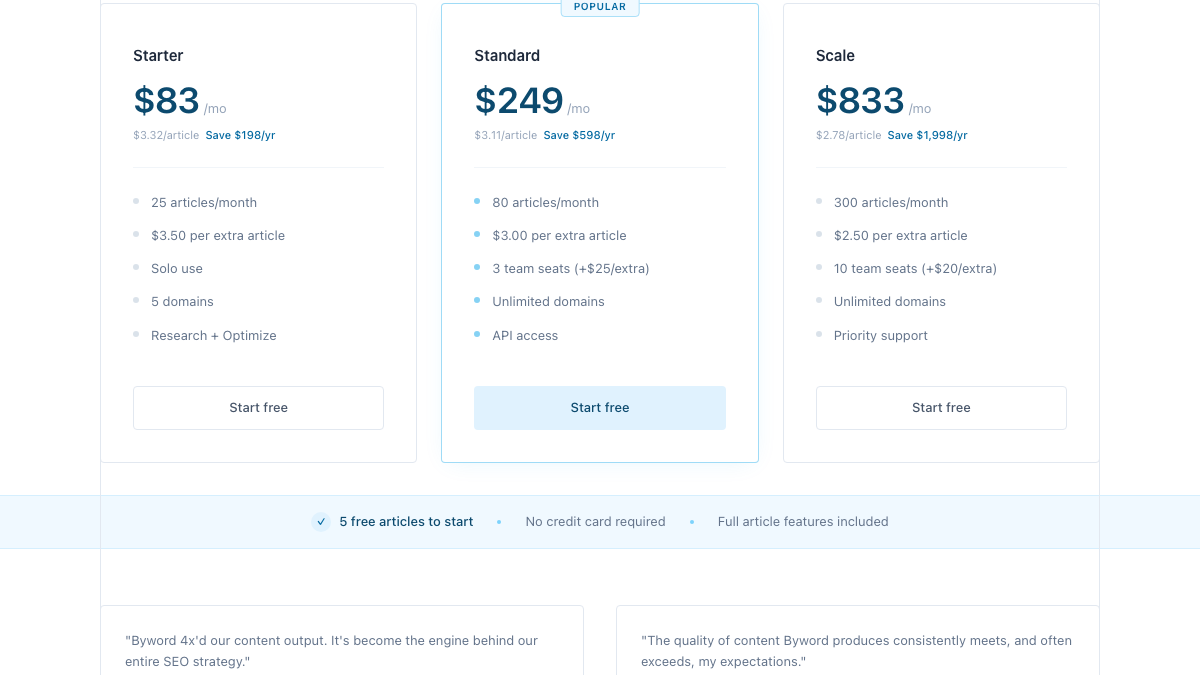
Byword lists Starter at $99 a month for 25 articles, Standard at $299 for 80 and Scale at $999 for 300. Billed yearly those drop to $83, $249 and $833, which the pricing page itself works out to between $2.78 and $3.32 an article. Unused credits roll over while you're paying, extra articles cost $2.50 to $3.50, and an Unlimited plan runs $1,999 a month on your own AI keys, with Byword putting the direct AI cost at about 10 cents an article.
RankControl costs $400 a month, or $4,000 a year, and works out to about $4 a page if you use the full allowance. The $101 a month between Byword's Standard plan and RankControl pays for seven engines of citation tracking, outreach sent from your mailbox and 20 more pages, and Standard is the closer match, since Starter is limited to one seat.
Trials, cancelling and refunds
Byword's free start is five articles with no card. To cancel, go to Account → Billing → Change → Cancel subscription. It takes effect at the end of the period. The account then drops to the Free plan and keeps your articles, domains and settings, and deleting it takes an email.
Its terms don't refund unused time. Refunds are reserved for billing errors, generations that produced nothing usable and mistaken annual renewals reported within seven days.
RankControl's trial is seven days with a card up front and $0 charged during the week. Cancelling takes effect at the end of the paid period, and unused time isn't refunded either.
RankControl vs Byword: which wins AI search visibility?
For AI search visibility, RankControl wins for teams that want the whole job done under one plan. Byword will write a large number of articles for a low price per page, and then the questions that decide AI visibility sit outside it: which engines cite you, which questions you're losing, and which other sites should be talking about you.
RankControl answers those inside the plan. We track seven engines weekly, plan articles from the questions you're losing, publish up to 100 pages a month to your CMS and send outreach from your mailbox after you approve it.
You can run that loop by hand next to Byword: add a tracker, check seven engines every week, and find and pitch the sites worth a link. Or RankControl's agents can run it every month for $400, with a 7-day free trial. Before you decide, the free AI visibility check shows who ChatGPT cites for three questions from your market.
AI search traffic grew 835% this year. Is your content ready?
RankControl generates 26 content formats optimized for ChatGPT, Claude, and Perplexity. Published on your domain, matched to your brand.