
A reader searching "LSI keywords" right now will land on Google's own AI Overview, which says plainly that Google doesn't use them. Scroll past it and almost every result below still treats LSI keywords as a tactic worth learning: how to find them, how many to add, which tool generates the best list.
That gap is the whole story. The phrase survives because it sounds technical, it gives you something to count, and a few tools still sell it. I want to walk through where the idea actually came from, what Google has said about it on the record, what its systems use instead, and what that means for how you write, for Google and for AI search engines.
What Google has said
Google doesn't leave much room for doubt here. In July 2019, someone asked John Mueller about LSI keywords on Twitter, and he didn't soften it. "There's no such thing as LSI keywords -- anyone who's telling you otherwise is mistaken, sorry."
@klaudiofejzaj There's no such thing as LSI keywords -- anyone who's telling you otherwise is mistaken, sorry.
 John 🧀 ... 🧀@JohnMuJul 30, 2019
It would be easy to write that off as one person's opinion, except the companies that make money selling keyword tools agree with him. Semrush's own guide states that "Google has stated explicitly that it does not use latent semantic indexing to rank search results." Ahrefs lands in the same place. Neither has an obvious reason to kill a popular feature unless the evidence left them no choice.
Where LSI actually comes from
Here's what gets lost in the argument: latent semantic indexing is a real thing. It just never had anything to do with Google.
The method comes from US patent 4839853A, "Computer information retrieval using latent semantic structure," filed on September 15, 1988 and granted on June 13, 1989. The assignee was Bell Communications Research, the research arm that spun out of the old regional phone companies.
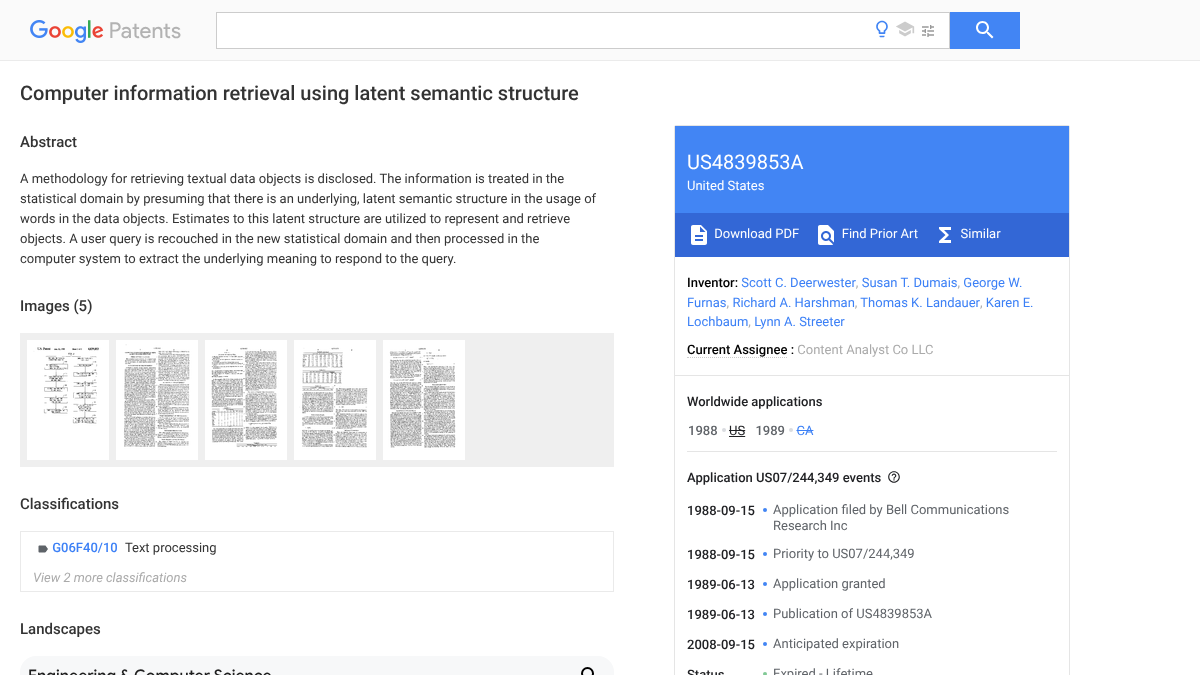
The patent's own abstract frames the idea as presuming "an underlying, latent semantic structure in the usage of words" across a set of documents, then using that structure to connect a search to documents that share meaning without sharing exact wording. It's a clever piece of 1980s information retrieval.
| Year | What happened |
|---|---|
| 1988 | LSI patent filed by Bell Communications Research |
| 1998 | Google founded, about ten years later |
| 2008 | LSI patent expired |
Line those three years up and the mismatch is obvious. LSI was built to index small, fixed collections, something closer to a library catalog than a search engine. Google didn't exist yet, and the open web it would eventually crawl wasn't the problem LSI was solving. Somewhere between then and now, SEO tools started slapping the "LSI keyword" label on any word loosely related to a topic, which isn't what the patent described at all.

Your competitors are getting cited by AI. You're not.
Every day without citation tracking is a day your competitors pull ahead in ChatGPT, Perplexity, and Claude.
What Google uses instead
Google maintains a public guide to its ranking systems, and LSI never appears in it. What does appear is a short list of systems built specifically to handle meaning, each one considerably newer and more capable than a 1980s patent.
| System | What Google says it does | When it arrived |
|---|---|---|
| RankBrain | "Helps us understand how words are related to concepts" | 2015 |
| BERT | Understands "how combinations of words express different meanings and intent" | October 2019 |
| Passage ranking | Identifies "individual sections or 'passages' of a web page" to judge relevance | February 2021, US English |
| Neural matching | Understands "representations of concepts in queries and pages and match them to one another" | Listed in the current guide |
| MUM | Understands and generates language, used for specific tasks | May 2021 |
Google didn't undersell BERT when it shipped. The company called it "the biggest leap forward in the past five years" and said it would help Search better understand "one in 10 searches in the U.S. in English."
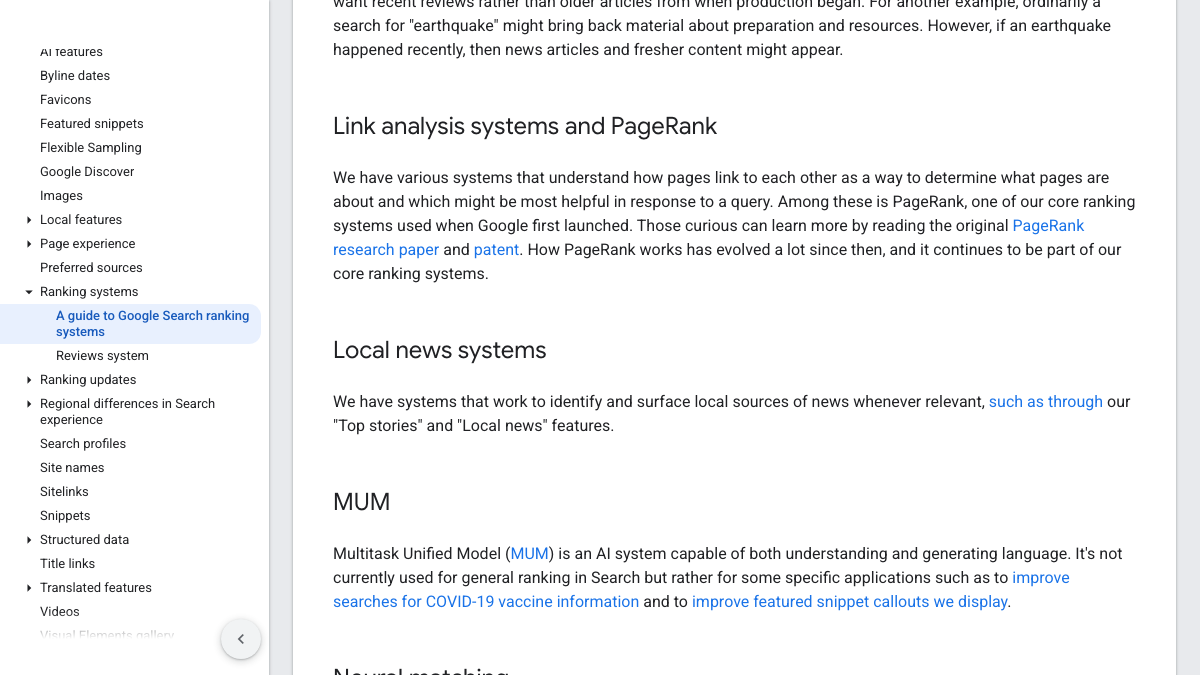
One line in that guide is easy to miss and worth flagging. MUM gets name-dropped constantly in marketing content, but Google says it's "not currently used for general ranking in Search." It shows up in narrower places, like COVID-19 vaccine information and featured snippet callouts, while BERT, neural matching and passage ranking do the heavy lifting on everyday results.
None of this is subtle. Google built systems that understand meaning, synonyms and context on their own. They don't need a sidecar list of related words to tell them what a page is about.
Why the myth won't go away
I checked Google's US results for "LSI keywords" on October 19, 2026, out of curiosity more than anything. The AI Overview at the top gave the same answer Mueller gave in 2019: no LSI algorithm, with natural language processing, the Knowledge Graph, BERT and MUM doing the actual work.
Right underneath its own AI Overview, though, 7 of the first 8 organic results still sold LSI keywords as real. Generator tool roundups, how-to guides, forum threads asking how to use them properly. Only one page agreed with Google, and one of the pages selling the myth was dated 2026, published years after Mueller's tweet made the rounds.
Part of the reason is simple demand. Keyword tools show roughly 320 US searches a month for "LSI keywords," and as long as that many people type the phrase, someone will keep writing a page that gives them the answer they went looking for.
To be fair, plenty of people asking about it aren't chasing a myth on purpose. A thread on r/SEO asked whether LSI keywords still work and whether they deserve the same treatment as primary and secondary keywords. The top reply drew a useful line: Google has always denied LSI specifically, but it does run real semantic analysis, so the instinct isn't crazy even if the label is wrong.
Are LSI Keywords still relevant?
Hey, do you think LSI keywords work today? If yes, then should I mention it once in the blog article or treat it in the same way as I treat my Primary/Secondary keyword?
That instinct, that a page should cover its topic completely, is the one part of this myth worth keeping.
What to do instead
Forget the keyword list. Write for the topic and let the related words show up because the subject required them. A simple test: could someone who actually knows the subject read your page and spot nothing obviously missing? If the answer is yes, you've already covered the related terms without trying to.
Four habits get you there.
Cover the subtopics the way the top-ranking pages already do, and check what People Also Ask surfaces for your keyword. If every strong page on how to brew pour-over coffee mentions grind size, water temperature and the brew ratio, yours needs to as well, not because a tool told you to, but because the subject demands it.
Name things specifically. "A paper filter like a Chemex filter" tells a reader, and a search engine, far more than "the right filter" ever could.
Write each passage so it can stand alone. Passage ranking judges sections of a page individually, so open each one with the answer before you explain it.
Use synonyms the way a person actually talks, not the way a list demands. Varying your wording naturally is good writing; swapping in near-synonyms purely to hit a quota is not.
The difference shows up fastest in a side-by-side. Here's the keyword-list version: "Pour-over coffee brewing, the pour over method and manual coffee brewing all need the right pour-over coffee grind." And here's the topic-test version: "Use a medium-fine grind, about like table salt, and water just off the boil. Start with 1 gram of coffee to 16 grams of water." The second barely uses the keyword at all, and it's the one that actually answers the question.
Choosing the right main keyword for a page still matters plenty; our guide to types of keywords covers that part. It's only the list of "LSI" extras bolted on afterward that doesn't.
200+ SaaS teams already track their AI citations.
They know exactly when ChatGPT mentions their brand, and when it stops. Do you?

What this means for AI search
AI search engines skip LSI keywords too, for the same reason Google does. When ChatGPT, Perplexity or Google's AI Mode answer a question, they're reading a page for meaning and lifting out the passage that answers it, not scanning for a density of related terms.
That raises the stakes on the topic test rather than lowering them. A page that names its subject plainly, covers the questions buyers actually ask, and answers each one near the top of its section gives an AI answer something worth quoting. A page padded with keyword variants gives it nothing extra to work with.
Entities matter here too, since AI engines need to know exactly which company, product or person a page is describing. Our post on Wikipedia, Wikidata and AI recall covers how brands become recognized entities in the first place, and if the whole alphabet soup of AI search terms has you lost, our guide to LLM SEO, GEO, AEO and AIO sorts out which term means what.
A quick checklist
Run your page against these six questions instead of an LSI list before you hit publish.
- Does it answer the main question in the first paragraph?
- Does it cover the subtopics the top pages cover?
- Does it answer the related questions people ask?
- Does it name the specific things it's about?
- Does each section start with its own answer?
- Would an expert find anything obvious missing?
Six yeses and you don't need a single "LSI keyword" anywhere on the page.
Doing it yourself or handing it off
Getting all six right takes real research on every single post: reading what already ranks, listing what it covers, finding the exact questions buyers are asking.
You can run that process by hand for each article you publish. RankControl runs it automatically on every one. It writes against the pages already ranking for a keyword, covers what they cover, and scores the finished article for how easily AI engines can quote it, with a list of fixes attached. From there it publishes to your site and tracks up to 50 buyer questions every week across seven AI engines. Expect the Google traffic to show up first, with AI citations following more slowly as links and mentions build.
How often does ChatGPT mention your brand?
Most founders have no idea. The answer might surprise you.