
Add schema markup. That's step one on almost every AI-citation checklist floating around right now, as though a few lines of JSON-LD will make ChatGPT sit up and notice you. It feels like real technical work, which is probably why it gets repeated so often.
Look at the actual research and that advice gets shaky fast. Google's own documentation says its AI features need no special schema at all. Ahrefs went further and ran a real test: it tracked 1,885 pages that added JSON-LD against 4,000 pages that didn't, and found no major lift on any AI platform. A separate, independent preprint landed on almost the same answer, with one narrow exception worth knowing about.
This post lines up every dated source we found on schema and AI citations, what each one measured, where they land differently, and why. Then it covers which schema types are still worth your time, and what the same research says actually moves citations instead.
The short answer, by source
Four sources carry this whole argument, so here they are side by side before we go deeper into any one of them.
| Source | Date | What it measured | Finding |
|---|---|---|---|
| Google Search Central | Current docs | Requirements for AI Overviews and AI Mode | No special schema needed |
| Ahrefs, correlation | May 2026 | 6 million URLs, cited vs not cited | Cited pages almost 3x more likely to have JSON-LD |
| Ahrefs, controlled test | May 2026 | 1,885 pages adding schema vs 4,000 controls | No major lift on any platform |
| Fischman preprint | Feb to Apr 2026 | 1,006 pages, 730 citations from ChatGPT and Gemini | No effect overall; Product and Review attributes the exception |
Notice the two Ahrefs rows aren't the same study. The first is the one that gets screenshotted into every AEO listicle. The second is the one that actually ran an experiment, and it's the one almost nobody quotes.
What Google says
Start with the source that actually runs AI Overviews and AI Mode. Google's page on AI features and your website could not be more direct about it: "You don't need to create new machine readable files, AI text files, or markup to appear in these features. There's also no special schema.org structured data that you need to add."
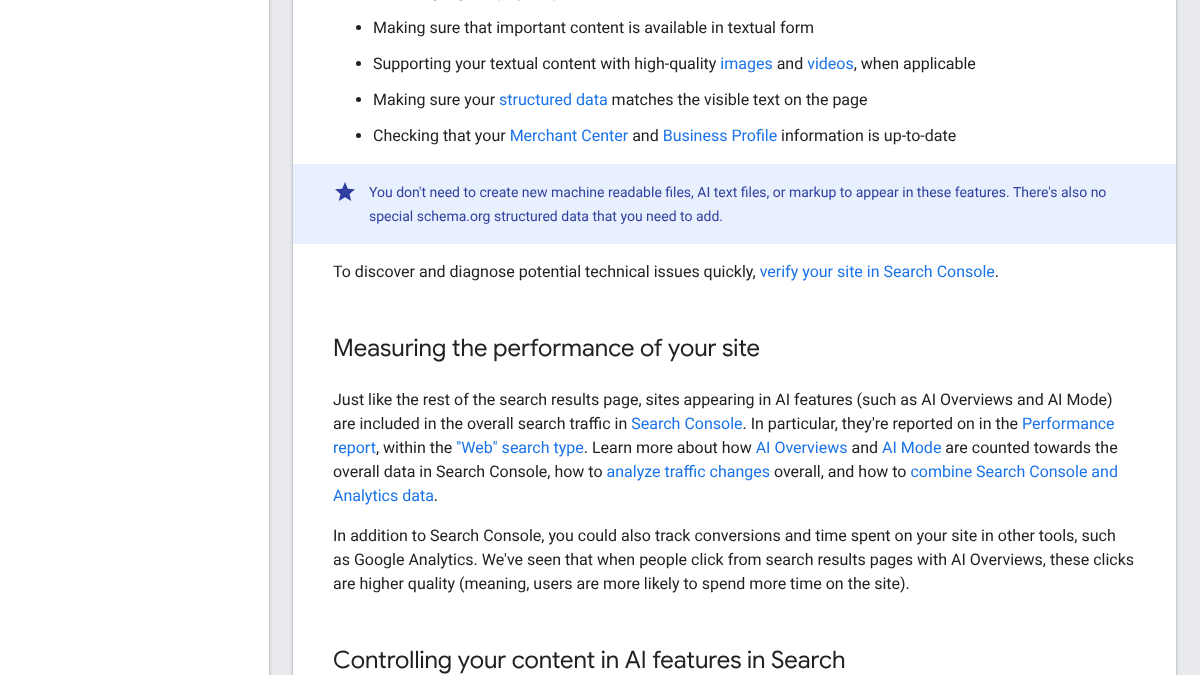
That line doesn't stand alone. It sits inside a short list of ordinary SEO advice: keep pages crawlable, link to them internally, build a good page experience, put the important content in actual text, and make sure whatever structured data you do have matches what's visible on the page. Google isn't telling you to avoid schema here. It's saying schema belongs to normal SEO hygiene, and there's no AI-flavored version of it you're missing.
One thing worth sitting with: Google has every reason to want structured data used, since its rich results run on it. It has little incentive to talk schema down. So when even Google says its AI features don't need it, that's not a company protecting a format it dislikes.
15 hours a week manually. Or 15 minutes with RankControl.
Track citations, monitor competitors, and fix content gaps across every AI search engine. Automatically.

The correlation everyone quotes
Ahrefs' first pass at this question is probably the stat you've already seen somewhere. It looked at 6 million URLs, split them into pages AI engines cited and pages they didn't, then checked how many of each carried JSON-LD. Cited pages, in Ahrefs' own words, were "almost three times more likely to have JSON-LD than non-cited pages."
Broken out by citation type, the gap looks even wider.
| Page group | Has JSON-LD | No JSON-LD |
|---|---|---|
| Not cited | 18.3% | 81.7% |
| Cited as a reference | 51.6% | 48.4% |
| Cited inline | 53.1% | 46.9% |
Around 53% of cited pages carry schema. Roughly 18% of uncited pages do. On that comparison alone, you'd go add JSON-LD to your whole site by lunchtime.
Ahrefs didn't leave it there, to its credit. It named the problem with its own number directly: "Schema markup tends to live on better-maintained, more technically sophisticated sites, and those same sites publish stronger content, build more authority, earn more links, and do all the other things that get pages cited."
We'd call that the tidy-site effect. Schema tends to show up on sites that already do everything else well, so it absorbs credit that the rest of the site's work actually earned. Any study that only lines cited pages up against uncited ones is going to run straight into this.
The Ahrefs experiment: 1,885 pages
To actually separate schema from everything else sitting underneath it, Ahrefs ran a real experiment this time, with an actual test group and a control group. Louise Linehan, who wrote the study up for Ahrefs, laid out the method in one sentence: "We tracked 1,885 web pages that added JSON-LD schema between August 2025 and March 2026, matched them against 4,000 control pages, and measured citation changes across Google AI Overviews, AI Mode, and ChatGPT."
Ahrefs could tell exactly when a page added schema from its crawler's history of that page's HTML. From there it compared citations in the 30 days before and after the change against similar pages that hadn't changed anything. That's a difference-in-differences design, the standard way researchers strip out whatever would have happened anyway.
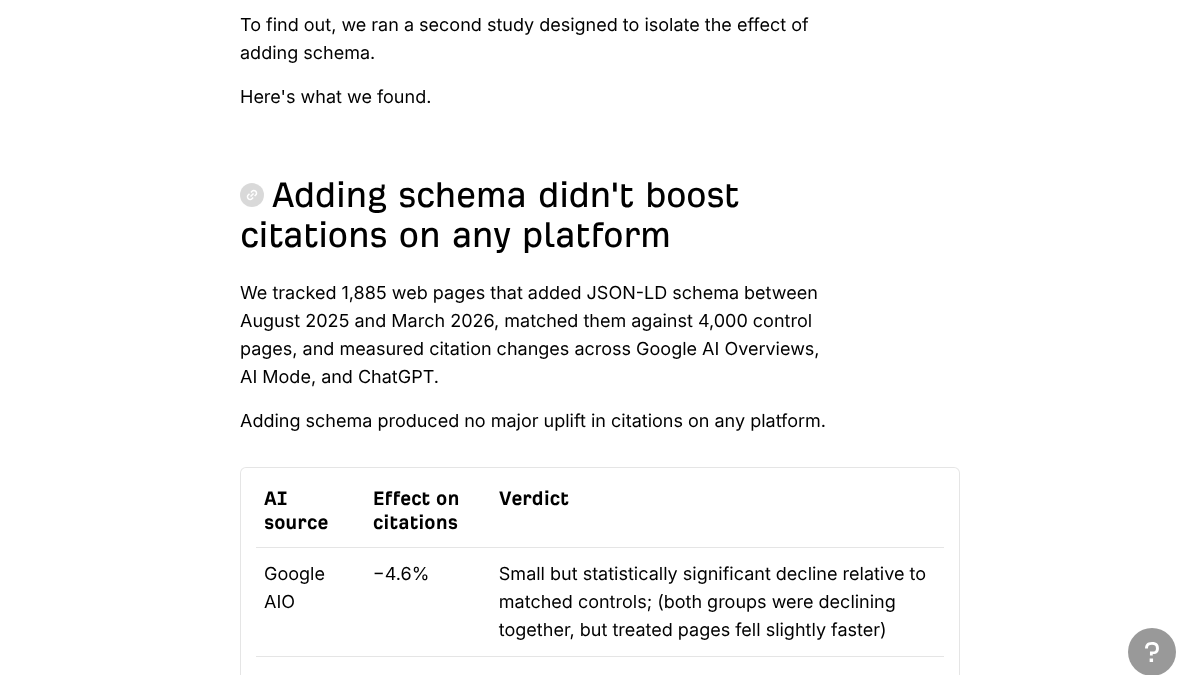
| AI source | Change in citations | Ahrefs' verdict |
|---|---|---|
| Google AI Overviews | -4.6% | Small but statistically significant decline |
| Google AI Mode | +2.4% | Statistically indistinguishable from zero |
| ChatGPT | +2.2% | Statistically indistinguishable from zero |
Ahrefs put it plainly. "Adding schema produced no major uplift in citations on any platform."
The AI Mode row is worth slowing down on, because it shows how a raw number can trick you. Looked at as a simple before-and-after, pages that added schema saw AI Mode citations jump 43%. But the control pages, which changed nothing, grew almost as fast over the same stretch, because AI Mode was sending more citations to everyone that quarter. Strip that background growth out and the 43% collapses to 2.4%.
The AI Overviews decline looks stranger at first glance, until you notice both groups were falling at the time. The schema pages just fell a touch faster. Nobody should walk away from that thinking schema actively hurts you.
Ahrefs was upfront about the test's limits, too. It pooled every schema type into one bucket, Article, FAQ, Product, HowTo, Organization, all mixed together, and admitted "it's possible some types help more than others." It also only tracked the 30 days after each change. Reaction in r/SEO split a little. One commenter pointed out the test pages were already getting cited before they added anything, so the result says less about a brand-new page starting from zero. Another called it, bluntly, not "a very good 'controlled' experiment," while still agreeing the conclusion probably held up.
AI search traffic grew 835% this year. Is your content ready?
RankControl generates 26 content formats optimized for ChatGPT, Claude, and Perplexity. Published on your domain, matched to your brand.

The Fischman preprint: rank first, schema after
The second major study fills in the gap Ahrefs' test left open. Kurt Fischman, from the consultancy Growth Marshal, posted a paper called "Does Schema Markup Predict AI Citation?" to SSRN in April 2026, based on a preprint dated February 20, 2026.
His method ran differently from Ahrefs'. Fischman collected 730 AI citations from ChatGPT (GPT-4o with web browsing) and Gemini (1.5 Pro with search grounding) across 75 commercial queries spread over five categories, then used Google's top 10 results for those same queries as the comparison group. In total, 1,006 unique pages got checked for schema and domain authority.
The first result looked damning. Pages with schema were less likely to get cited, at an odds ratio of 0.546. Fischman tracked that down to an artifact of where the pages came from. Google's own top 10 is already stuffed with schema-heavy pages, so the "not cited" group in his sample was full of schema too. Within Google's results alone, cited and uncited pages carried almost identical shares, 43.1% against 44.8%.
Once he corrected for that, the effect disappeared.
| Factor | Effect on AI citation | Significant? |
|---|---|---|
| Schema present | Odds ratio 0.678 | No (p = .296) |
| Entity richness | Odds ratio 1.001 | No (p = .833) |
| Schema matches the query | Odds ratio 1.068 | No (p = .626) |
| Google rank position | Odds ratio 0.762 per position | Yes (p < .001) |
Schema presence, how rich the entity data was, how closely the schema matched the query: none of it moved the needle. What did predict a citation was rank. Each position lower cut the odds of being cited by roughly 24%. In Fischman's own words, "Position-1 pages were cited in 43% of queries in which they appeared, declining to 5% at position 7."
There was one real exception. Pages carrying Product or Review schema with actual attributes filled in, price, rating, specs, got cited 61.7% of the time, against 41.6% for generic types like Article, Organization and BreadcrumbList. The gap widened most on sites with a Domain Rating of 60 or under.
That holds together logically. Product schema with a price and a rating hands an AI engine something concrete to repeat. Article schema mostly just confirms the page is an article, which the engine already knew.
A few caveats are worth keeping in view. It's a preprint, not a peer-reviewed paper. The models it tested, GPT-4o and Gemini 1.5 Pro, have both since been retired for newer versions. Fischman also discloses that Claude assisted with research design, statistical interpretation and drafting. And sophisticated entity linking, like Wikidata sameAs references, turned up on fewer than 4% of schema pages, too few to say anything meaningful about.
Where the studies agree, and where they don't
Set side by side, these three sources agree a lot more than the competing headlines about them would suggest.
| Question | Ahrefs | Fischman | |
|---|---|---|---|
| Is schema required for AI answers? | No | Not tested | Not tested |
| Do cited pages have more schema? | Not stated | Yes, about 3x | Only versus all pages, not within Google's top 10 |
| Does adding schema raise citations? | Not stated | No major lift | No effect overall |
| Do some types help? | Not stated | Not broken out | Product and Review with attributes |
| What matters more? | Normal SEO practice | Content, authority, links | Google rank position |
Where they split is almost entirely about method, not belief. Correlation studies line cited pages up against uncited ones and spot schema sitting on the cited side more often. Controlled studies compare pages against their own earlier selves, or adjust for rank directly, and the schema effect mostly evaporates. Change the method and the tidy-site effect drops right out.
The gap that matters more is between this research and the advice still circulating. Plenty of AEO content treats schema as step one for getting cited. These three sources, taken together, say it's closer to one of the weaker levers available to you.
What practitioners are seeing
People doing this work day to day land in roughly the same place. A technical SEO who audits pages for AI-answer readiness asked the question plainly in r/TechSEO: is schema a real lever here, or just overrated? They said it's the first thing everybody reaches for, but they couldn't tell if it did anything beyond being table stakes, and wanted to know if anyone had actually isolated it and watched citations move.
Structured data / schema for AI citations: real lever or overrated? What have you actually seen move?
I keep going back and forth on this one. I spend a lot of time auditing pages for AI-answer readiness, and schema is always the thing people reach for first — Article, FAQ, Author, Organization, the usual suspects. It's cheap to add, it's n...
Most replies agreed with the skepticism. One commenter summed it up well: AI reads a page roughly the way a person does, and schema is mostly there for other bots.
A widely shared post on X made a bigger claim, from an AI education account. It said a study of 2 million AI citations across 10,000 pages found near-zero impact from schema once domain strength was accounted for.
Researchers cracked why LLMs cite certain websites and completely ignore others. They analyzed 2 million AI citations across 10,000 web pages. For years, digital marketers have tried to game "LLM SEO" (GEO) with the same old tricks: keyword stuffing, FAQ blocks, schema markup, https://t.co/chQxmtrhmP
 How To Prompt@HowToPrompt__Oct 5, 2026
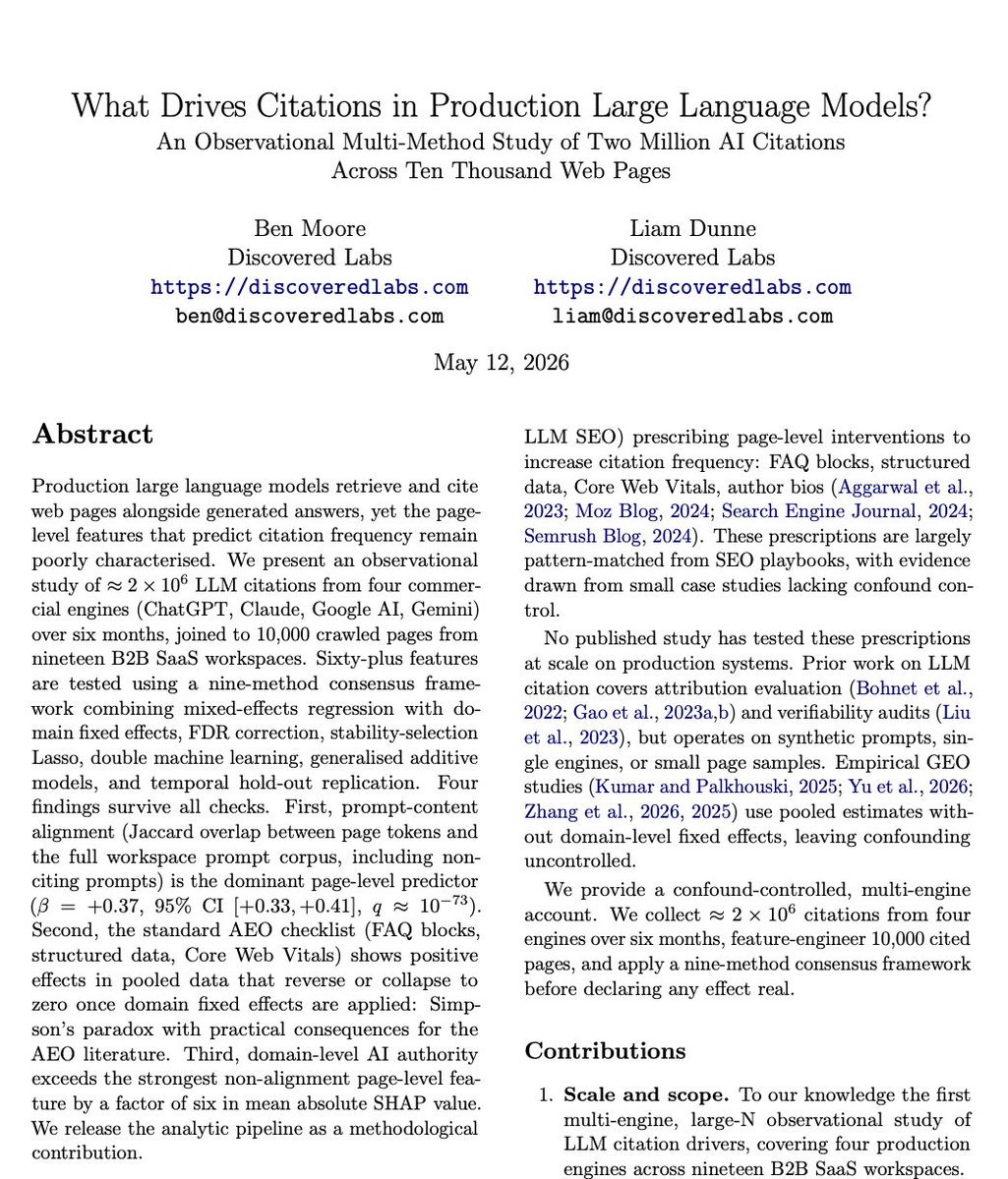
We went looking for that underlying study and couldn't find it anywhere. Treat the claim as a sign of where the conversation has drifted, not as a data point you can cite.
What Google's results show for this question
We also checked what Google itself shows for this very question. On October 19, 2026, we pulled the US results for "schema markup ai citations," and three things jumped out.
An AI Overview sat right at the top, which is a little on the nose: the question of whether AI engines reward schema gets answered by an AI engine first. The Ahrefs study, the one with the actual experiment, didn't crack the top 20. What filled those spots instead was mostly smaller blogs and LinkedIn posts reacting secondhand to it. The framing across those results was split roughly down the middle, with some titles flatly saying schema won't get you cited by AI and a similar number insisting structured data is crucial for it. Fischman's paper turned up at position 14, hosted on ResearchGate.
Search demand for the topic is small, too. Of the keyword variations we checked, only "schema markup for AI search" had measurable US volume, and that was about 50 searches a month. Most people asking this question are phrasing it far more broadly than that.
What schema is still worth adding
None of this is an argument for ripping your schema out. It's an argument for adding it with the right expectations.
| Schema type | Evidence for AI citations | Worth adding? |
|---|---|---|
| Product and Review, with price, rating and specs | Some, mostly for lower-authority sites | Yes, if you sell products |
| Organization | None tested directly | Yes, it's cheap and describes your business clearly |
| Person (author) | None tested directly | Yes, if you have real authors |
| LocalBusiness | None tested directly | Yes, for local businesses |
| Article and BlogPosting | None found | Fine, but don't expect citations from it |
| FAQPage | None found | Low value; Google limited FAQ rich results to authoritative government and health sites in 2023 |
Look down that list and the pattern holds steady. Schema earns its keep when it carries actual facts, a price, a rating, opening hours, a founder's name, a location, the kind of thing an engine might repeat word for word. Schema that only labels what type of page you're looking at doesn't give anything new to repeat.
Whatever types you add, keep them matched to the visible text. Google's own guidance says structured data should agree with what's on the page, and markup that contradicts the page is worse than no markup at all.
If you're going ahead with it, our structured data blueprint covers which types to use and how to check them. For the two that are worth doing on almost any site, our guides to Organization schema and author schema go deeper.
What moves citations instead
The same studies all point at the bigger levers.
Rank in Google still comes first. In Fischman's data it was the strongest predictor of AI citation by a wide margin, with citation odds falling about 24% with every position down. Our analysis of CTR by position shows the same steep drop happening to clicks.
Where the answer sits on the page matters almost as much. AI answers tend to quote passages from early in a page, and our analysis of where AI engines pull citations from walks through that data.
Links and mentions still do real work too. Ahrefs' own explanation of its correlation finding said as much: the pages that get cited sit on sites that "build more authority, earn more links."
And put the actual facts in your visible text, since your markup alone won't carry them. If Product schema with a real price helps a little, it's because the price is a fact an engine can repeat. Write that same fact into a plain sentence on the page, so every engine gets to read it, including the ones that never parse JSON-LD.
How to test schema on your own site
Want your own answer instead of trusting ours? Borrow Ahrefs' method, just smaller.
- Pick 20 similar pages that already pull in some AI citations.
- Add schema to 10 of them. Leave the other 10 untouched.
- Track citations for both groups for at least 30 days before the change and 30 days after.
- Compare how much the first group moved against how much the second group moved on its own.
That second group is the part people skip, and it's the part that actually matters. Without it, you're just watching whatever happened to AI search that month and crediting it to your own schema.
Doing it yourself or handing it off
You can track all of this by hand, asking the same questions across each AI engine every week and logging who comes up. It works. It's just slow, and the answers shift from one day to the next.
RankControl takes the tracking part off your plate. Its AI visibility tracking checks up to 50 buyer questions every week across seven AI engines and sends a notification the moment a new citation shows up. It also writes and publishes the articles built to answer those same questions, with the answer placed near the top, and scores each one for how easily an AI engine could quote it. Expect traffic from Google to show up first, with citations following more slowly as links and mentions build behind a page.

Built by the team that got cited in 48 hours.
Content generation, backlink building, AI visibility tracking, and Google rankings. One platform, zero guesswork.