Organization schema quietly turned into one of the highest-impact technical SEO tags of the AI era. Google expanded the type in November 2023 with 15+ new fields: naming fields like legal name and alternate name, hard identifiers (tax ID, DUNS, NAICS, iso6523Code), plus address, contact points, founding date and employee count. AI engines cross-reference every one of them when deciding whether the "Acme" your page mentions is Acme Software, Acme Anvils or the Acme in someone's LinkedIn bio.
The catch is the same one Person schema has: adding Organization markup alone doesn't buy you citations, and Ahrefs' 1,885-page schema experiment settled that argument in May 2026. What the markup does is make your brand entity legible to the systems that are already scoring who to trust. Glenn Gabe surfaced it in the form most SEO practitioners absorbed:
Interested in Schema impact on AI citations? Here's the latest study from @ahrefs -> We Tracked 1,885 Pages Adding Schema. AI Citations Barely Moved "We tracked 1,885 web pages that added JSON-LD schema between August 2025 and March 2026, matched them against 4,000 control https://t.co/y40FL9e7Dy
 Glenn Gabe@glenngabeMay 11, 2026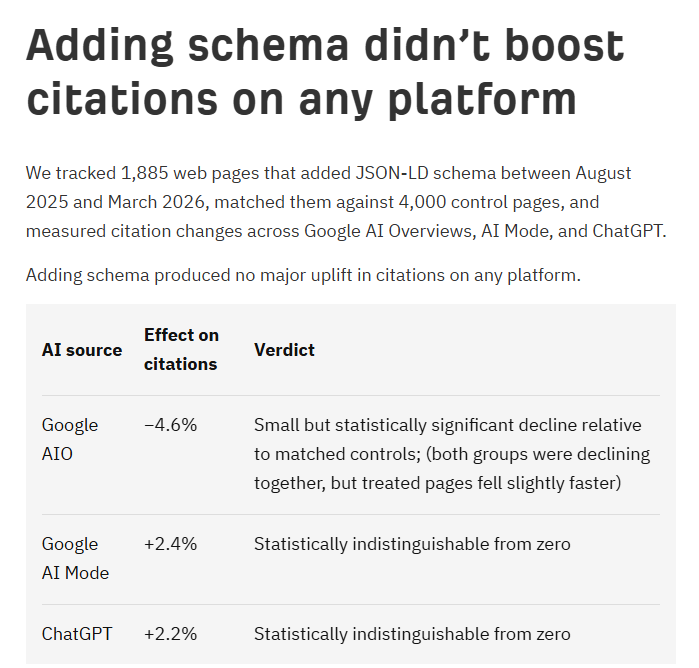
So Organization schema is the foundation for entity comprehension, and the signals that do move citations (mentions, sameAs targets, brand search volume) compound on top of it once it's right. Skip it and even strong entity signals stay ambiguous to the models trying to weight them.
The full field map
Google's Organization type has no required fields but recommends 20+ categories of information, from identity and business identifiers to location, commerce fields and external references. The docs sort the fields into five groups:
| Field | Group | What goes in it |
|---|---|---|
name | Identity (always include) | The display name as customers know it |
alternateName | Other names you're known by: product name if different from the company, common misspellings, historical names | |
legalName | The official legal entity name (LLC, Inc., etc.) | |
url | Your canonical homepage URL | |
description | A 1-2 sentence company description that matches your Crunchbase and LinkedIn descriptions | |
logo | A URL to a high-resolution logo; Google's minimum is 112×112 px, 500×500 is recommended (PNG/JPG/SVG/WebP) | |
iso6523Code | Business identifiers (include what applies) | Format XXXX:YYYYYY, where XXXX is a 4-digit International Code Designator |
duns | The Dun & Bradstreet number | |
leiCode | The Legal Entity Identifier (used in financial regulation) | |
naics | The North American Industry Classification System code | |
taxID | Country-specific tax registration | |
vatID | VAT registration where applicable | |
address | Location and contact | A PostalAddress node with streetAddress, addressLocality, addressRegion, postalCode, addressCountry |
telephone, email, contactPoint | contactPoint takes a ContactPoint node for customer service | |
foundingDate | Business details | ISO 8601 format |
founder | A nested Person node; multiple allowed | |
numberOfEmployees | A QuantitativeValue node | |
sameAs | External references | An array of URLs pointing to your brand's identity references |
Most SaaS companies won't have every business identifier. Include the ones you have, since each is a disambiguation signal AI engines can check against public registries. Even a pure SaaS with no physical office should list an address (a corporate registered address works), because it strengthens the entity match against government registries.
The founder field is underused for SaaS. If your founder has a strong personal entity (LinkedIn, a personal site, a Wikidata entry), linking that Person from the Organization strengthens the graph in both directions.
The sameAs strategy for a SaaS brand
sameAs does the entity-resolution work, so the order you fill it in matters, and for a SaaS company I'd start with Wikidata. A QID URL in the format https://www.wikidata.org/wiki/Q... is the gold standard of the entity graph. If your brand has no entry yet, creating one is about an hour's work for an outsized payoff.
The Google Knowledge Graph now holds ~1.6 trillion facts about 54 billion entities (Ahrefs, May 14 2026), with Wikidata as a primary input. Wikidata's notability policy accepts brands with a Crunchbase profile or a funding announcement, an SEC filing, or coverage in an authoritative structured database, and since its bar is much lower than Wikipedia's, most funded SaaS companies qualify.
LinkedIn and Crunchbase come next. A public LinkedIn Company Page with matching name, description and logo is the strongest single external anchor for professional entities. Google reads Crunchbase heavily for entity data, so that profile should agree with your schema's name, foundingDate, founder and description. Add a Wikipedia article if you have one. Most SaaS won't clear its high notability bar at seed stage, but once you're past it (typically Series B+), the article becomes your strongest sameAs anchor.
The rest are profiles you likely own already. Your X/Twitter handle URL belongs there if the public account carries matching branding, and so does your YouTube channel URL. Ahrefs' 75K-brand study found YouTube mentions correlate with AI visibility more strongly than any other single signal (r=0.737). Developer-facing SaaS should add the GitHub organization URL, and Product Hunt, G2 and Capterra profiles add category-specific authority.
Count matters less than quality here. Three high-authority targets with consistent naming beat ten mixed-quality ones with a broken URL in the middle, and practitioner consensus lands at around 3 for basic disambiguation and 8+ for strong entity resolution. Whatever you include, validate the URLs monthly.
We'll show you exactly where your brand stands in AI search.
No commitment. $0 due today, cancel anytime. See how ChatGPT, Perplexity, Claude, Gemini, Grok, and Google AI Mode talk about your brand today.
Organization vs LocalBusiness vs Corporation
People get three type decisions wrong, starting with LocalBusiness. It inherits from both Organization and Place, so it triggers address, geo and openingHours requirements that don't apply to pure SaaS. It only belongs where customers can physically interact with you at a location. A service business with offices can declare both types with a combined @type array, "@type": ["LocalBusiness", "ProfessionalService"], while pure SaaS stays on Organization or one of its subtypes.
Corporation is the second trap. In schema.org it's technically meant for share-issuing corporations, which means LLCs and most private SaaS startups are more correctly typed as Organization. Some validators tolerate the mismatch, but AI systems may flag an inconsistency between a Corporation schema and your visible legal filings, so default to Organization unless you're publicly traded.
The third decision is the subtype. OnlineBusiness, a subtype of Organization added recently, makes sense for pure-digital companies, NewsMediaOrganization fits publications and EducationalOrganization fits edtech. When none of them fits cleanly, Organization is the safe choice.
AI engine treatment of brand entities
AI engines disambiguate brands by cross-reference. When ChatGPT builds an answer that mentions your brand, it has to verify that the "Acme" on your page is the same "Acme" it has seen on LinkedIn, Wikidata and Crunchbase. Consistent Organization schema plus sameAs makes that check cheap. Inconsistent or missing schema makes it expensive, and expensive verification often means the model defaults to a more recognized competitor.
Ahrefs' 75K-brand correlations put numbers on it: YouTube mentions correlate with AI visibility at r=0.737 and branded web mentions at r=0.664, while backlinks manage only r=0.218. I wouldn't read that as "backlinks don't matter." Off-site brand signals track AI citation more closely than link signals do, and schema is the mechanism that lets those brand signals add up under one entity.
Barry Schwartz flagged the type's latest expansion when Google added loyalty program and membership pricing fields to Organization in June 2025:
Google adds loyalty programs support to organization structured data https://t.co/A9mZ0JZTYG https://t.co/xYJ09kMcFG
 Barry Schwartz@rustybrickJun 10, 2025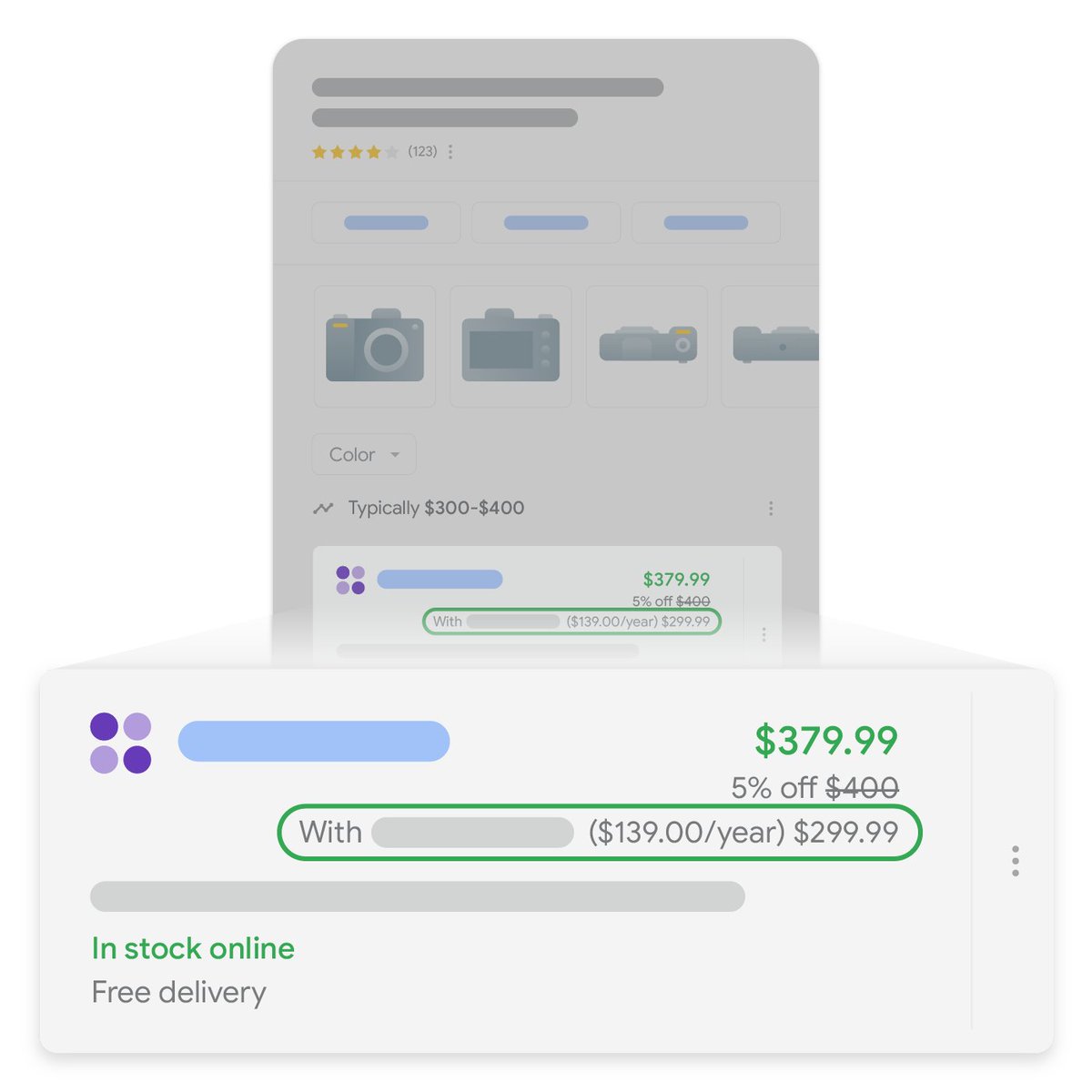
Every field you leave out now is one your competitors can include, and the pattern behind that tweet is consistent: Google keeps expanding Organization to absorb the merchant-level and business-level fields it needs for richer answer surfaces.
Practical implementation
Three stacks cover most sites, and WordPress with Yoast or Rank Math does most of the work for you. Yoast auto-generates a unified JSON-LD graph with Organization at the root, linked via @id to Article, WebPage, Author and so on. You toggle "Organization vs Person" in the Yoast settings and fill in the name, logo and description. Rank Math offers a manual Organization builder in its free version, along with 20+ schema types.
On the Next.js App Router, Google's own recommended pattern is to put an Organization JSON-LD <script type="application/ld+json"> in app/layout.tsx so it fires sitewide. Use dangerouslySetInnerHTML with < escaped to < for XSS safety, and pull in the schema-dts package if you want type-checked JSON-LD with compile-time validation.
Custom stacks follow one rule: a single Organization node per site, referenced by @id from every other schema node that needs it. Article schema's publisher field should be {"@id": "https://example.com/#organization"} rather than a full duplicate Organization object.
Validate with both tools, always. The Google Rich Results Test checks rich-result eligibility and the Schema Markup Validator checks generic schema.org syntax. A pass on validator.schema.org doesn't guarantee Google will use your markup, while a pass on the Rich Results Test tells you Google can parse it for rich features.
Know exactly what AI says about your competitors.
RankControl's Recon Agent monitors competitor citations across ChatGPT, Perplexity, Claude, Gemini, Grok, and Google AI Mode. See where they show up and you don't.
The traps
Six failure modes keep coming up, and the most common is multiple conflicting Organization nodes. Your theme emits an Organization block, Yoast emits another and your page builder adds a third. The Rich Results Test only surfaces the first one, so the conflict stays silent while AI engines see three competing entity definitions on the same page. Fix it by choosing one canonical source (usually Yoast), disabling the others and referencing @id: "https://example.com/#organization" everywhere.
Every 404 in your sameAs array reads as a broken entity link, so verify those URLs monthly with a link checker.
Then there's the mismatched brand name. Your schema name says "Acme Software Inc." while your H1 says "Acme", LinkedIn says "Acme, Inc." and the Wikidata label says "Acme Software." Each discrepancy weakens entity resolution, so pick one canonical form and use it everywhere. Google's minimum logo size is 112×112 pixels and smaller logos get silently rejected, so use at least 200 px on the shortest side, and 500×500 is safer.
The last two traps repeat the type decisions above: Corporation (meant for share-issuing entities) on a private LLC that isn't publicly traded, and LocalBusiness on a pure SaaS, which makes the Rich Results Test throw warnings about address, geo and openingHours.
An r/TechSEO thread from late 2025 wrestled with the exact "one node or per-page" question every SaaS eventually asks:
Is sitewide Organization schema enough or each pages must have their specific schema?
As Generative Engine Optimization is trending, every blog about it emphasizing the importance of Schema. I want to know about the impact of Schema.
The 27-comment consensus lands where this playbook does. Organization schema is the entity root, and per-page schema (Article, Product, FAQPage) has to link back to it through publisher and @id references. Otherwise the graph never gets stitched together, and AI engines see disconnected fragments where there should be one entity.
What to ship this week
It's about a three-day project, in five steps:
- Audit your current Organization markup. Run the homepage through the Rich Results Test, check for conflicting nodes and confirm
name,url,logo,descriptionandsameAsare all present. - Fill in the business identifiers you have, such as
foundingDate,founder,address,contactPointandnumberOfEmployees, plustaxIDif it's public. Every one is a disambiguation signal. - Build the sameAs array from LinkedIn, Crunchbase, X, YouTube, GitHub and your category profiles (G2, Product Hunt, Capterra). Add your Wikidata QID or create one this week, and add Wikipedia if you qualify.
- Reconcile naming. Match your schema
nameagainst your LinkedIn Company Page name, Wikidata label, Crunchbase legal name, footer and H1, then fix the discrepancies. - Set up validation, with the Rich Results Test and validator.schema.org both linked from your dev docs.
It's the technical SEO piece that pays off most in the AI-search era and the one fewest sites implement correctly, so fix it once and refresh it quarterly.
Our content engine writes Article and FAQ schema into every article it publishes. The site-wide Organization graph stays yours to add with the checklist above. Our AI visibility tracking then shows which of your brand mentions across ChatGPT, Perplexity and AI Mode actually match to your entity (versus getting absorbed into a competitor's or a generic-keyword answer). For the human side of the entity graph, our author schema deep dive covers Person markup and byline trust.
26 content formats. Published on your domain. Matched to your brand.
Guides, comparisons, listicles, case studies, and more. RankControl generates content that gets cited by ChatGPT, Perplexity, Claude, Gemini, Grok, and Google AI Mode.