
When we searched "google search algorithm" on October 19, 2026, the first thing on the page wasn't a result. It was an AI Overview, sitting above all ten organic links. The top two links under it were glossary pages from SEO sites, and none of the results we pulled mentioned AI Overviews in its title.
So the answer to "how does the algorithm work?" now arrives through a layer the top-ranking explanations don't cover. This guide walks through the whole pipeline from Google's own documentation: how pages get found, stored and ranked, how updates change the ranking, and where AI Overviews and AI Mode fit on top.
The pipeline in one table
| Stage | What Google does | What it means for you |
|---|---|---|
| Crawl | Finds pages by following links and sitemaps | If Google can't reach a page, nothing else matters |
| Index | Analyzes the page and stores it | Unindexed pages can't rank or appear in AI answers |
| Rank | Sorts indexed pages for each search | Where relevance, usefulness and trust come in |
| AI layer | Builds AI Overviews and AI Mode answers from indexed pages | Same index, plus a step that runs extra searches |
We call this the pipeline test. Each stage depends on the one before it. A page that fails at crawling can't be helped by better ranking signals, and a page that isn't indexed can't be cited in an AI Overview, however good it is.
Stage 1: crawling
Google's How Search Works documentation, last updated December 18, 2025, describes crawling plainly. "Google downloads text, images, and videos from pages it found on the internet with automated programs called crawlers."
Crawlers find new pages mostly by following links from pages they already know, and from sitemaps site owners submit. A thread on r/explainlikeimfive described it the simple way. Start at a well-linked page, write down every link on it, visit each of those and write down their links, and keep going.
ELI5: How do search engines like Google actually "crawl" and index the entire internet?
It just seems like an impossible task for a computer program to visit every single website and understand what it's about. How does it even start?
That's why internal links matter. A page nothing links to is hard for a crawler to find. Our guide to asking Google to crawl a page covers what to do right after you publish.
Stage 2: indexing
Next, "Google analyzes the text, images, and video files on the page, and stores the information in the Google index."
The index is why search feels instant. Another r/explainlikeimfive thread asked how Google returns results so fast. The top reply compared Google's index to the index at the back of a book. It's built ahead of time, so when you search, Google looks up which pages contain your words instead of reading the web from scratch.
ELI5: How do Google and other search engines provide me with results so quickly?
Even if they analyze what I write and filter where to search based on that, there should still be a huge list of sites to search, so I don't understand how it can be so immediate
Not every crawled page gets indexed. Duplicates, thin pages and pages marked noindex can be left out. Search Console's page indexing report shows which of your pages made it.
Know exactly what AI says about your competitors.
RankControl's Recon Agent monitors competitor citations across ChatGPT, Perplexity, Claude, Gemini, Grok, Google AI Mode, and Google AI Overviews. See where they show up and you don't.

Stage 3: ranking
Then comes the part most people mean by "the algorithm." In Google's own description, its ranking systems "are designed to sort through hundreds of billions of webpages and other digital content to present the most relevant, useful results on the first page in a fraction of a second."
Google says they weigh "the words of your query, relevance and usability of pages, expertise of sources, and your location and settings."
It isn't one algorithm. Google's ranking systems guide lists many named systems, each doing one job.
| System | What Google says it does |
|---|---|
| BERT | Understands "how combinations of words express different meanings and intent" |
| RankBrain | "Helps us understand how words are related to concepts" |
| Neural matching | Matches "representations of concepts in queries and pages" |
| Passage ranking | Identifies "individual sections or 'passages' of a web page" to judge relevance |
| Link analysis and PageRank | Uses how pages link to each other "to determine what pages are about" |
| Freshness systems | Show "fresher content for queries where it would be expected" |
| Reviews system | Aims "to better reward high quality reviews" |
| Site diversity | "Generally won't show more than two web page listings from the same site in our top results" |
| Deduplication | Shows "only the most relevant results to avoid unhelpful duplication" |
| Spam detection | Deals with "content and behaviors that violate our spam policies" |
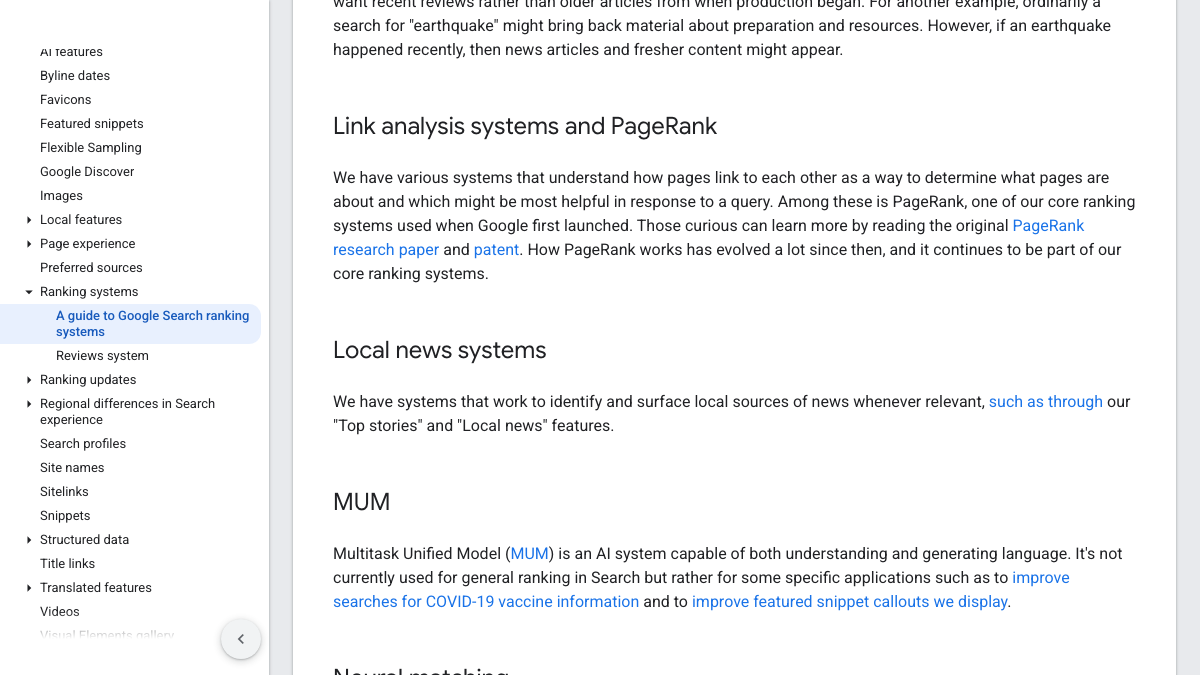
MUM, Google's more advanced language model, is on the list too, but Google says it is "not currently used for general ranking in Search." For a deeper look at the language systems, see our post on why LSI keywords are a myth, and for the trust side, our guide to E-E-A-T.
Systems that were folded in
Some names you'll still see in SEO advice no longer exist as separate systems. Google's guide says they were absorbed into core ranking.
| System | Announced | Folded into core ranking |
|---|---|---|
| Panda | 2011 | 2015 |
| Penguin | 2012 | 2016 |
| Helpful content system | 2022 | March 2024 |
So "recovering from the helpful content update" now means improving the page for the core systems. There's no separate filter to escape.
How updates change the ranking
The systems change all the time. Google says it runs "hundreds of thousands of experiments every year." A few times a year, it ships bigger changes. "Several times a year, Google makes significant, broad changes to our search algorithms and systems." These core updates "don't target specific sites or individual web pages."
Spam updates are narrower. Google's spam policies define spam as "techniques used to deceive users or manipulate our Search systems into featuring content prominently," and say violating sites "may rank lower in results or not appear in results at all."
We checked Google's Search Status Dashboard on October 19, 2026.
| Update | Started | Took |
|---|---|---|
| March 2026 core update | March 27, 2026 | 12 days, 4 hours |
| May 2026 core update | May 21, 2026 | 11 days, 21 hours |
| June 2026 spam update | June 24, 2026 | 2 days, 1 hour |
| August 2026 spam update | August 18, 2026 | 2 days, 16 hours |
| September 2026 spam update | September 24, 2026 | 13 days, 16 hours |
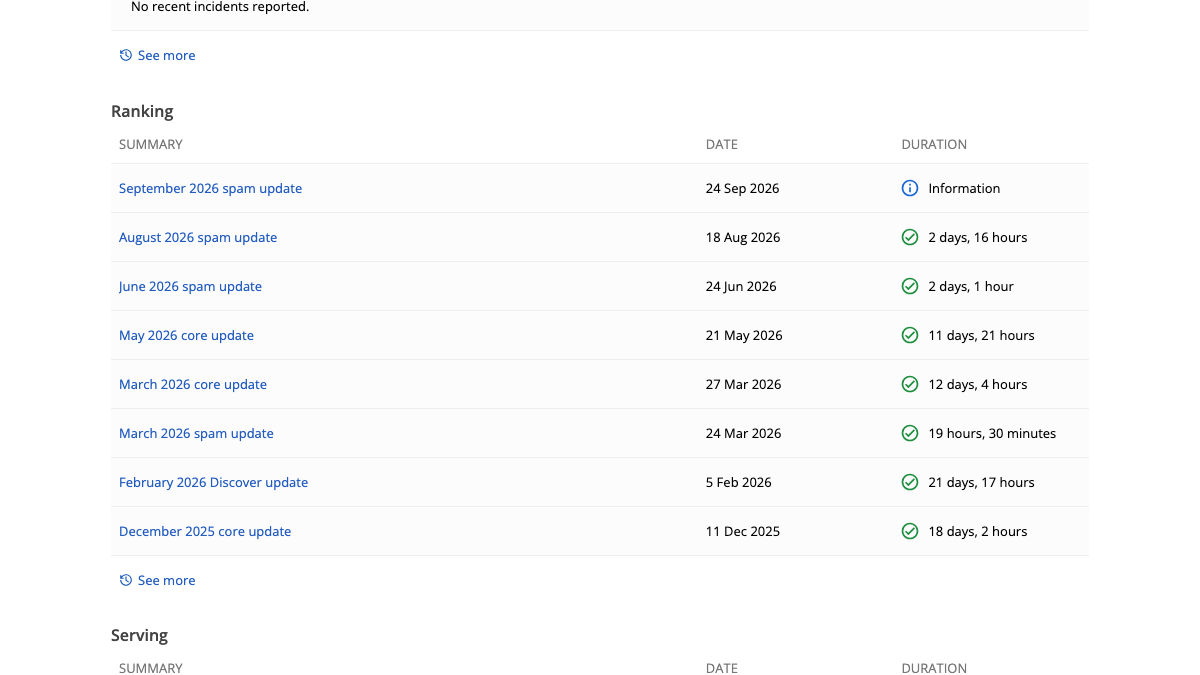
As of that date, the May 2026 core update was still the most recent, 151 days earlier, with three spam updates since. Our August and September 2026 update breakdown covers what those did, and our guide to diagnosing a traffic drop after a core update covers what to check.
26 content formats. Published on your domain. Matched to your brand.
Guides, comparisons, listicles, case studies, and more. RankControl generates content that gets cited by ChatGPT, Perplexity, Claude, Gemini, Grok, Google AI Mode, and Google AI Overviews.

Where AI Overviews and AI Mode fit
Here's the part the glossary pages skip. AI Overviews and AI Mode don't run on a separate web. They draw on the same index.
Google's AI features documentation, last updated December 10, 2025, is direct about it: "To be eligible to be shown as a supporting link in AI Overviews or AI Mode, a page must be indexed and eligible to be shown in Google Search with a snippet." And: "There are no additional technical requirements."
What's different is how the answer gets built. Google says "Both AI Overviews and AI Mode may use a 'query fan-out' technique," running several related searches across subtopics and data sources to put together one response.
When Google launched AI Mode on March 5, 2025, it described fan-out this way: "issuing multiple related searches concurrently across subtopics and multiple data sources and then brings those results together to provide an easy-to-understand response." Its example was a question comparing sleep tracking on a smart ring, a smartwatch and a tracking mat. One question became several searches, one for each device and feature.
That has a practical effect. Your page doesn't have to rank for the exact question someone typed. It can be pulled in because it ranks well for one of the smaller searches the question fanned out into. A clear page on one specific subtopic can earn a link in an answer to a broader question.
Our post on what became of SGE covers how AI Overviews got here, and our guide to featured snippets covers the older answer box they partly replaced.
The controls you already have
Because AI features use the same index and snippet rules, the controls are the same too. Google lists nosnippet, data-nosnippet, max-snippet and noindex as the ways to limit how your content appears.
| Control | Effect |
|---|---|
noindex | Keeps the page out of Search and AI features entirely |
nosnippet | No snippet in results, and no use as a direct input to AI Overviews and AI Mode |
data-nosnippet | Hides one part of a page from snippets |
max-snippet | Limits snippet length |
Use these with care. A page you block from snippets is also a page AI answers can't quote.
What this means in practice
Walk the pipeline test for your important pages.
- Can Google crawl it? Linked from other pages, in the sitemap, not blocked in robots.txt.
- Is it indexed? Check URL Inspection in Search Console.
- Does it deserve to rank? Relevant to the search, useful, from a source with real expertise and linked from elsewhere.
- Is it quotable? A clear, direct answer to one question near the top, so it can be lifted for a fan-out search.
Most problems are at steps 1 and 2, which are the cheapest to fix. Step 3 is where most of the work goes.
Doing it yourself or handing it off
The pipeline hasn't changed much. Pages still need to be found, indexed and worth ranking. What changed is the layer on top, which rewards pages that answer specific questions clearly.
RankControl writes for that. We find the questions your buyers search, write each article against the pages already ranking for it and publish it as a native post on your site. Our AI visibility tracking then checks up to 50 buyer questions every week across seven AI engines, including Google's AI Mode and AI Overviews. Expect traffic from Google first, with AI citations following more slowly as links and mentions build up.
Your competitors are getting cited by AI. You're not.
Every day without citation tracking is a day your competitors pull ahead in ChatGPT, Perplexity, and Claude.