On May 19, 2026, Google announced a new AI-powered Search box, calling it the biggest upgrade to its search box in over 25 years. Two days later, on May 21, the May 2026 core update started rolling out, and it ran for almost 12 days.
If your traffic fell in late May, two very different things could have caused it in the same week. One site owner posted on r/seogrowth that daily visitors dropped from about 20,000 to between 5,000 and 6,000 during that rollout, and hadn't come back after it finished.
Lost 70% of Traffic During Google May 2026 Core Update and Still Haven't Recovered After Rollout
This guide shows how to tell a ranking loss from a core update apart from traffic lost to AI answers, using the update dates and Search Console. The fixes for the two are different, so the diagnosis matters. Sources were checked on September 26, 2026.
Two losses that look the same in analytics
A core update loss means Google now ranks your pages lower for the queries that used to send traffic. Positions fall, and impressions and clicks usually fall with them.
An AI search shift works differently. Your pages can keep the same positions while fewer people click, because an AI Overview or AI Mode answer handles the question on the results page. In a 2025 Pew Research Center study, people clicked a traditional search result on 8% of visits to a results page with an AI summary, against 15% without one.
AI answers now appear on far more than trivia questions. On September 26 we checked 20 B2B software searches on Google's US desktop results, half informational and half commercial, and all 20 showed an AI Overview at the top. That included "gusto pricing" and "hubspot vs salesforce," where the overview quoted plan prices and gave a verdict before any link.
So a chart showing clicks down 30% can't tell you which one happened. The Search Console data behind it can.
Start with the dates
Google lists confirmed ranking updates on its Search status dashboard, with start dates and how long each rollout took.
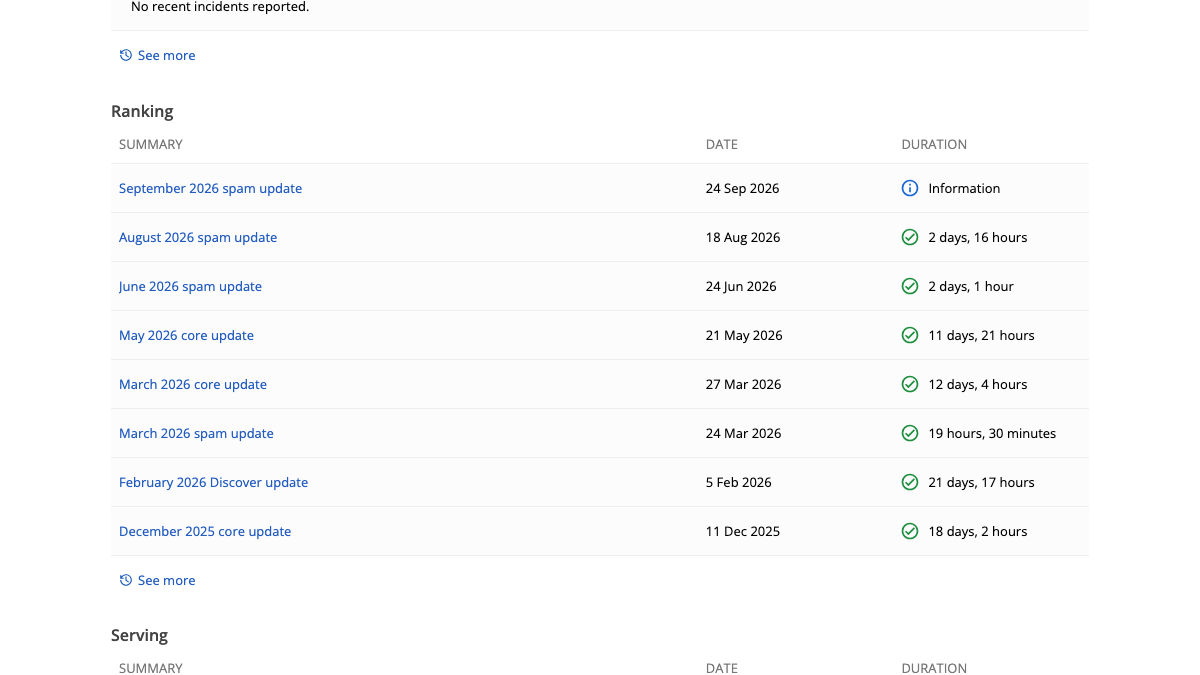
Two core updates have shipped in 2026 so far, starting March 27 and May 21, and each took about 12 days. A spam update began on September 24 and was still rolling out when we checked. Compare two full weeks after a rollout finishes with the same two weeks before it began, since mid-rollout numbers move around.
Seasonality can hide inside those windows. The December 2025 core update ran for 18 days across the holidays, when B2B search demand usually dips anyway, so for an update like that, compare against the same weeks a year earlier as well.
Then add the dates Google doesn't list as ranking updates. Google I/O on May 19 brought the new search box. In early May, Google also changed how AI Overviews and AI Mode link to sources, and one analytics team on r/GoogleAnalytics saw about a 90% drop in sessions carrying the text-fragment links they had used to spot AI Overview clicks.
#:~:text= no longer sent from AI Overview links after May 6 update — how are you tracking this traffic now?
Has anyone else lost their AI Overview traffic tracking after Google's May 6 update? We were using the #:~:text= (Scroll-To-Text Fragment) in referral URLs as a proxy to identify traffic coming from Google AI Overviews and AI Mode. When Goo...
A drop that starts on the day a tracking method broke may be a measurement problem. Our explainer on whether there was a core update in August or September covers the other suspects from late summer.
15 hours a week manually. Or 15 minutes with RankControl.
Track citations, monitor competitors, and fix content gaps across every AI search engine. Automatically.

The position test
The fastest way to separate the two losses is what we call the position test: before you look at clicks, check whether average position moved on the queries that lost traffic. Run it in Search Console for each query group, using the matched periods from the dates above.
| What changed for the affected queries | Most likely cause |
|---|---|
| Position fell, impressions fell | Ranking loss, often a core or spam update |
| Position held, impressions held, CTR fell | Answers on the results page taking clicks |
| Position held, impressions fell | Less demand, from seasonality or searches moving elsewhere |
| Clicks held, conversions fell | A change in traffic quality or mix |
Two cautions apply. Sitewide average position can mislead when you gain lots of low-ranking impressions, so segment by query group or page type first. Impressions from AI features also count in Search Console's main performance report, which can lift impressions without a single extra visitor.
Most real drops mix rows. A core update might cost you positions on a handful of pages while AI Overviews thin out clicks on the rest, so run the test page group by page group.
Split queries by whether they show an AI Overview
The most useful practical check we've seen came from a reply in an r/seogrowth thread about this exact problem. Take your top 50 non-brand queries, check which ones show an AI Overview today, and compare the click-through trend for the two groups. If CTR fell only in the AI Overview group, that's your answer. If it fell in both, the cause is something else.
Search Console now helps with the first half. Its generative AI performance report, added in June 2026, shows impressions from AI Overviews and AI Mode, broken down by page and by where the impressions came from. It doesn't separate clicks from those features, so you'll still need the bucketing test to see what the impressions cost you.
Our guide to measuring the click impact of AI Overviews walks through the CTR math in more detail.
Check whether the intent changed
There's a third cause that looks like a ranking loss but isn't a quality problem. During a core update, Google sometimes decides a query wants a different kind of page, such as a free tool instead of an enterprise platform, or a forum thread instead of a vendor guide.
Lily Ray has given a whole talk on intent switches during core updates. In July she pointed to another SEO's case where a client's feature pages went to zero because buyer intent had shifted toward cheaper, simpler tools.
Indeed… I did a whole @Moz talk on this: “Intent Switches During a Core Update” https://t.co/PG10LIjXGu
 Lily Ray 😏@lilyraynycJul 21, 2026
To check, search your lost queries and look at who ranks now. If the new top results are a different type of page from yours, rewriting your page won't bring the traffic back. You'd need a page that matches the new intent, if that audience is worth having.
If it's a core update
Core updates reassess quality across the web, so the fixes are slower than most teams hope. Google's guidance is to focus on making content more helpful rather than making quick technical changes, and many sites only recover during a later core update, months after the fixes.
Glenn Gabe's analysis of the May update covered cases from gambling and other YMYL topics to sites that had been gaming AI search, and it's a useful read for spotting patterns that match your own losses.
Google's May broad core update was a beast. My latest post covers interesting cases, findings, and analysis. Grab a cup of coffee or a red bull. It's not short :) -> Core Roars Back – Interesting Cases and Findings From Google’s May 2026 Broad Core Update I cover: * How March https://t.co/K8Y5jK8yhl
 Glenn Gabe@glenngabeJun 10, 2026

Our retrospective on the May 2026 core update covers what changed and what recoveries looked like 60 days later.
AI search traffic grew 835% this year. Is your content ready?
RankControl generates 26 content formats optimized for ChatGPT, Claude, and Perplexity. Published on your domain, matched to your brand.
If it's AI search
If positions held and clicks fell, recovering the old click-through rate isn't realistic. What you can change is whether your brand is named and your pages are cited inside those answers.
Google says AI Mode has passed one billion monthly users, with queries more than doubling every quarter since launch, so the answer layer is growing. The practical response is pages that answer the specific sub-questions the AI features pull from, measured by citations as well as clicks. Watch branded search as well. Research by Similarweb with Rand Fishkin found that most visits following a ChatGPT recommendation arrived through search rather than a click in the answer, so rising branded impressions can offset part of a non-brand click loss.
If some of your traffic now arrives from ChatGPT or Perplexity, our GA4 guide to AI referral tracking shows how to separate it from the rest.
When both happened at once
Late May 2026 is the clearest case of a mixed loss, with a new AI search box and a core update in the same week. Run the position test on each page group. Fix the pages that lost rankings, and track the ones whose clicks moved into AI answers.
Doing that by hand is slow. Checking 50 questions on six engines takes about five hours a week, and publishing eight solid articles a month takes 16 to 24 hours more. Those are rough estimates.
RankControl covers the AI half. AI visibility tracking runs your 50 questions every week on six engines, including Google AI Mode, and marks each one as mentioned, cited or both, alongside your Google and Bing rankings. The content engine writes each article against the pages already ranking for its keyword and publishes it on your own domain.
You can run the position test yourself with Search Console and a spreadsheet. Or RankControl's agents can keep watching rankings and AI answers every week, so the next drop comes with its cause attached.

Built by the team that got cited in 48 hours.
Content generation, backlink building, AI visibility tracking, and Google rankings. One platform, zero guesswork.